A brief prelude to this post:
Covid lockdowns in London, a fear that my old brain would lose all the details of this trip, finally provided the impetus for me to pen this final travel chapter of our time in Seoul. Writing the post and revisiting photos taken provided me with a great distraction and a chance to “armchair travel” during this slow, constrained time. It has been a wonderful trip down the proverbial memory lane and with the new perspective we now have on our previous freedom to explore the world prior to this pandemic, the travel opportunities we had while living in Seoul are that much more precious. Here is the final post of “Seoulful Sojurn”!
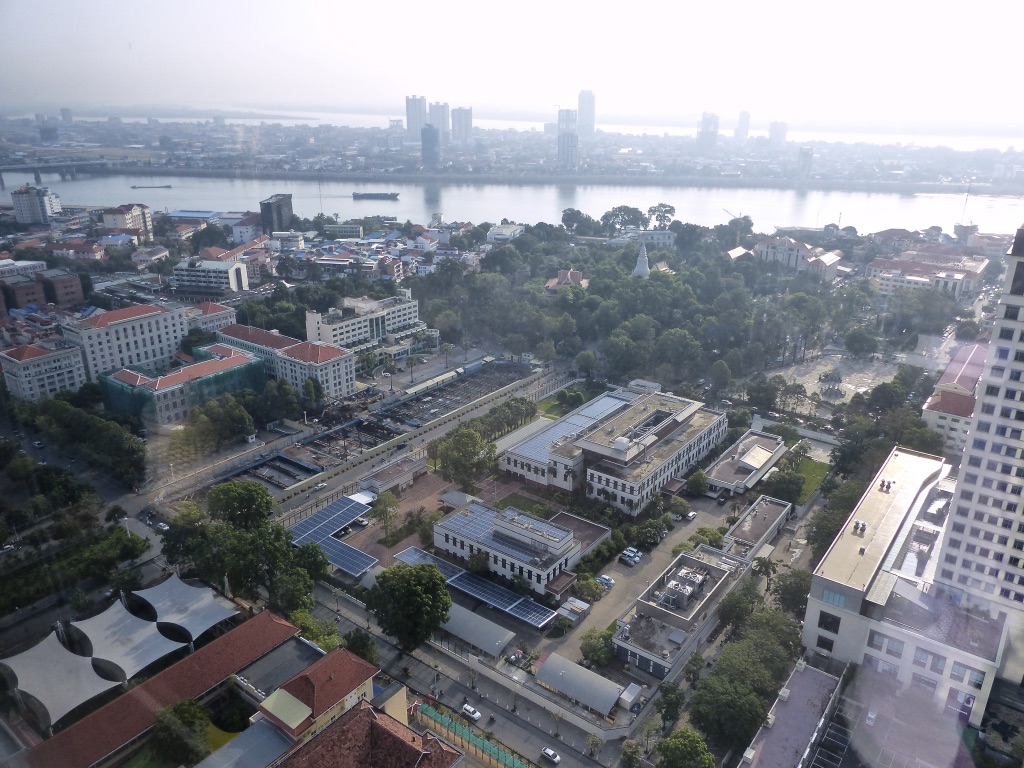
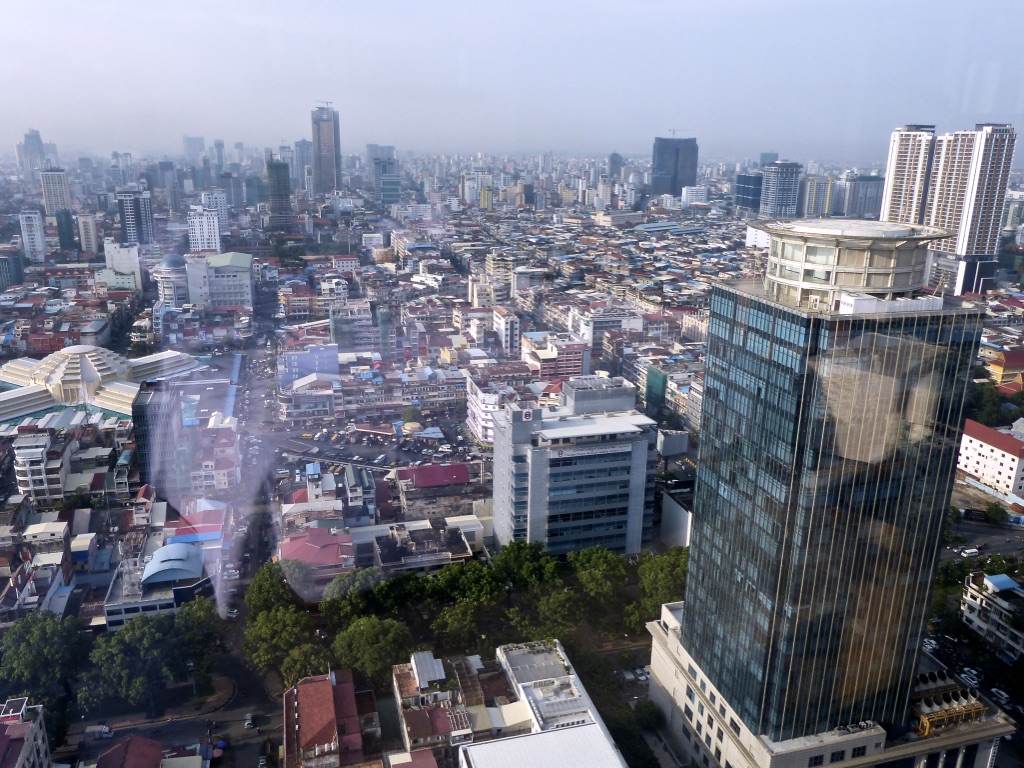
With our time in Seoul drawing to a close, we decided to take a quick trip to Cambodia before the weather became unbearably hot and the monsoon season arrived in full force. Technically, we were already in this “low” season, but the temperatures were manageable and the rain held off during the day. We flew Friday evening to Phnom Penh and stayed at the Rosewood which had spectacular views of the city and of the 4 rivers that converge there. Like many SE Asian cities, Phnom Penh awakens early to take advantgage of cooler temperatures before the midday heat kicks in. This schedule suited our “Seoul time zone” bodies that awoke early. Sipping some very strong Cambodian coffee and peering out of the panoramic windows in our room, we watched the city streets and river traffic begin their daily routine. Even though the photos below were taken through the glass windows in our room, one can see the scope of Phnom Pehn.
 For breakfast, I tried the local soup, hoping it would be as delicious as the pho style soups in neighboring Laos and Vietnam., but found the Cambodian version of the broth a bit less flavorful. Still mighty good! Bill opted for a western breakfast…of course.
We met our guide Sethavy and rode in a nicely air-conditioned van to our first stop on our very abbreviated tour of Phnom Penh: the Royal Palace (which has a ridulously long name that I’ll skip repeating here) and the Silver Pagoda. When King Norodom moved the capital of Cambodia to Phnom Penh in 1865, this Royal Palace became, and remains today, the residence of the king and his mother so only some of the buildings in the complex are accessible. As we entered the palace’s extensive grounds, it was hard to avoid the multitude of kids selling songbirds in small bamboo cages that one is encouraged to buy and then set free for good luck (inhumane and downright creepy!). The Throne Hall below is a highly ornate building made of marble, gold and precious stones all in the yellow (for Buddhism) and white (for Hinduism) colors and it dazzles in the bright Cambodian sun. Though predominantly a Buddhist country today, Cambodia was mostly Hindu until the 13c and its architecture and statues still have considerably more Indian influence than in Vietnam where Chinese culture and arts are more visible.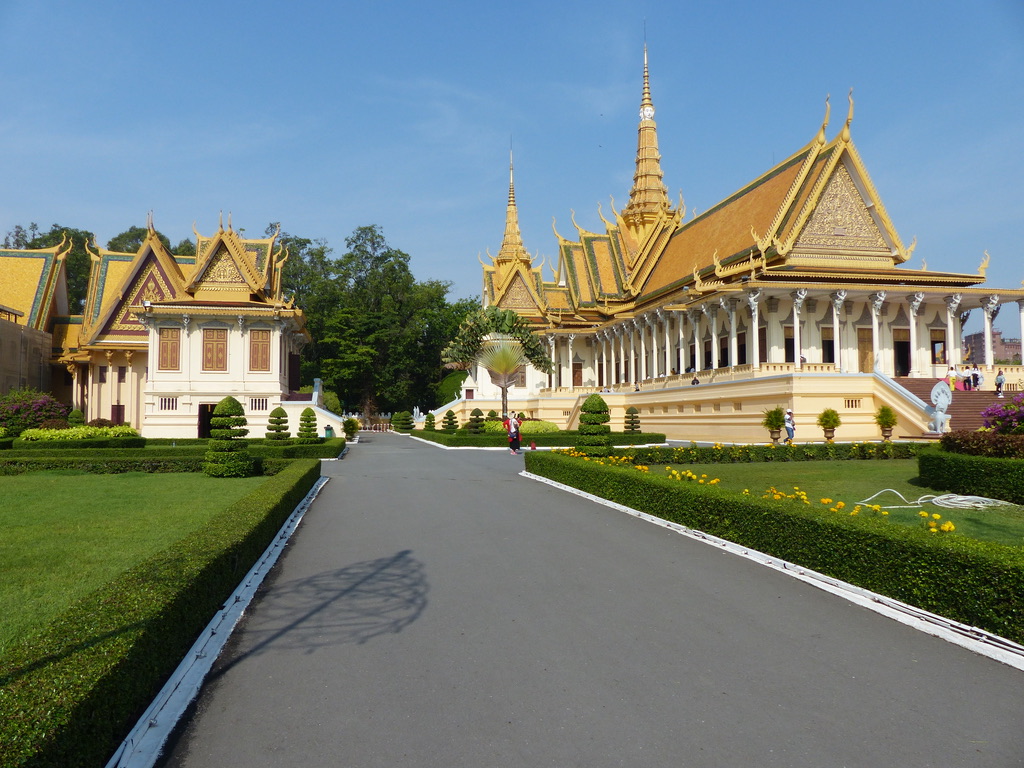
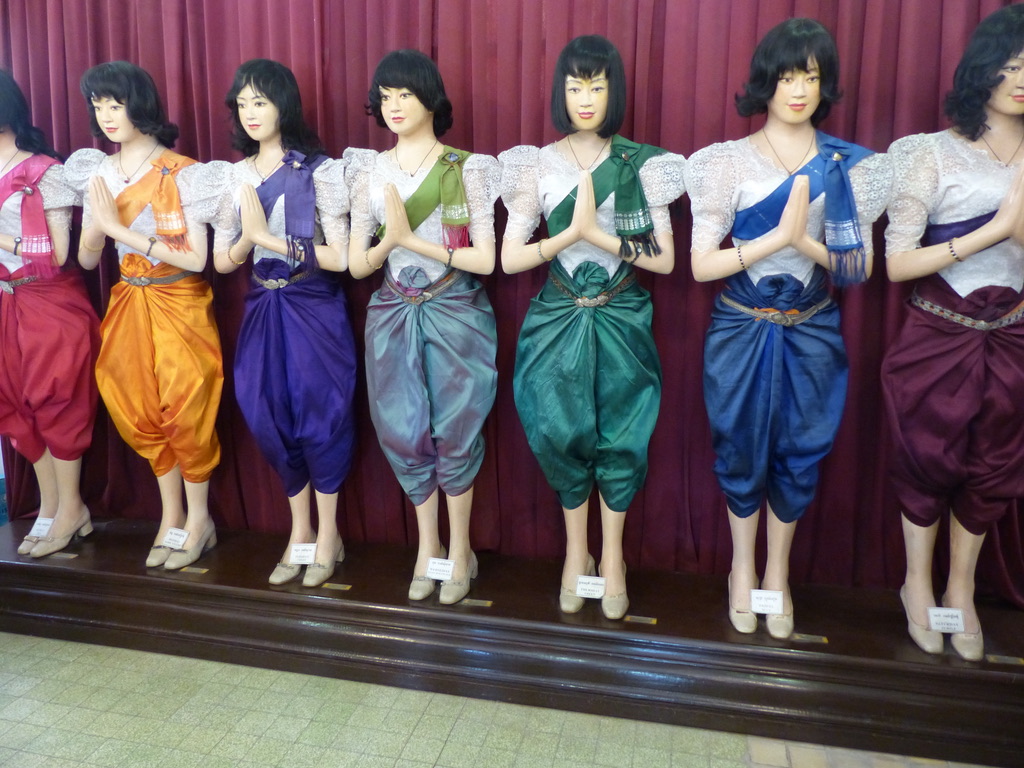
In a small adjacent wooden building there was a display of the traditional dress worn by women, the kaben, which elicited a few comments from the “peanut gallery” who accompanies me throughout life.
Much of this royal complex was destroyed by Pol Pot under his Khmer Rouge regime in 1975-1979 and so the buildings we toured had all been rebuilt, save for the Silver Pagoda. In fact, the Silver Pagoda is one of Cambodia’s only temples to survive the Vietnamese invasion and subsequent Khmer Rouge regime but much of its contents were pillaged. No photos were allowed so you’ll have to imagine the magnificence of the lovely Italian marble staircase which leads up to a life-sized golden Buddha statue that is decorated with over 2,000 diamonds weighing over 25 carats. Built in 1892 by King Norodom using over 5,000 tons of silver coins melted down to make the tile floor, the temple was funded with local coins vs. French paper money and symbolized the King’s desire to make Buddhism more accessible to the local people. With walls adorned with small golden Buddha statues, traditional masks and other gifts from various heads of state, the Silver Temple is FULL of treasures and reminiscent of Cambodia’s former wealth.
Every year there are two royal festivals held here, one to commemorate Cambodia’s independence from France in 1953 and the other to celebrate the defeat of the Khmer Rouge in 1979. The current King is himself very religious and many, many Buddhists in Cambodia visit the royal palace and temple frequently according to religious custom and practice. Acting as head of state under the country’s constitutional monarchy, King Norodom Sihamoni has been in power since 1985, but he is largely a figure head and the Prime Minister is the effective head of the multi-party democracy in Cambodia today.
We wandered around the courtyards, admiring the giant, ash-filled stone stupas and practiced one of sculpted poses.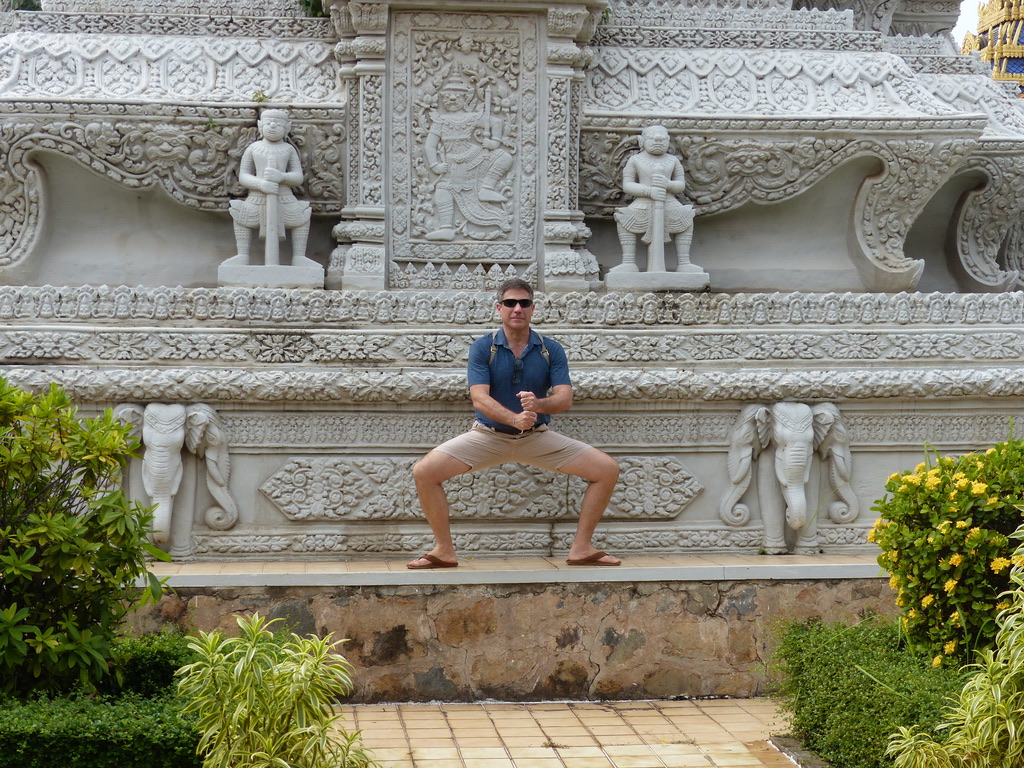
I loved the unique cannonball flowers left as offerings by the many Buddha statues. We saw the same littering temple grounds in Sri Lanka.


After the royal palace, we went to the National Museum and took in some of the Khmer art and relics. Khmer refers to the ethnicity, race, religion, culture and language dating from the ancient kingdom in SE Asia that ruled the Mekong valley for centuries with its capital in Ankhor Wat. Khmer is distinct from Cambodia which strictly deliniates just the country AND Khmer is also very different from the infamous Khmer Rouge regime. A tad confusing I admit! In the 12th and 14th centuries, Thailand successfully defeated the Khmer dynasty and much of the former empire’s land is now split among Vietnam, Laos, Thailand and Myanmar such that there is a wide Khmer diaspora throughout SE Asia today.
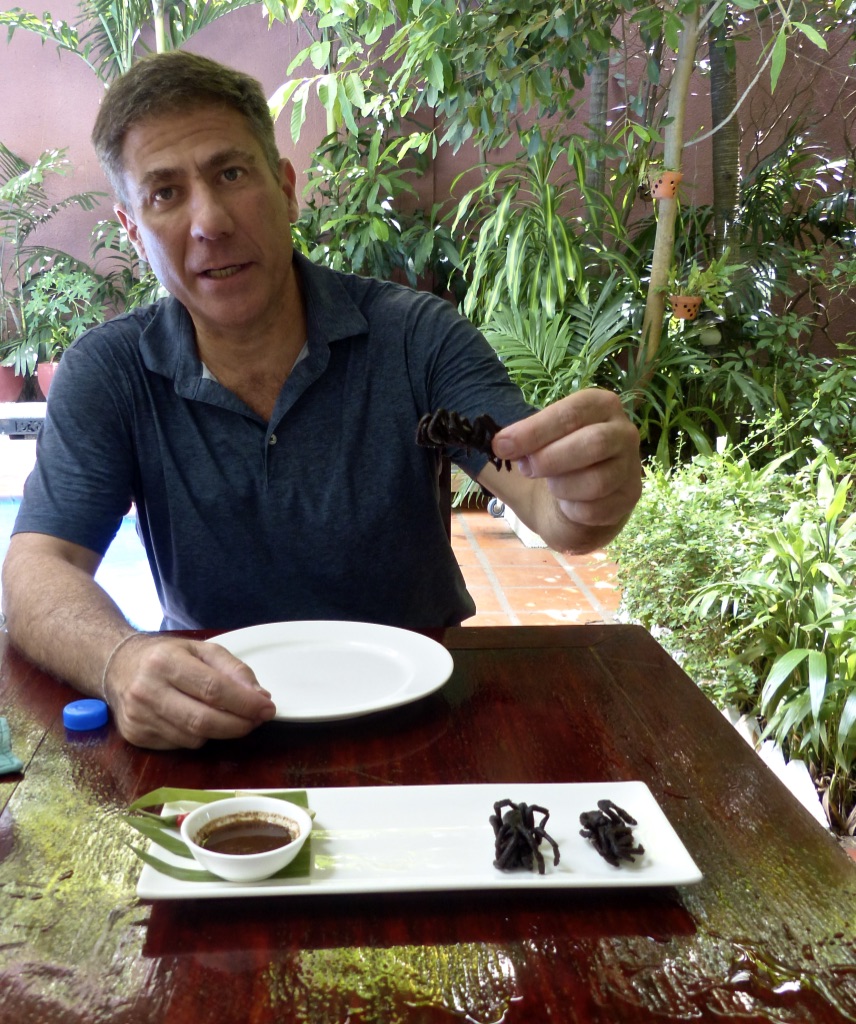
Lunch at Romdeng restaurant was an adventure to say the least and just a warm up for our Vespa food tour later in Siem Riep. We had come a long way in four years and were much more adventuresome with our dining than we ever could have imagined. We ordered the house specialties #1 and #10 on the menu and actually found them to be delicious! Bill made me “go first” because he was a TAD nervous as is perhaps evident in the photo below? And yes, those were fried tarantulas…crispy and so delicious that we ate all 3 of them!
After lunch we toured Tuol Sleng Genocide Museum and learned about the Khmer Rouge era from 1976-1979. Even as I write this post, it is hard to imagine how such a terrible event could occur.
Super briefly, the Khmer Rouge was a brutal Marxist regime led by Pol Pot that had its origins in the 1960s in the jungles of eastern Cambodia with the support of the North Vietnamese and Viet Cong. It took hold despite America’s military efforts to suppress the Marxist army. Slowly over 4 years, the Khmer Rouge soldiers made their way through the jungles, seizing major cities until the regime ultimately captured the capital city of Phnom Pehn, overthrew the government of the Khmer Republic, winning Cambodia’s civil war. Civilians of Phnom Pehn were given just 3 days to join the new government (Republic of Kampuchea) or else be forcibly evacuated. Millions fled into the countryside, carrying only what they could. During the first few days of the Khmer Rouge regime, hundreds of thousands of Cambodians deemed “opponents of the regime” and were executed. In essence, the Khmer Rouge army killed 25% of its own population.
Similar in some respect to the principles used to justify the Reign of Terror during the French Revolution, Chairman Mao’s Great Revolution and even Hilter’s Nazism, the Khmer Rouge regime was autocratic, xenophobic and sought to purge society of anyone who was a professional, educated, or of high-social ranking as well as those persons deemed “not pure” Cambodian. Private ownership of property was abolished and replaced with collective farming. Egalitarian language (e.g. “comrade”) was introduced among the masses. Under Pol Pot’s brutal autocracy and many internal purges, comrades often killed each other out of paranoia. All of this resulted in a horrific genocide of 1.5-2 million Cambodians in just four years, as well as devasting famine and disease for those who were not killed quickly. Without a doubt, this genocide remains one of the worst events of the 20th century.
Below are the clothes distributed to everyone, whether an ordinary comrades or a high-ranking soldier in the army, during the Khmer Rouge regime.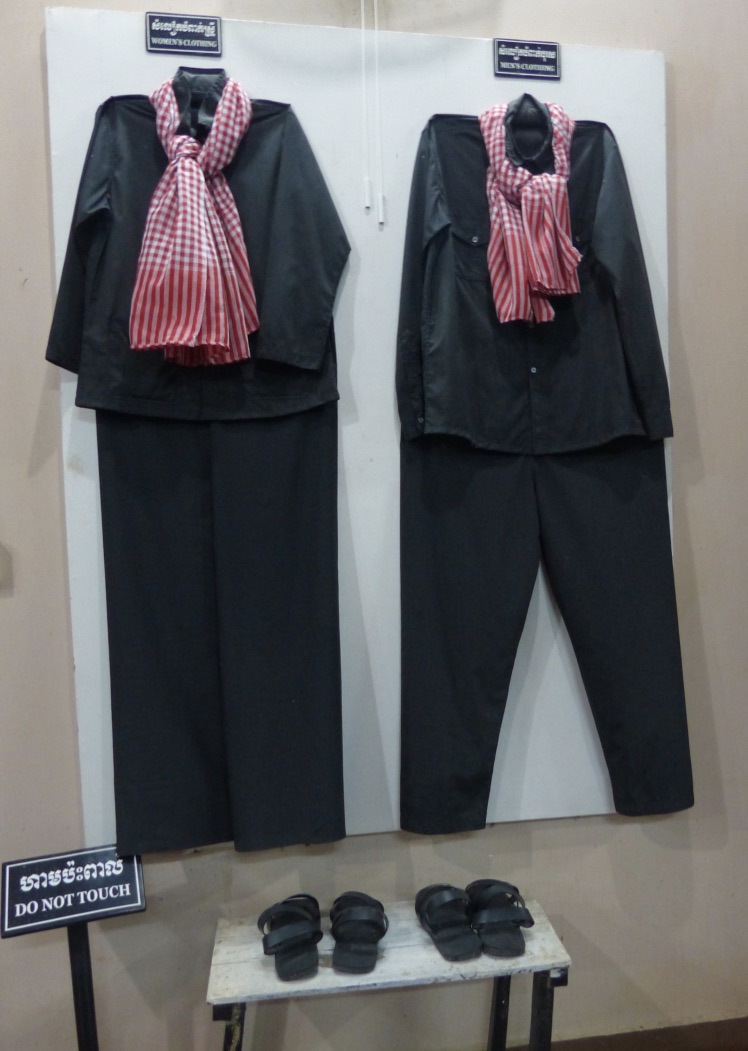
In 1979, forces from Vietnam entered Cambodia and quickly squelched the regime and the Khmer Rouge forces fled to Thailand where they continued to fight until 1989 in the Cambodian-Vietnamese War. What is so striking to Western visitors like ourselves is the sheer number of people who died during these horrific 4 years and that this all occurred relatively recently…while Bill and I were in grade school?! For those who wish to learn more, I highly recommend First They Killed My Father: A Daughter of Cambodia Remembers by Loung Ung which is moving account of this time.
Prior to 1975, the Tuol Sleng Genocide Museum was a secondary school. When the Khmer Rouge forces seizeed Phnom Pehn, the school was commandeered by the army and turned into a torture, interrogation and execution site known as Prison S-21. Today, this museum houses the meticulous archives and photos kept by the Khmer Rouge of the inmates. The Khmer Rouge chronicled each Prison S-21 inmate and the utter desperation, fear and pain of the men, women and children are palpable as one views some of the 6,000 preserved photos on display.
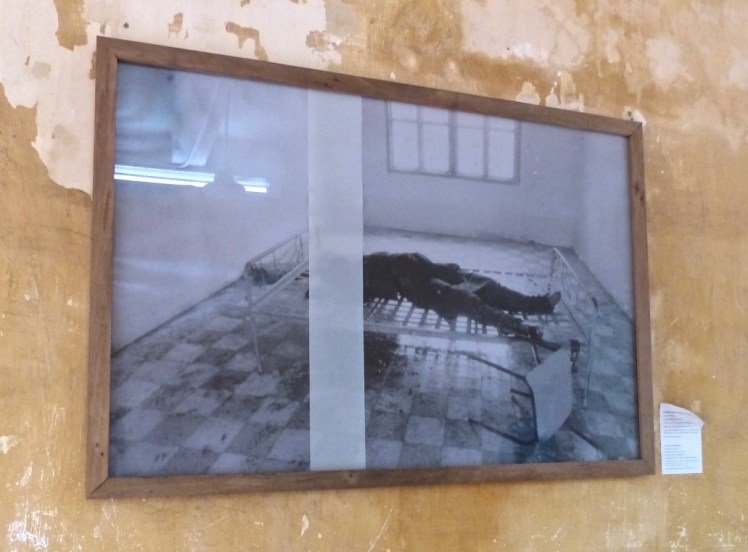
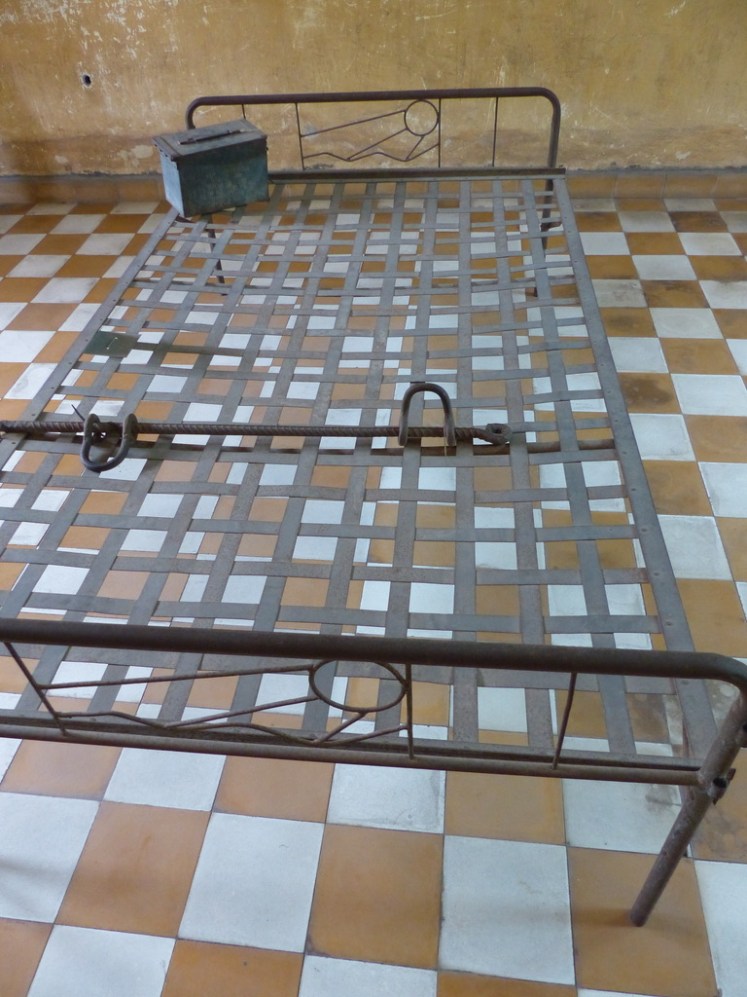
14,000 individuals were known to have entered Prison S-21 and only 7 survived. The average prisoner only lived for 6 mos here, usually dying quickly of starvation or from wounds inflicted during interrogation sessions. Most of the Khmer Rouge guards/torturers were only children themselves aged 15-19 years old! Several of the survivors have written books and painted pictures describing their time here and we met them silently on our way out of the museum, absolutely humbled and shaken by what they endured.


The grounds contain five plain school buildings and an outdoor area originally used for recreation by the school and then for torture by the Khmer Rouge. The buildings are covered with barbed wire and sparsely decorated just as they were found by photo jounalists in 1979. The tiny, crude cell blocks were the prisoners were chained were horrific to see as was the gallows area.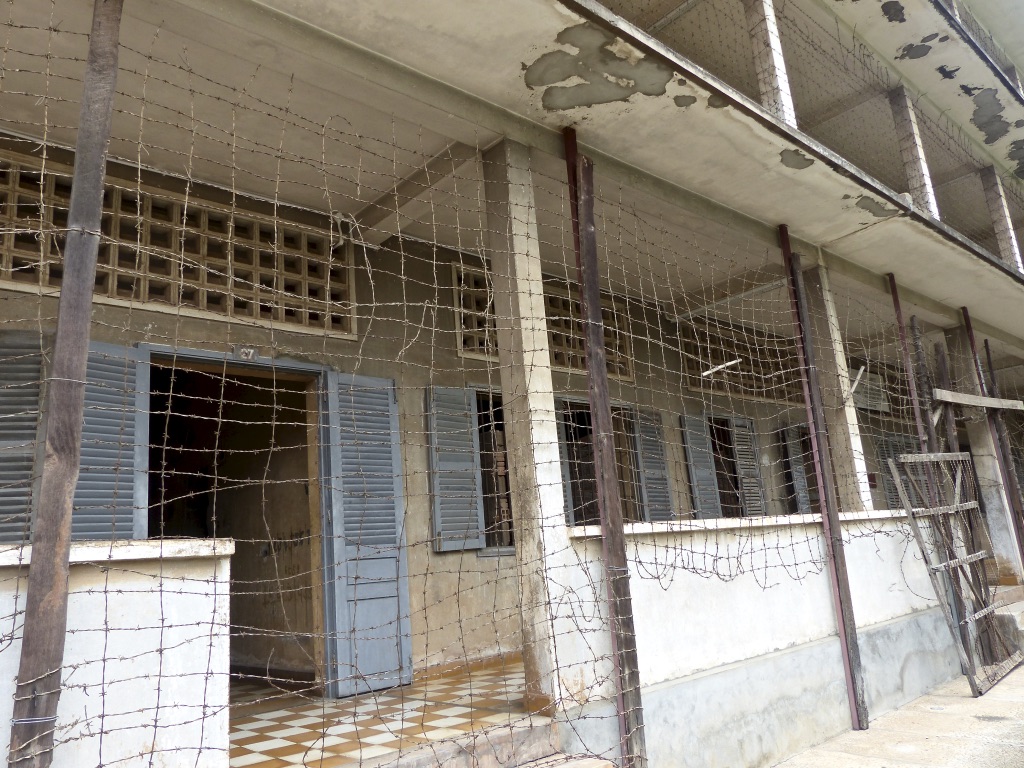
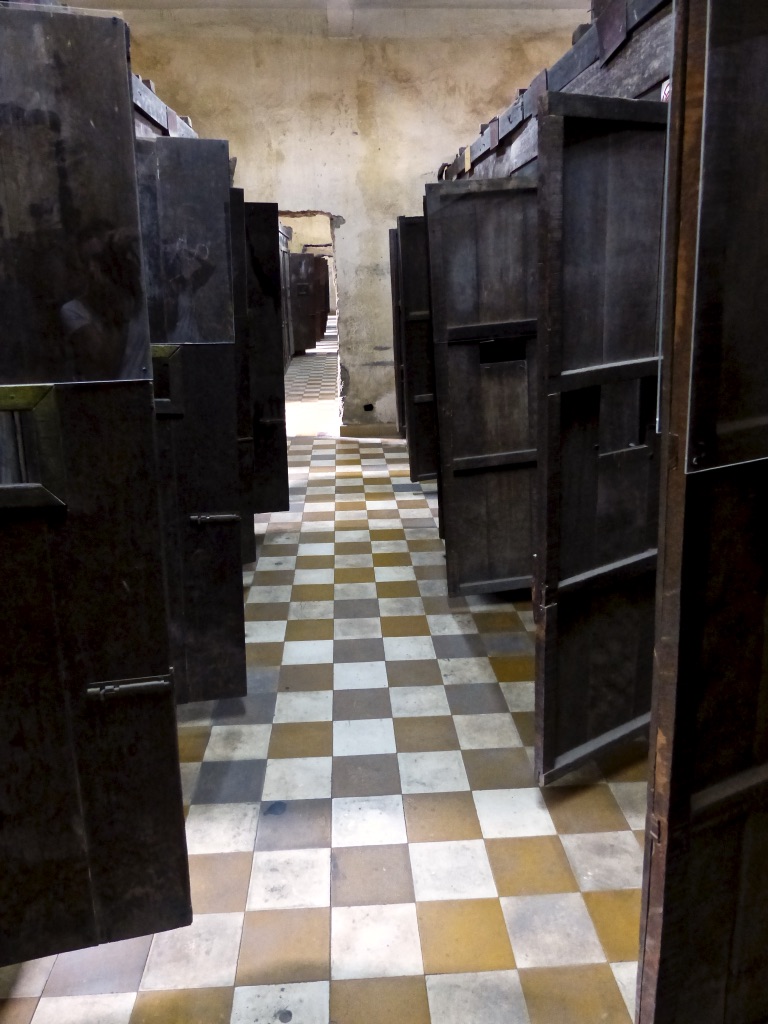
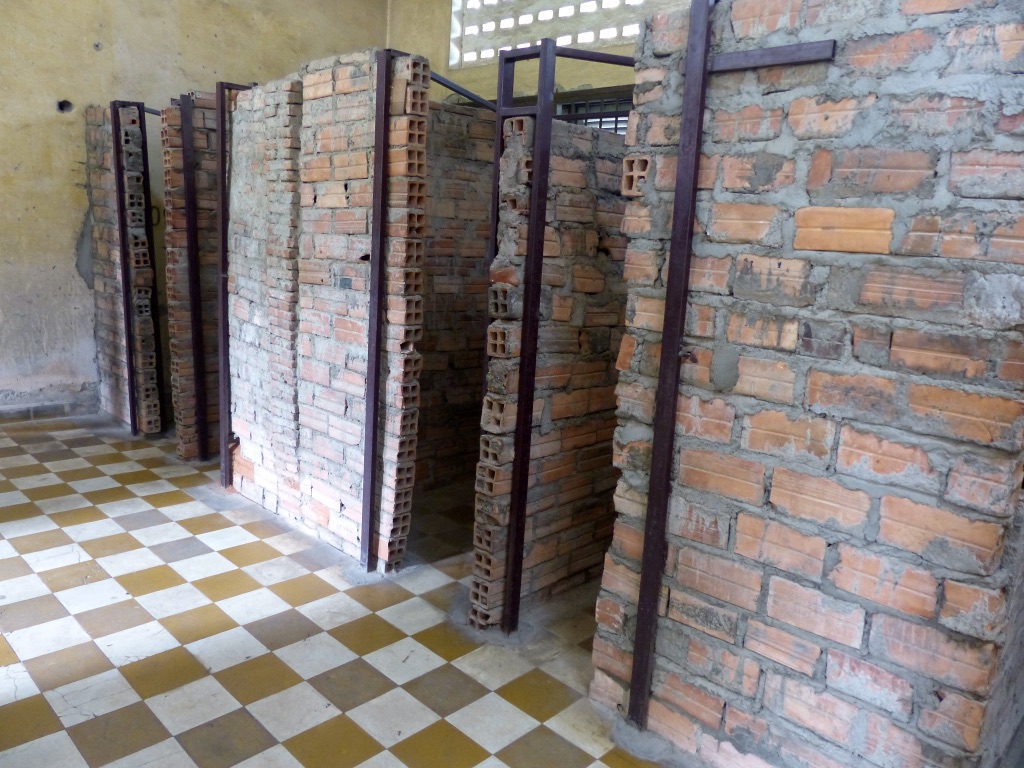
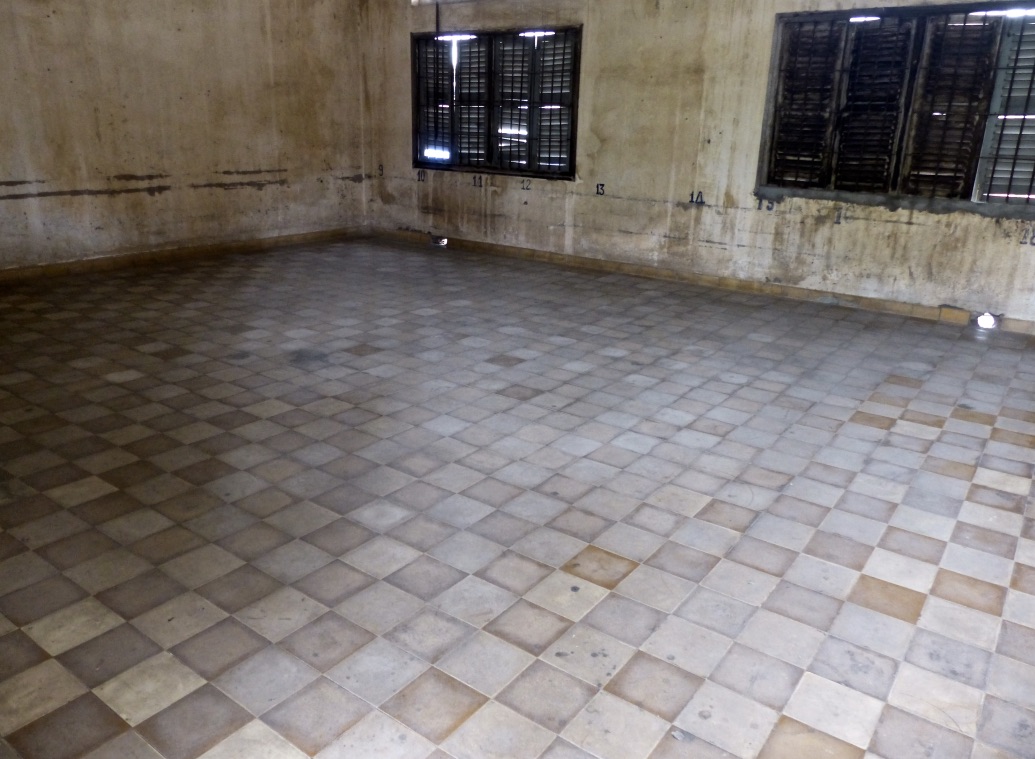
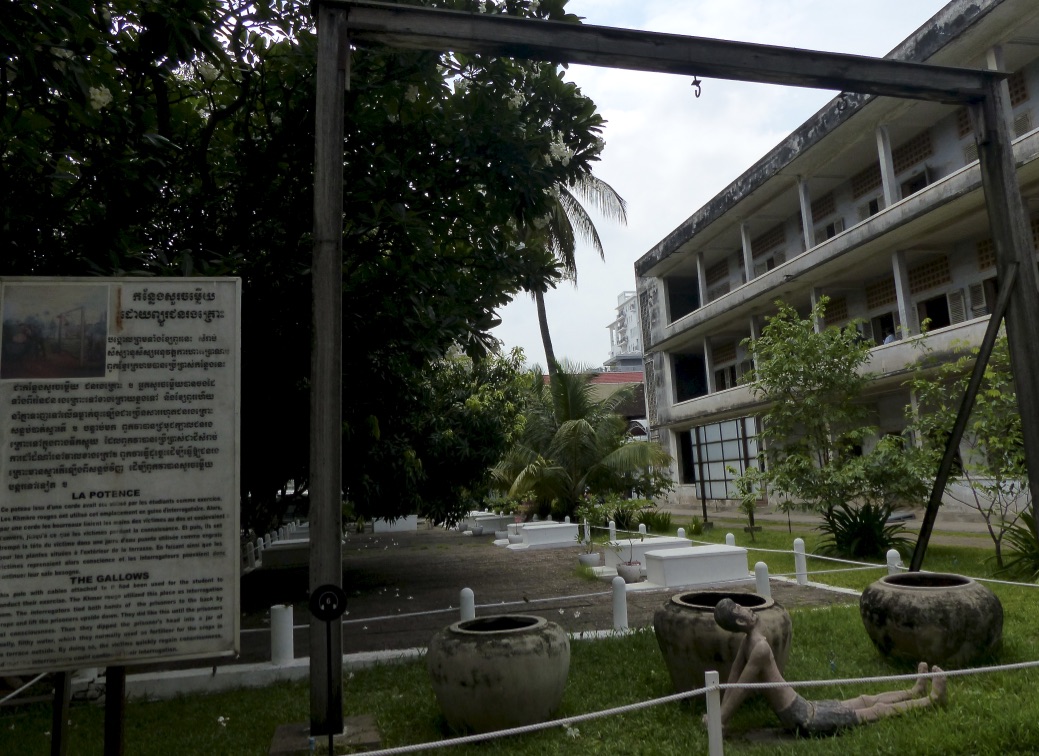
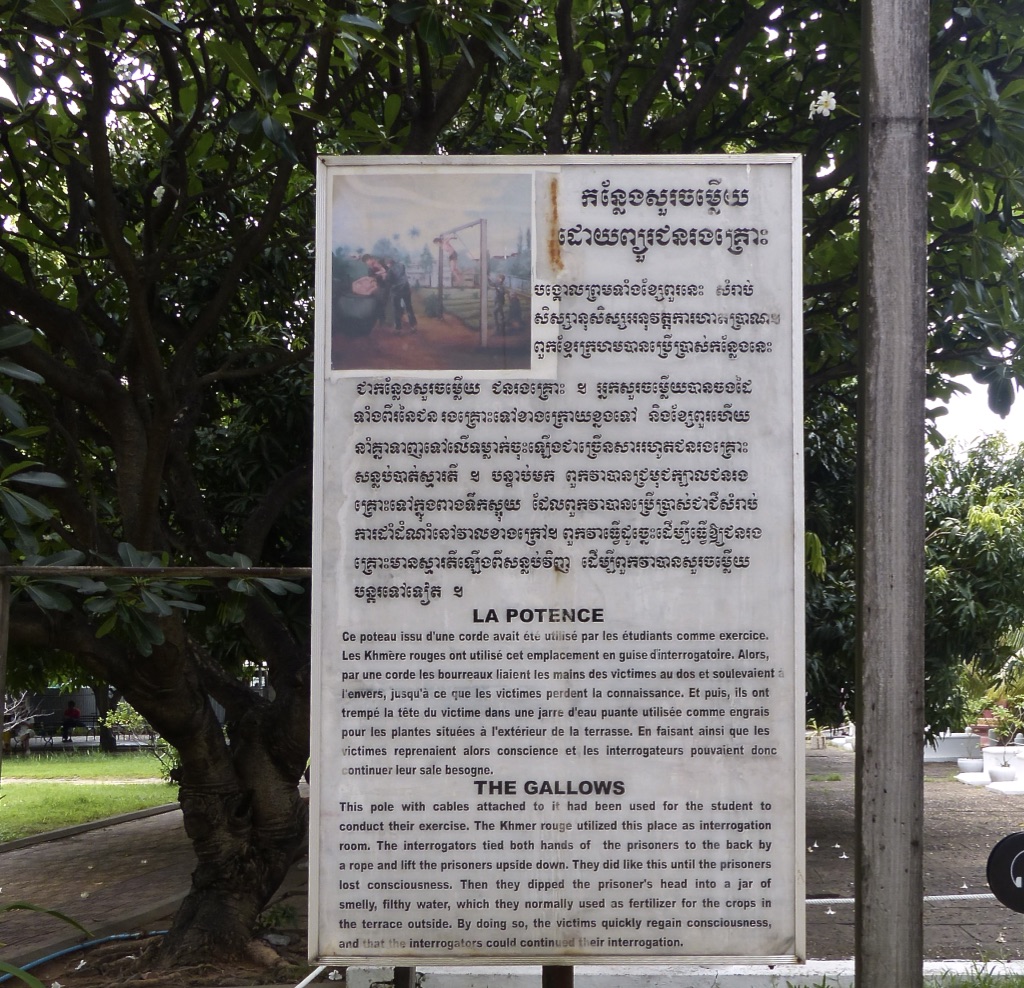
Words truly cannot describe how we felt as we learned about the atrocities committed here by Pol Pot and his army on their fellow Cambodians.
We then traveled just 17 km outside of the city to Cheung Ek (“Fields of Death”) which become famous in the film “The Killing Fields” . Here, a museum and monument have been erected to memorialize the 17,000 individuals killed at this site alone. Cambodia’s countryside is filled with other such “fields of death” and there are far too many skeletons to identify and/or count. In fact, there is no active effort today to excavate skeletons on the part of the government and instead, the monument at Choeung Ek is meant to represent all who perished much like the graves of the unknown soldiers around the world.
Choeung Ek is a simple plot of land with a self-guided route for visitors to follow, reading the various placards. There are several depressions where the ground has been excavated. The signs provide simple images and details of the genocide committed in these killing fields.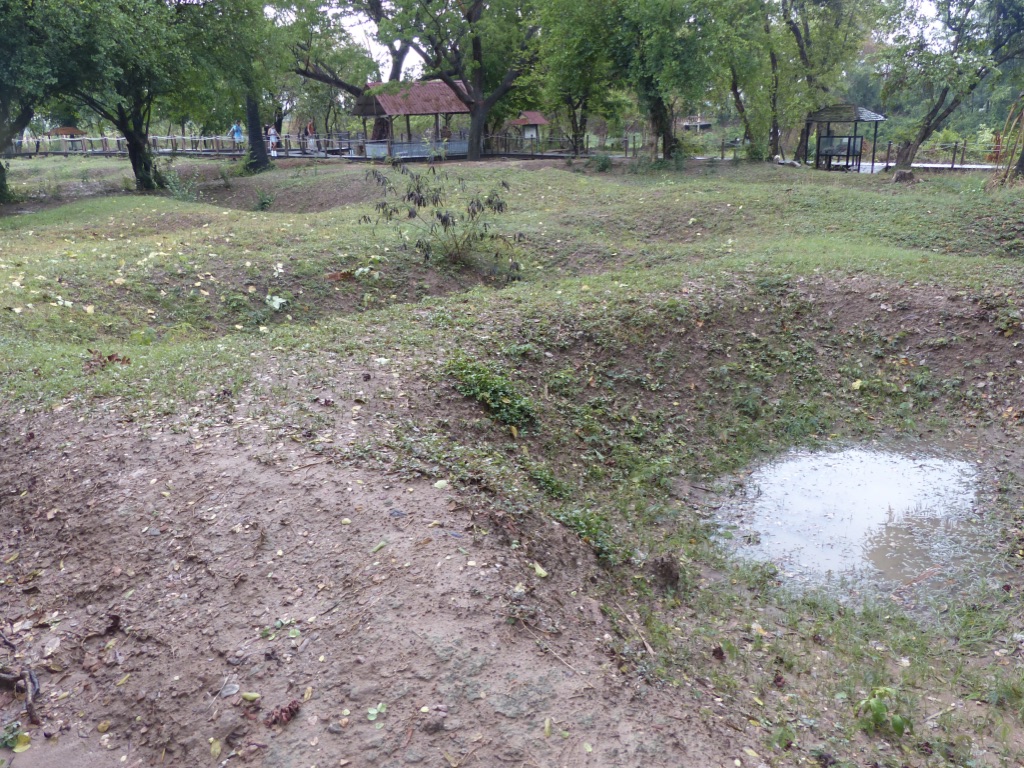

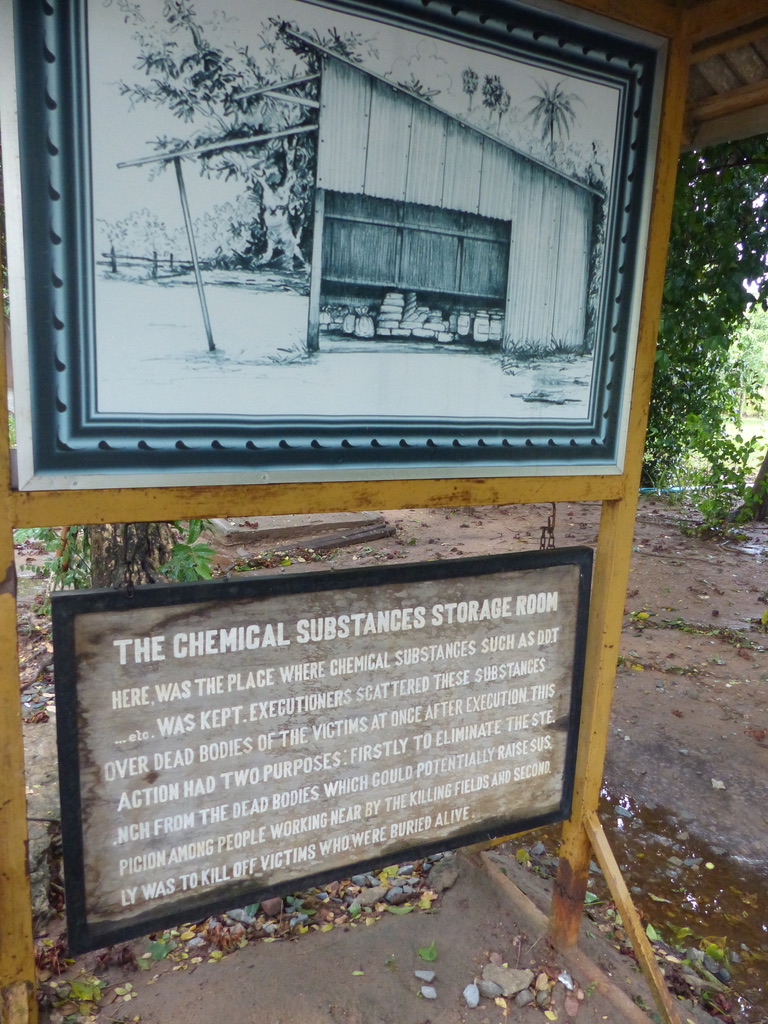
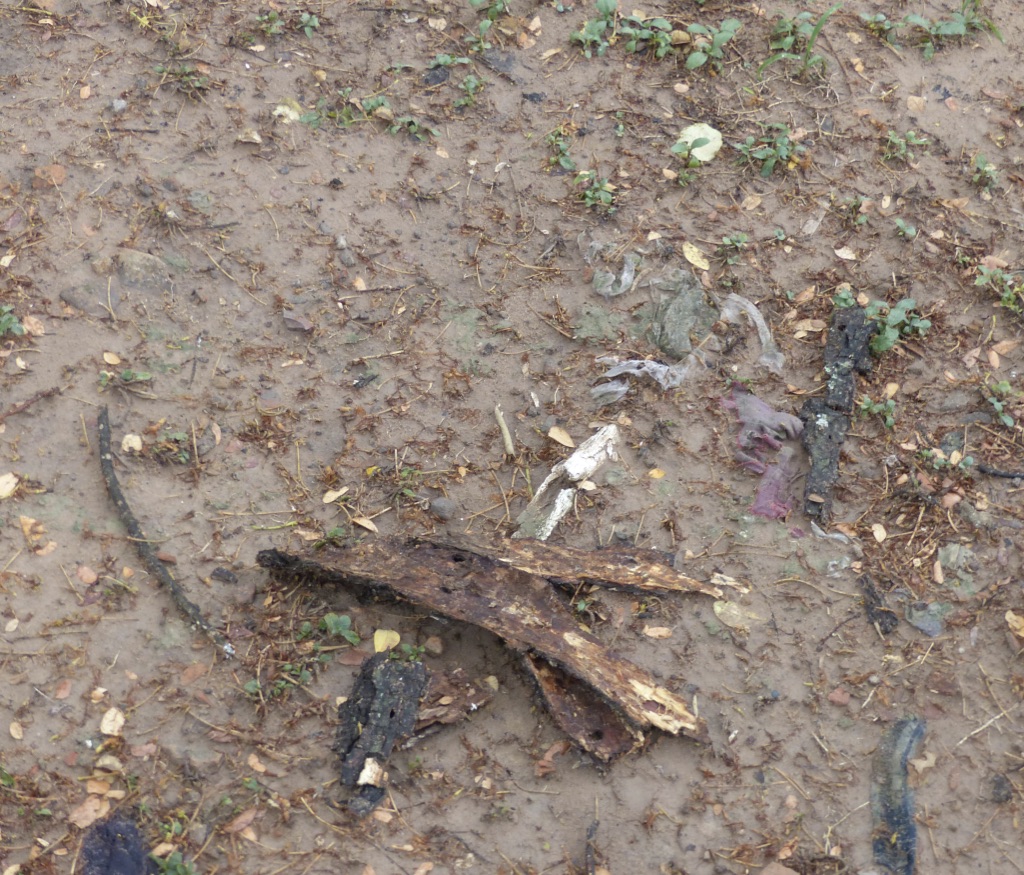
It had been raining so the ground was muddy and full of puddles…AND…bones, teeth and clothes of victims!!! These “relics” float to the earth’s surface whenever it rains and the locals simply pile the clothes and bones together. Our guide pointed out several teeth and bones as we walked around silently trying to absorb the atrocities committed at this site. The teeth all had long roots since they didn’t just fall out naturally and the clothing was everywhere we stepped. Using the big yellow leaf as twelve o’clock, find the tooth at 5:30 in the image directly below and a bone fragment in the next photo. 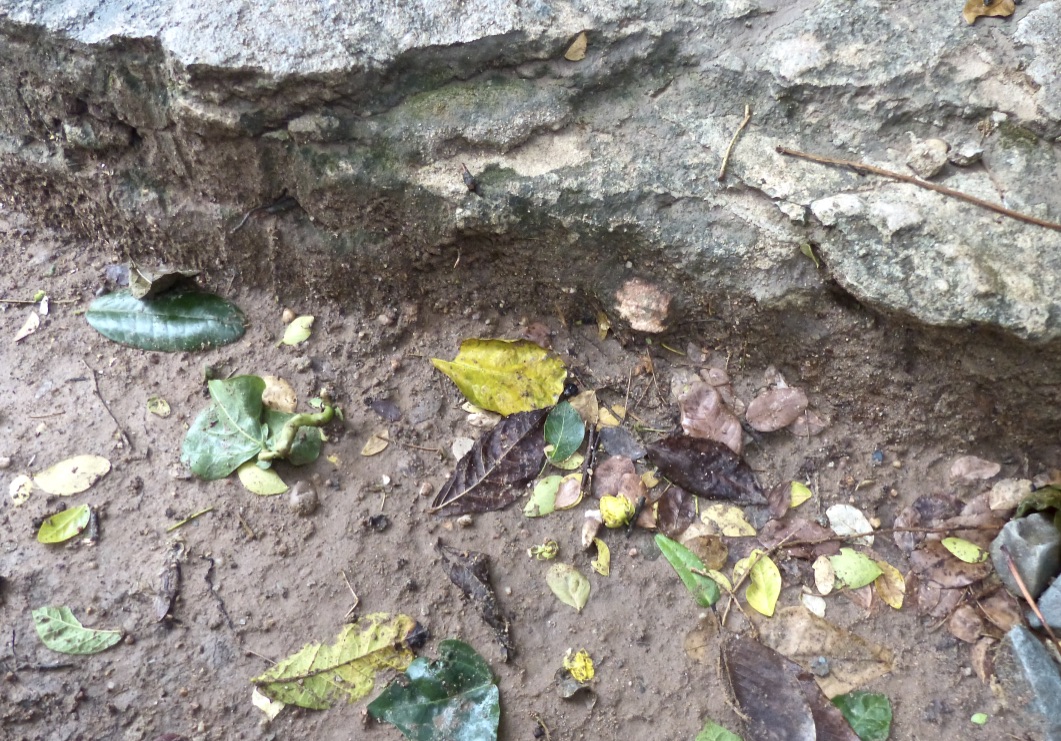
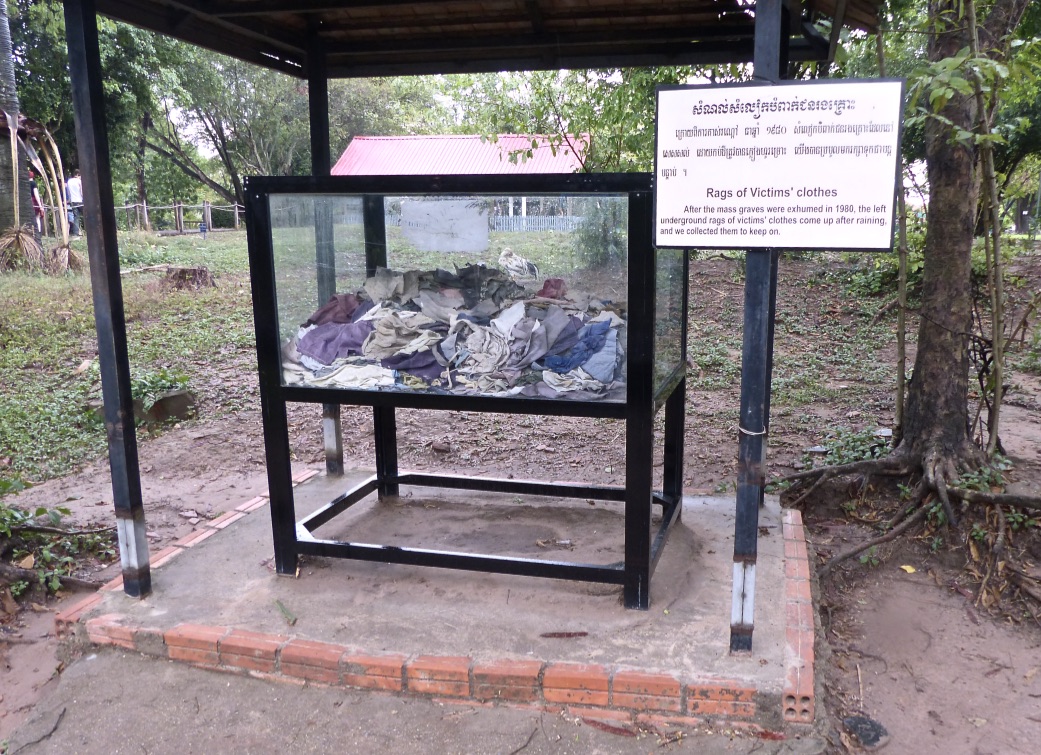
Some of the mass graves were identified and the number of victims excavated counted. These plots were tiny relative to the number of bodies they contained.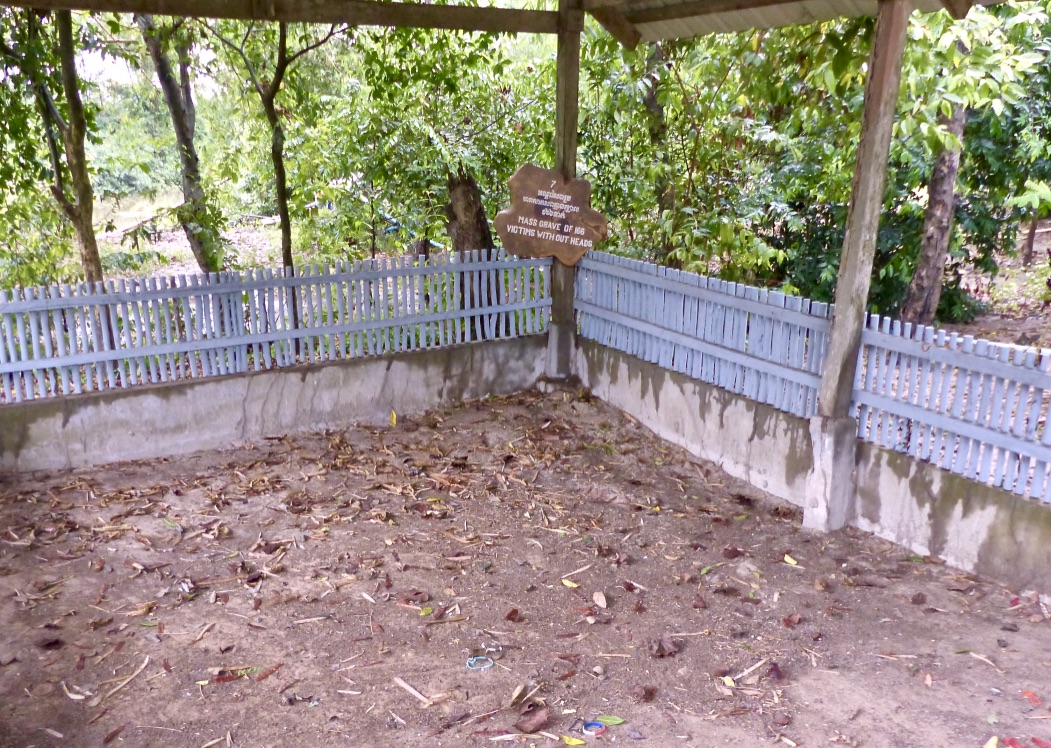
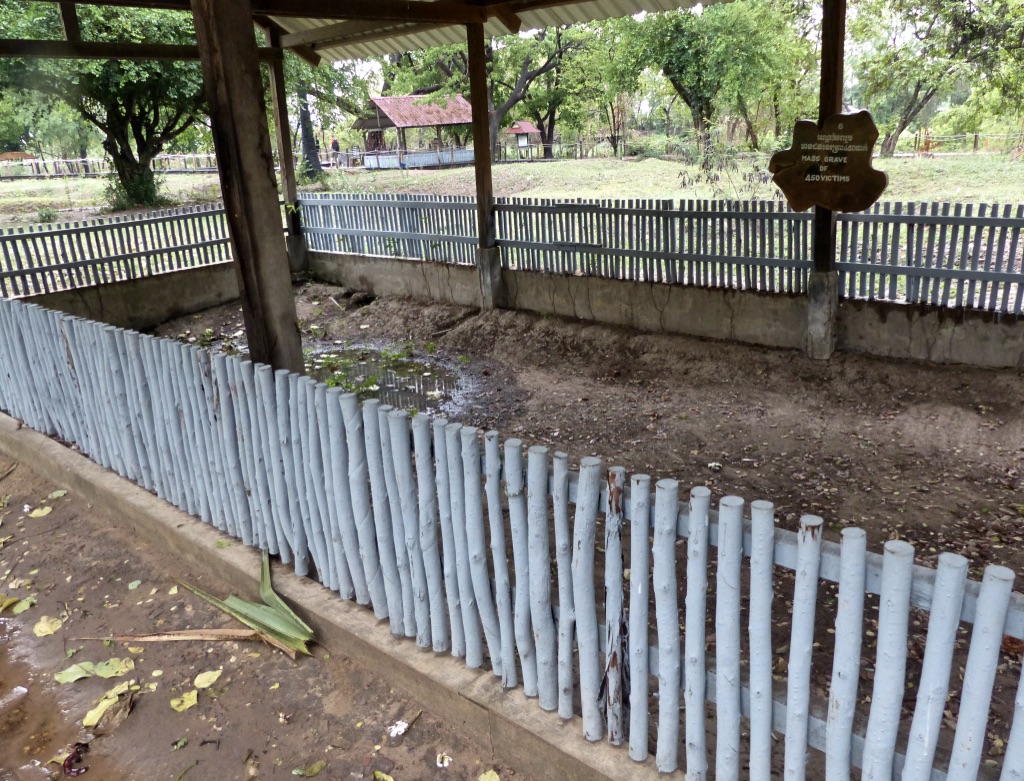 The most upsetting, gruesome area of all was a large tree covered with memorial ribbons. Khmer rouge soldiers literally threw babies against this tree to kill them.
The monument is gigantic a pile of skulls and bones found at Choeung Ek. Silent and somber, the 203 ft tower of bones is beyond description.


Well worth a visit, Choeung Ek is a sobering experience to say the very least. It is also striking, and frankly admirable, how much effort the people and government of Cambodia have made to move beyond this tragic time, to acknowledge, accept and ultimately heal the wounds of the past. Everyone we met was willing to talk about this time, but at the same time all the Cambodians we met were looking toward a brighter future, didn’t seem to still harbor anger or to be solely defined by the past. Compared to how other countries around the world, Germany, Turkey, Russia, Bosnia and America to name just a few, recognize “ugly” moments of their own past, Cambodia’s attitude is truly remarkable given the magnitude of the genocide (nearly 2 million people killed/25% of the population!) and how recently this occurred. Virtually everyone we met, including Sethavy our guide, lost a close relative during these 4 years.
We left Choeung Ek and headed back to the airport for our late afternoon flight to Siem Reap. Despite the cloudy weather and small plane, the ride was smooth…thankfully! The beautiful, peaceful accommodations at Amansara could not have been more of a stark contrast to the sites we toured earlier in the day. A local blind and very talented singer/musician, performed while we ate dinner alone and contemplated the full day.
Most everyone visits Siem Reap to tour the magnificent temples and ruins of the former Khmer Empire. Occupying over 400 acres of land, this vast complex of temples is most famous for its largest and best preserved temple: Angkor Wat. However, there are many, many temples in the area, some completely engulfed by the surrounding jungle, but all are testaments to the vast wealth and sophistication of the Khmer Empire. At this time, Angkor Wat was the center of the ruling government and at its peak during the 11th-13th centures, satellite imagery shows that it was the largest pre-industrial urban center in the world and home to 15 million people. The largest temple, Angkor Wat, was built in just 37 years and was originally a Hindu religious temple donated to the god Vishnu but was later converted to a Buddhist temple. No written records have been recovered from the area, except for inscriptions on stone, but much has been learned through the archeological study of the architecture, reliefs and historical records of peoples who traveled from China to the area.
The 4:30am wake up call the next morning was rough, but this is arguably the best time to visit Angkor Wat as few folks opt to rise early enough to capture the sunrise so the grounds are not crowded. At the suggestion of our guide, we were dropped by our driver on the East Causeway and then walked along a forest footpath to an entrance gate. From there, we explored the various parts of this magnificent temple, ascending to the first and second levels as the sun rose. Photos do not do justice to Ankgor Wat but I will share a few that hopefully capture the beauty, complexity and scale of this 7th Wonder of the World. Do go and visit yourself if you can!
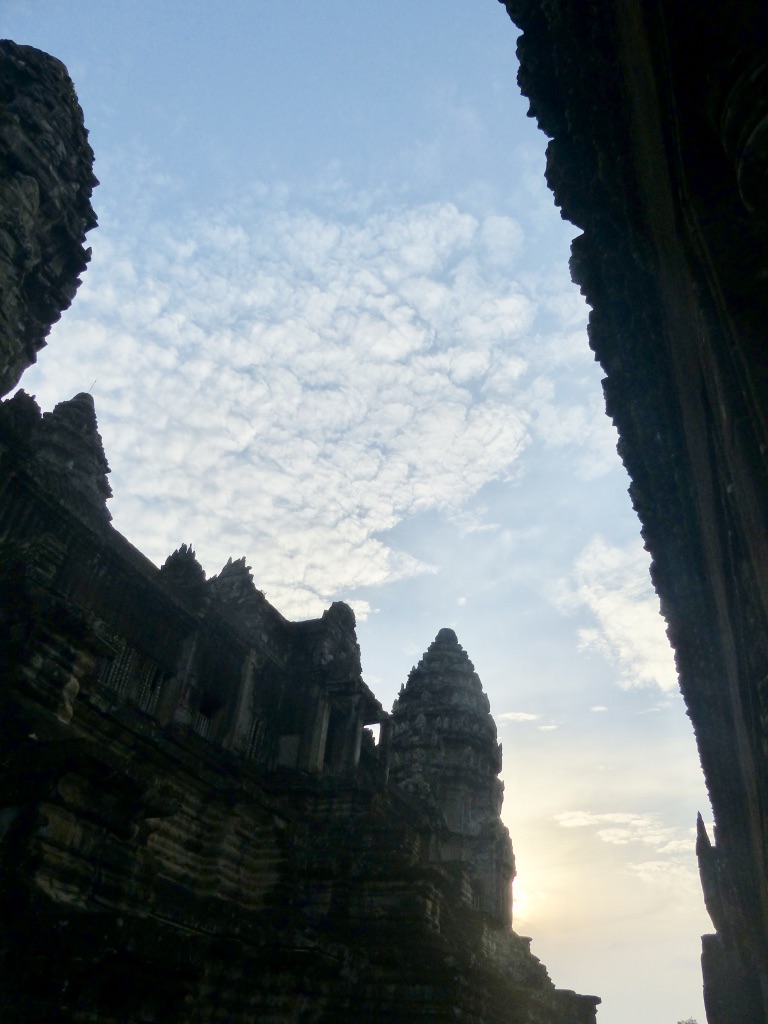
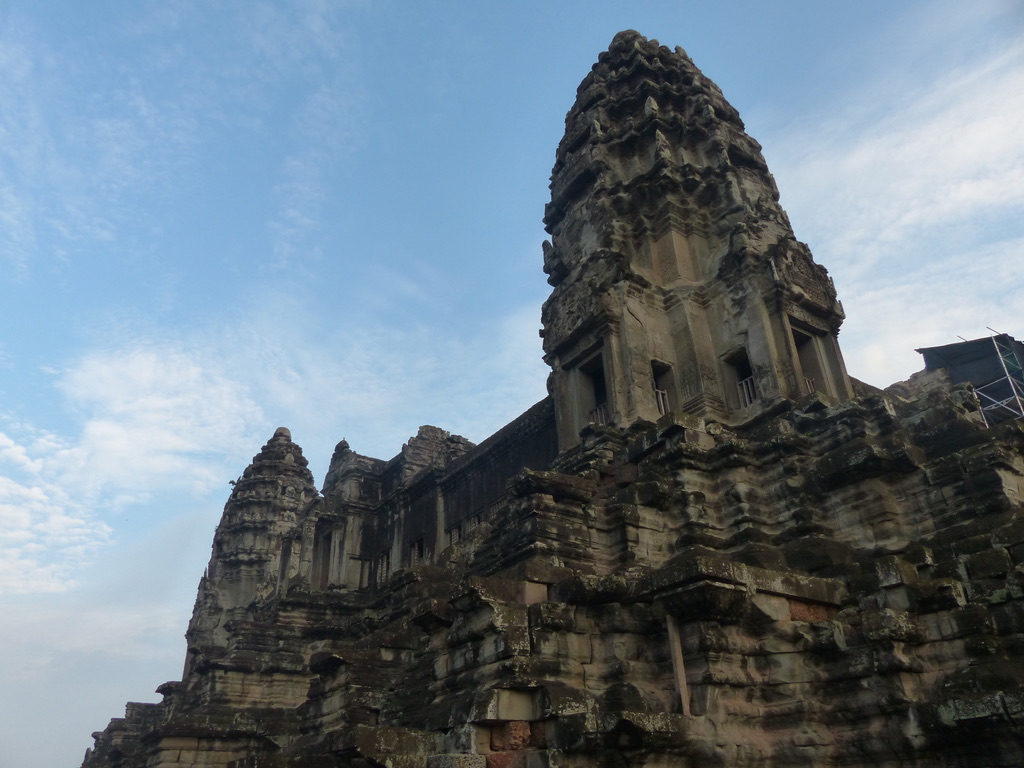

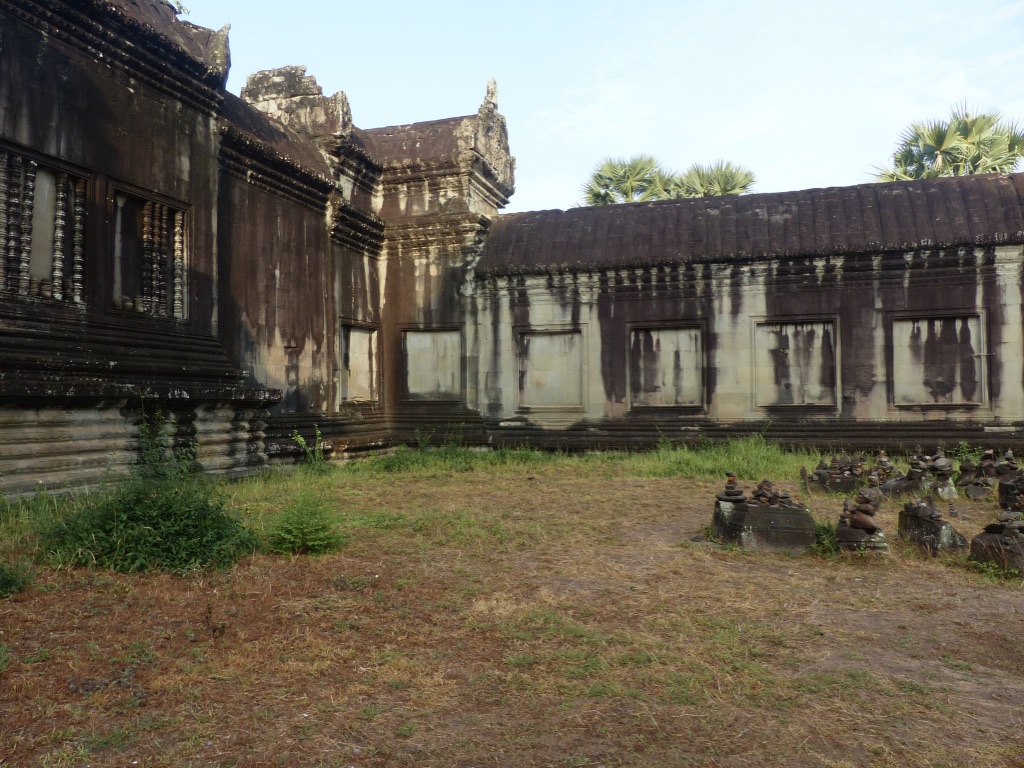
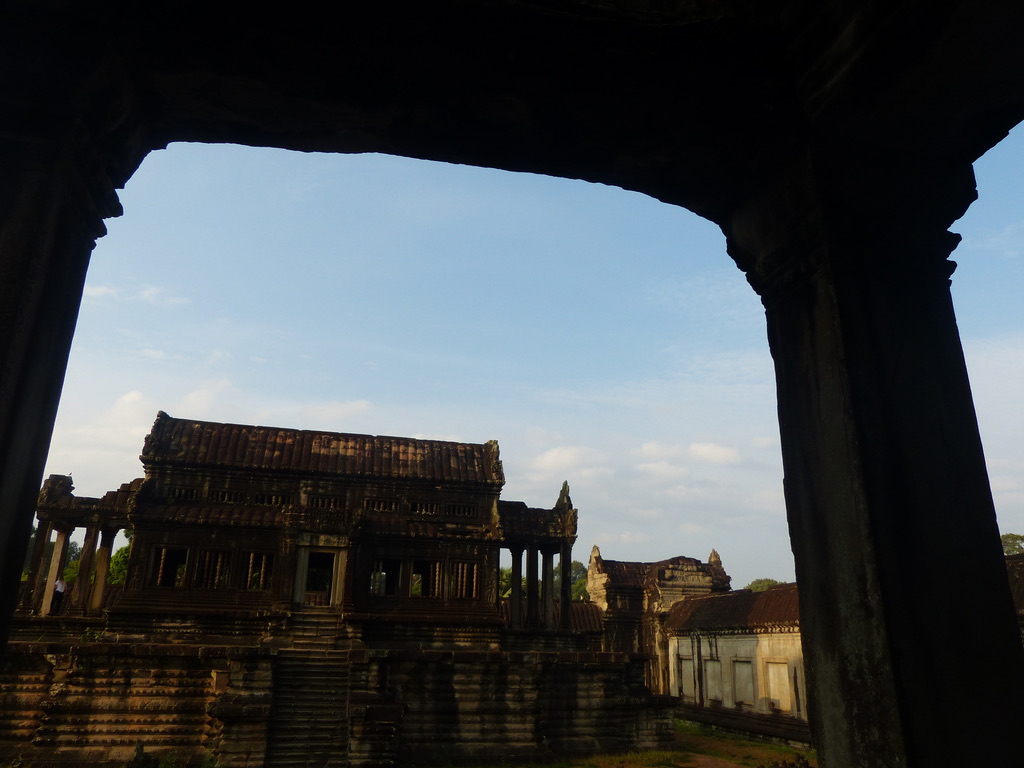
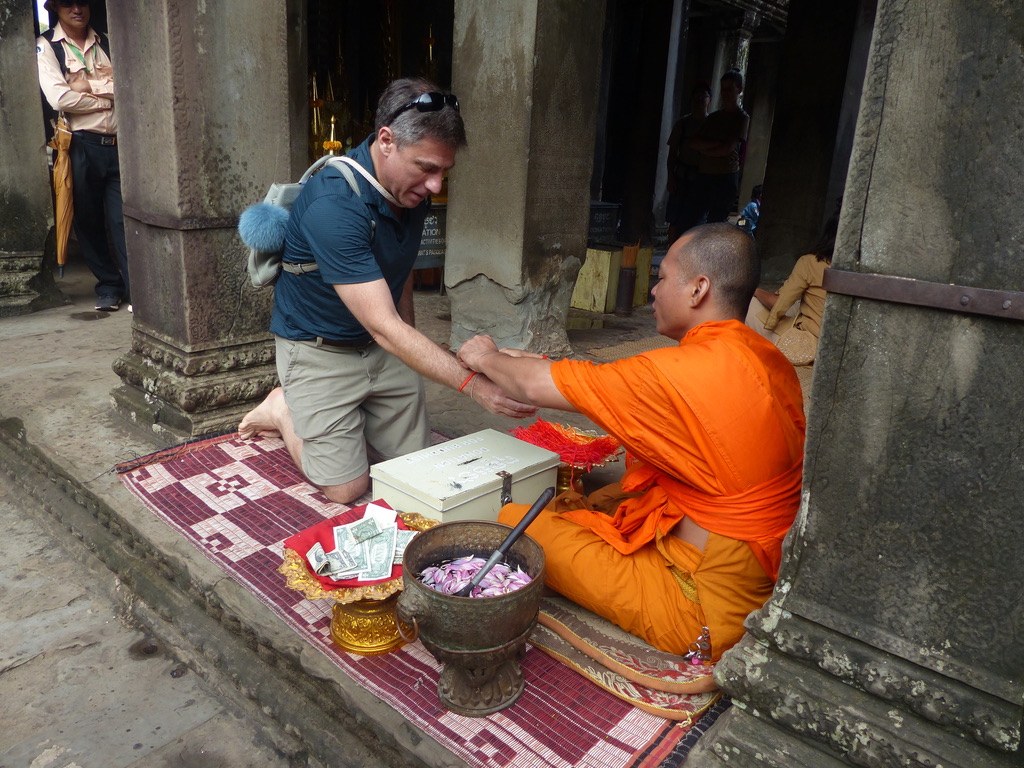
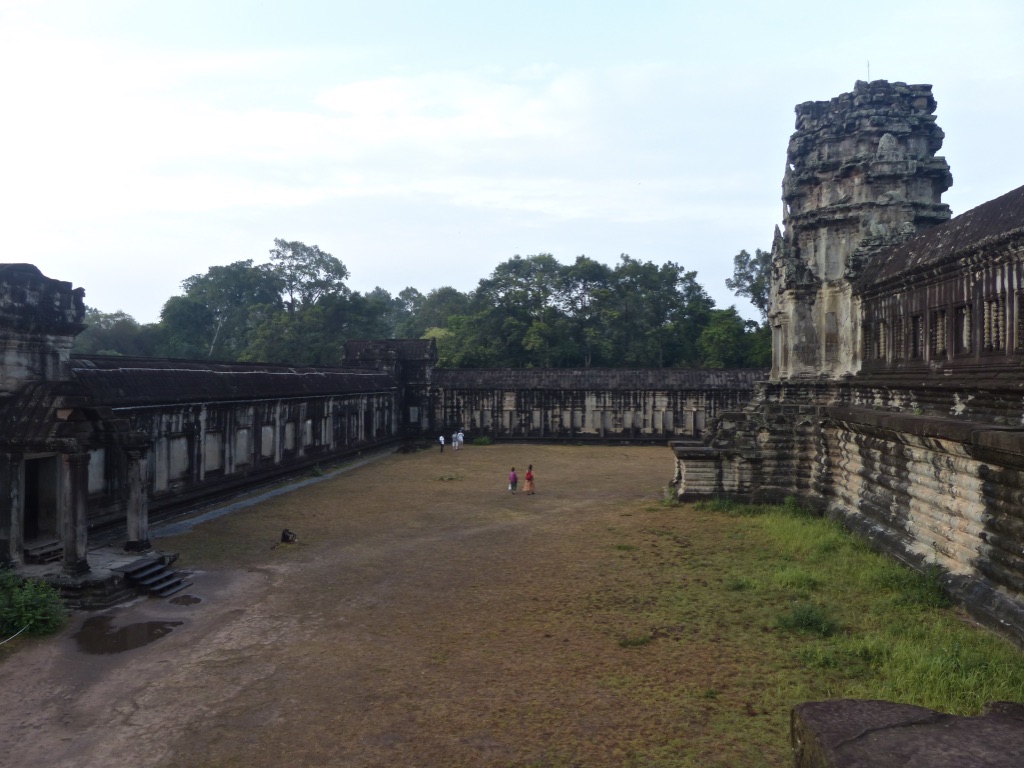 As we ascended and explored the many buildings and higher levels of the temple complex, the sun rose and more visitors arrived and yet a sense of peace pervaded this ancient ruin. On the top level, there were monks performing blessings and Bill was pleased to don yet another string bracelet. Please, do note how Bill was kindly carrying my backpack with pompom while I carried the camera. He was still wearing the simple single white string he got in Sri Lanka until last year. The bright orange one he received here was passed onto a daughter (nameless) who lost it swimming.
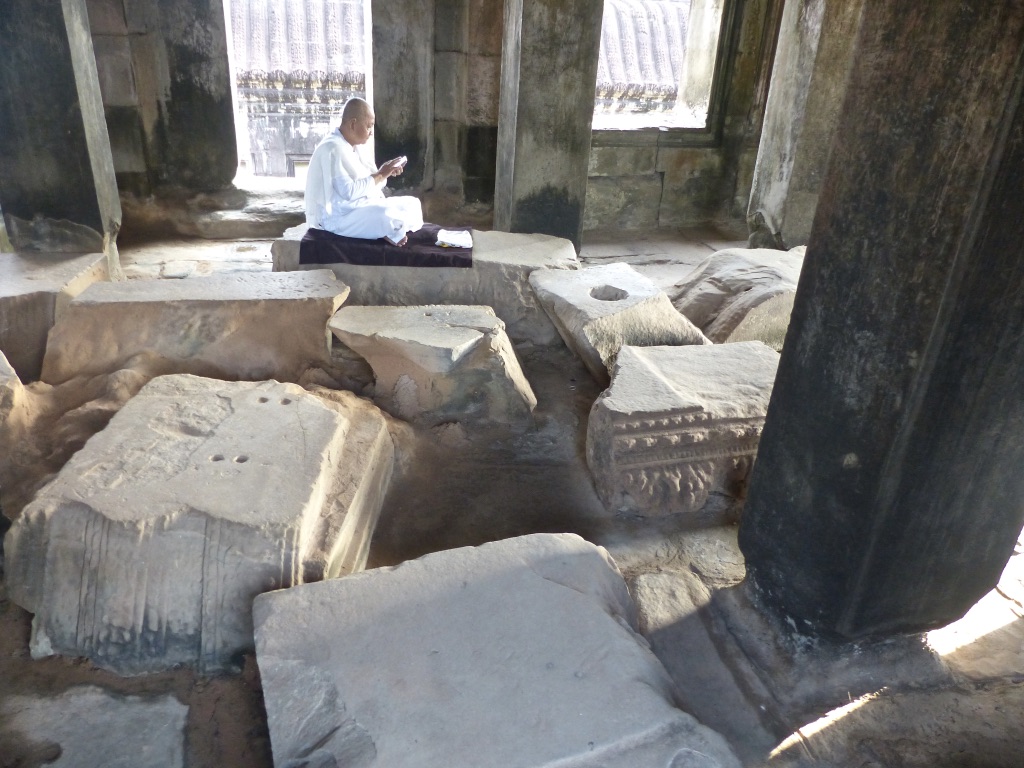
 One of the gems we discovered on the upper level of Angkor Wat was a tiny temple with very steep stairs…that of course beckoned me! Inside we were surprised to find a lone monk at prayer.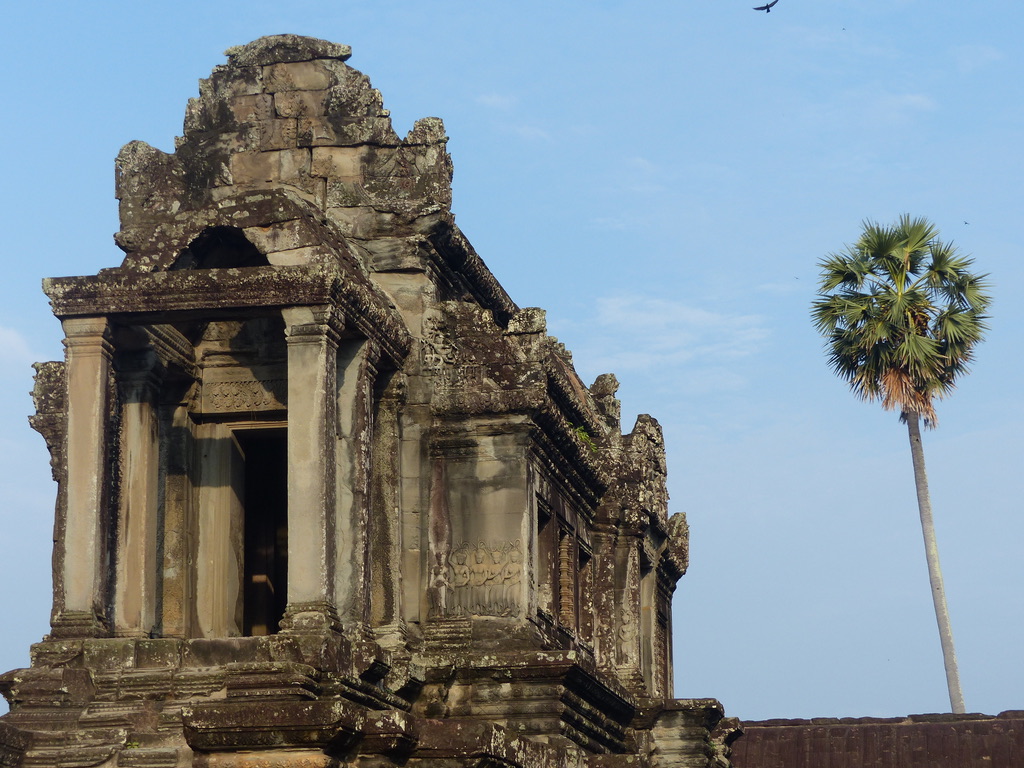
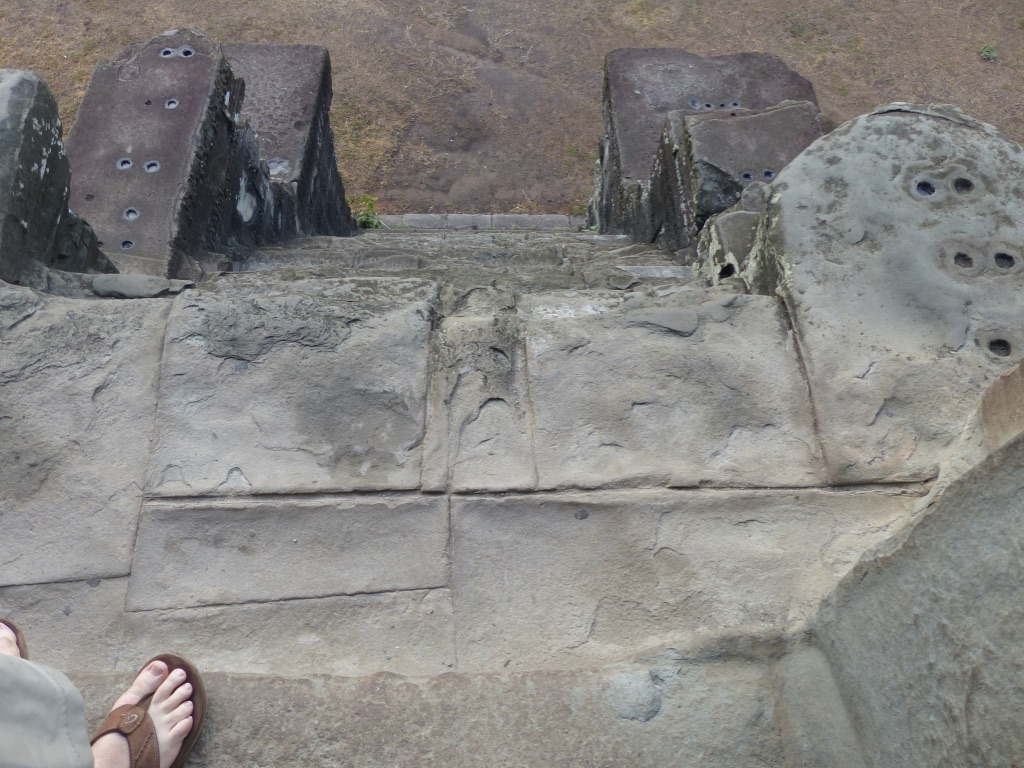
The descent was a bit daunting as perhaps you can tell by the photo below.
Many of the facades were covered with beautiful stone carvings depicting various religious stories. There were also several long cloister type alleyways with long friezes that were full of beautiful details.


The magnitude of the architectural feat accomplished by the Khmer people without any mechanized tools, amid a jungle, in the searing heat/monsoon rains, is staggering and awe-inspiring. As we exited via the main entrance, we could gain a sense of Angkor Wat’s enormous scale and the tremendous engineering that was accomplished in just 37 years! My camera couldn’t begin to capture its entire length.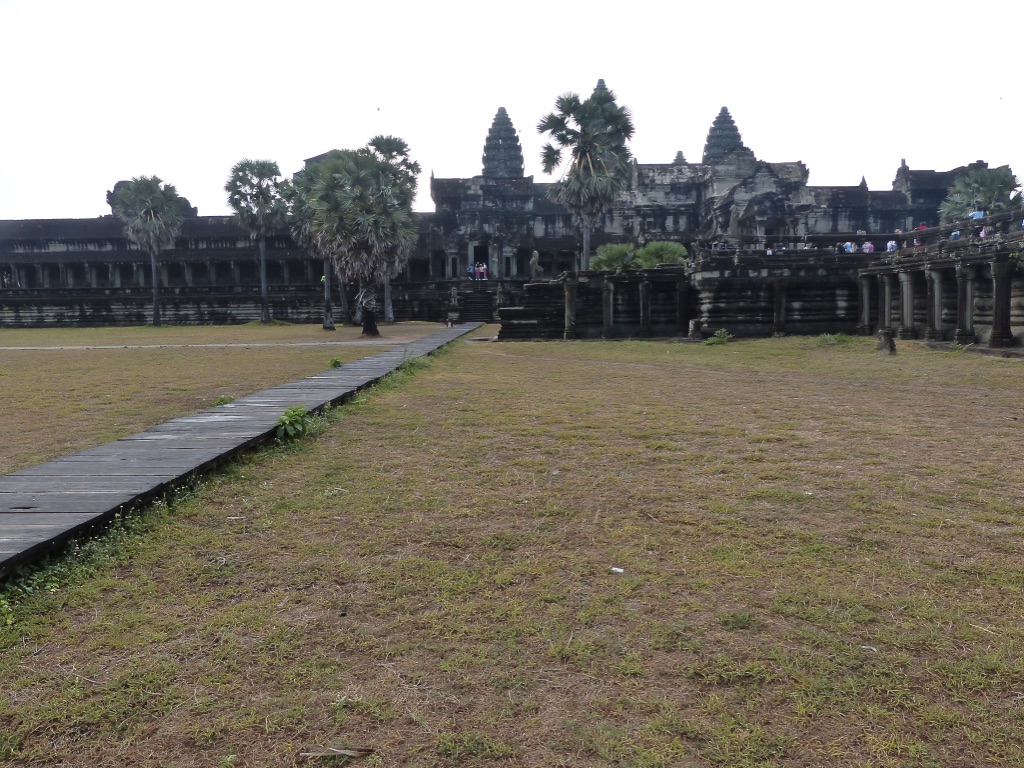
In addition to the highly ornate and grand temples, there was also an elaborate waterway system of canals and reservoirs built to support the population, irrigate the crops and transport goods. You can see the enormous size of the man-made reservoirs that were dug in the photo below.
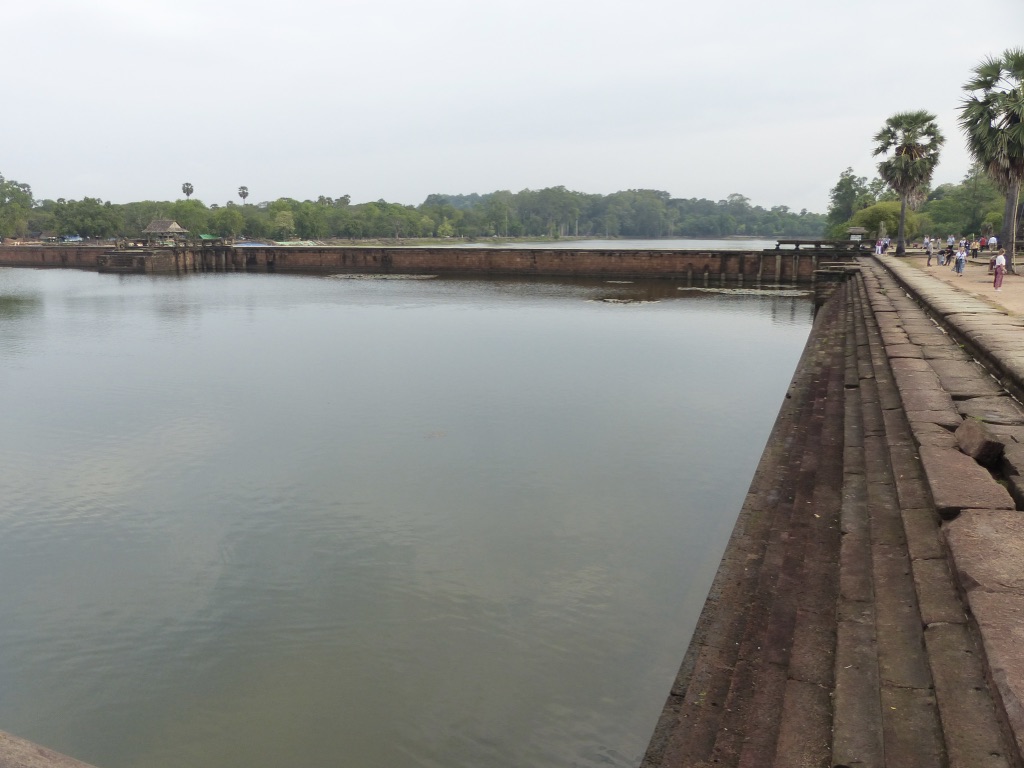 There are several theories as to why the great Khmer Empire fell in the late 15th century and all of the Angkor Wat complex was abandoned but it was most probably a combination of pressure from outside invaders, climate change/ecological damage from monsoons and serveral major epidemics that affected Asia at this time. Most of Cambodia’s land then became part of what are Myanmar, Laos, Vietnam and the Malaysian Peninsula today. All of the majestic temples in the Seim Reap province were abandoned, infrequently visited by Buddhist monks or the occasional European traveler. Consequently, the temples were completely overtaken by the surrounding jungle. In 1860, Henri Mouhot, a French explorer, discovered the vast temple complexes, but it wasn’t until 1908 that official excavation/restoration of the ruins by the French government began. Nonetheless, the vast size and splendor of the Khmer Empire is readily apparant to any visitor.
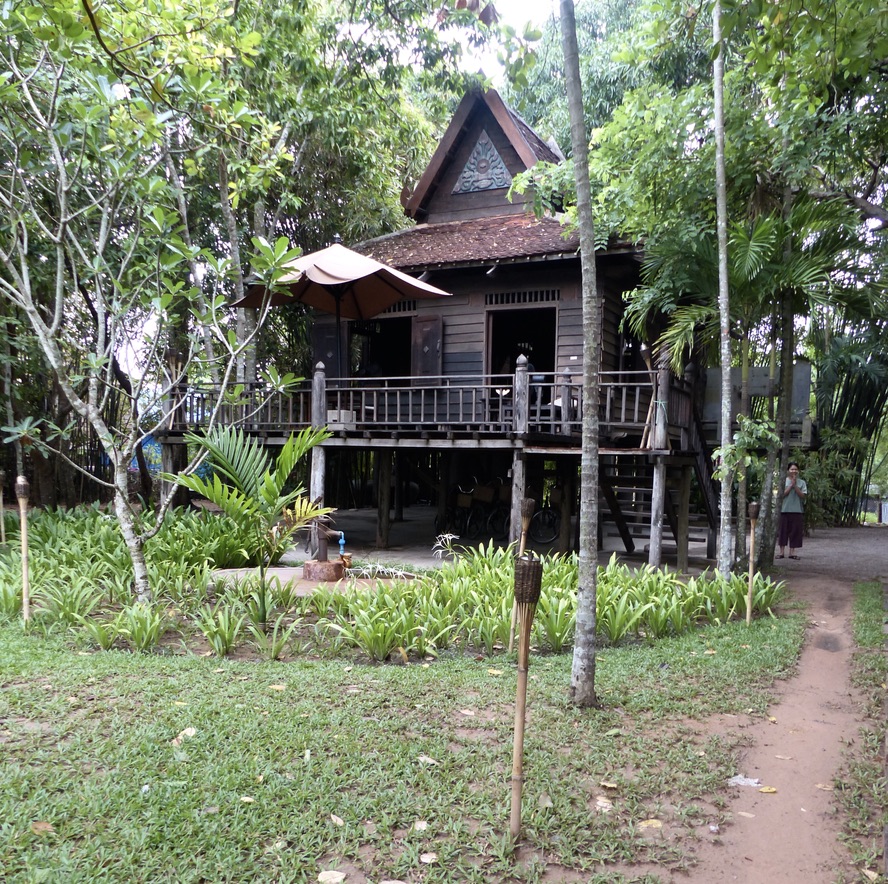
For lunch, we were taken to a family run restaurant built on stilts over looking a lake. The food was beautifully presented, delicious and as the only guests, we had the FULL attention of the family’s kids and their friends. Word quickly spread in the neighborhood that we were interested and friendly tourists (aka “Suckers”) and the kids kept bringing us various handmade items for sale. If you look closely below, you’ll see Bill “negotiating” the purchases of six (!) handmade flutes. First, the oldest child would sell an item to Bill, then the next youngest, and so on, so it was VERY hard not to purchase one from the littlest seller who couldn’t even really speak. Good thing we have a large family and can now perform as a small woodwind ensemble!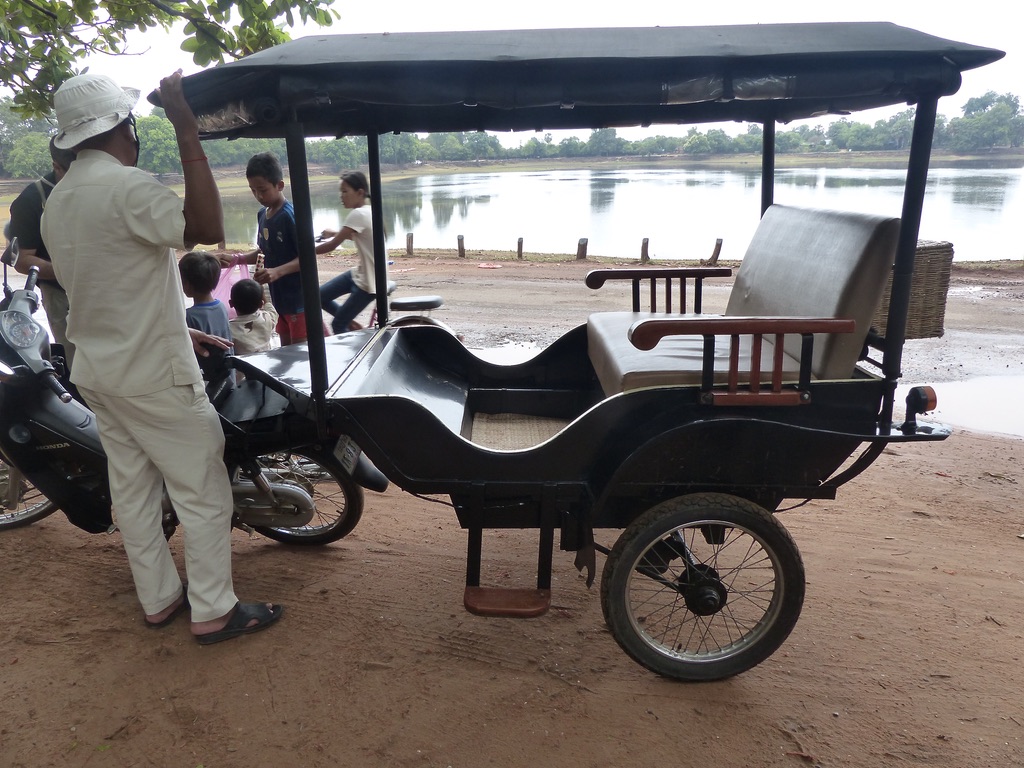
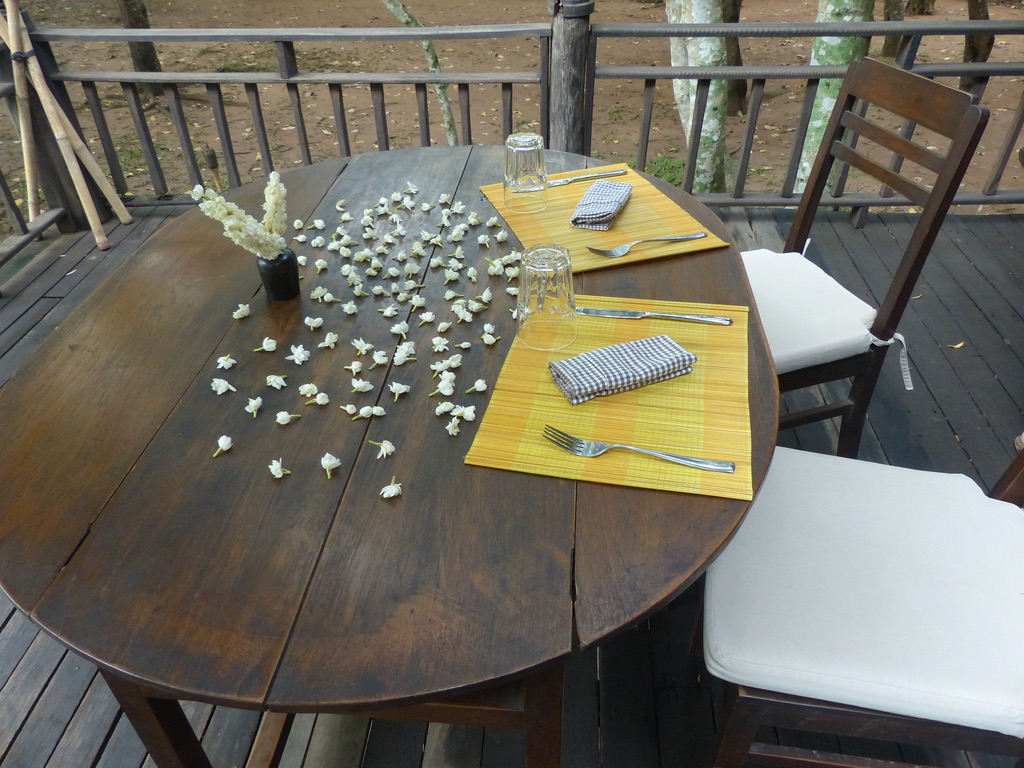
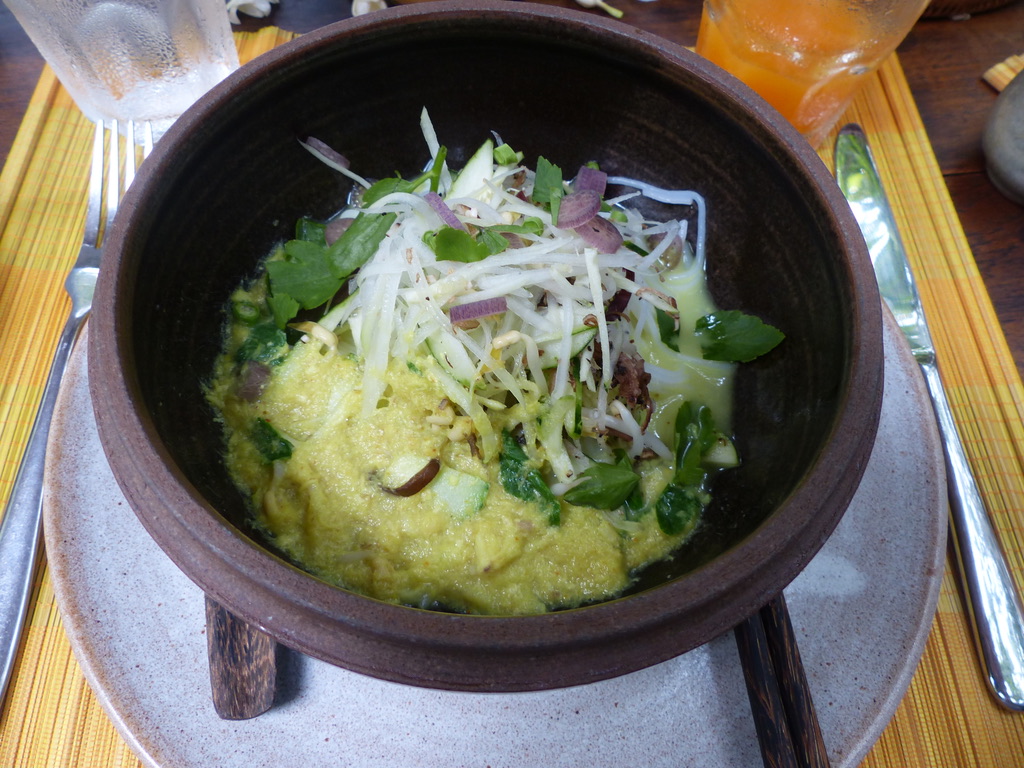
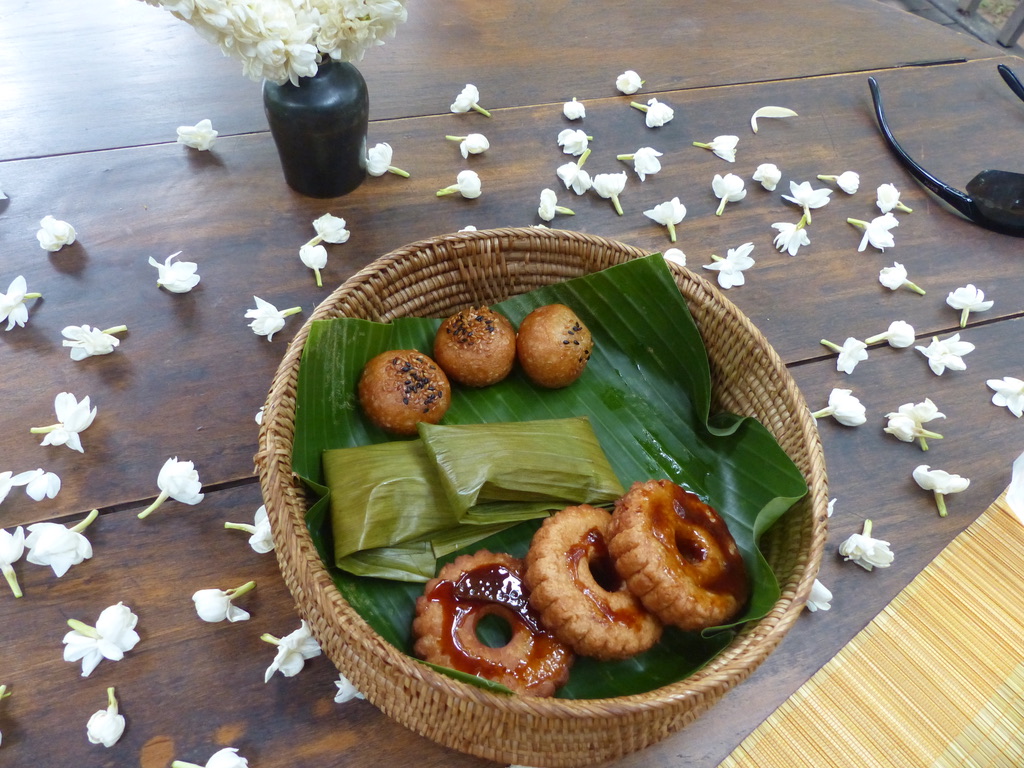
Our lunch fare consisted of fresh fruit, vegetables and some sort of stew, all accompanied by rice served in a variety of sweet and savory ways. We were honored and humbled by the obvious care and pride the husband and wife put into our meal. I particularly loved the smell of the tuberose blossoms scattered on the table.
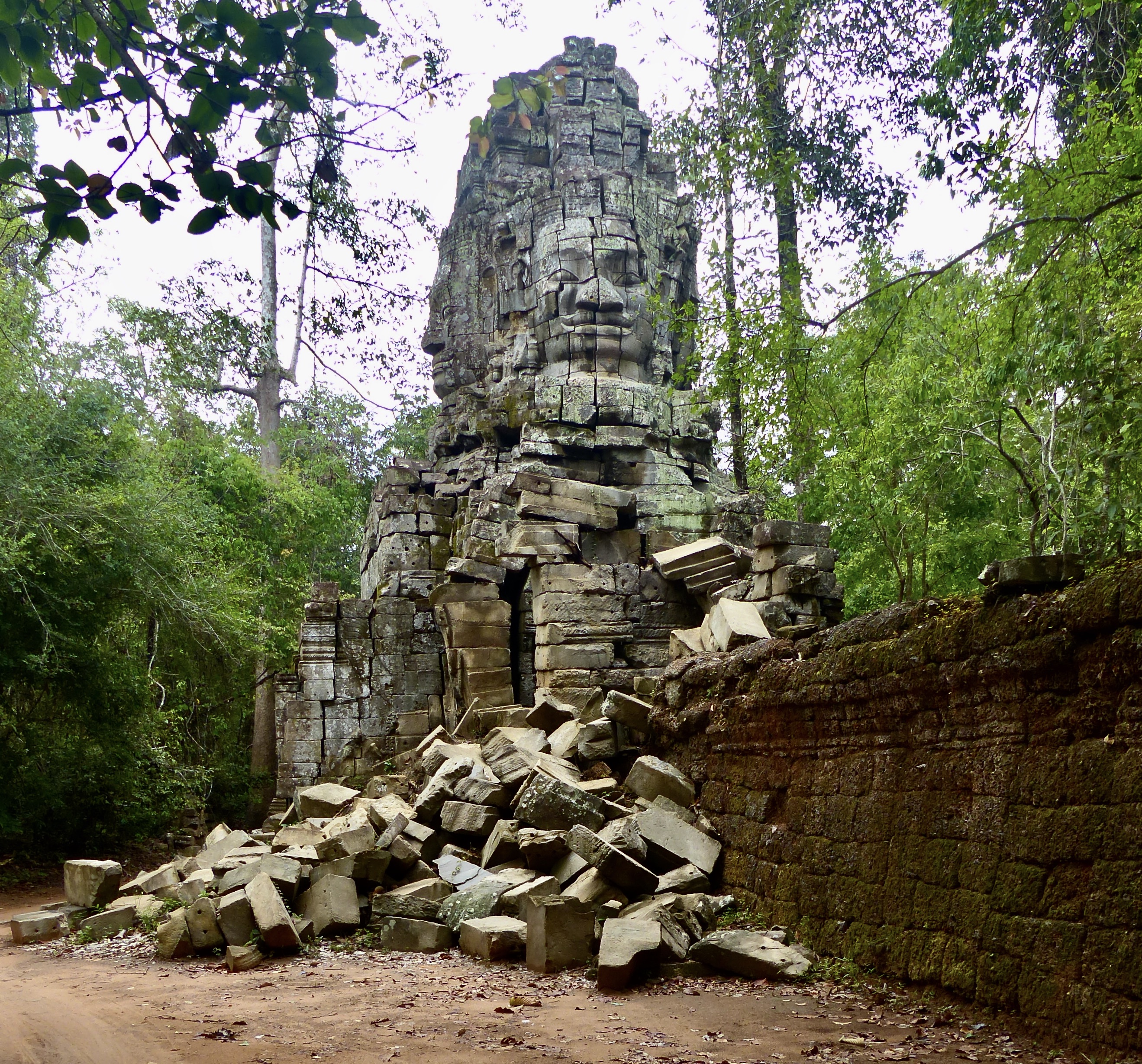
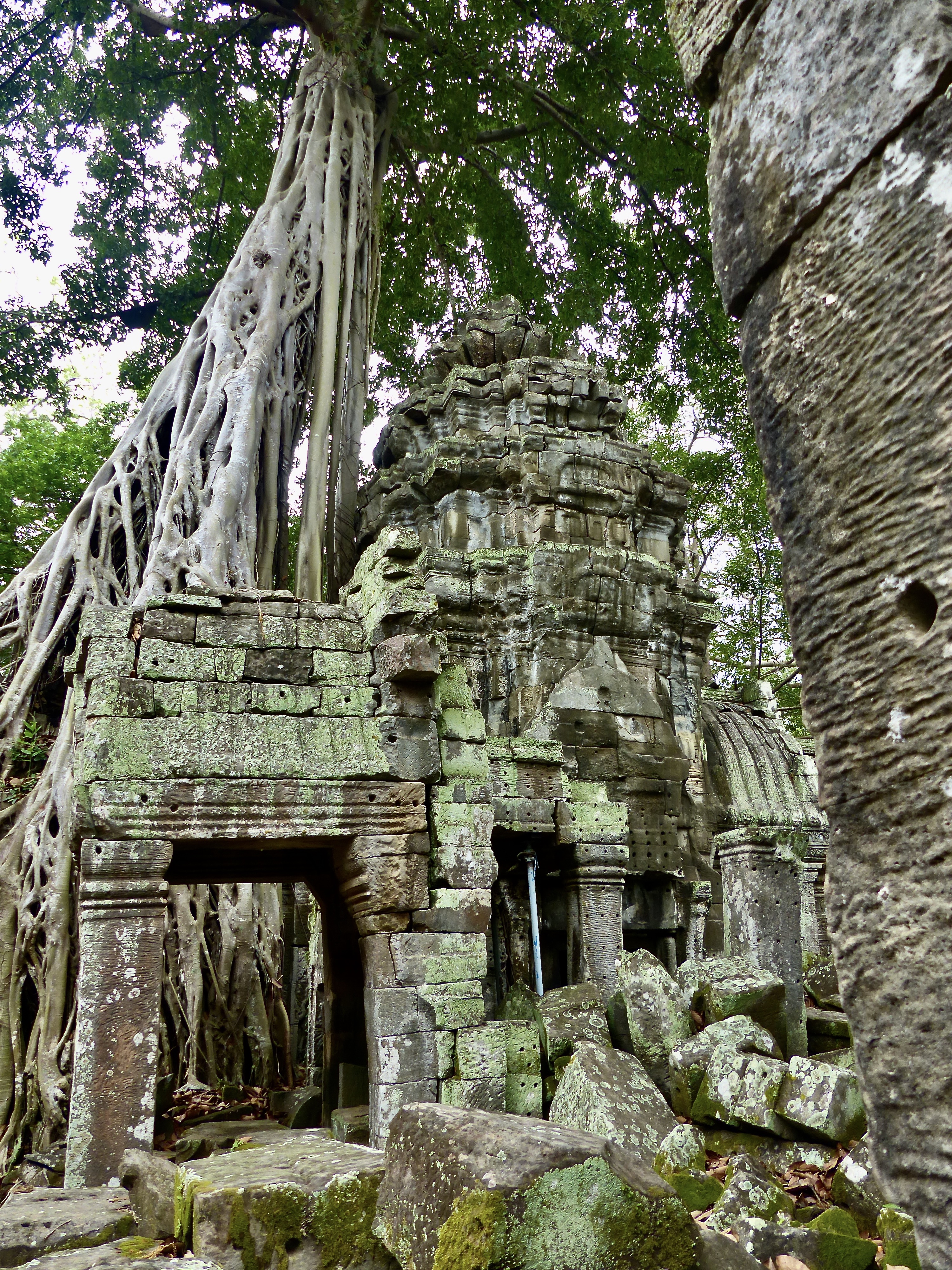
We spent the afternoon visiting Angkor Thom, home to over 100 temples alone (!) and Ta Phrom, depicted in the film “Tomb Raider”, all the while marveling at the surreal manner in which the jungle and temples now co-exist. Literally every bit of the ruins are photo-worthy and fortunately, we had the place to ourselves until very late in the day when a busload of tourists rolled up. Then, we had to wait while each visitor had a friend/relative take a picture of him/her, and then beckon to the next person in line to quickly do the same such that everyone in the entire group took the same picture over and over and over again while we waited (somewhat) patiently nearby for our turn. It was a reminder of how NOT to act when visiting World Heritage sites! Below are just a few of the stunning, and somewhat haunting, ruins that greeted at us at every turn. The scale of the temples, evident in both what is still standing and the size of the blocks that have tumbled down, was impressive given that the construction was completed by human hands alone. The magnificently tall trees, with their crazy root structures, were also breathtaking.
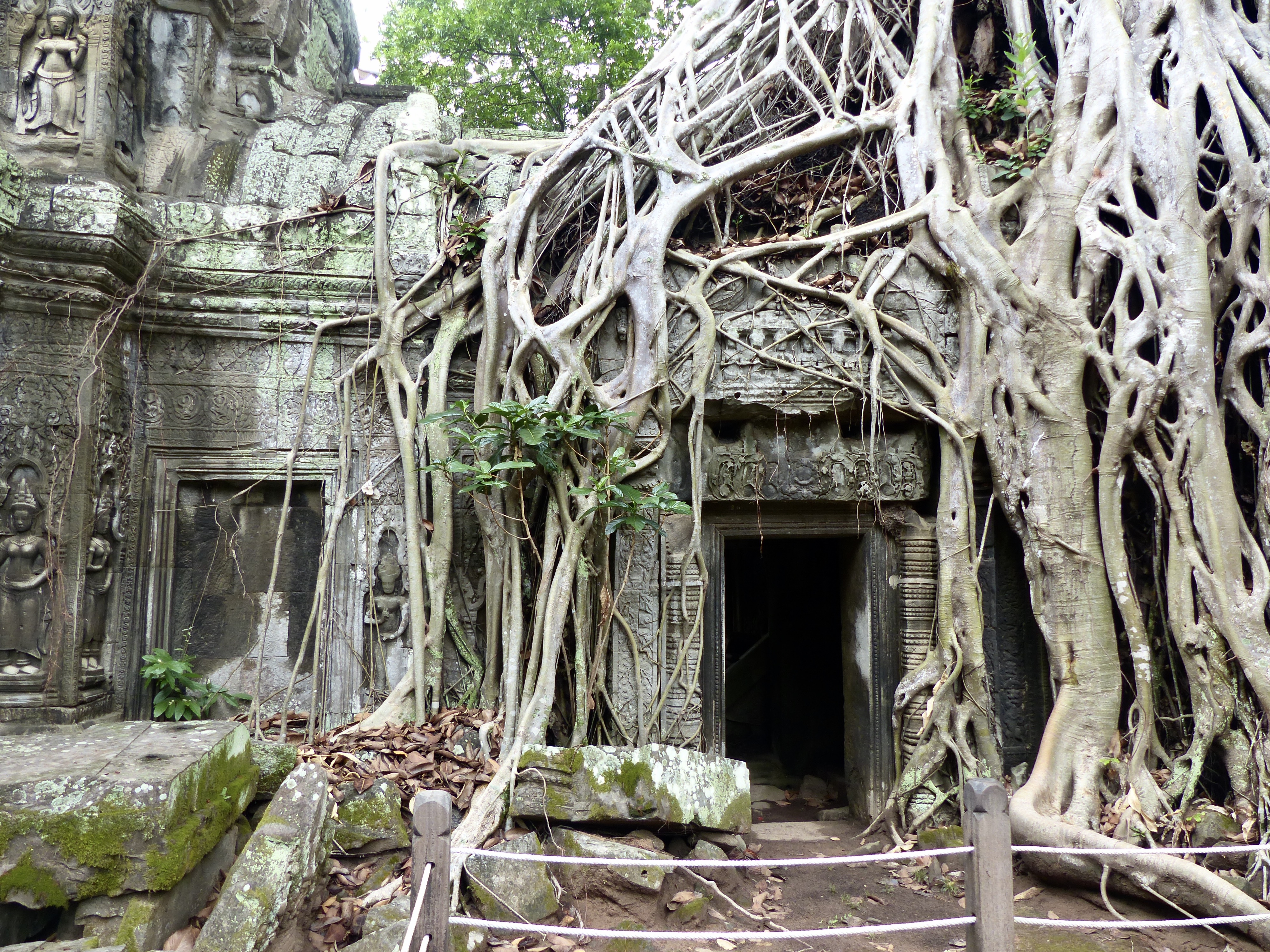
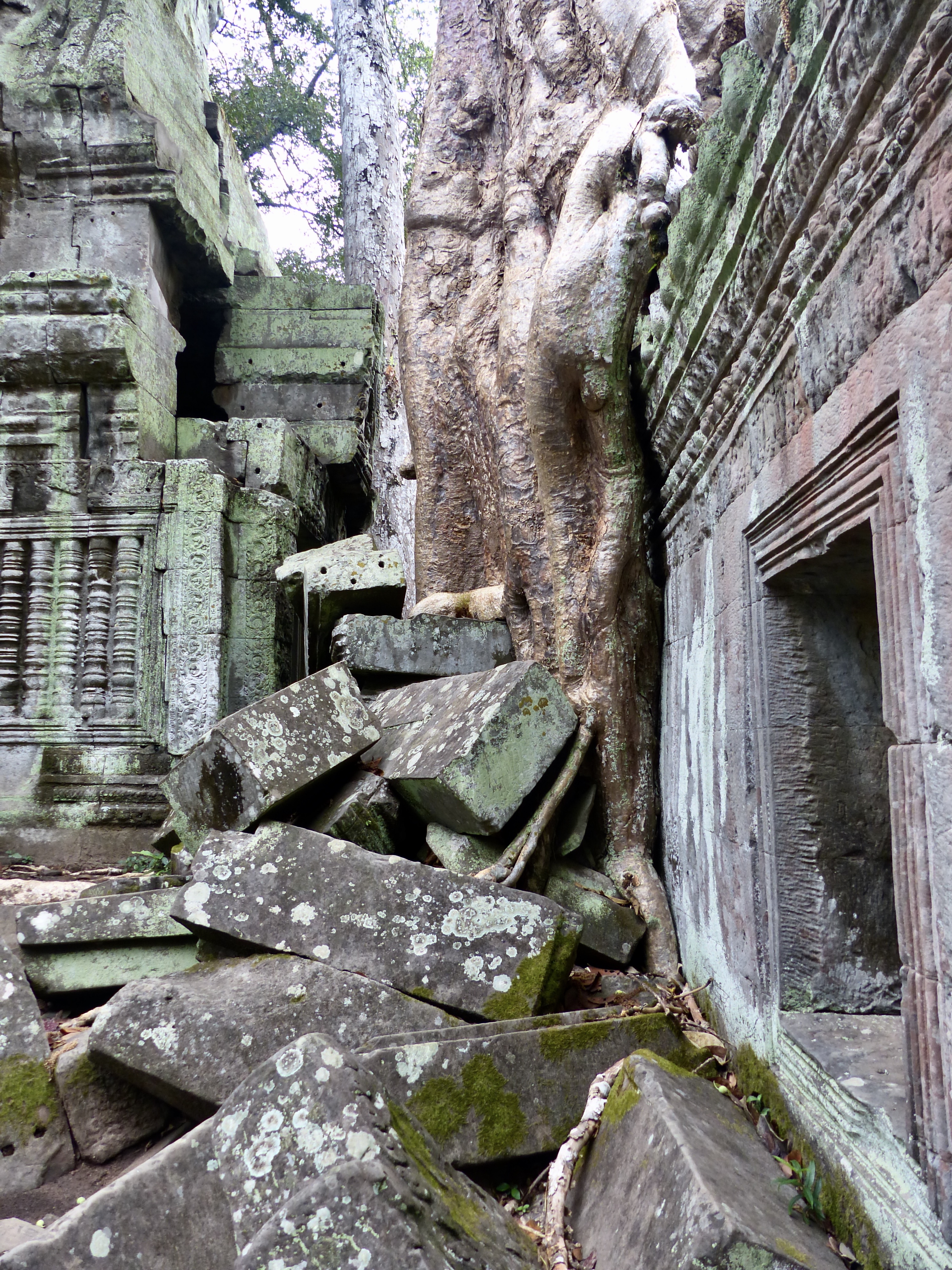
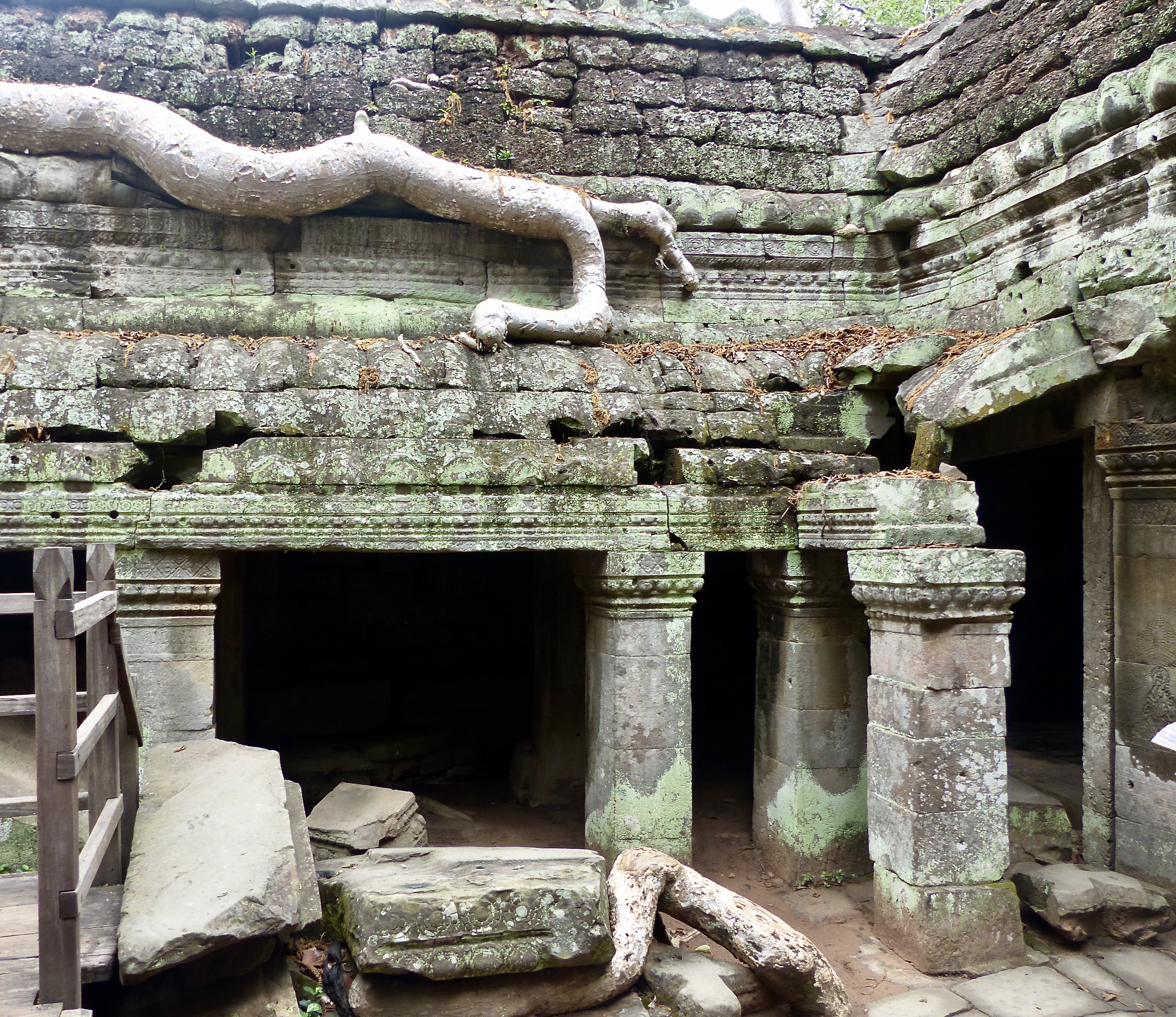
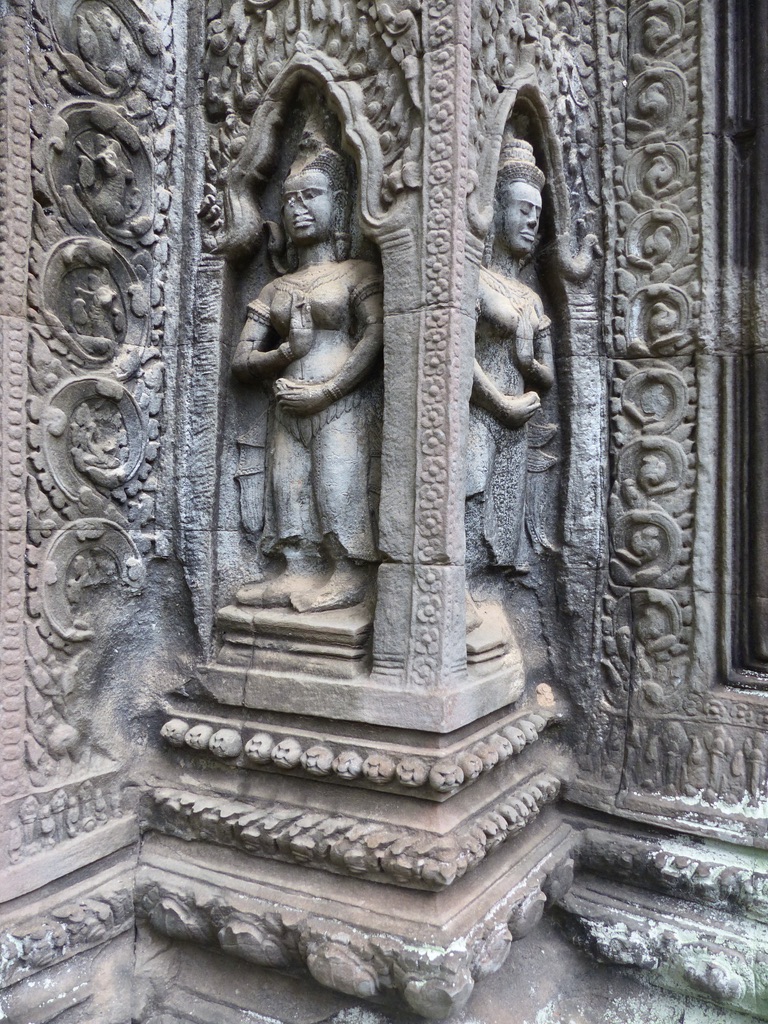
We stumbled upon numerous intricate carvings still intact after so many centuries. The carvings are invaluable to archeologists as they provide a critical glimpse of the this ancient civilization, its religious beliefs, societal organization and all aspects of daily life.
The statues along the victory gate of Angkor Thom were some of my favorites. Angkor Thom was the last and most enduring temple of the Khmer Empire and it is surrounded by a large moat. The bridges and gates pictured below lead into the temple complex’s interior.
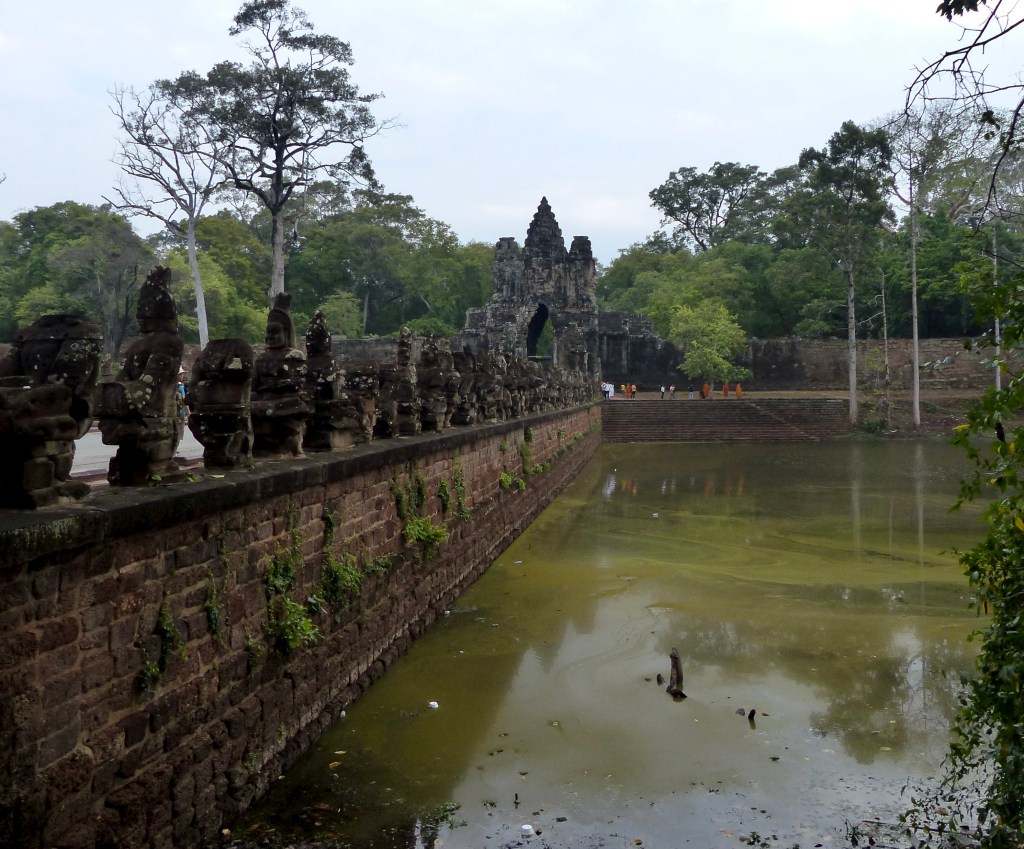
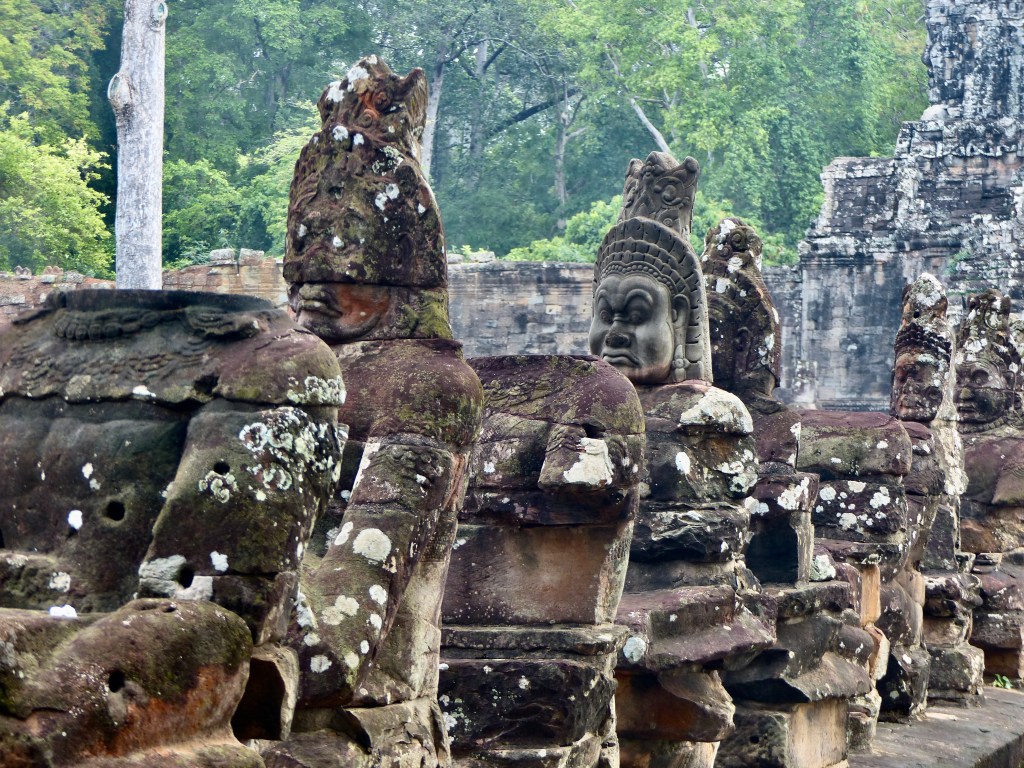
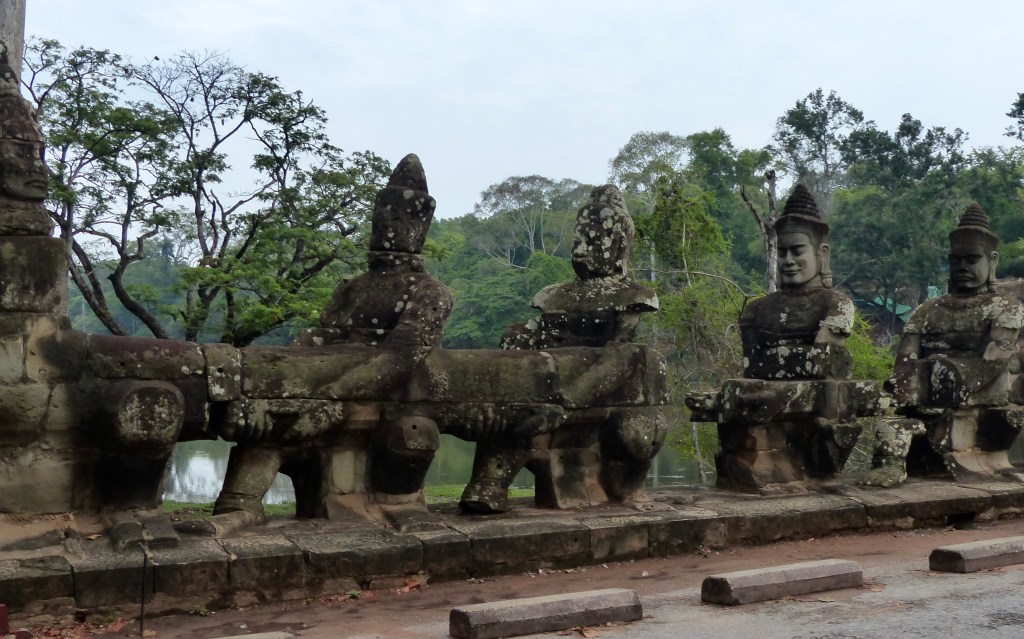
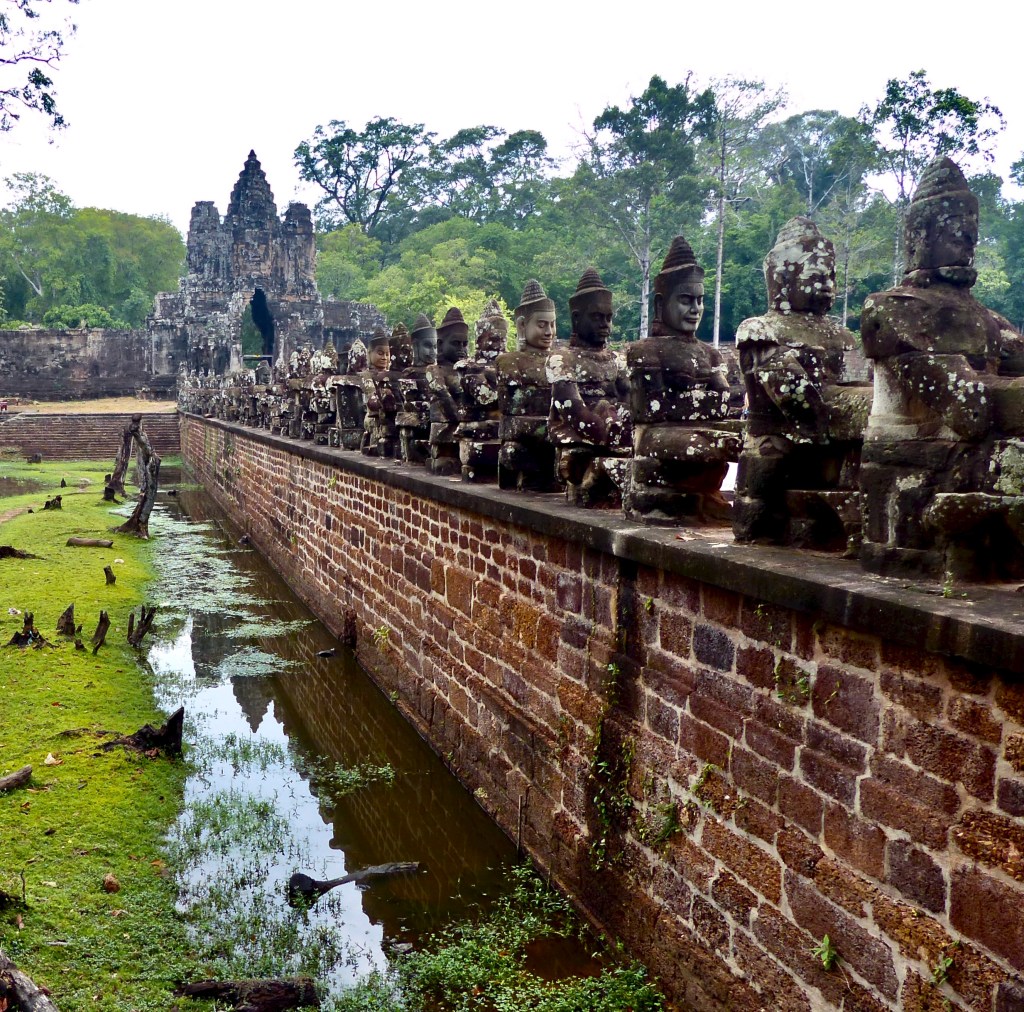
At it’s heart is Bayon temple, built as a Buddhist shrine and famous for its 50 giant towers.
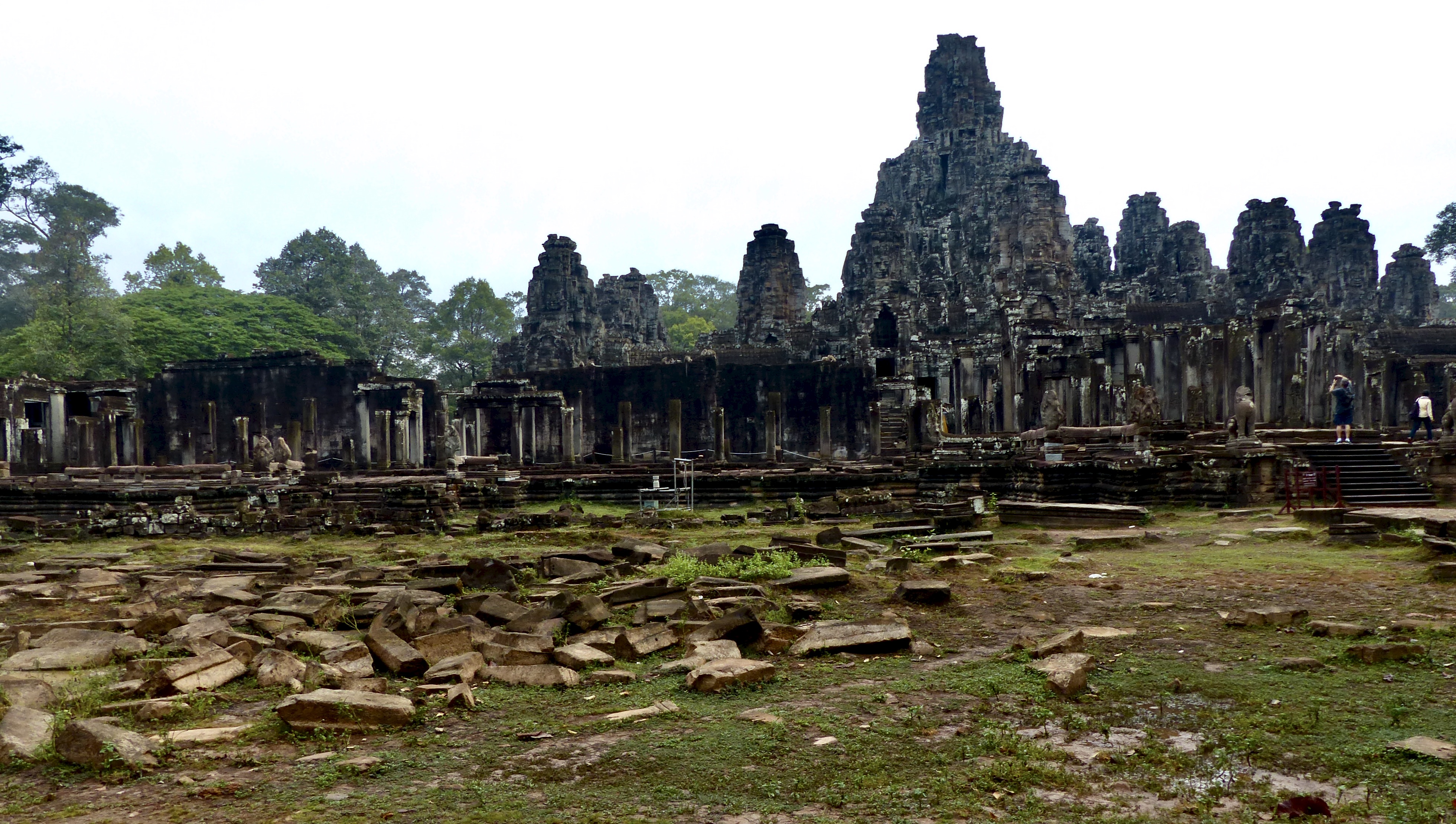
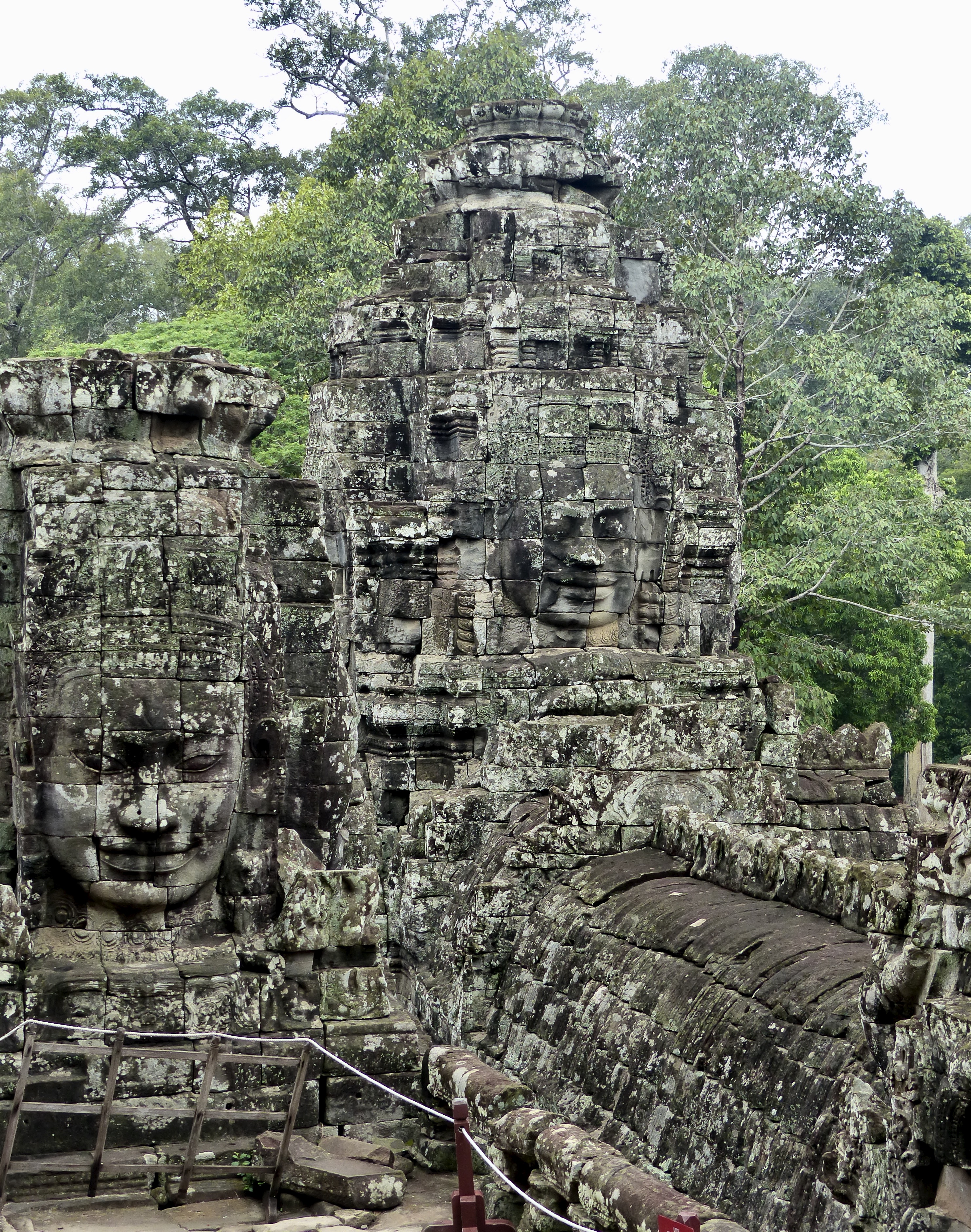
Within Bayon temple there are over 200 nearly identical faces, each 4 meters high, with closed eyes and a gentle smile, meant perhaps to exude a sense of Nirvana. The statues all face in different directions and are thought to be EITHER made in the likeness of the bodisattva goddess of compassion OR images of Jayavarman VII, Angkor Thom and Bayon’s ruler. The two interpretations of the smiling face statues are not mutually exclusive however since Jayavarman VII considered himself a demi-god. Given the monumental civics projects erected during his rule one could argue he had an accurate opinion of himself!
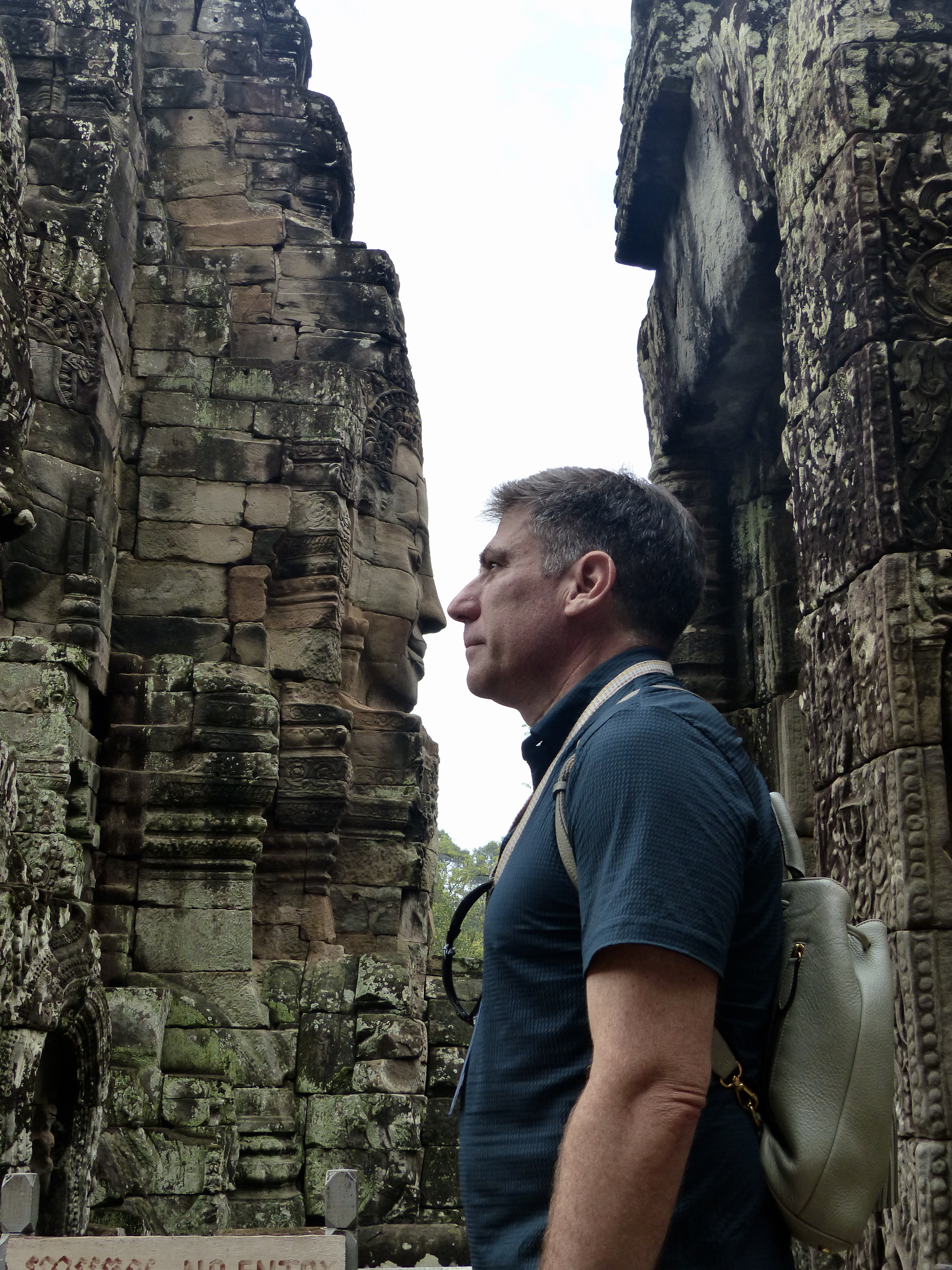
Below you’ll see Bill looking every part of the Korean he became after 4 years of living in Seoul since he is happily carrying my backpack purse, complete with furry blue pompom (not visible in the photo but a definite statement on my part!). It is common and considered polite for men to carry women’s handbags in Korea and we became very accustomed to seeing men toting very feminine, brightly colored and often bejeweled purses as they strolled alongside their female partner. Truth be told, Bill was more willing to perform this gesture because a few days earlier he caused me to injure my shoulder in a bad bike accident and was feeling a tad guilty.
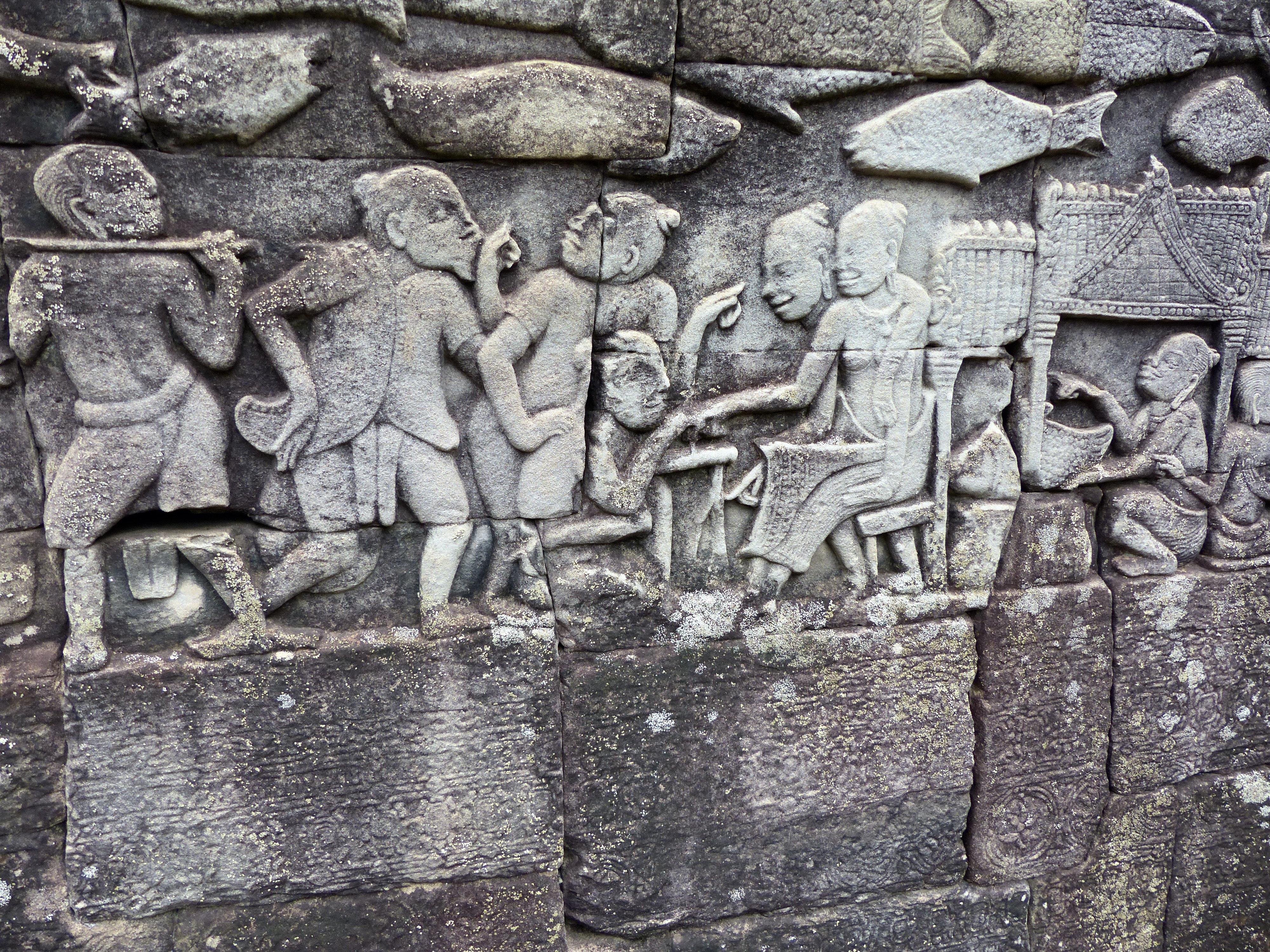
The Bayon ruins are particularly well known for the many surviving bas-reliefs which depict the daily life, trading practices, garments and jewelry worn by the peoples of this ancient civilization. In the bas-relief image below, one can almost “hear” the dispute between two men at the marketplace and perhaps the rosy vision of the future being related to the happy couple by the fortune teller.
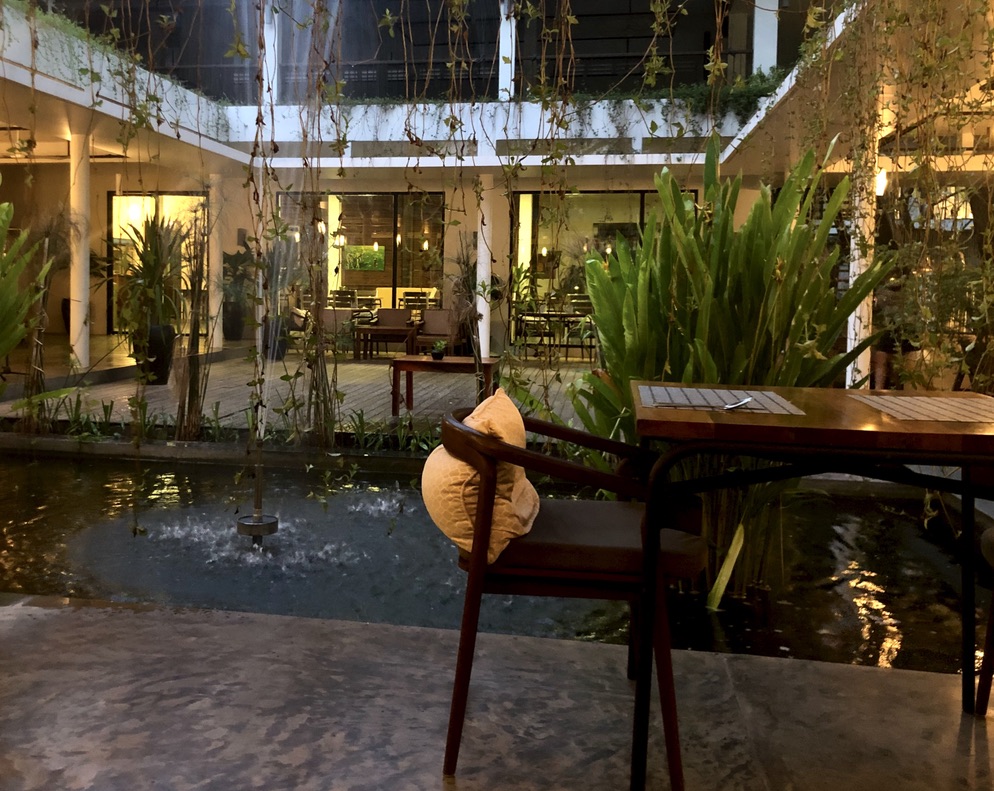
After awhile, one ruin/temple/statue/carving, no matter how monumental in scale or intricate in detail, began to look just like another and the humidity became oppressive. We were very happy to return to the French Quarter and sink into the Amansara hotel’s peaceful campus. Originally, the hotel was a guest house of King Sihanouk in the 1960’s until it was abandoned in the 1975 rebellion. Elegantly restored in 2002 in keeping with the New Khmer architectural style, Amansara (which means peace and harmony in Sanskrit) now features a sleek, low-rise building with bedroom suites, surrounding a grassy courtyard, swimming pools and common spaces for dining, reading, spa treatments that are light and airy with floor-to-ceiling windows. We both uttered audible sighs of “Ahhh” upon entering our suite.

Intrepid travellers that we are, we soon elected to leave the Amansara’s enticing grounds to venture out in the POURING rain for the a night food tour on Vespas that we’d booked ahead of time. Neang and his colleague, from Vespa Adventures (same company we used to explore Hanoi’s city streets at night with the Hansons a month earlier) arrived to help us explore Siem Riep, gamely offering ponchos and helmets and we were OFF! The heavy rain was quite a deterrant but worked in our favor since we had Neang to ourselves as opposed to the group of 39 tourists Vespa Adventures had toured the previous night.
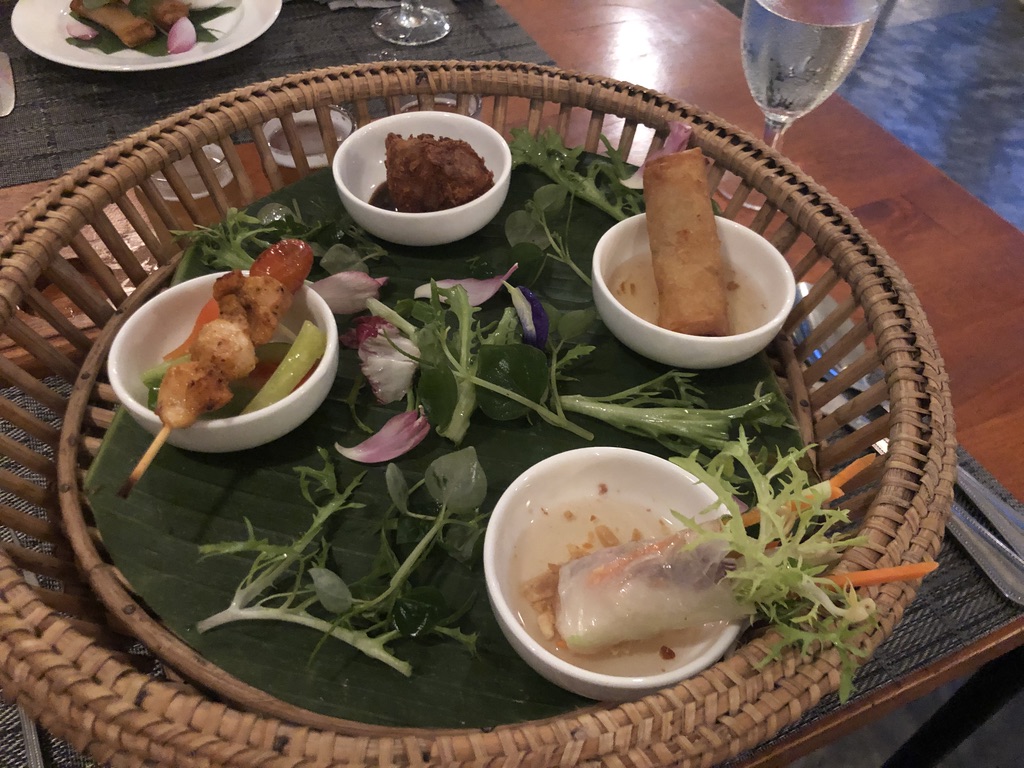
The first stop was a popular indoor/outdoor beer pub which had indoor water features to echo the downpour outside. Neang, Bill and I bonded over a flight of 4 local craft beers and we happily dove into some traditional appetizers. The pulled-pork ball was hands-down our favorite.

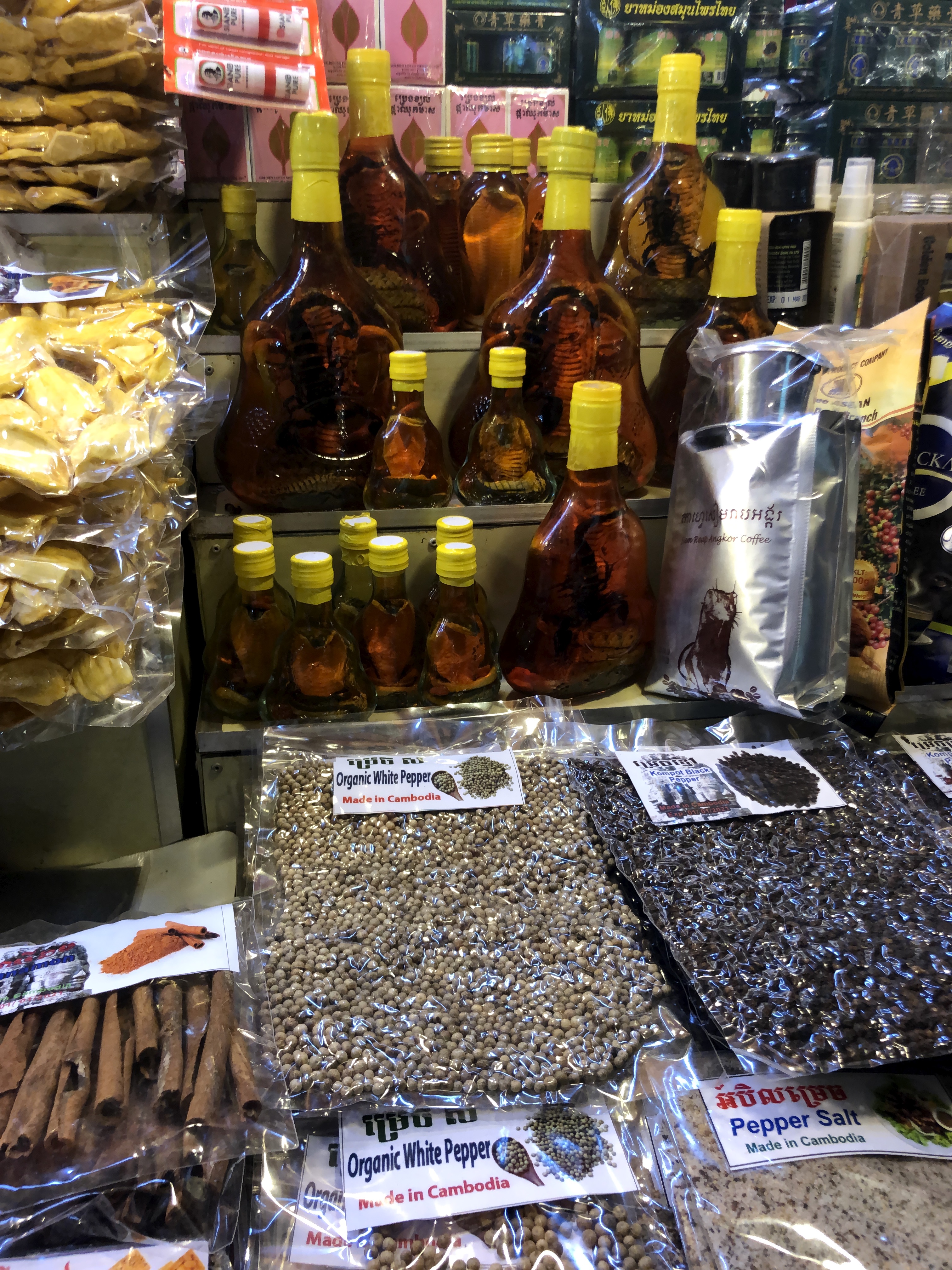
We then scootered off to wander around a night market frequented often by locals and tourists alike. These days, Neang said that most Cambodian families eat dinner out and often shop at night markets like the one we visited. We walked by aisles and aisles of clothing, food and other everyday items like the spices and snake-infused (!?!) liquor shown below.
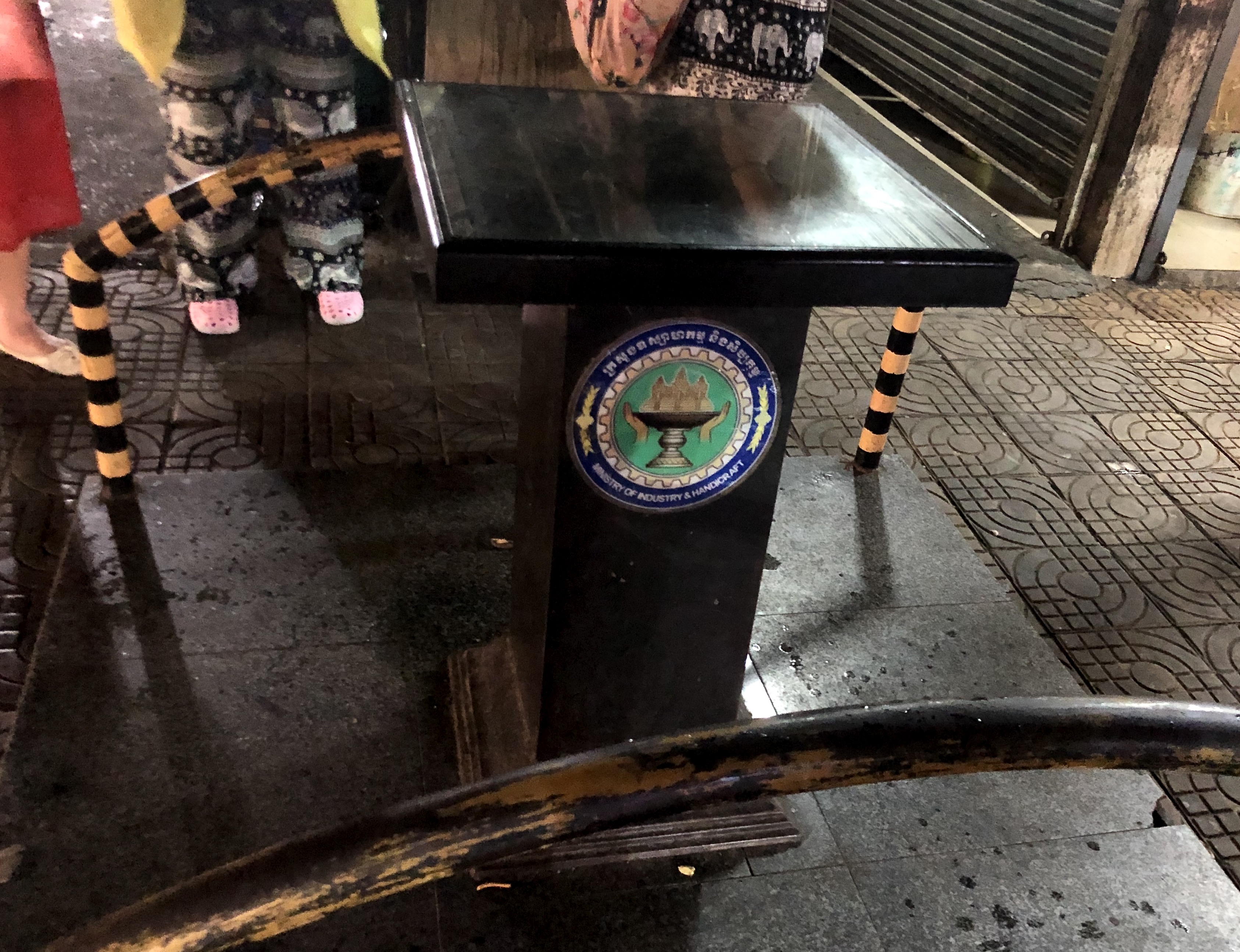
Located directly across the street from another, separate market where produce/meat is sold each day. Here, not so long ago, vendors would attempt to up-charge tourists but the Cambodian government stepped in and stopped this practice. Now, there is a public scale available to anyone who wishes to verify weight and ensure legitimate prices are being charged.
Action shots were difficult to take on this rainy evening and the “photographer” was worried about damaging her camera, but here’s one of Bill and Neang.

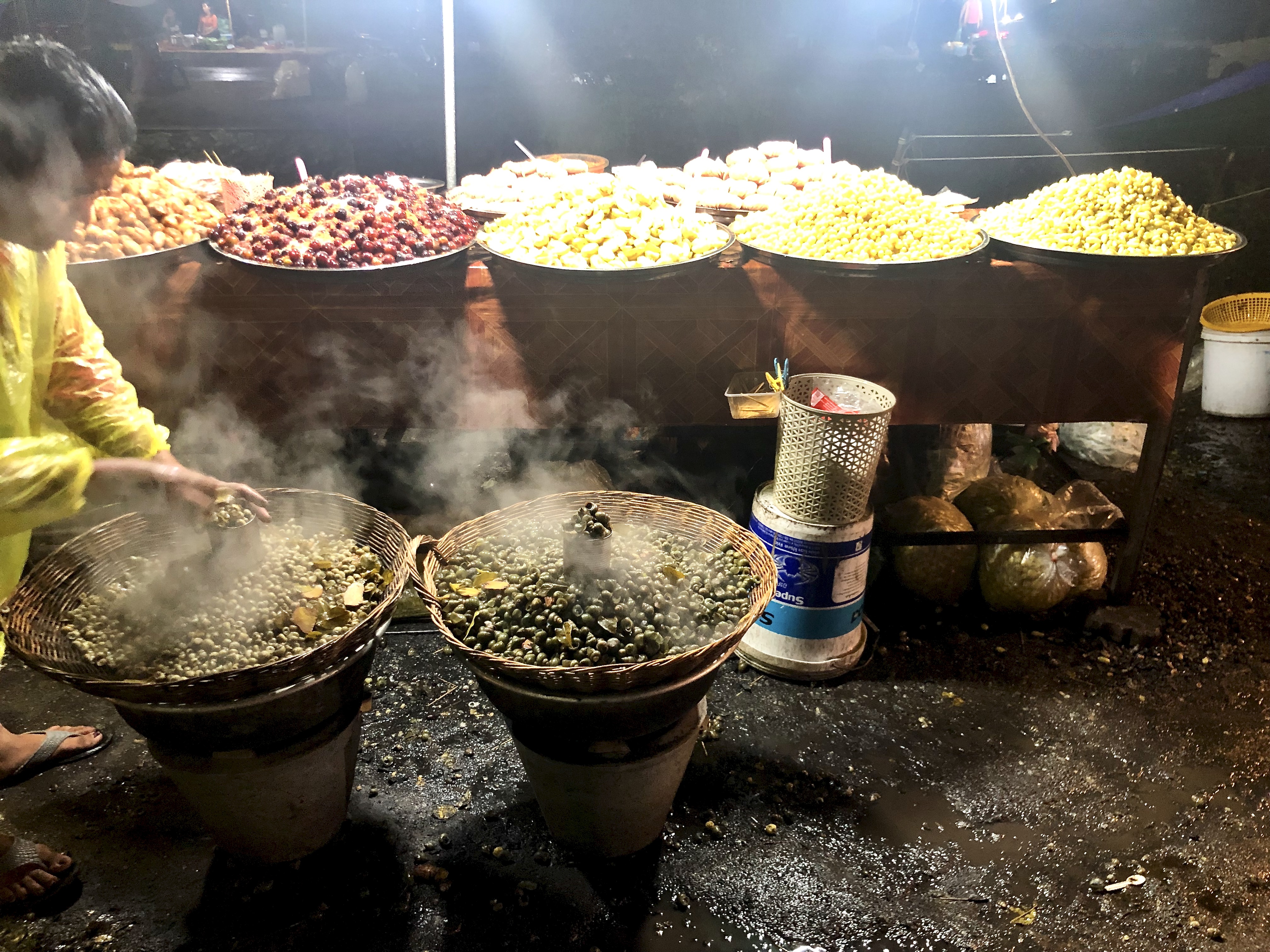
Without a doubt, the most interesting stop on our food tour was a group of stalls along a main road, just outside of the city center. Neang explained that this area opens and closes each day from 6-10pm and is therefore a considerable amount of work for the vendors. The effort is worth it however since vendors are exempt from large government fees that night market vendors in the city center must pay. There were many stalls but fewer than usual Neang admitted because of the rain.
We first tried various “green” fruits which, not unsurprisingly, are more sour than the riper version to which we are accustomed. These green fruits are often pickled and/or spiced with red chili so they tasted a bit like Korean kimchi. Kimchi fan that he is, Bill happily indulged in this stand’s offerings.
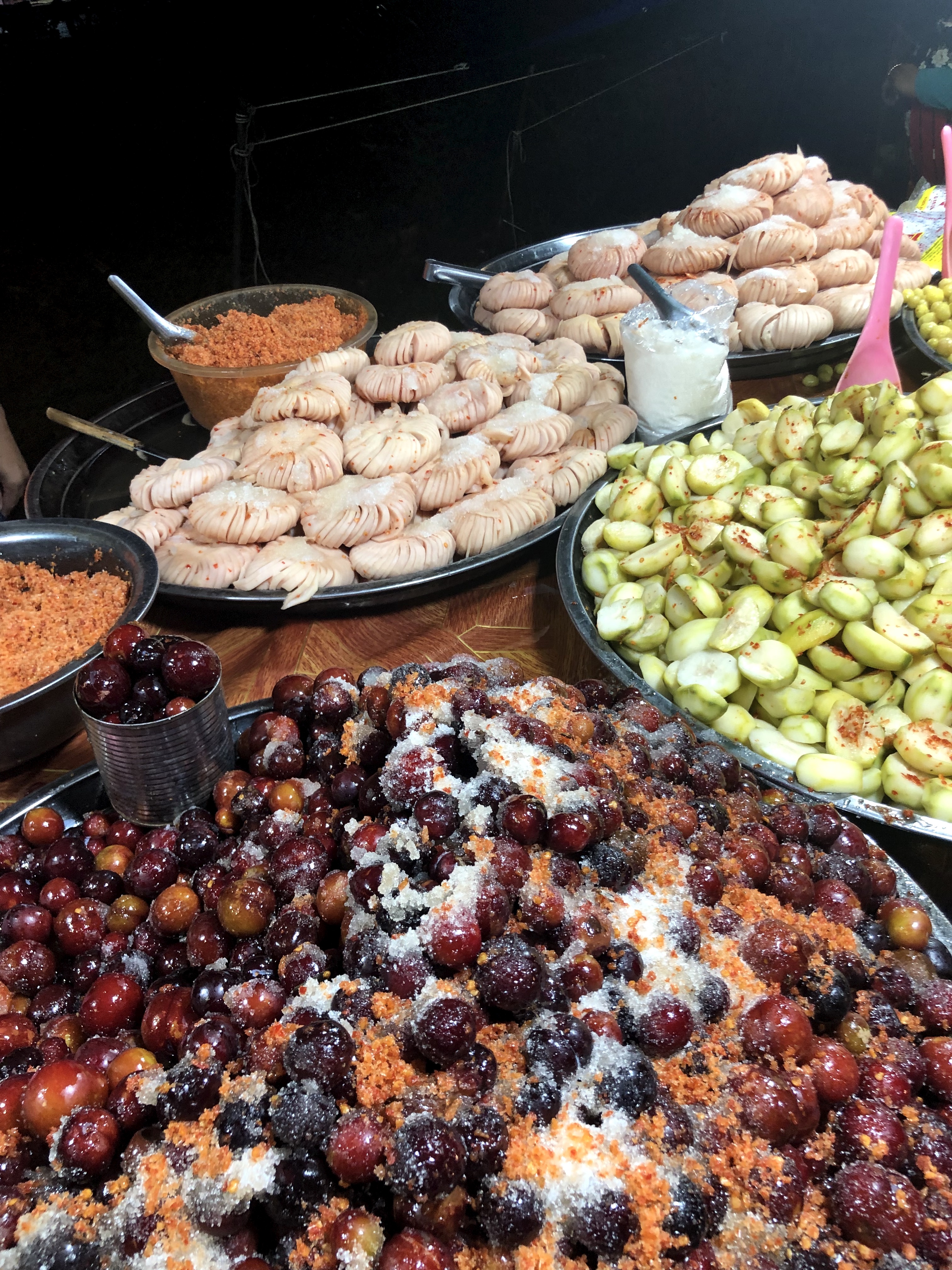
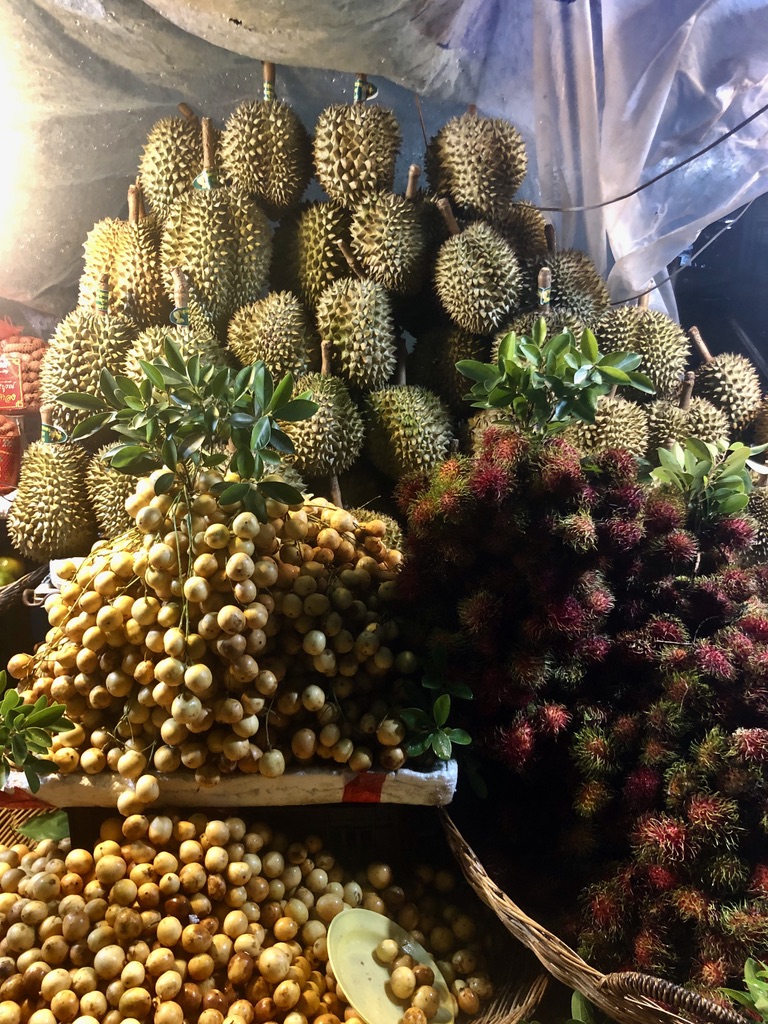
Both of us also sampled the “king” of fruits (Durian fruit) with its spiky exterior and smelly rind. The durian flesh is delicious but the rind is so stinky that transport of this fruit is actually banned in Hong Kong, Japan and Thailand. Singapore allows transport, but the durian fruit owner must announce it’s presence to any taxidriver.
At the next stall, some of “us” bowed out of the food tour since the menu options included a wide selection of roasted insects (crickets, silk worms, grasshoppers), small fried frogs and black, slimy water beetles which even this intrepid eater wouldn’t sample!
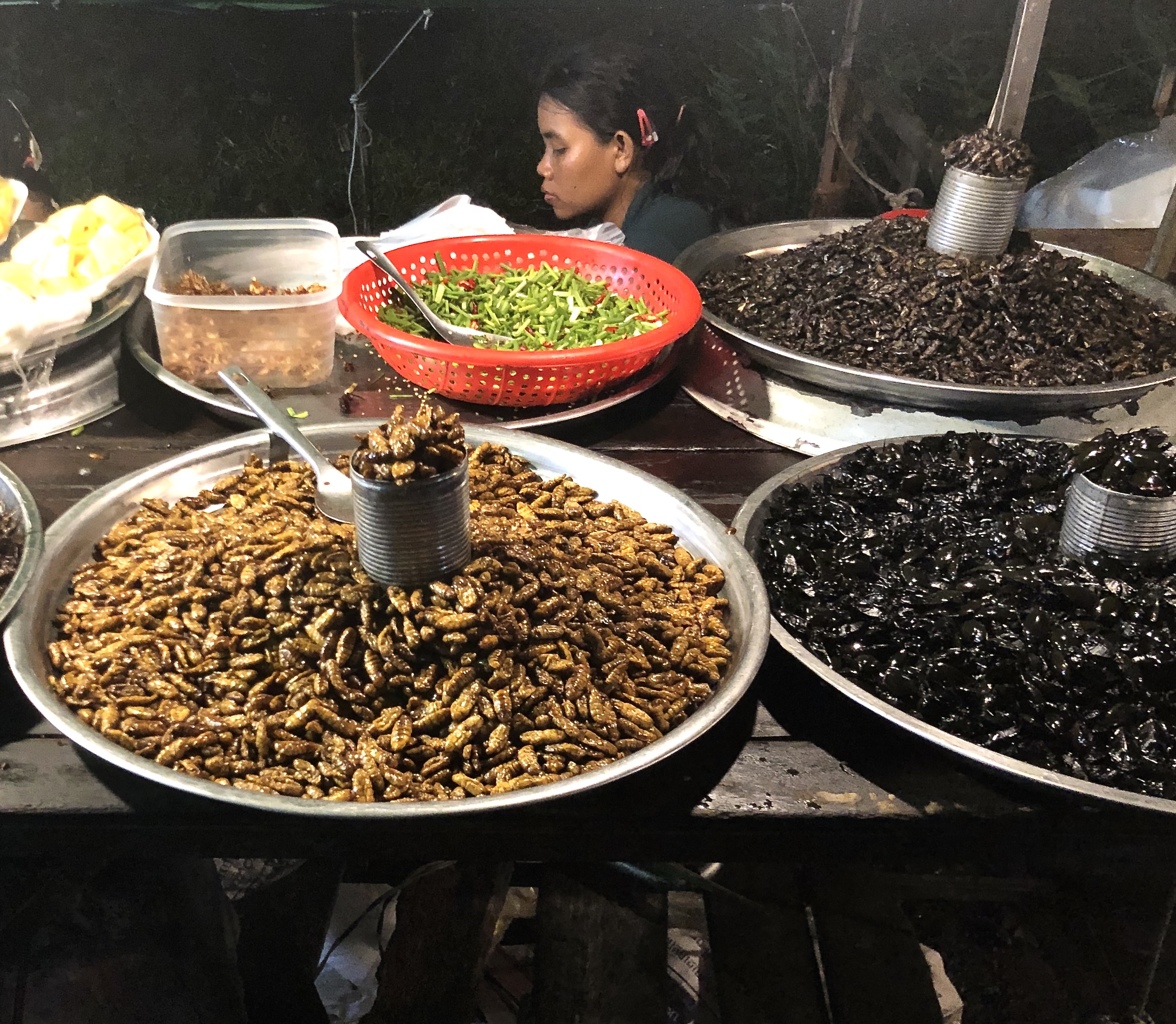
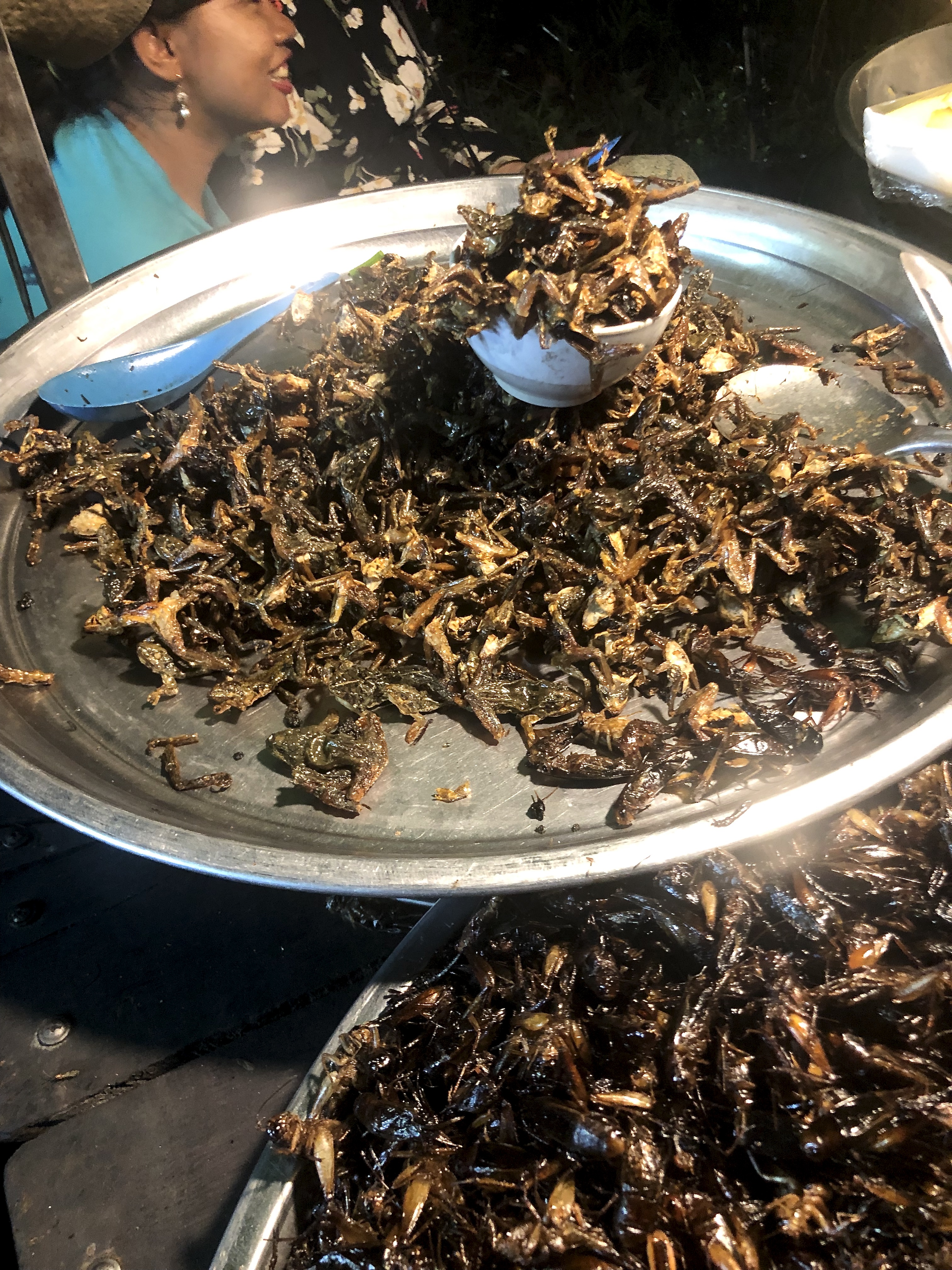
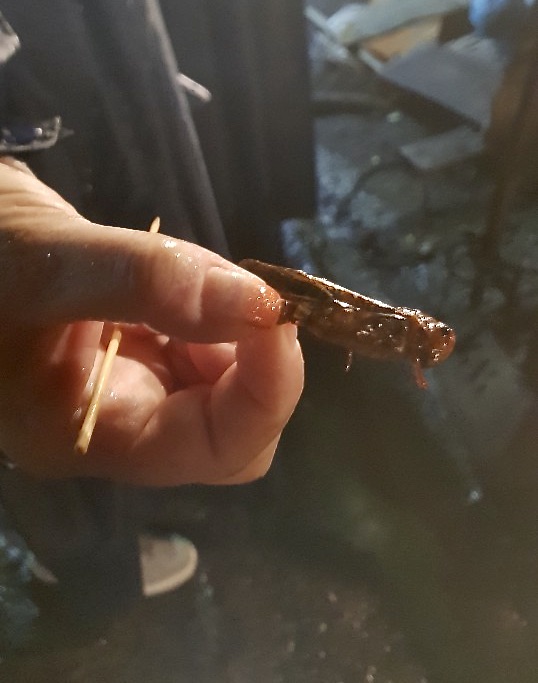
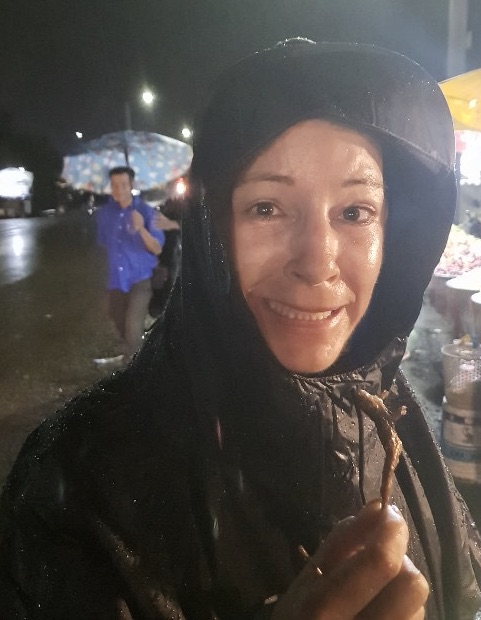
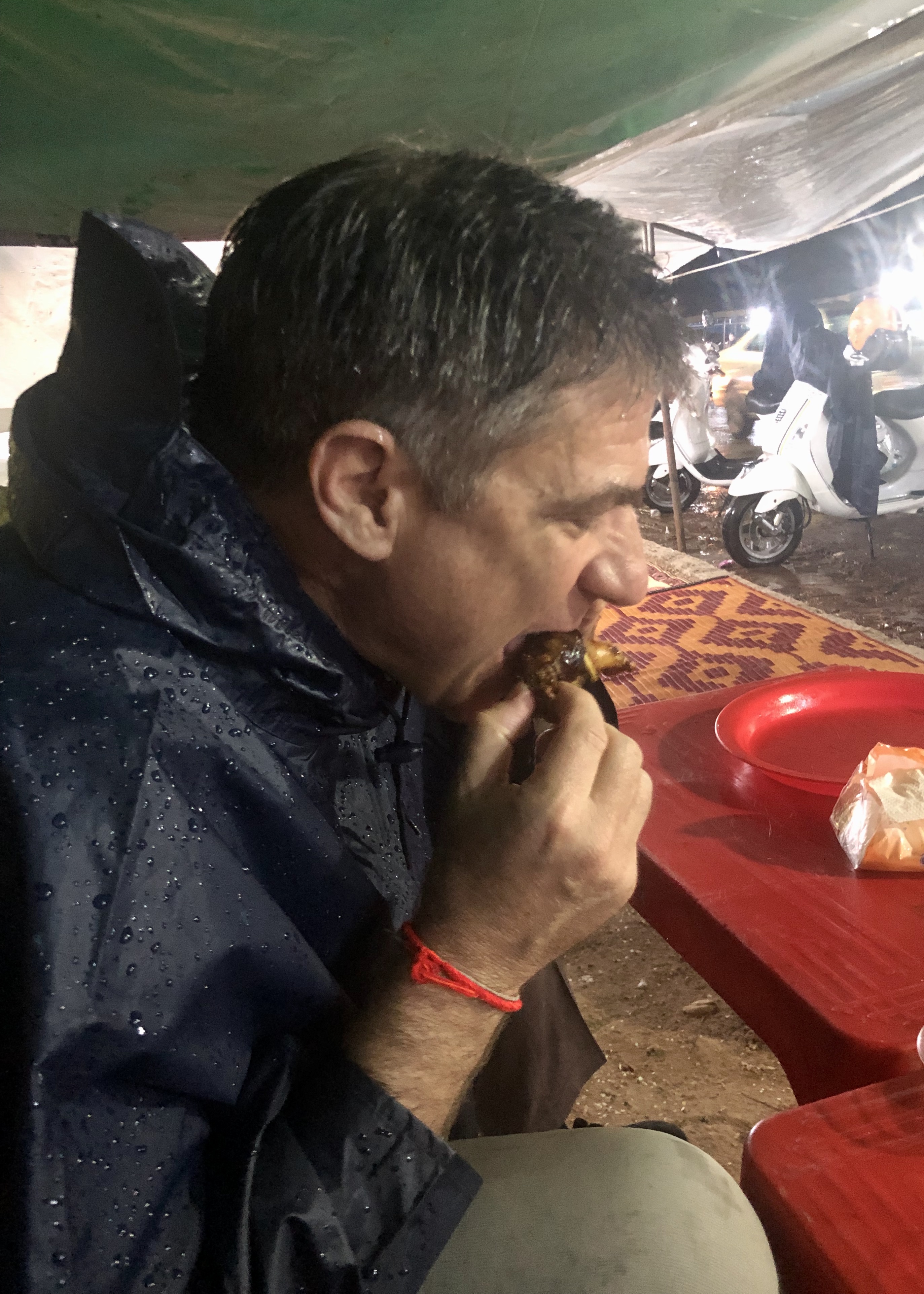
I found most of the items to be crunchy without much taste. The silk worms were soft and these are generally eaten with red chili and scallions (?) as a snack like potato chips. You can tell by the photo below just how much nerve it took for me to try to fried frog!
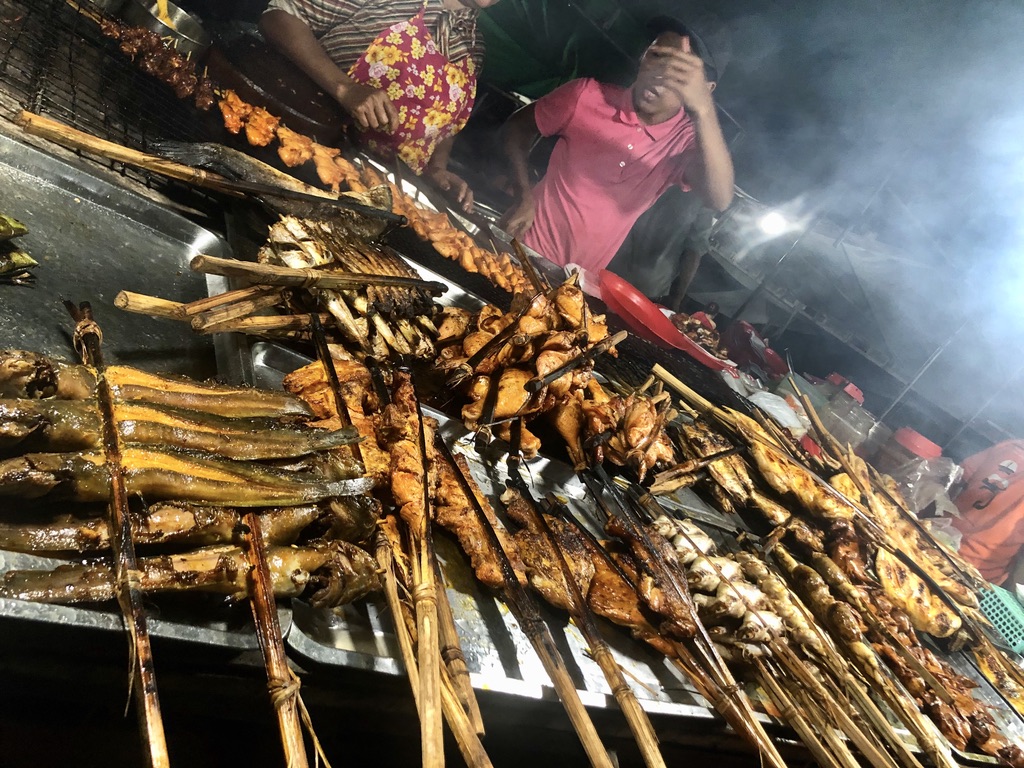
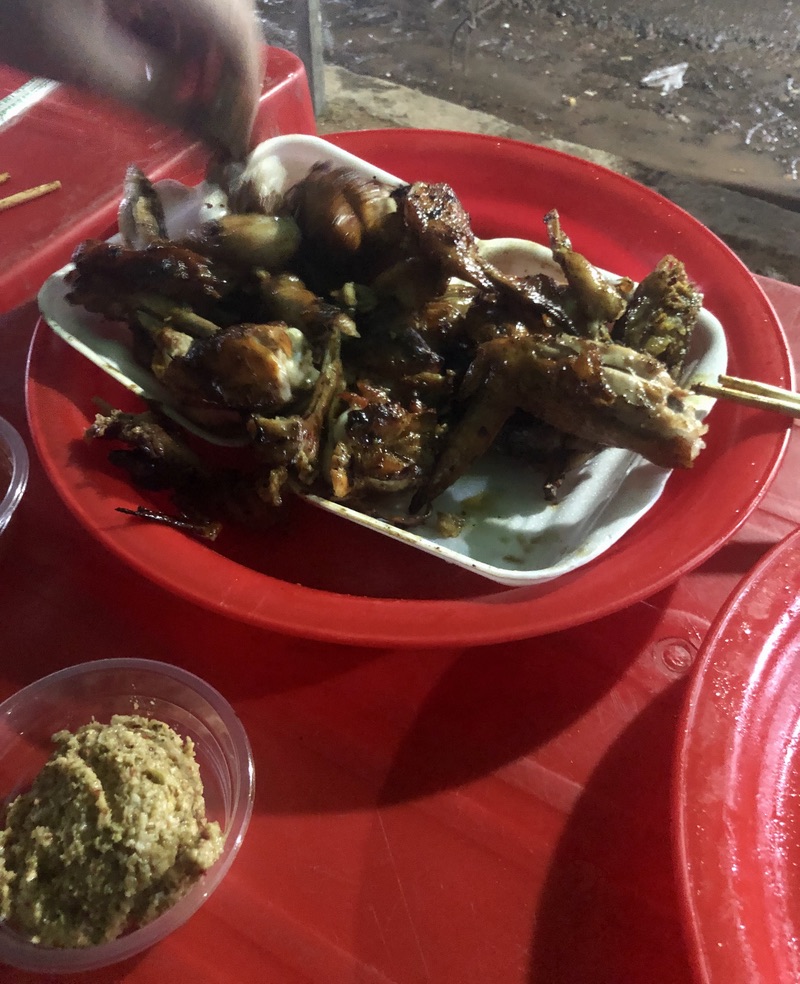
Hunger, desperation and perhaps embarassment got the better of our “selectarian” at the next stall which featured various grilled items including chicken, squab, fish and larger frogs stuffed with pork, lemongrass, kafir lime leaves and tamarind. Bill and I both liked the stuffed frogs the most…go figure! The grilled items were served with pickled tamarind as the condiment and we gobbled it all up.
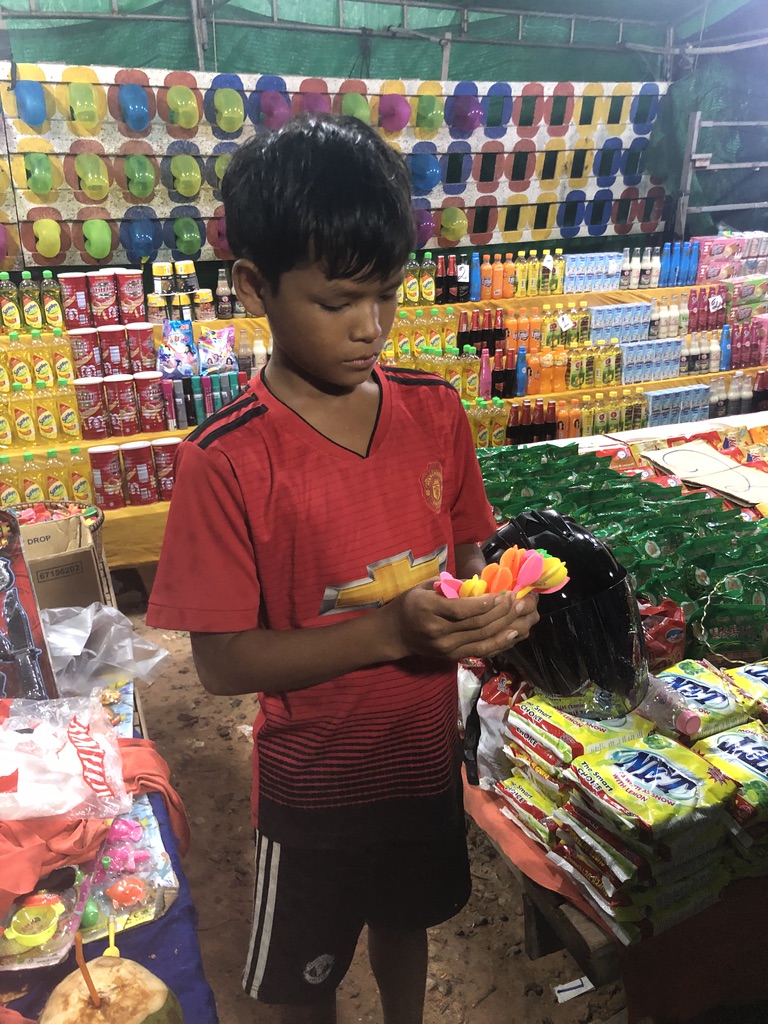
Adjacent to the food stalls were games like ones at travelling carnivals/fairs in the US. Bill and Neang took turns throwing darts. My injured shoulder prevented me from participating but I’m pretty sure I would have done better than Bill who only got 2/15?! But then again, ice hockey was his sport, not darts. He “won” a battery-operated toy creature which he gave to Neang for his daughter.
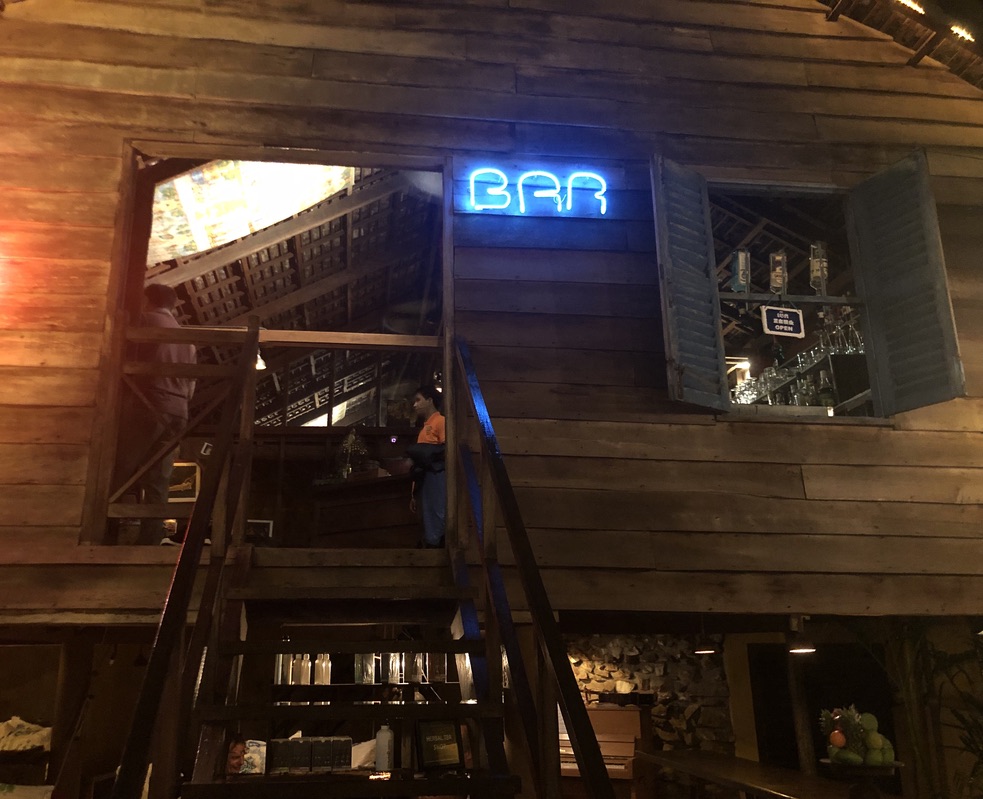
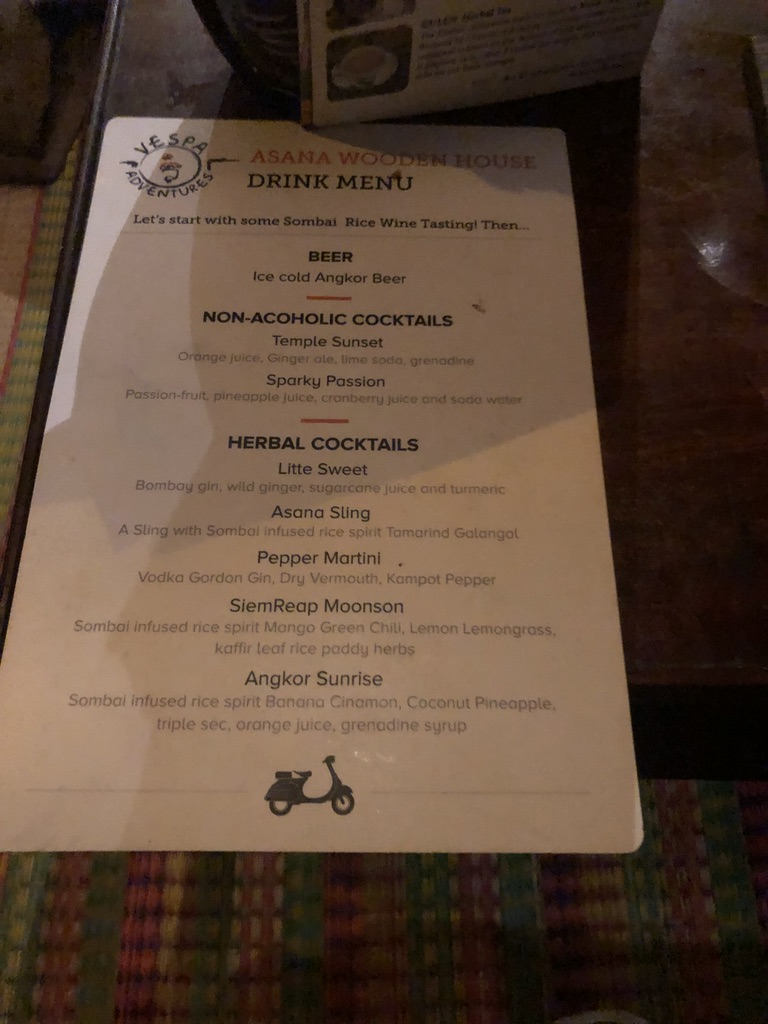
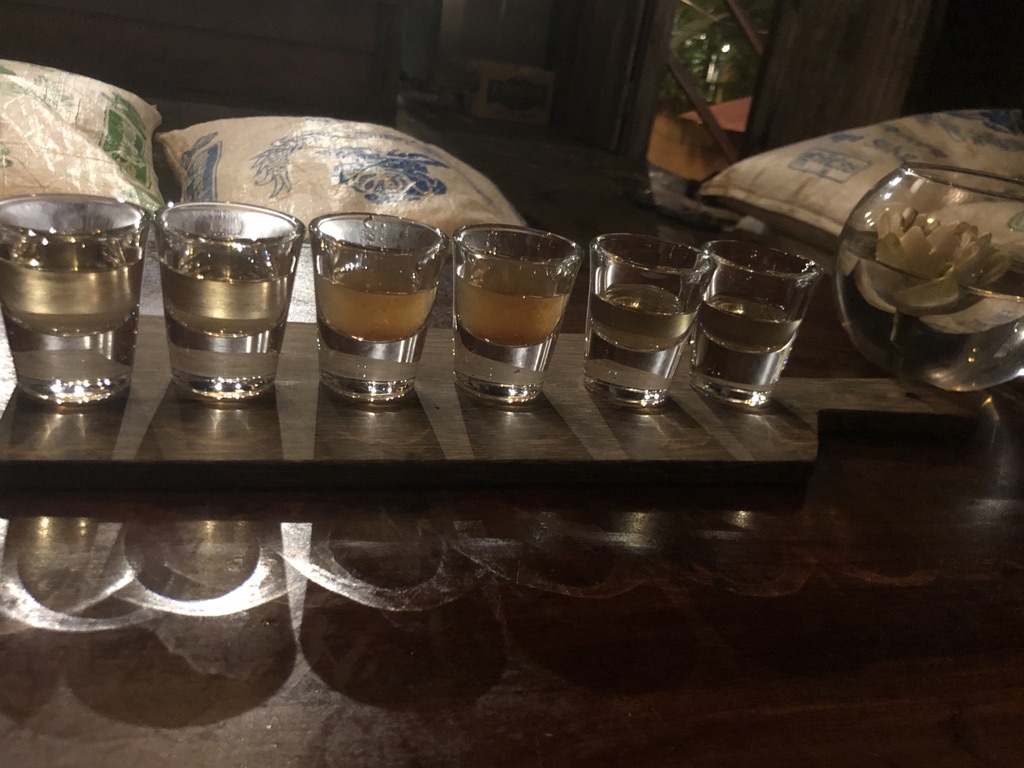
The final stop on this food tour was at the Old Wooden House bar where we sampled a flight of flavored rice wines. Though flavored rice wine isn’t the drink of choice for either of us, nor what we craved at the late hour, we did find the drinks delicious and the descriptions intriguing. We sat on giant sacks of rice and sipped the last moments of our evening out in Siem Reap away!
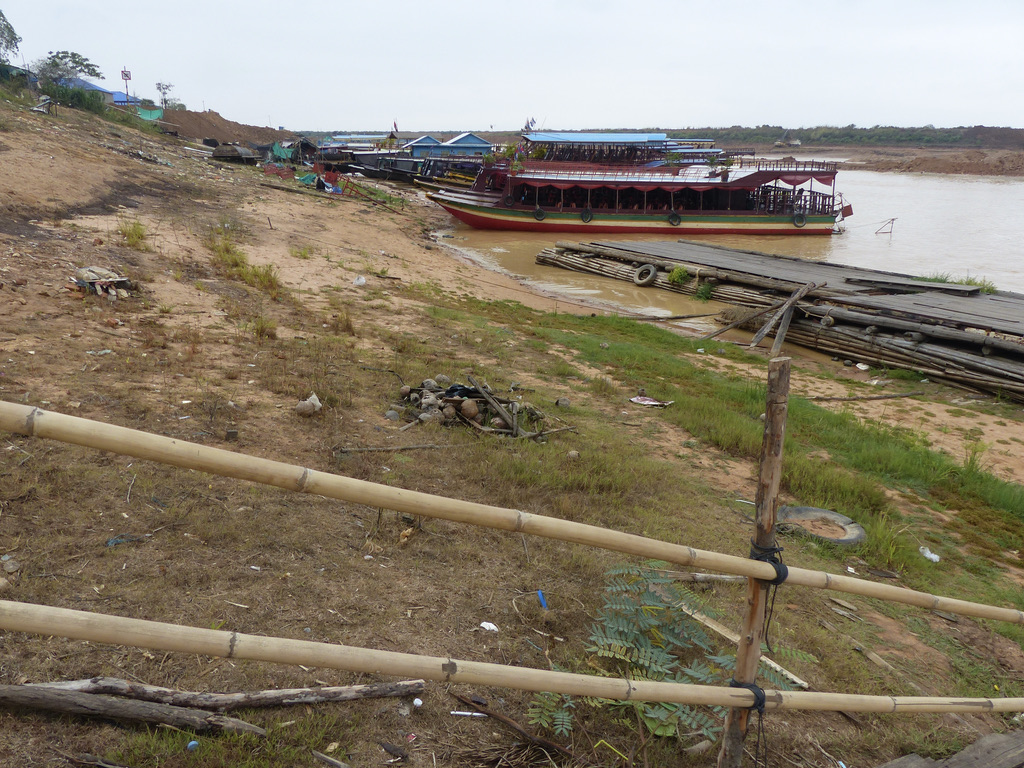
We arranged to visit Tonlé Sap Lake (“Great Lake”) the following day for a more passive and relaxing view of daily life in Cambodia. Fed by the Mekong and other rivers, Tonlé Sap Lake is the largest freshwater lake in all of S.E. Asia and home to the world’s most productive inland fishery. During the 6-month long rainy season, Tonle Sap Lake swells to 5x its size during the wet season and the surrounding forests/riverbanks are completed inundated. Annually, Tonlé Sap Lake’s fisheries catch more fish than those caught in all of N. America’s rivers and lakes combined. Hence, Tonlé Sap Lake has always been a vibrant source of food and livelihood for many Cambodians. In recent years, however, much of the forests adjacent to the lake have been burned/cleared for farming. The deforestation, combined with less rainfall/shorter wet seasons associated with global warming, are having a negative impact on Tonlé Sap Lake. The lake is shrinking dramatically, the rich biosphere that fed the fish is depleted such that today, the fisheries are much less productive. We visited at the end of the rainy season and the dry banks of the river, with beached fishing boats, were readily apparent.
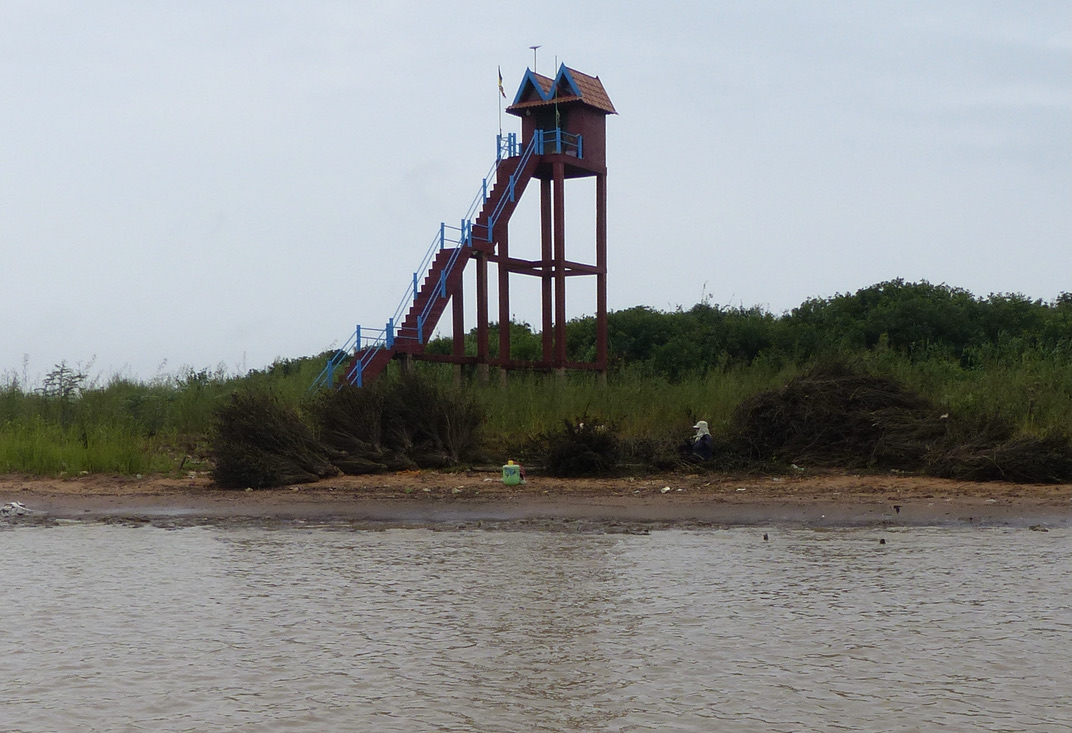
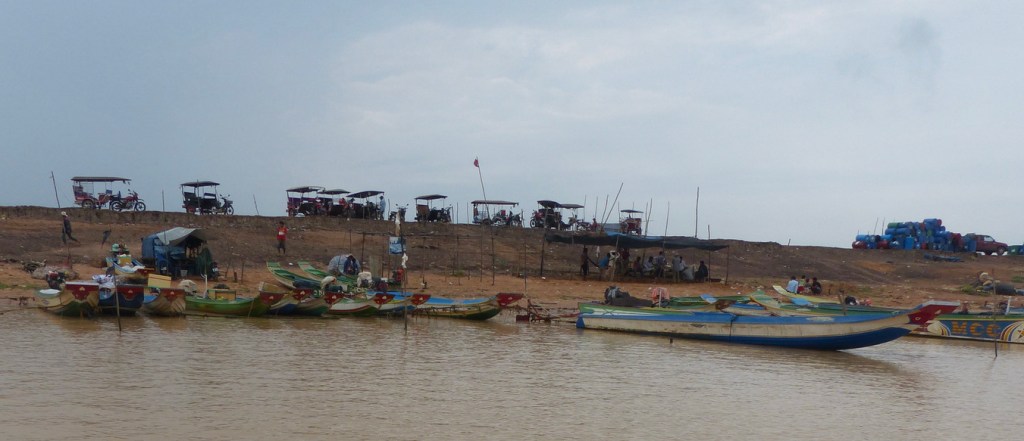
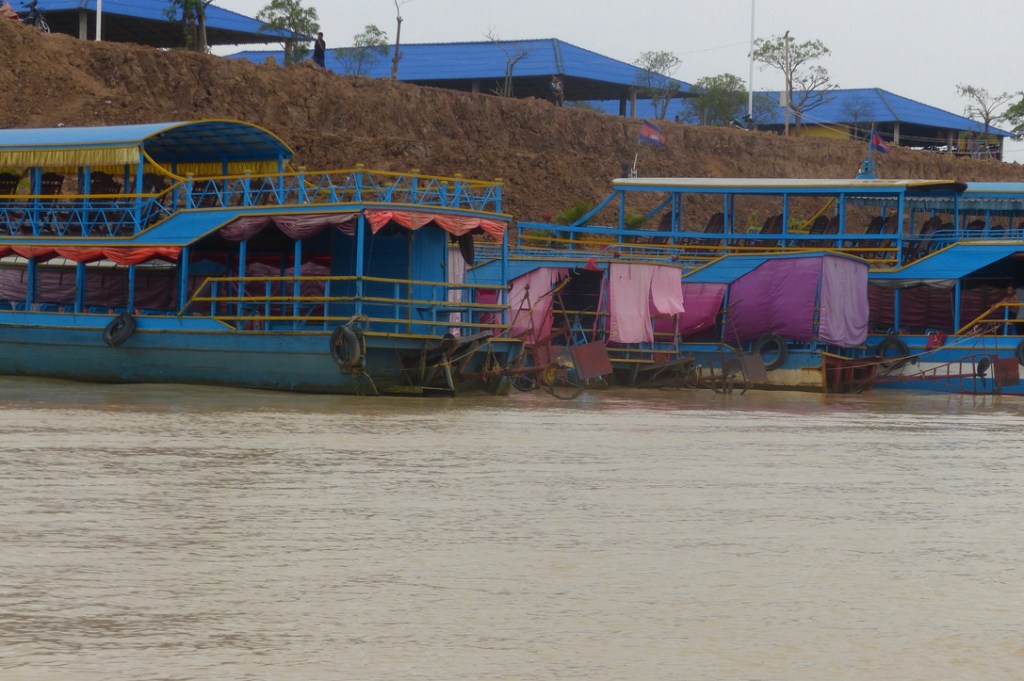
Apparently, at the height of the season, the river banks are teeming with trade and the waterway is very crowded with boats and ferries but we seemed to have the place to ourselves and were the only passengers on our vessel. We motored along peacefully for nearly an hour and then our destination was revealed and it was honestly, quite underwhelming. We docked at a “restaurant” amidst a floating village that is clearly reliant on tourist trade.

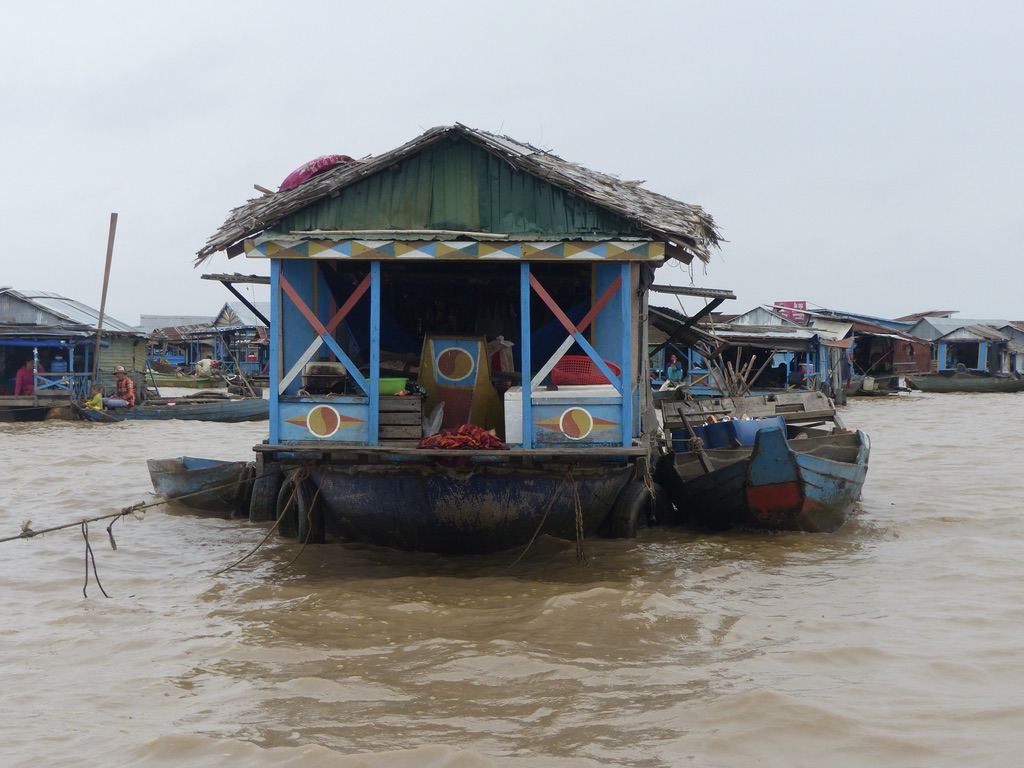
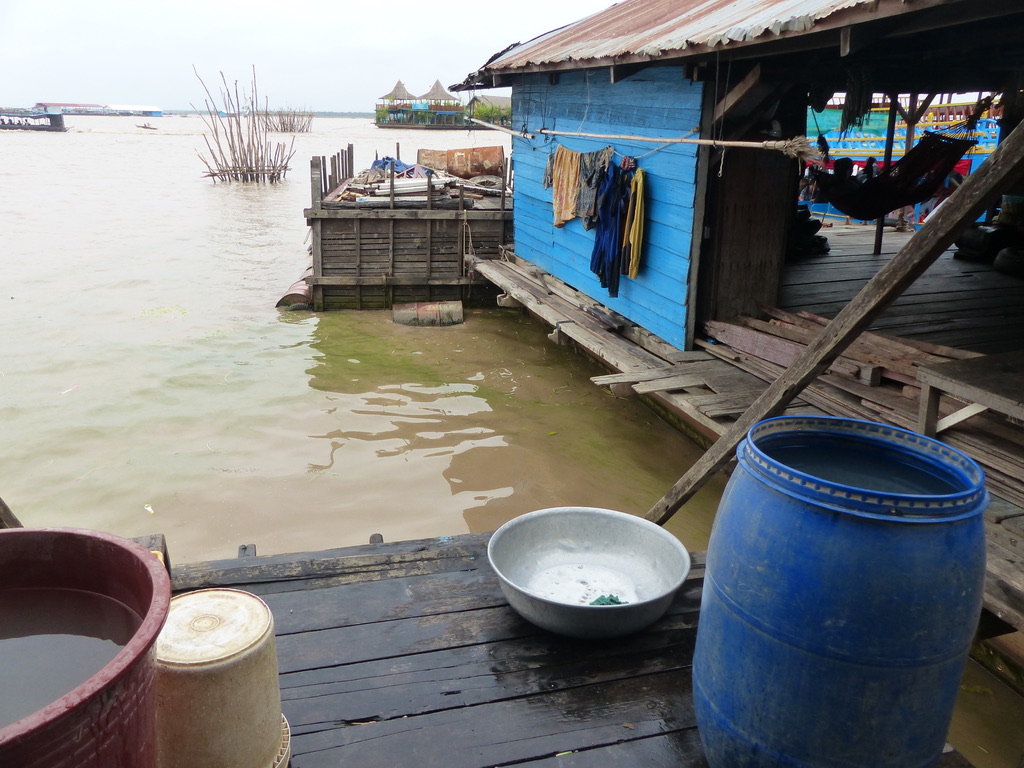
The restaurant was the building with twin thatched roofs in the distance, but we found the views of daily life in this small village far more intriguing, if not humbling.

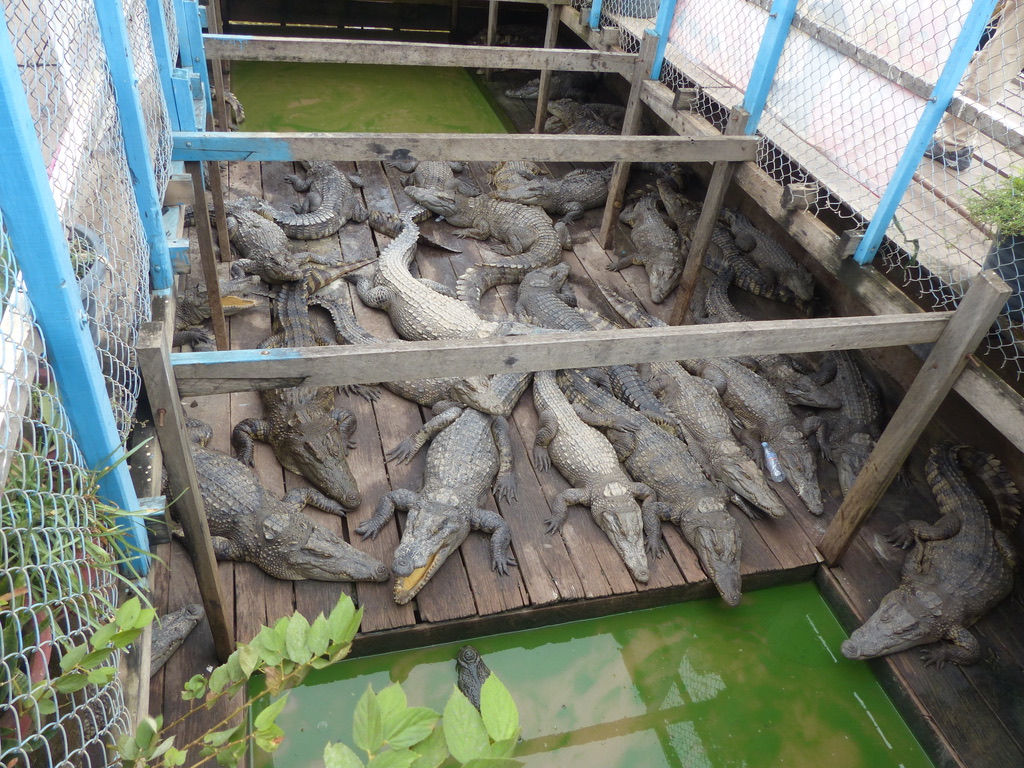
We chose not to indulge in the menu of duck eggs and ??? that was on offer. And instead, We wandered around the empty venue and “admired” the cache of crocodiles that are sold to make handbags, shoes, etc. Yikes!
Thus ends the last “episode” of our amazing travels throughout Asia while we lived in Seoul. We still haven’t made it to several countries (Mongolia, Bhutan, N. Korea to name a few) and barely scratched the surface of those that we did get to experience. Once this pandemic is firmly behind us and time allows, Bill and I are very eager to visit this part of the world again.
 seoulfulsojourn.net