After just a few years together (36 yrs. actually since we started dating in 1982!), you’d think I’d know exactly what to give Bill, my best friend in the whole wide world, for Christmas and his annoyingly-soon-thereafter January 4th birthday, but NO. Every year, I wrack my brain trying to find something new and original. This year, as I chatted with Sangeeta Sadarangani, an expat friend at our monthly Seongbukdong potluck lunch and she was telling me about her travel agency business, gently asking if I would consider using hers next time we planned a trip, I felt a light bulb go off! Bill loves to travel more than anything else; a surprise trip would be a perfect gift. Since it was already mid-December and I was super busy and headed home for the holidays, I enlisted Sangeeta and the services of Crossing- A Travel Company to plan it all for me. What a release it was at the time…and then what a fabulous trip we enjoyed to Sri Lanka over Seollal, the Korean Lunar New Year holiday.
Neither of us knew anything about Sri Lanka and I’ll even admit here to thinking it was still somehow part of India (audible gasps can be heard I know!). Several friends have recommended it as as a destination, but for me this was a “what’s somewhat close to Seoul, warm in February and new territory for us to explore while we are still in Asia STAB at the map” decision. As it turns out,it was a good one! We flew through Singapore and then were efficiently escorted through the Colombo International customs and airport by the Crossing Travel team, scooped up by our driver/guide Ganesh and delivered to the Taj Samudra Hotel where we plopped into bed.
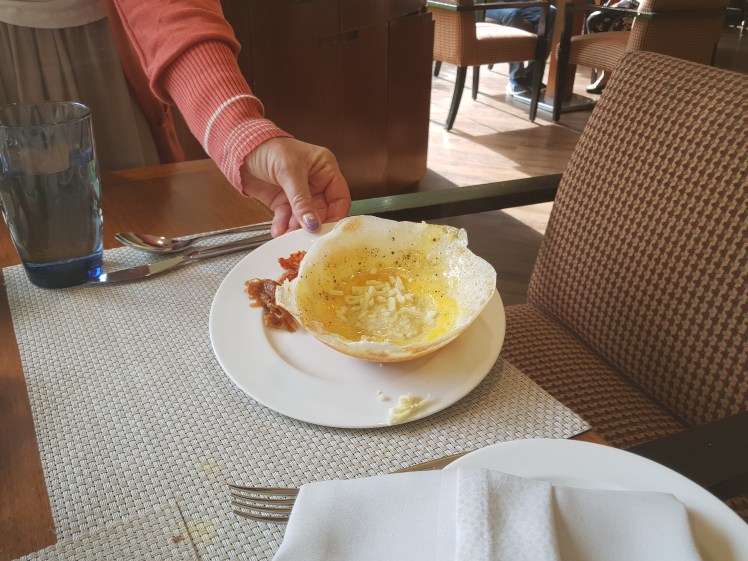
We didn’t linger in the capital city and asked Ganesh to meet us early to begin our drive north up the coast and then due east to Dambulla located in the middle of Sri Lanka. I did however take my friend Chris Semler’s advice and sampled a Sri Lankan “hopper” at my very first breakfast opportunity. The coconut rice crepe filled with egg, cheese and sweet onion was scrumptious…and it was one of many I enjoyed during our trip!
 The Crossing Travel team supplied us with a nice gift basket which we slowly worked our way through over the next week, enjoying the tasty snacks and Lion lagers, donning the sarongs and socks when visiting temples, and fortunately never once using the bug spray! The spicy potato kokis and sweet coconut squares were our favorites.
We didn’t mind the long car ride to Dambulla and happily soaked in the lush green scenery, local sights, sounds and smells as Ganesh drove us along and gently provided some key Sri Lankan history pointers. We stopped for lunch at one of many large buffet restaurants that cater to tourists, a large percentage of whom were Chinese and, like us, taking advantage of the Lunar New Year holiday to travel. Although we invited him to join us each meal, Ganesh always chose to eat alone, giving us a chance to completely unwind…and for me to stop asking questions…)) The buffet lunch had a wide array of familiar and unfamiliar items, but all were labeled, attractively presented and tasty. We didn’t have any tummy trouble at all in Sri Lanka and found the cuisine absolutely delicious, full of fresh vegetables, seafood, fruit and not nearly as heavy as we sometimes find Indian cuisine One could easily tailor the spiciness/heat of each meal to one’s liking too. Throughout our visit, we were also treated to sound bites of Beethoven’s “Für Elise” since this is the jingle played by bread trucks that deliver freshly baked bread to shops/homes everyday. It reminded us of how excited we used to get when we heard the ice cream truck’s jingle in the neighborhood.
Our first stop was at Elephant Rock (or “Athagala” in Singalese, the national language of Sri Lanka) which is located in Kurunegala. Once a great medieval city during the 13-14th centuries, this city today is still thriving and in 2003 completed the construction of a 66 ft. giant snow-white Buddha atop of Elephant Rock. Today, this white Buddha benignly sits 1,000 feet above this important medieval city. It can be seen for miles around and offers beautiful views for those willing to walk up the stairs…or drive up the short road like we did. To us, watching Ganesh maneuver the car and negotiate with the locals to avoid “monkey damage” was quite humorous, until we realized that the monkeys far outnumbered us and were actually quite aggressive. Bill got a little too close to one and gave quite a yelp when the monkey hissed at him. They certainly made themselves right at home with no regard for personal property as you can see below: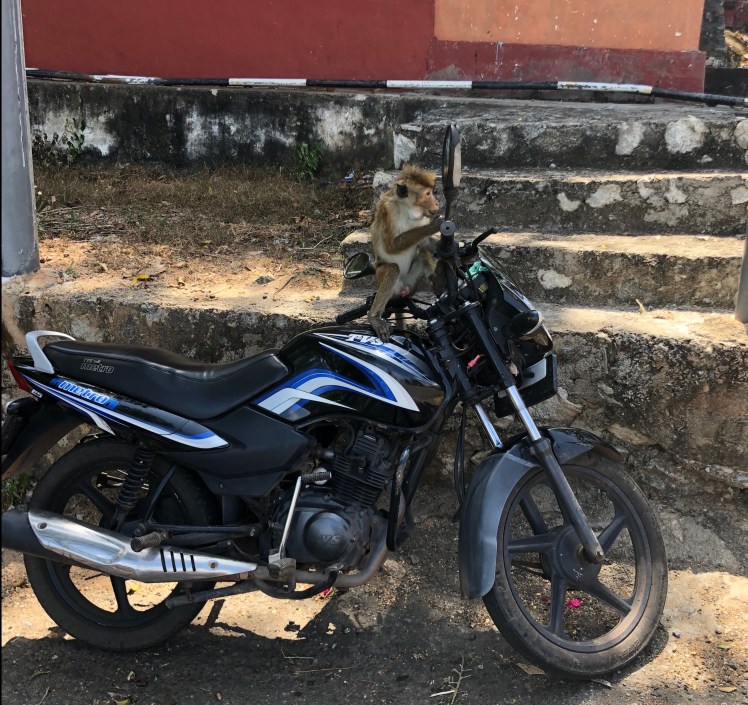
We began one of our many Buddhism “lessons” here with Ganesh, who is actually Hindu but studied Buddhism at university, married to a Singalese Buddhist, and a knowledgeable, patient guide. It felt great to take in the warm sun, stretch our legs and look out over the surrounding countryside while standing below this majestic Buddha.
Ethnically, Sri Lanka is 74% Singalese, 16% Tamil since the British relied on Tamils from southern India for labor at their tea plantations, 9% Muslim and 1% other. Most Sri Lankans are Buddhists (69%), then Hindu (14%) and Islamists (9%). The remaining population is Christian mostly due to the Portuguese, Dutch and British occupation/trade activity during the 16-18ths centuries.
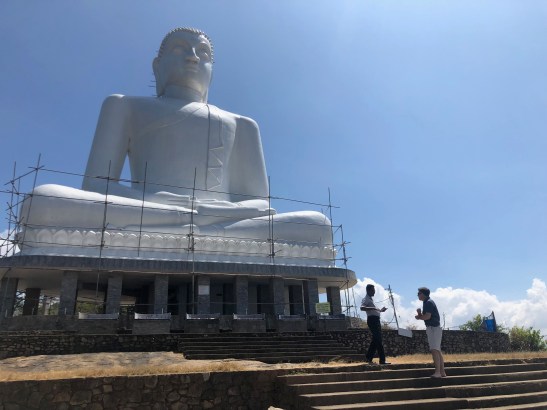
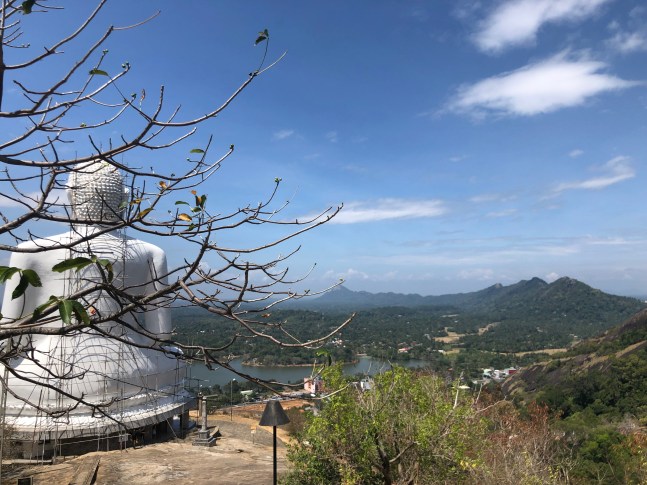
Ever noticeable for our white skin in Sri Lanka, we were asked by another group of local visitors, to pose for a picture and learned that one should never to turn one’s back fully on Buddha despite the desire to do so when having one’s picture taken in front of his statues. Note Ganesh’s sideways stance above.
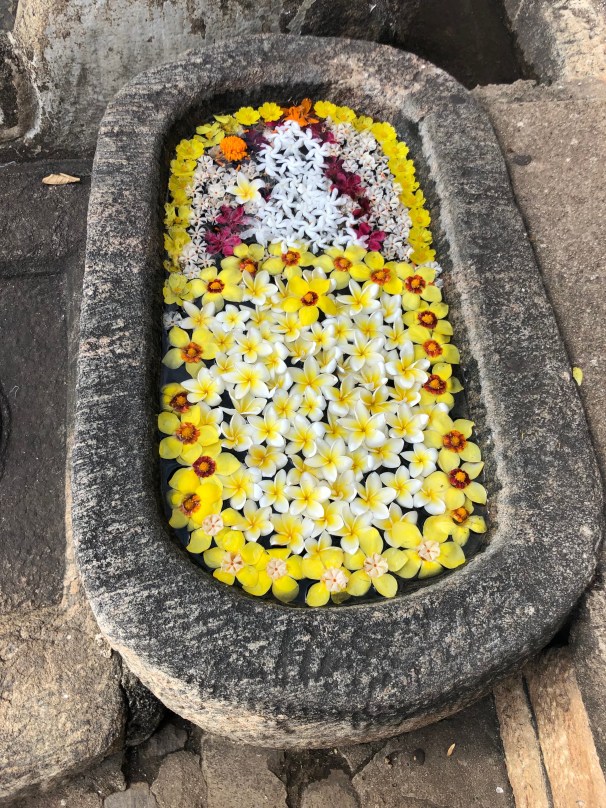
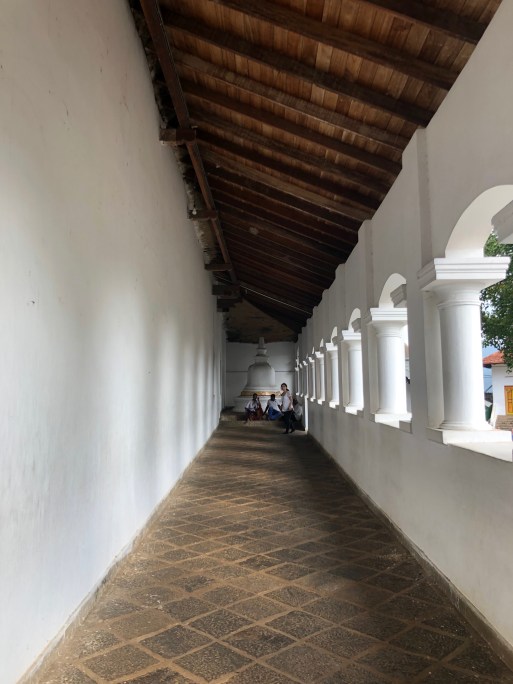
We continued on a bit farther to Dambulla, a city almost dead center in the middle of the country and famous for the Dambulla Cave Temple situated on a large bare black rock 600 feet above the surrounding jungle. Sri Lanka has several rock cave temples but Dambulla is the most extensive and well preserved and this cave monastery has been a sacred pilgrimmage site for 22 centuries. Writings inside the 5 caves, which lie below the drip line of the large overhanging rock and offer refuge from the elements, demonstrate that hermetic Buddhist monks inhabited these caves since the the 1st c. BC. 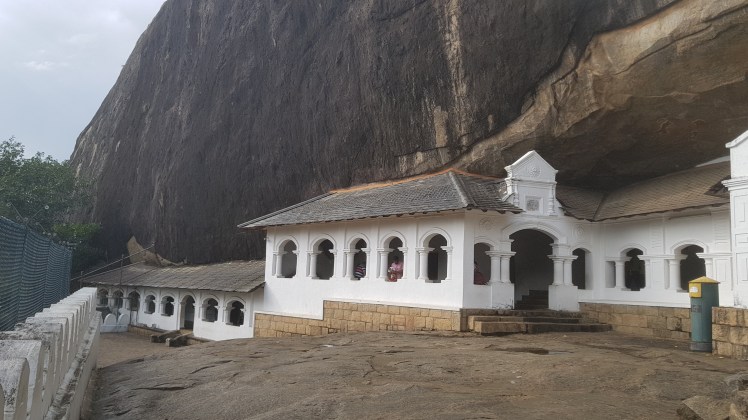 Much later in the 12thc AD, a King whose sovereignty was under threat sought refuge at Dambulla. Later when he regained control, he returned to enlarge and smooth the interior cave surfaces, adding drawings, Buddha statues and establishing a monastery such that Dambulla became a central place of Buddhist worship. Below, you’ll also see one of the many beautiful floating flower arrangements we came across at temples, hotels and museums.
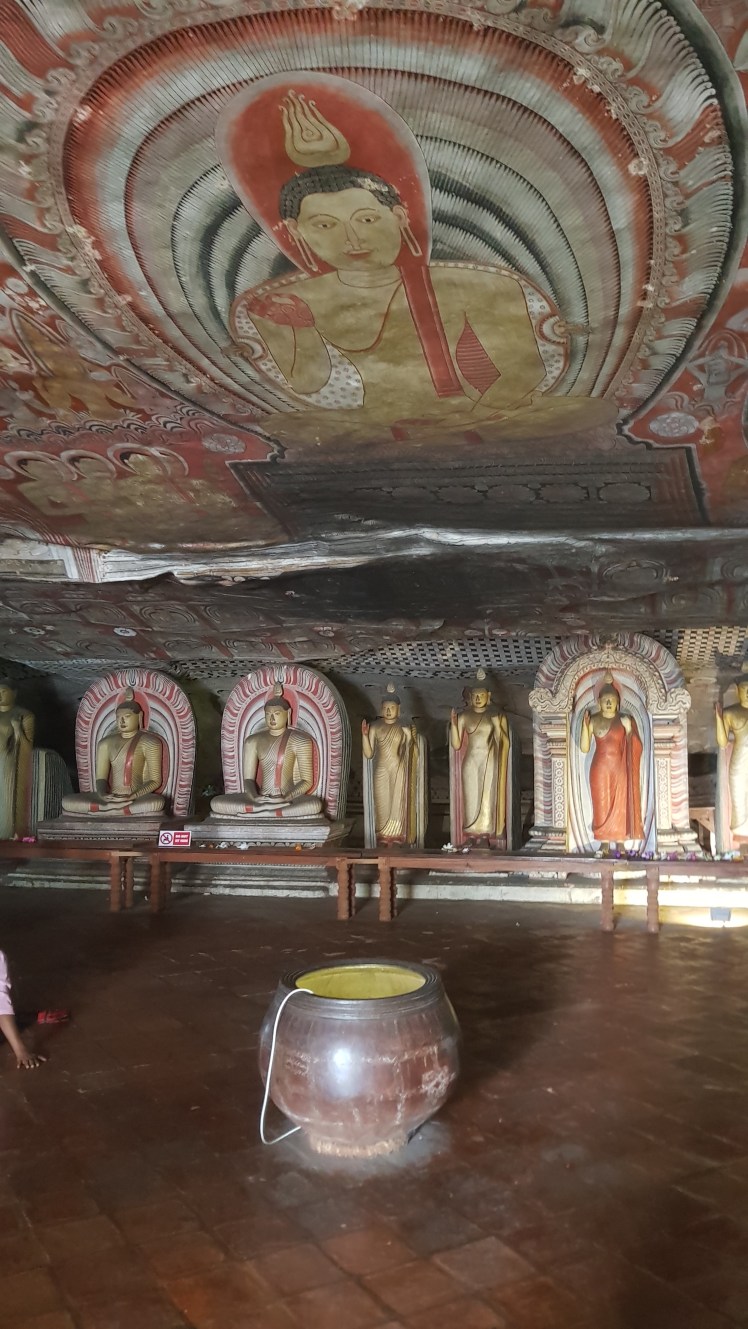

In the 18thc, yet another King made significant contributions to Dambulla, filling the caves with over 150 brightly gilded Buddha statues, including a 40 ft. long reclining Buddha that my camera lens couldn’t begin to capture so I shot his decorated feet instead.
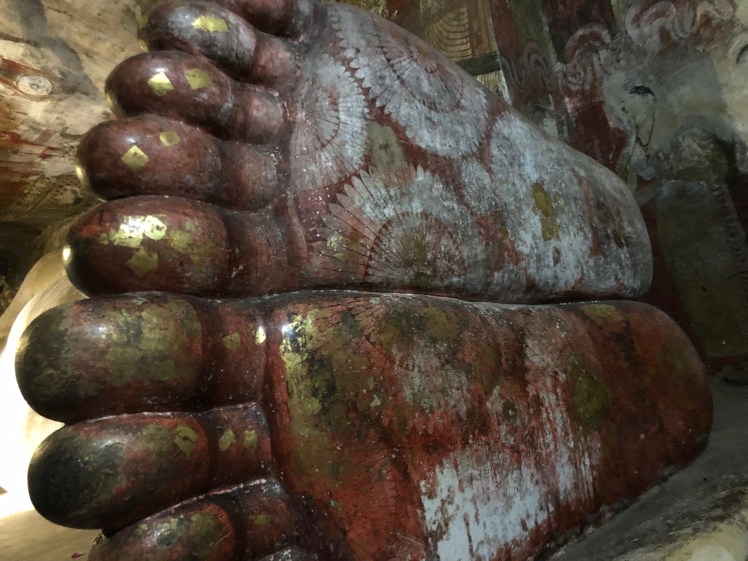
The Dambulla caves felt very peaceful despite the many other visitors there with us. Most everyone was a practicing Buddhist, often wearing the customary white temple-going attire, and visiting Dambulla to make a simple offering, share a problem or celebrate an occasion. Many visitors receive a simple white blessing thread in exchange for donated coins wrapped in white cloth. Ganesh explained that Buddhists worship Buddha as a super-human who achieved nirvana and is therefore freed from the endless cycle of reincarnation. Buddha however is not a God to whom one prays. Instead, a worshiper strives to follow in Buddha’s footsteps and to adhere to the key moral concepts of Buddhism that include not harming other living things, not taking what is not given, refraining from sexual misconduct, lying and the use of alcohol/drugs.
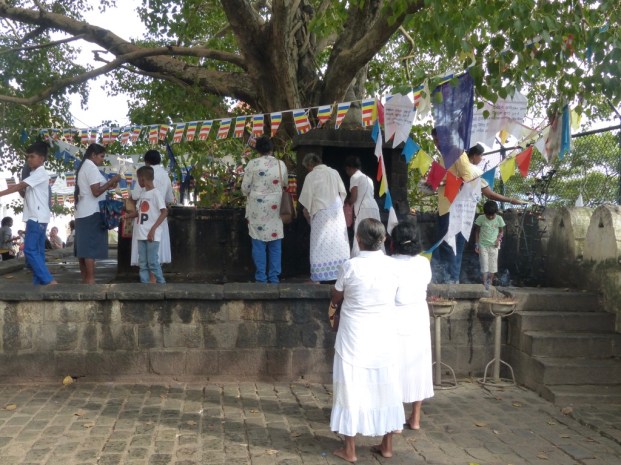
At every Buddhist temple, there is always a Bodhi (ficus religiosa) tree planted since Buddha is believed to have attained his enlightenment while seated under a bodhi tree in India. The original Bodhi Tree still stands in Bodh Gaya, India and offspring/descendents from this original tree have been planted by Buddhists around the world. When Buddhism was introduced to Sri Lanka in 247BC, a sapling from the right branch of the original Bodhi tree was planted at Anuradhapera, the site of the very first kingdom. Today, Sri Lanka has 32 descendants of the original Bodhi tree at various important temples throughout the country. Bodhi temple trees are always decorated with Buddhist flags and usually have a Buddha statue with offerings beneath them. The large Bodhi tree at the Dambulla Rock Cave Temple was stunning. 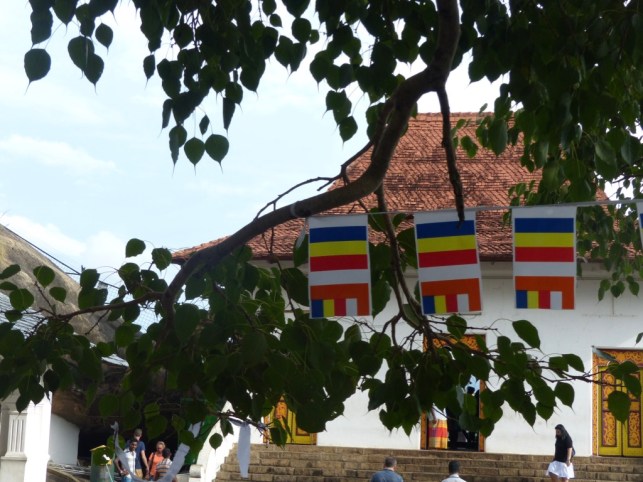
Our hotel this evening was a true gem and was one of 4 very special accommodations the Crossing Travel Team arranged for us. Kalundewa Retreat is located in a small town within Dambulla and is a quiet oasis set on a 100 acre agricultural farm. The retreat is comprised of only 6 guest suites, all of which are sleek/modern in style and made of wood and glass to maximize the views. Our lovely room overlooked the rice paddies and vegetable plots while others perched on the edge of a small river. Nearby the suites is a natural spring but we arrived too late in the day to swim and chose instead to hop on some bikes and toodle around a bit before dinner. In addition to the property’s central open-air dining room/reception area, there are many paths on which to walk, bike and take in the breathtaking views with Sigiriya (our destination the following day) in the distance.
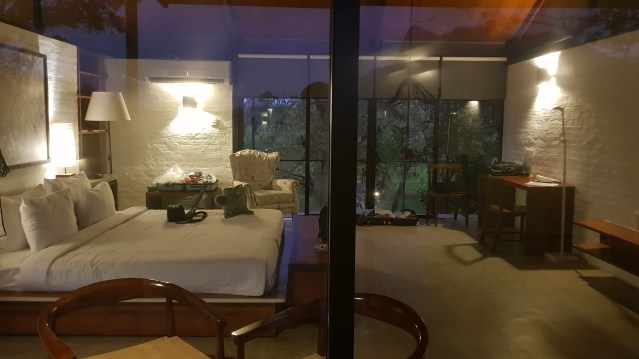
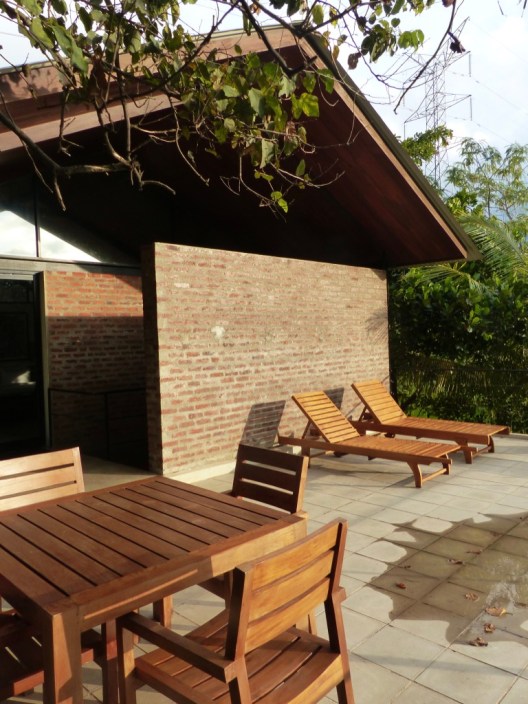
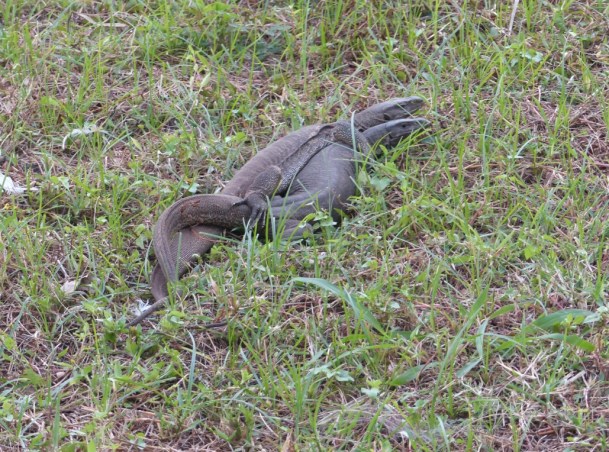
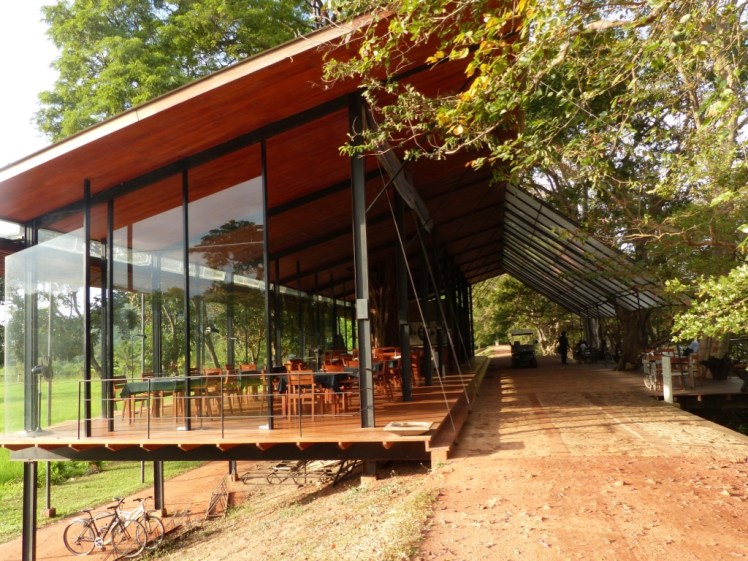 In the “lobby”, there’s a chalk board which encourages guests to write down the wildlife they’ve encountered on the property. Here are some of the moments I captured at dusk of this little bit of paradise near Dambulla as well as a pic of some very “cozy” monitor lizards that almost made me fall off my bike! But, then again, almost anything makes me crash when I’m on a bike since I’m a TERRIBLE biker!
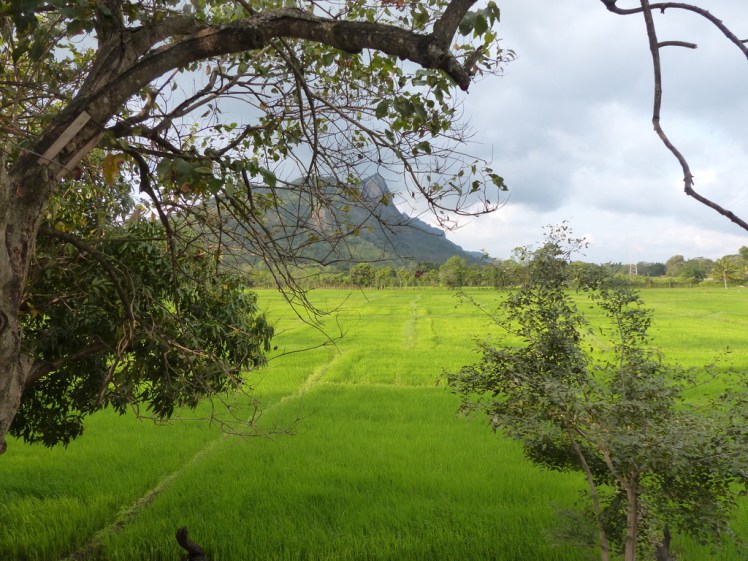
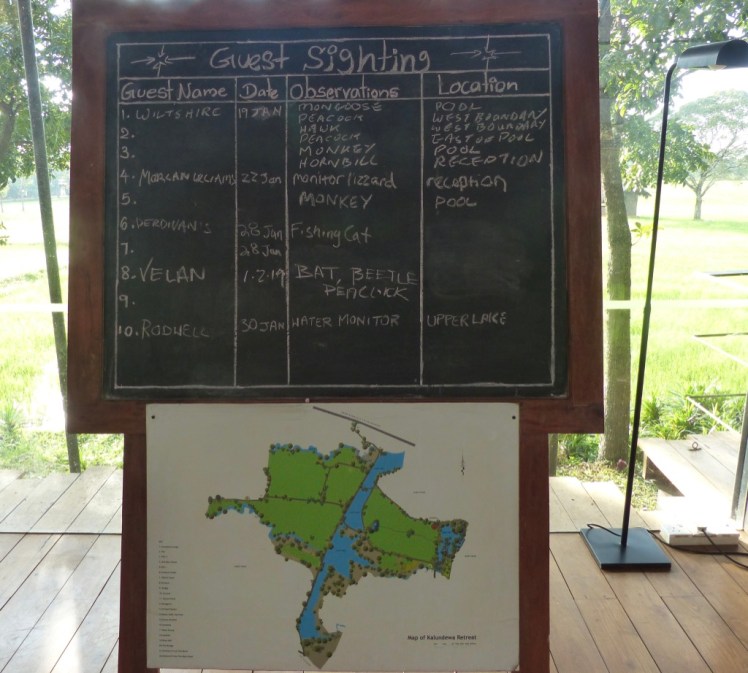
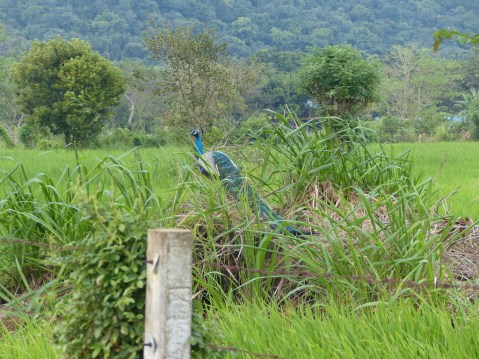
Roughly 85% of the produce served at Kalundewa Retreat is grown locally and the chef cooked up some lovely fish curries and grilled chicken dishes for us that evening as the sun set over the vibrant green rice paddies. The setting was so peaceful that we regretted having to leave early the next morning since we didn’t really downshift properly take take full advantage of Kalundewa Retreat. Next time?
Virtually everyone who travels to Sri Lanka visits Sigiriya (Lion Rock and “cover” photo for this blog post) since it is not only a stunning natural rock plateau that rises up out of the surrounding jungle to stand at 1,200 ft above sea level, but it also has quite a celebrated history. Long inhabited by Buddhist monks, remote Sigiriya served as a monastery since the 3rd century BC and its drip line caves were filled with lovely carvings. Sigiriya’s true “claim to fame” however occurred during the 5thc AD when it became a royal place for 18 years under King Kasyapa. After beheading his father, King Kasyapa seized power but did not gain approval of the Buddhist leadership (after all, he violated one of the 5 main Buddhist tenets with his act of violence!) and was therefore forced to establish his kingdom atop this rock plateau. That he did so, was an act of magnificent engineering and today, the ruins that remain remind one of Machu Pichu. Eventually, this rogue king fell to his brother who re-established the royal palace back in Anuradhapura. Buddhist monks however continued to occupy Sigiriya until the 7th or 8th century. During this time, many visitors carved poems to express their wonder and delight upon visiting Sigiriya and seeing the beautiful cave drawings. This poetic “graffiti” is well preserved and one of the many attractions of Sigiriya.
Before we began our walk up to the top of Sigiriya we visited the museum at the park’s entrance and were fascinated by all the artifacts, jewelry, weapons and coins of ancient civilizations that have been excavated from the royal residence atop of this rock. It is incredible to imagine all of the global trade that was occurring between Sri Lanka and other countries so long ago, especially given the current efforts to impede global trade by some leaders today!
Although it had rained heavily the night before, the sun was shining as we grabbed cameras, water bottles and set out for our trek. At the last minute we decided to bring our umbrellas…a good thing too as the heavens opened up mid-way up Sigiriya!
After entering the national park, we first walked through the water gardens, admiring the beauty of these ruins and imagining how the royal palace used these grounds as gardens and water reservoirs during the dry season. The effective management of water by people who lived centuries ago, like the Romans and their extensive aquaducts or the Greeks in Ephesus, really made us wonder at the incredible waste and mismanagement of such a critical natural resource now plaguing so much of our planet!


We happened to be visiting on the Sri Lankan holiday celebrating independance from British rule in 1948 so we were accompanied by many locals who, like us, were making a pilgrimage to this important cultural site. As we followed the path through giant boulders and began our ascent of the stone staircase the multitude of the folks around us became clear so we just settled into a steady, albeit slow, climb up Lion Rock.


It was hot and humid and yet every Sri Lankan infant was wearing a ski hat which we found humorous, but Ganesh acknowledged the importance of keeping babies’ heads warm since “they get sick so quickly”. His comment reminded us that Sri Lanka does still struggle with hygiene/clean water/disease.
About half way up our ascent, it began to pour! The heavy, but fortunately warm, rain did not deter anyone and so we made silent friends via nods and gestures with those around us, carefully holding our umbrellas over infant heads. 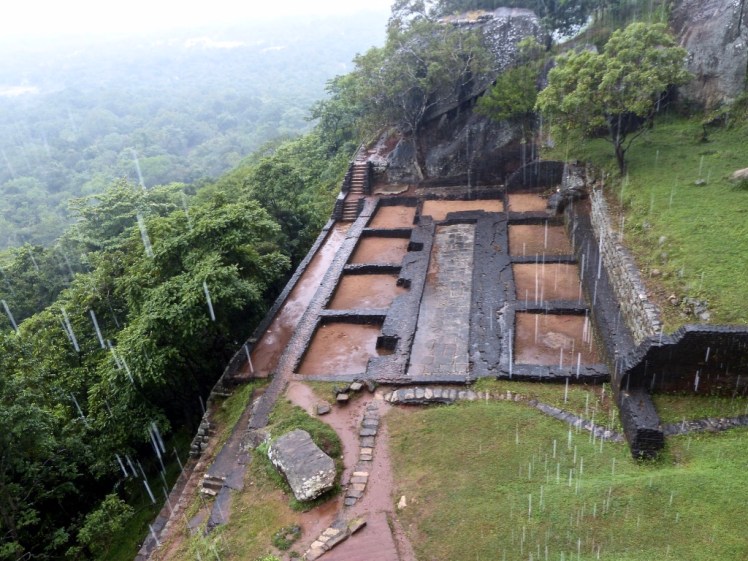
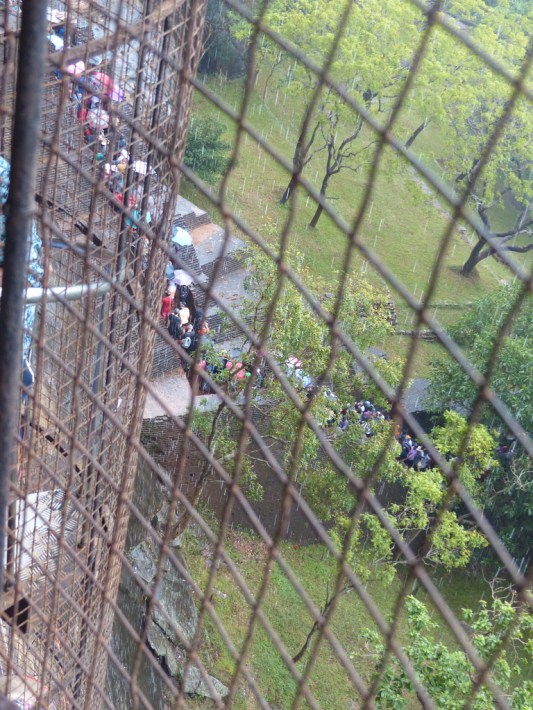
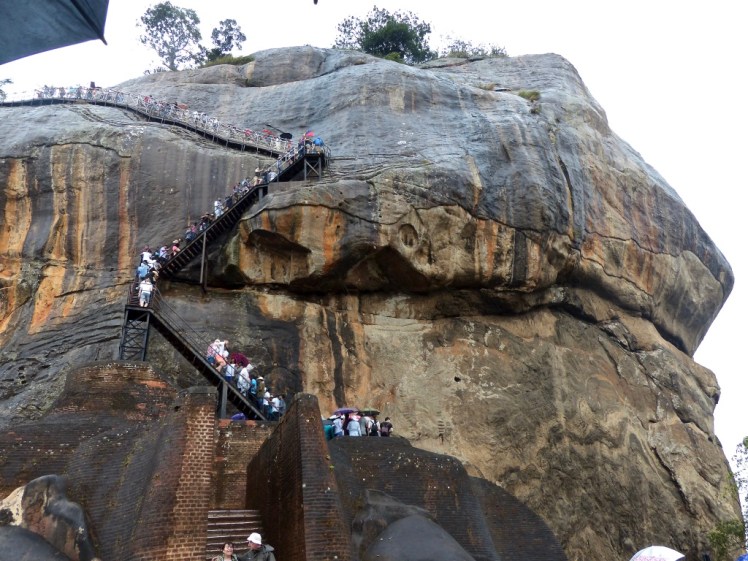
After another hour of so of slow, wet ascent, we finally reached the spiral staircase which leads to the famous Sigiriya cave drawings and poets’ graffiti praising the beauty of the “angels” (all dewy-eyed and large-breasted). No photos were allowed but our take-away was that these angels sometimes had extra hands or nipples because the artists used tempura paint on wet plaster to create a vibrantly colored image, but could erase/correct errors.
Fortunately, the rain decided to stop just as we made our way up to Sigiriya’s plateau so we could explore the royal ruins without our umbrellas. Dodging puddles, we explored the excavated areas, the ruins of the royal baths, galleries, performance areas and took in the views of the water gardens way down below. 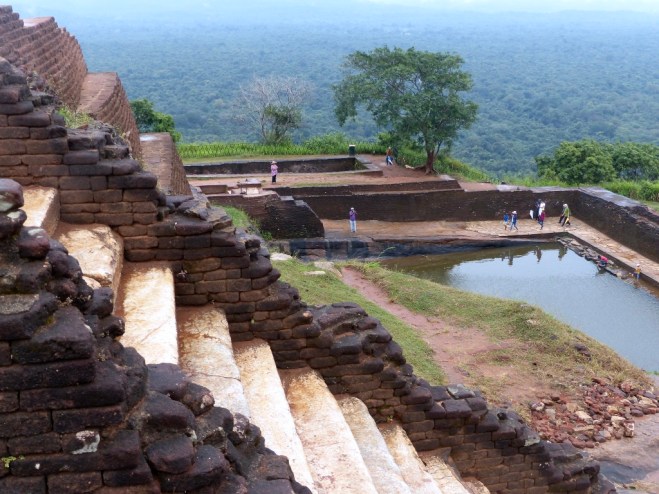
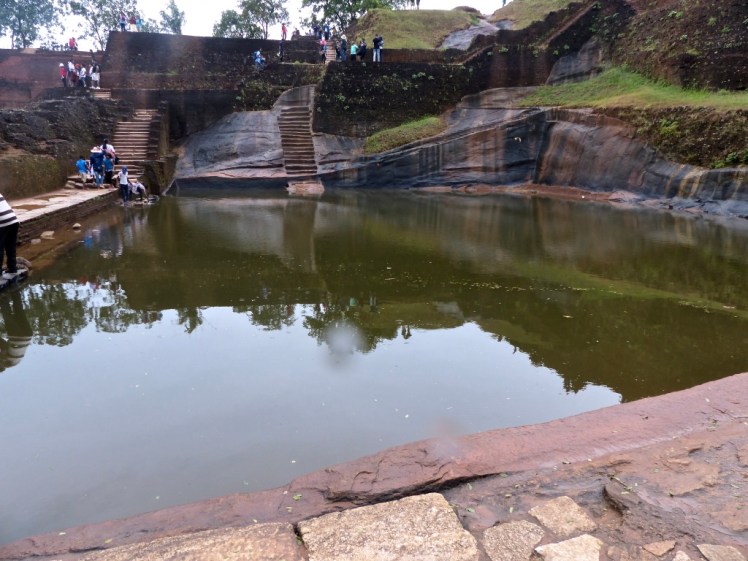
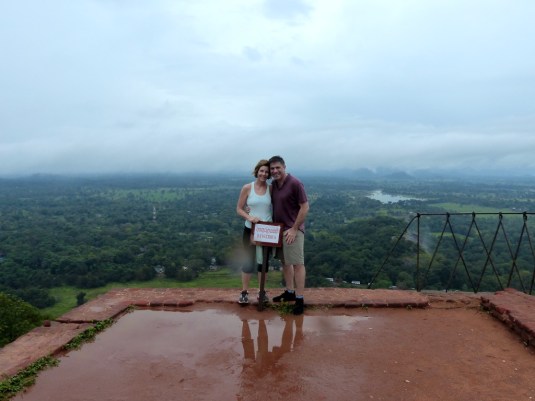
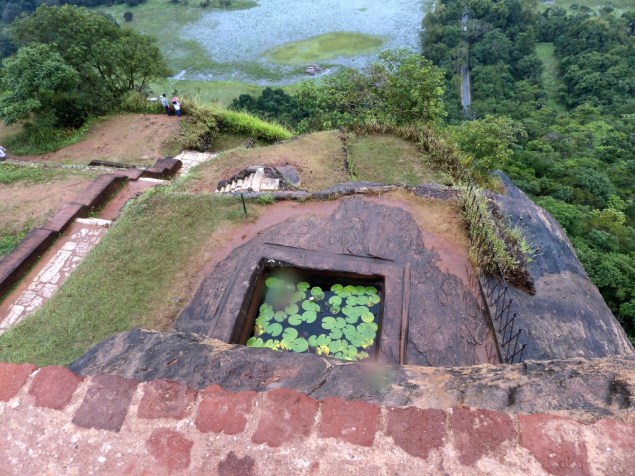
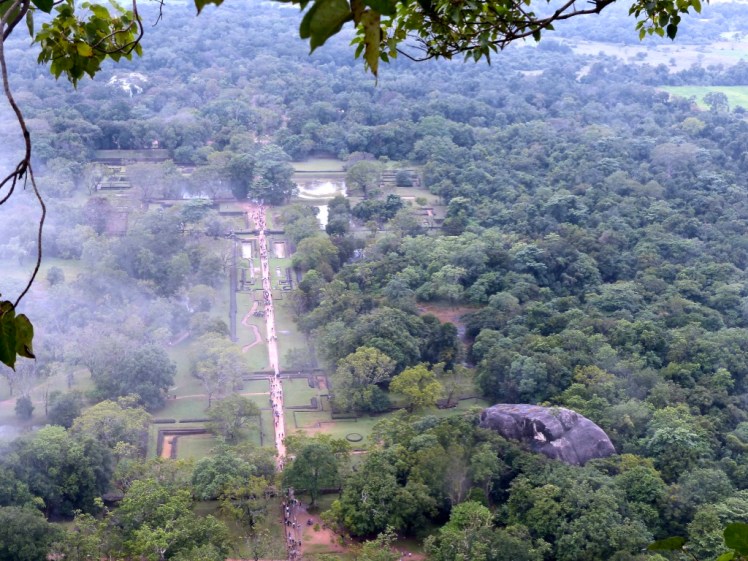
The descent was rain-free and much faster, though we took great care not to slip on the muddy, steep stairs. We decided to skip the tourist buffet style restaurant and went “local’, sampling some delicious roti as we drove into the central highlands where the famous Ceylon tea and spices are grown.
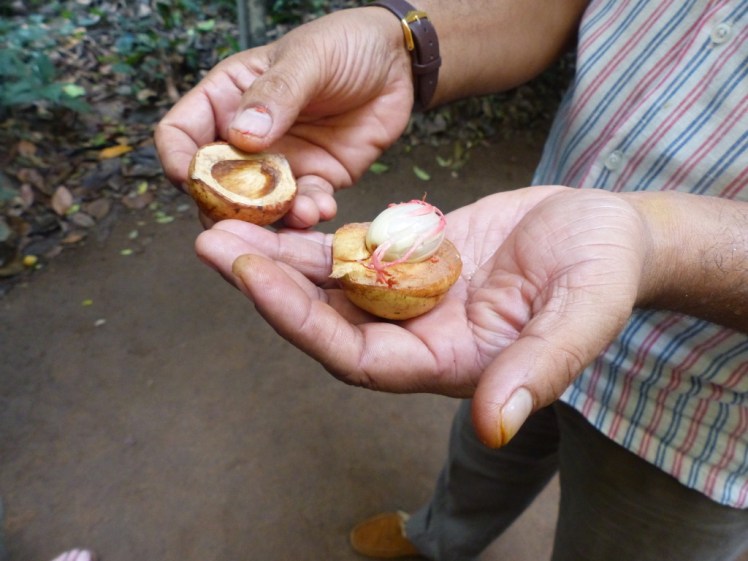
Along the way, we stopped quickly at a spice plantation where a vast array of plants used in Aruveydic medicine and therapy are cultivated. Clearly, these spice plantations are “tourist traps” since they offer brief hand/neck/feet massages and rote demonstrations, but they are also an integral part of Sri Lankan culture and herbal/Aruveydic medicine is one of the country’s key industries. Fortunately, Ganesh understood that we wanted the “quick and dirty” explanation so he set the guide’s expectations very low about what loot we might purchase after his presentation. We did snatch up some sore muscle/headache salves derived from nutmeg that exuded that familiar Ben Gay odor and had a nice cooling effect on the skin. We were in and out in 30 minutes which was just perfect. I also identified the nutmeg flower for the first time, having previously only ever encountered its dried pit in a spice jar.
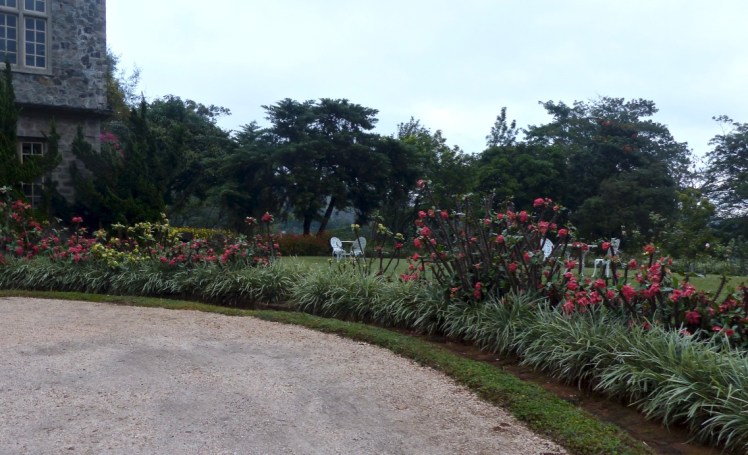
The rest of the drive was memorable for its crazy curvy roads and slow pace and I was VERY thankful that neither of us suffer from car sickness. Ganesh did an excellent job maneuvering around the motorcycles, buses and pedestrians and we were all relieved to finally arrived at Taylor’s Hill Residence in the outskirts of Kandy. This boutique hotel is a 100 yr. old manor house adjacent to the Loolecondera Estate which isone of the oldest tea plantations in the area and home to the very first tea plant in Sri Lanka that is STILL in production today. Surrounded by beautifully-tended English gardens with plenty of roses at every turn, this stone manor house offers just 5 rooms. Apart from ourselves, the only other guests were an American diplomatic couple currently stationed in Baghdad who were spending their month leave in Sri Lanka. Each room is uniquely decorated and the common areas included a cozy sitting room, a Snooker room with an enormous snooker/pool table, a library and several small dining rooms.


We were offered a cup of hot tea (of course!) upon our arrival and then began the evening with an Aruveydic massage to soothe our tired bodies which, after all, had hiked up Sigiriya in the pouring rain. We enjoyed a quiet dinner alone in a stately dining room. Wearing my red shirt, I just had to sample the featured “Strawberry Jelly” dessert. Any guesses what dessert makes perfect sense in the Sri Lankan climate and was a “blast from the past”?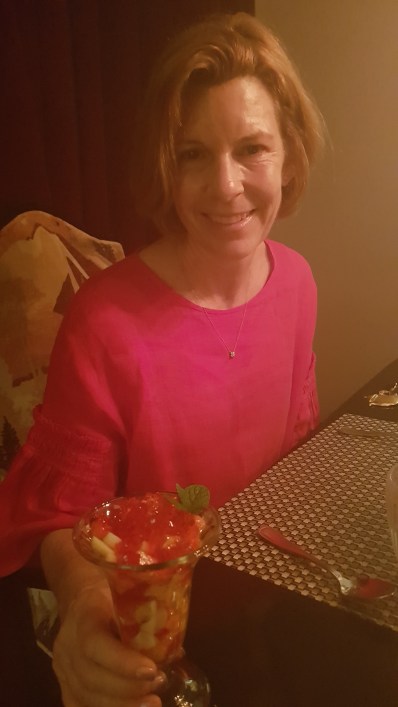
It had been foggy and rainy when we arrived in the evening so when the sun rose and fog lifted the following morning, we were delighted to see the rolling green hills of the tea plantations surrounding Taylor’s HIll and glimpses of the valley below. At breakfast, neither Bill or I was willing to give up our morning coffee despite staying on a tea plantation in the heart of world famous Ceylon tea country. Later when I queried Ganesh, he too admitted to preferring coffee to tea in the morning so we stopped feeling guilty. I absolutely loved my coconut banana pancakes soaked in jaggery syrup! 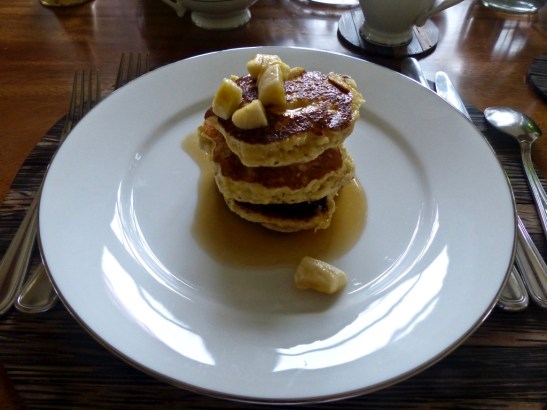 I also loved the wallpaper in the powder room which truly celebrates TEA!
 Before we hit the road to explore the nearby city of Kandy I strolled the grounds and found the pool, croquet lawn, badminton and tennis courts, all of which miraculously appeared as the morning fog lifted and the true glory of Taylor’s Hill Residence was revealed.


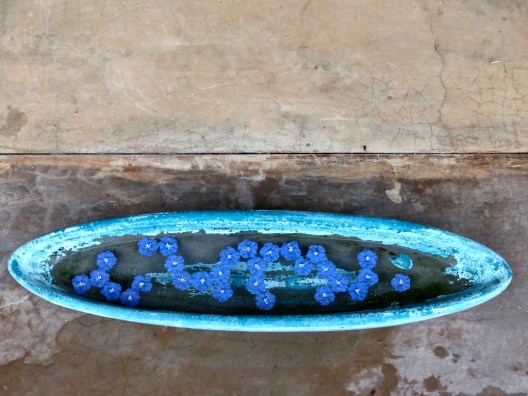
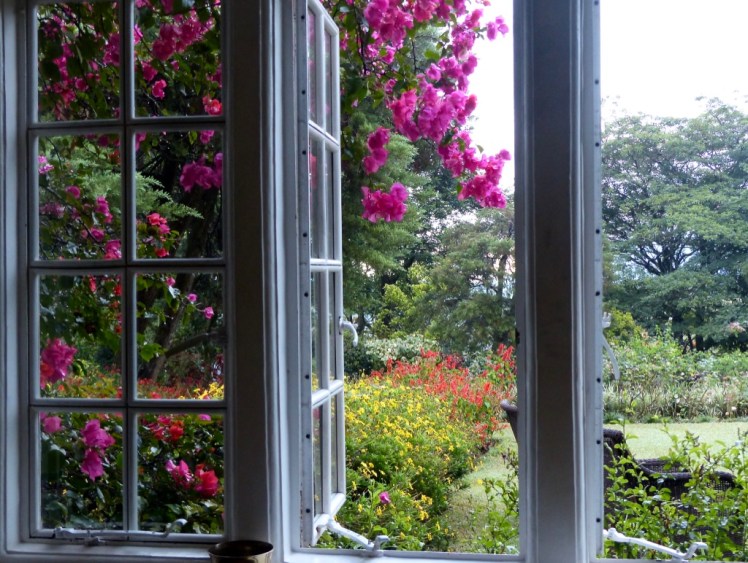
Tea was first introduced to Sri Lanka in 1867, when a Scottish farmer named James Taylor (a different one obviously!) brought the tea plant from Africa and took up residence at Loolecondera estate. James Taylor was able to successfully cultivate the plant in the central highlands; his previous attempts to grow coffee had proven unsuccessful since coffee plants were not disease resistant in the tropical climate. A close friend of his, Sir Thomas Lipton, soon followed in his footsteps, establishing Tetley Tea’s famous collection of Ceylon teas. In fact, up until just two years ago, Sri Lanka was the third largest tea producer in the world, behind China and India. Today, Kenya reigns as the 3rd largest producer while the relatively small country of Sri Lanka still ranks fourth and produces 300 kg. of tea annually.
Originally, the British tea plantations relied on imported labor from Tamil Nadu India, but today the tea pickers are all local women (though many of Tamil descent) who work 7 days/wk all year, earning one of the lowliest daily wages countrywide. They are offered free, but very rudimentary, living quarters and their children are often recruited into the workforce once they reach legal age so this cycle of hardship continues for generations. The women wear long sacks on their heads as they move through the tea fields plucking the newest shoots of each plant.
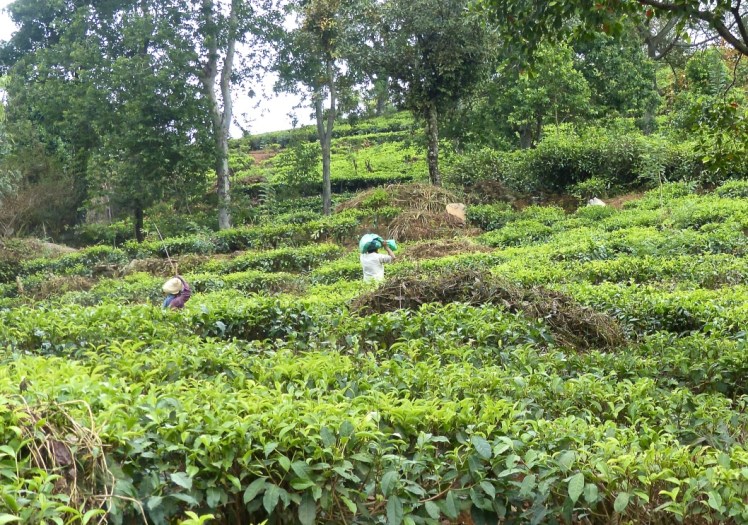 The tea plant reproduces a new shoot every seven days so there isn’t really any fallow and tea leaves can be harvested all year long, virtually forever like the original tea plant James Taylor brought in 1867 and is still picked today. The pickers start early in the morning and we saw their tea-laden heads in the fields as we left Taylor Hill. On the way down to the city of Kandy, we also drove by many abandoned tea factories since today much of the tea production in Sri Lanka has become centralized, leaving these ghost buildings as memories of the colonial times. In many parts of the world, these lovely old buildings made of galvanized steel with large windows could easily be transformed into wonderful artist studios or other coveted spaces.
After a short drive on a thankfully much less windy road, we arrived in Kandy, Sri Lanka’s second largest city where the last of the ancient kings established residency from 1505 until 1848. During their sovereignty, the Kandian kings successfully repulsed numerous attempts by the Portuguese, then the Dutch and finally the British to conquer Kandy. These same Kandian kings however did tolerate the presence of foreign settlers so long as they remained in the southern coastal areas to facilitate the mutually beneficial tea and spice trade.
Although the capital of Sri Lanka ultimately moved to Colombo, Kandy remains the country’s most important cultural city. In fact even today when getting married, many Sri Lankans forgo western/modern fashion influence and opt to wear the traditional attire of the Kandian Kings. (Sorry, no photo) We saw many boutiques offering this clothing/costume and noted that we would have rocked the Hanson’s annual Halloween party in this garb!
The city of Kandy is a UNESCO living world heritage site primarily because of its main temple: The Temple of the Tooth Relic. This temple is Sri Lanka’s most important national treasure and, as one of the most important Buddhist temples in the world, it is visited annually be millions of pilgrimagers. During the previous two days, Ganesh had mentioned this temple numerous times, but both of us were confused by its rather curious name and hesitant to visit yet another temple. Glad we did, though, and here’s why!
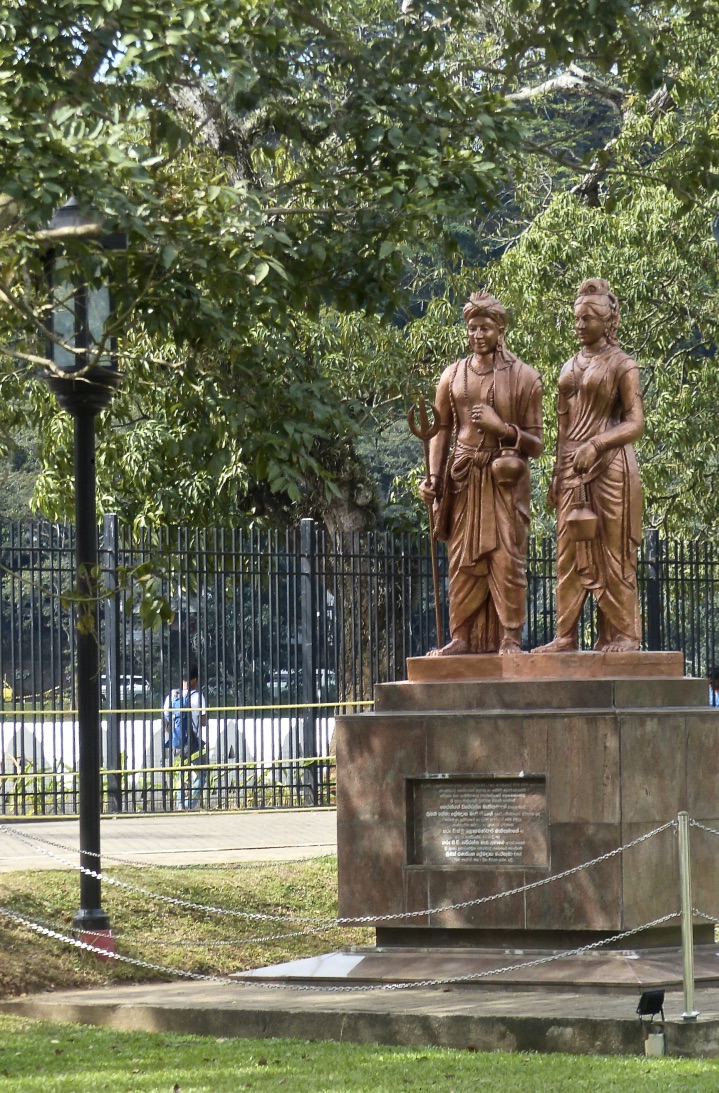
Back in 1594, the reigning king built the Temple of Tooth Relic to safeguard this extremely important item which traveled to Sri Lanka in secrecy. Around 487 BC, when Buddha died and was cremated, portions of his body (collar bone and teeth in particular) were taken from his funeral pyre and kept by various kings as a great treasure as well as a means of authenticating their royal authority. The Left canine of Buddha was kept in India for many thousands of years in just this manner. The tooth, however, always posed a danger to its guardian king since others would attack and attempt to seize control of this coveted item. In 304 AD, the king who was the current guardian/protector of the Tooth Relic was vulnerable and concerned about just such an attack. He thus arranged a good/stabilizing marriage for his daughter Princess Hemamali and then sent the new Indian prince and princess to Sri Lanka for a visit. He secretly hid the Tooth Relic in the Princess Hemamali’s hair, thereby smuggling this important item into Sri Lanka, widely known to be a devoted, peaceful Buddhist country, for safekeeping. The statue below appears just outside the Temple grounds to commemorate the bravery of this young Indian couple who safeguarded the Tooth Relic on its passage from India to Sri Lanka.
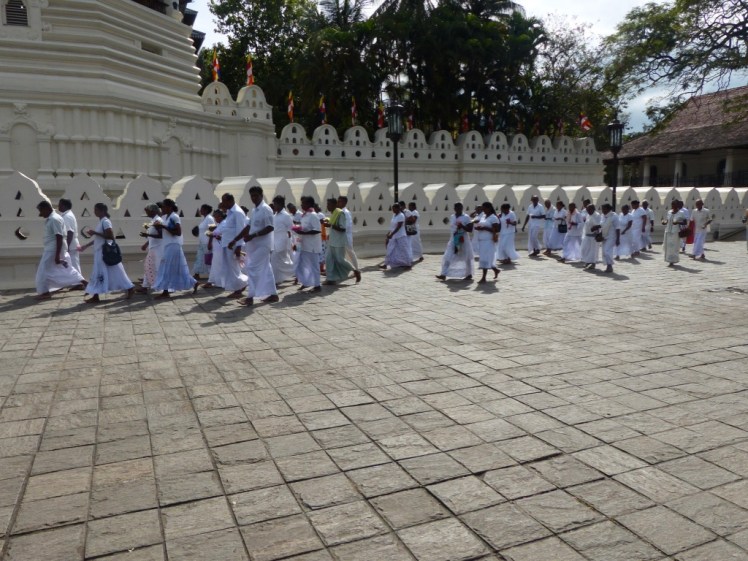
 As we approached the royal palace and Temple of the Tooth Relic, there were crowds of visitors walking along side us with their flower offerings and a certain hushed silence that augmented the significance of this site.
 Once inside, we then witnessed hundreds of Buddhists carefully placing their flower offerings on a long table in front of the Tooth Relic gallery. Every 30 minutes or so, the entire table was swept clean of the fragrant offerings by guards carrying trash bins. The gardener/flower lover in me looked on in dismay, hoping they would at least be used for compost!


Before we went upstairs to the wait for the critical viewing moment, Bill lingered to listen to the monks drumming. Living in Seoul where we are surrounded by Buddhist temples, we’ve come to love the drumming and chanting we often hear at home, in the city and when hiking and always find it soothing. He shot this video:
Everyday, there are two official moments when the Tooth Relic casket is on display to the public: 9:30am and 6:30pm. Also at this time, one lucky family from Kandy is selected to cook the hot noon meal (32 bowls of rice and curries) for the 5 monks who live at this Temple. The honored family is also allowed to invite family and friends to the 9:30am ceremony and they are permitted to enter the casket room whereas all other visitors like ourselves stand packed together, craning to get a glimpse of the casket when the door opens. This was particularly challenging given the 3 S’s (Short Stanton Stature)! Directly in front of the casket room is an area where young parents bring their babies to be blessed (see photo directly below).
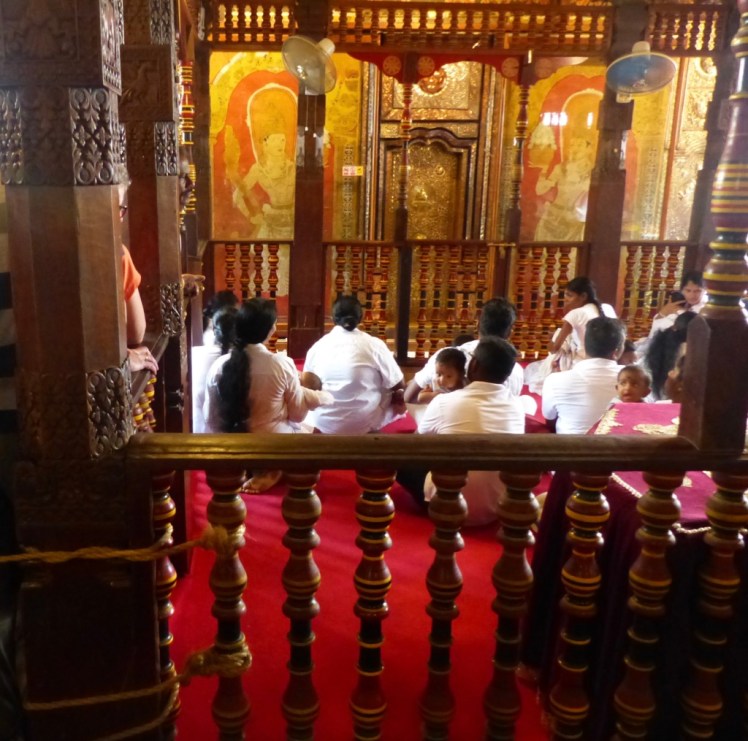 We waited patiently alongside hundreds of other visitors for the special moment when the door opens and the Tooth Relic casket is visible (sort-of…or really not at all..to this very short photographer who tried to capture the moment and failed!) If you look closely though, you can see that the gilded door is open.
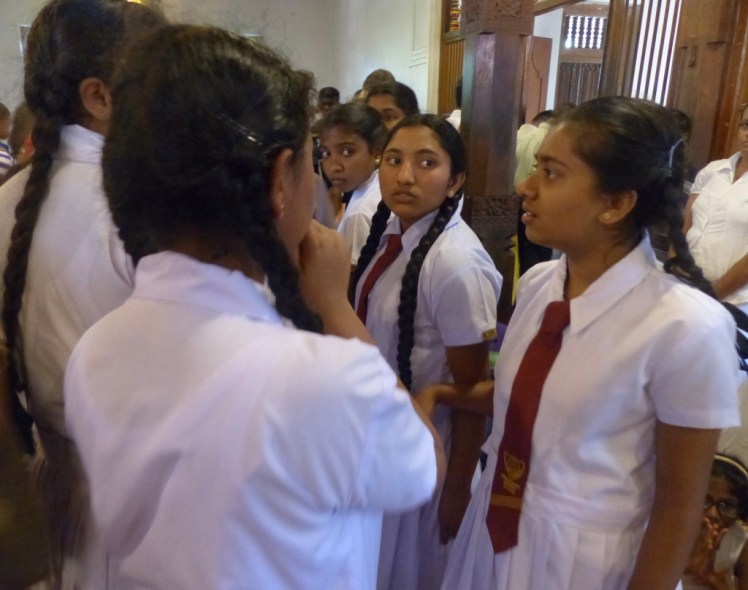
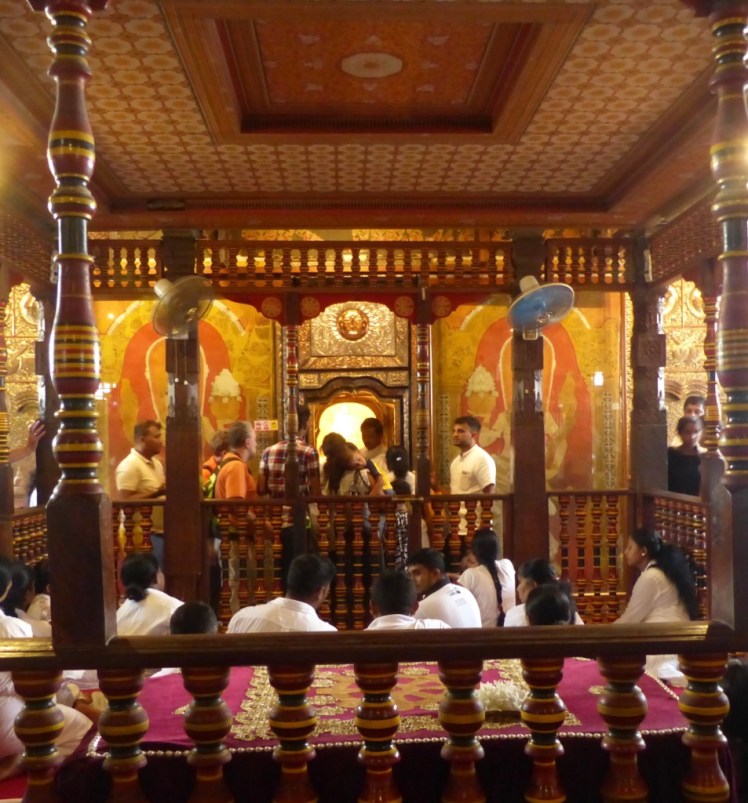 It was crowded certainly but also a great opportunity to observe the locals. We were particularly struck by the standard uniform and hair style worn by all Sri Lankan girls. Only the tie and emblem on the jumper vary from school to school. Boys are much luckier and can wear white collared shirts without a tie and blue shorts up until grade 8. All education through high school is free and English, Singalese and Tamil languages are taught to all students. Healthcare is also free to all Sri Lankan citizens.
 Every summer there is a big 15 day festival in Kandy during which a replica of the Tooth Relic casket is carried around by a “Tusker”. I thought “Tusker” was the cute name of the king’s elephant (I’ll admit to an Allegheny River moment here), but was surprised to learn that “tusker” refers to the 5% of Asian male elephants that are actually tusked. For 80 consecutive years, a very beloved tusker named Raja performed this honorific duty and his body is now taxidermified and on display next to the royal palace. He’s not quite as impressive as the elephants in New York’s Natural History museum but well loved and visited.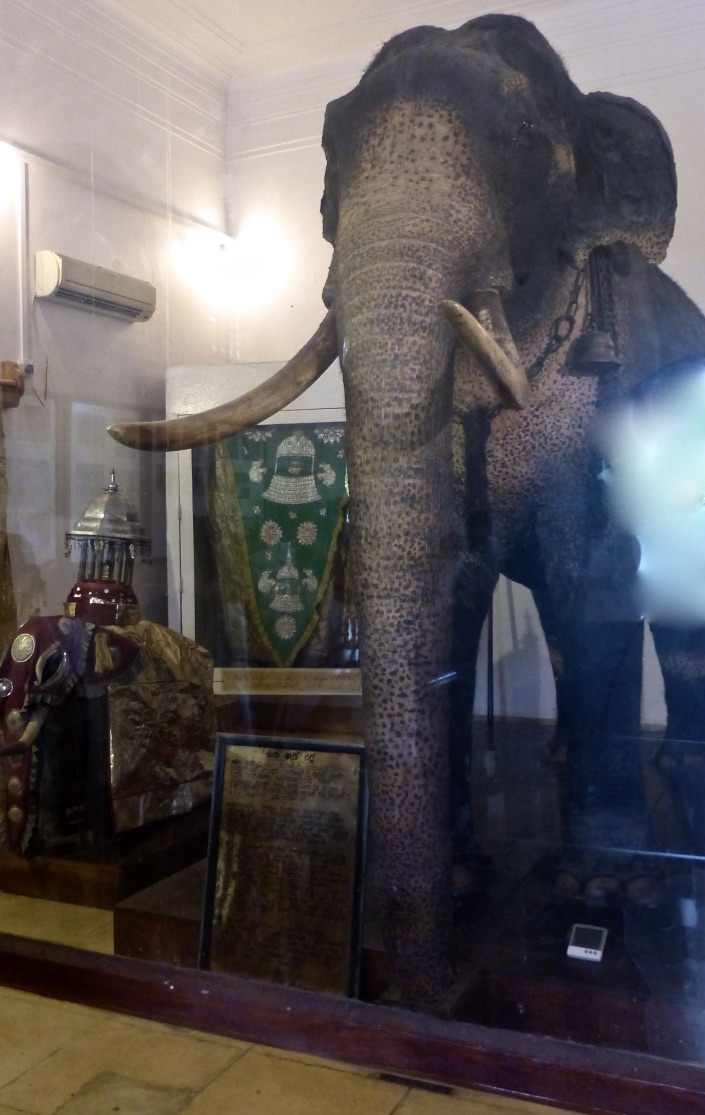
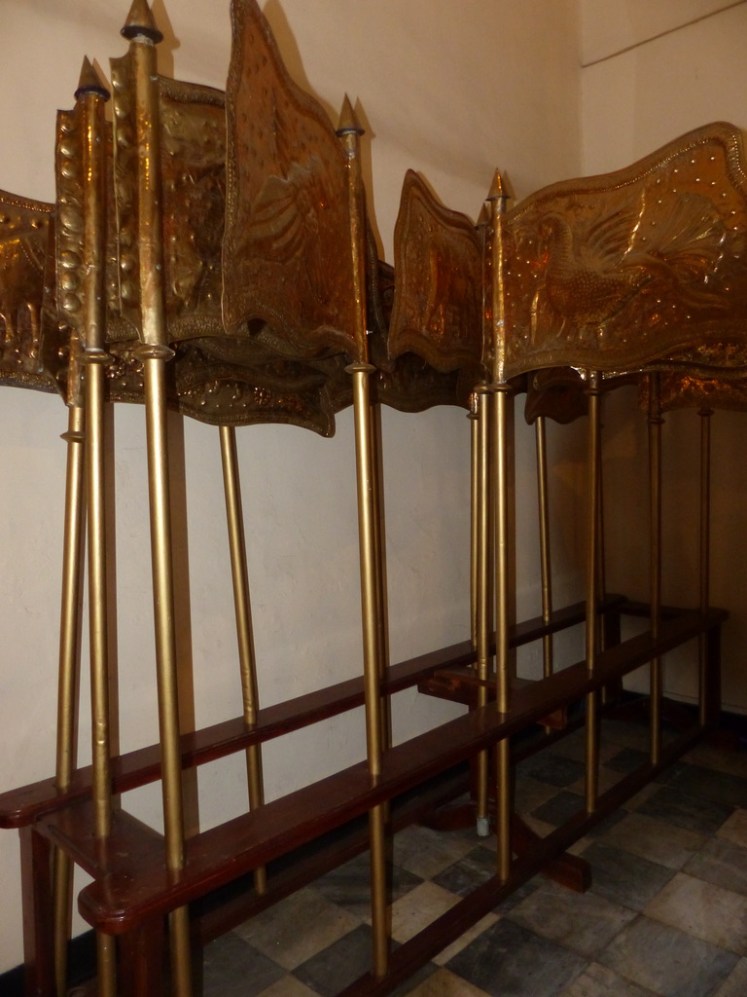
Below are the flags carried during the 15 day long procession as well as Buddhist flags interspersed with cloth-wrapped coins worshippers brought to this sacred temple.
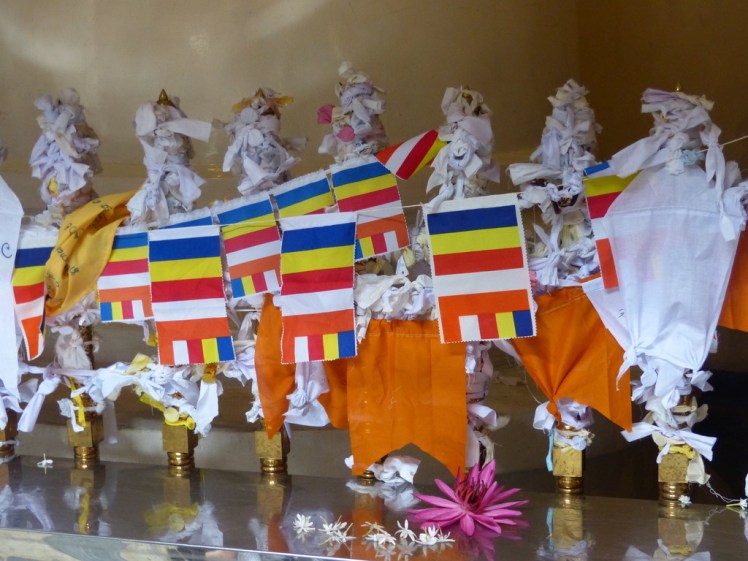 Once the Tooth Relic casket ceremony concluded and the crowds dissipated, we wandered around this beautiful temple with its grand painted archways tall enough to accommodate Raja’s procession, alabaster white stupa and fence of undulating waves. I think we even caught a monk talking on his cell phone!


I’d be remiss if I didn’t mention Sri Lanka’s tuk tuks. They are everywhere and manouever nimbly around cities and up mountains into more remote villages like those near the tea plantations. I loved this parking lot full of them in Kandy.
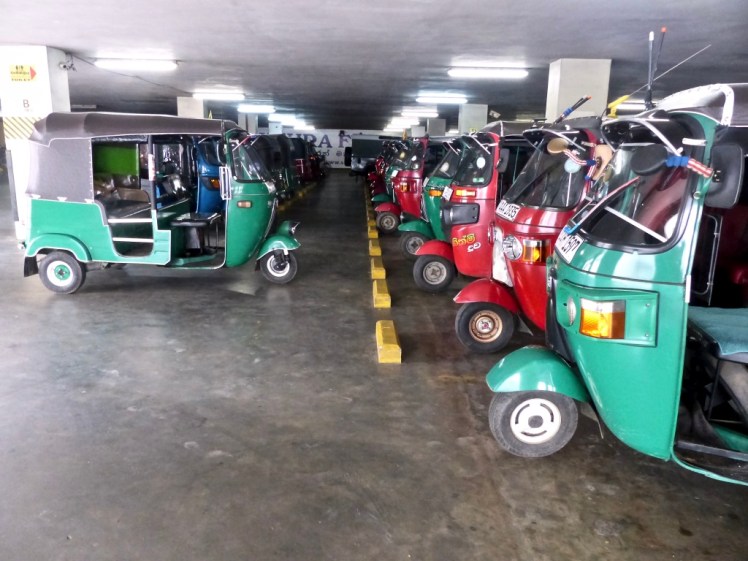
On our way south to the coast from Kandy, we decided to stop at the Geragama Estate Tea Factory to learn more about the history of Ceylon tea. 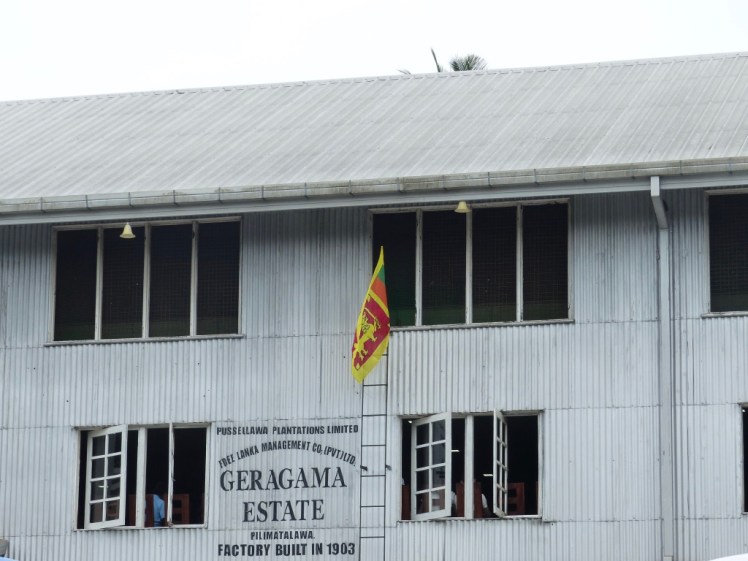 Full disclosure: we had trouble understanding our guide’s English as well as her explanation so can’t say we are now more knowledgeable about the subject…and in fact, may be even more confused than we were before. AND, we both still much prefer coffee to tea! I’ll do my best though. The basic steps for tea production are: 1) picking of top shoots of the tea plant.

The very top, still furled, leaf is used for gold and silver tea. However, during the production of gold and silver tea, these furled leaves must be dried naturally (vs. with large fans that sit under long riddling bins like one picture below) so only minimal amounts of gold and/or silver tea are produced. This special tea is only consumed locally and not exported at all.
2). Tea leaves are riddled/put in riddling machines. 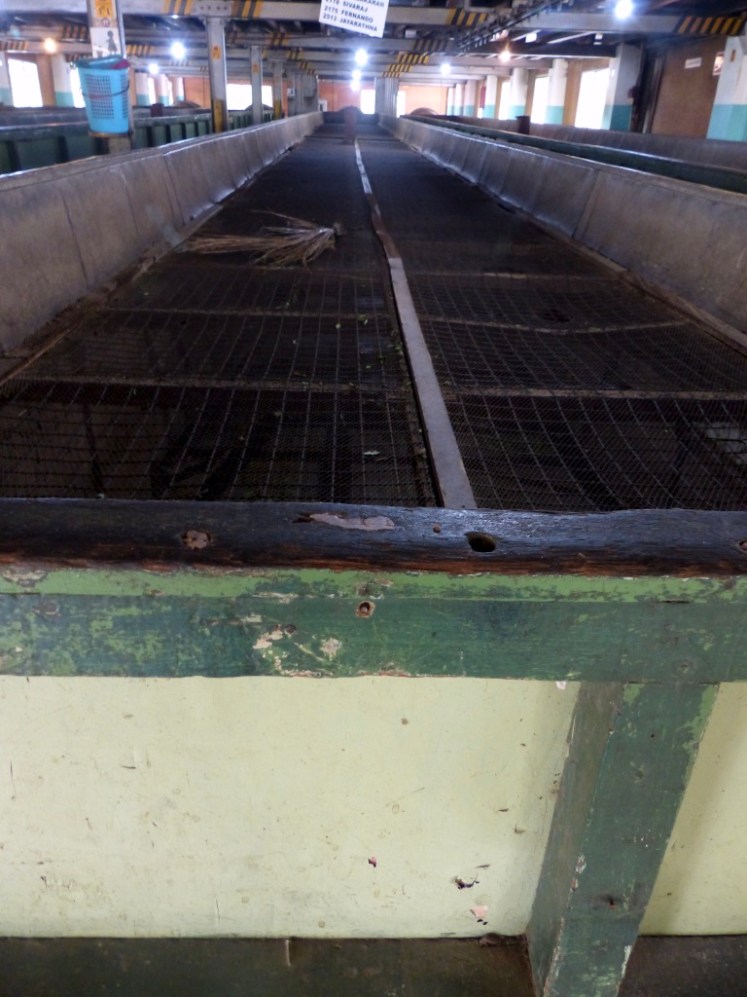 Each day at 5pm, new tea leaves are delivered to the factory from the surrounding plantations and 100 or so workers clean (wash/ separate) the leaves. Giant air fans located below the long mesh-bottomed platforms dry the leaves for 20 hrs. During the riddling process, the tea leaves lose 50% of their moisture and are consequently much lighter.
3) Next, the leaves are rolled 3 separate times in these rolling machines which can be set to different pressure levels.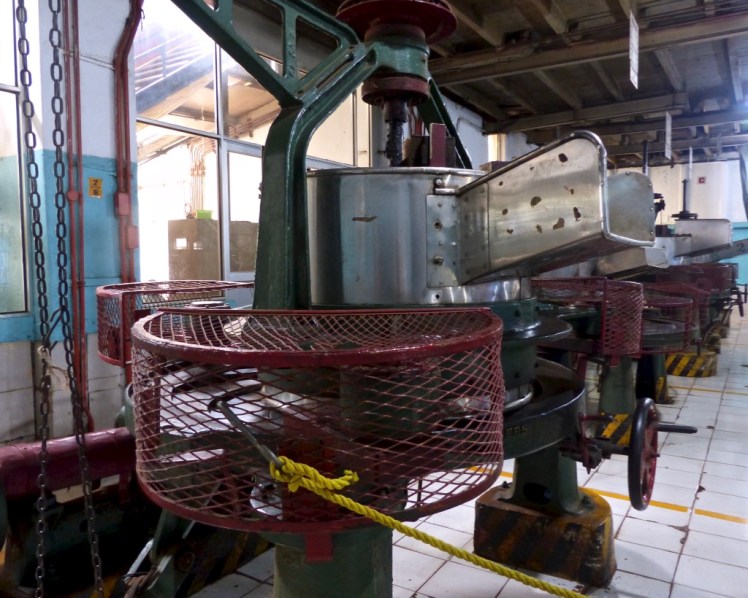
The first roll is done without any pressure and just curls up the tea leaves. The leaves are then rolled again with some pressure which produces balls. The final roll with a lot of pressure breaks the leaves into pieces (BOP stands for Broken Orange Pekoe).
4). The leaves are then sifted electronically in big sieves like the ones below. Stems and big pieces fall to end of each slide while leaves and dust are collected in plastic boxes below the giant sieves.


5) the various leaves are then fermented/dried in 100 degree Celsius ovens except for gold and silver (and green tea leaves) which are sun-dried. The biggest leaves result in the weakest/lightest flavor and flavor intensifies as the size of the tea leaf diminishes. Below is a display of all the different types and grades of tea produced at Geragama.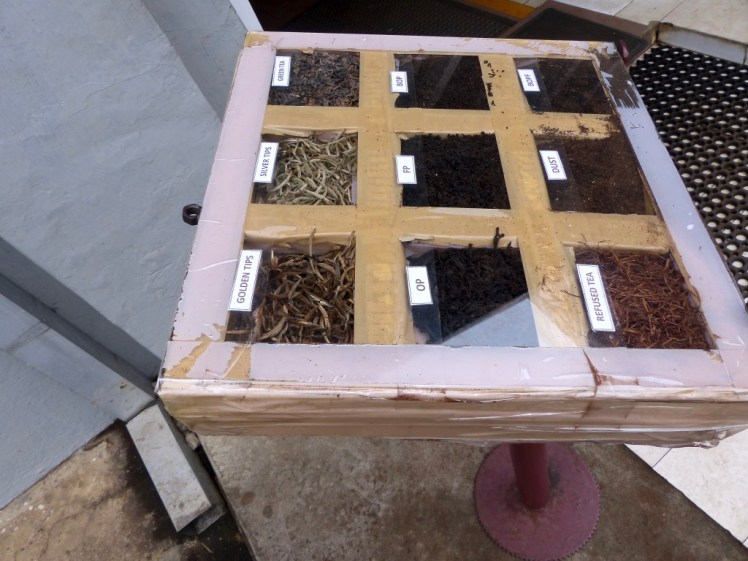
BOPF (Broken Orange Pekoe Fermented) is English Breakfast tea…strongest to be taken with milk and sugar. The lowest quality tea is called DUST and it is powdery and put into tea bags like those sold by Lipton. (This non-tea drinker now finds it even harder to reach for a tea bag full of DUST!) Nothing is wasted at Geragama since the brown leftover pieces and stems are made into natural fertilizer. After the tour, we sampled various teas in an effort to clarify our understanding of what we had just learned with, sadly, only marginal success.
We drank cups of BOP, first taking a nibble of a jaggery lump followed by a sip of tea. This was sweet and quite tasty. Foregoing his afternoon Diet Coke, Bill then asked to try BOPF with sugar and milk; he loved it and its buzz so much he left his phone on the table when we set off for Galle so we had to double back.
The second half of our trip to Sri Lanka was spent along the country’s south-southwestern coast where the major spice and tea trading routes were established centuries ago. Up until now, the weather had been overcast and rainy, though plenty warm and comfortable compared to Seoul’s February weather. We were hoping for blue skies and sun for the rest of the trip since our destinations were on the coast and we had planned to spend some downtime reading on the beach. Although our trip fell on the edge of the monsoon season, luck was with us.
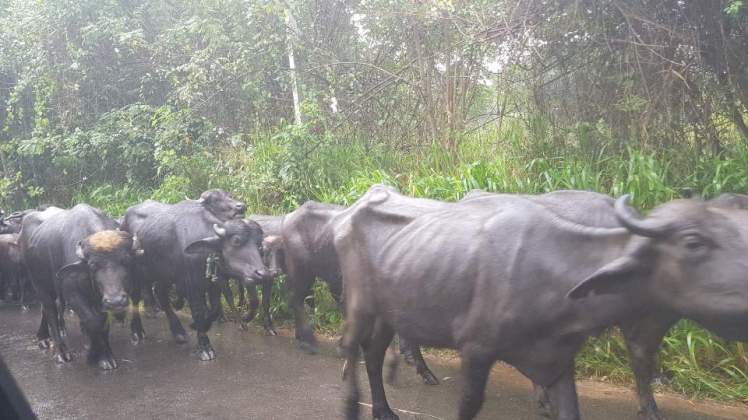
To get to Galle from Kandy, we had to drive 4 hours mostly on slow, crowded local roads. We were amazed to see a traffic light for the first time in 4 days despite having driven many miles. The photo Bill snapped from the car gives you a sense of road conditions. He sent this to the kids on Super Bowl Sunday with the caption “Sri Lankan Super Bowl”. He’s so funny…
We were equally surprised to see Singer stores everywhere, especially since Singer sewing machines seem rather outdated in the US. Ready-made garments comprise some of Sri Lanka’s most important exports however and Singer stores in Sri Lanka have expanded to sell all major home appliances in addition to sewing machines. Who knew that Singer competes with LG, Maytag, Bosch worldwide?!
Only an hour of our drive south was on a new highway which, like many we’ve seen throughout S.E. Asia, had been funded/constructed by the Chinese a decade earlier. A major extension is currently underway (again with China’s help) and it will make a tremendous difference in travel time. From the car windows, we could see rubber, palm, cotton, pineapple, coconut plantations. At one point, this ever-curious tourist asked Ganesh if he’d even been hit by a falling coconut. He laughed hard at this random question (one of many I ask…) and explained that obviously he had NOT, since this is often a deadly event!
We drove along the southern coast and past the famous surfing beach Weligama where the big waves beckon locals and Western tourists, many of whom were bright red and sunburned and would have made a Korean shudder. Our destination was a boutique hotel called The Owl and the Pussycat in the nearby town of Unawatuna and it was such a delight!! The Owl and Pussycat hotel was inspired and developed by Rita, an Indian woman who grew up in NYC and has other boutique hotels around the world. Although she calls “home” another property in Umbria (now on our “list), Rita happened to be at the Owl and Pussycat during our stay and was very personable and chatty. We were upgraded to a magnificent suite overlooking the ocean and just loved every detail of the colorful, whimsical decorating scheme. Here are a few snaps I took of our suite before we settled in:


Each room in this small boutique hotel has its own personality and the guests were all different ages and nationalities. We began our stay with a luxurious massage down by the ocean performed by a local masseur who has studied Aruveydic massage and reiki healing for 25 years and really worked our stomachs…to the point that both of our tummies were a little sore the next day after our second massage! On the wall of hallway leading to our room was Edward Lear’s poem that inspired the name of the hotel and its restaurant “The Runcible Spoon”. Last summer when my sister Julie and Bob got married, my mom read this poem at their wedding so our stay here felt truly serendipitous! The hotel also has a nice library which was decorated with vibrant colors, local crafts and reflects the somewhat eclectic, but very artistic, style of this lovely boutique hotel.


Having marveled earlier in the morning at the fisherman precariously balanced on the stilt poles in the ocean, we ate whatever seafood the chef recommended knowing it’d be fresh and delicious. The first night I ordered fresh crab curry with various chutneys.


Rita came over and chatted with us for awhile and at her suggestion, I ordered fresh lobster cooked in garlic butter for the following night. Sri Lankan lobsters are more like giant crayfish since they don’t have large front claws but they rivaled Maine lobsters in sweet taste!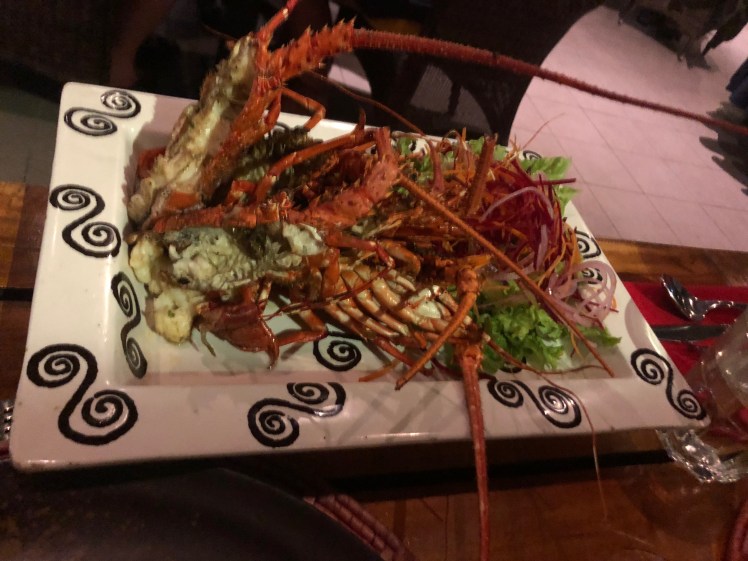 Bill loved his para fish cooked in lemongrass and coconut milk SO MUCH he was reluctant to veer off in another direction and in fact opted to reorder the exact entry Night #2. We watched a lively group of guests thoroughly enjoying their dinner, wine, playing the guitar and even receiving lengthy head massages while at the table. A truly relaxing evening next to the beautiful Indian Ocean.
The next morning, we joined the 8am yoga class on the lawn along with 3 other guests. Neither Bill nor I will ever forget how our instructor demonstrated the deepest Crescent pose we’ve ever seen and maximized his inhales (complete with a crazy right nostril crinkle!) Sorry, no pics but I was really tempted. Bill and I just love “yoga field trips” as there’s always a “take away” that stays with our practice and later transports us back to the various yoga adventures we’ve had around the globe.
Ganesh came to collect us for an outing to Galle, a small city on the southwest coast founded by the Portuguese in the 16th century and famous for its stone-walled fort along the water. It was hot (38C/100F degrees) and for the first time on the trip we really experienced the Sri Lankan heat. Fortunately, there were a nice ocean breezes as we walked for 2 hours around this old colonial city and its fortress.
In 1505, Portuguese sailors first came to Galle when their ship which had been chasing an Arabian enemy got lost in storm. For days, the Portuguese sailors floated at sea in hopes of finding land and then one morning heard a rooster and sailed towards it. “Galla” means rooster in Portuguese and hence the Portuguese name for this city. Galle is also affectionately called the “Coq on the Rock” as well.
Very quickly, the Portuguese ascertained the natural wealth and bounty of Sri Lanka, as well as the value of Galle’s protected harbor. Consequently, they decided to establish a trading hub, building a thick limestone fort along Galle’s coast line with 3 bastions and a moat with a drawbridge. Although over the subsequent years the Portuguese made several attempts to penetrate further inland to the north/central areas controlled by the Kandian kings, they were never successful. The superior defenses of the Kandian armies, as well as the oppressive heat and ever-present malaria proved too strong for the Portuguese. The Kandian kings however tolerated the Portuguese explorers and allowed them to trade and control coastal areas surrounding Galle.
Not much of the stone walls of the original Galle fortification remains. It was known as the “Black Fort” due to the charcoal that covered the limestone walls. On one of the jetties, there was a really rusty shipwreck that served as a reminder of this harbor’s rocky approach that sailors navigated for years without a lighthouse let alone LORAN equipment!
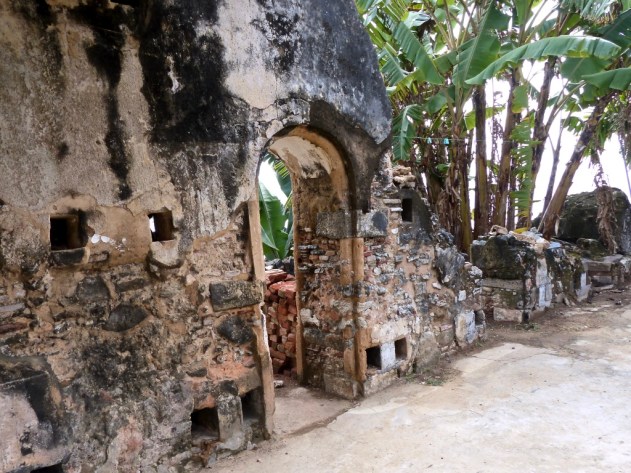
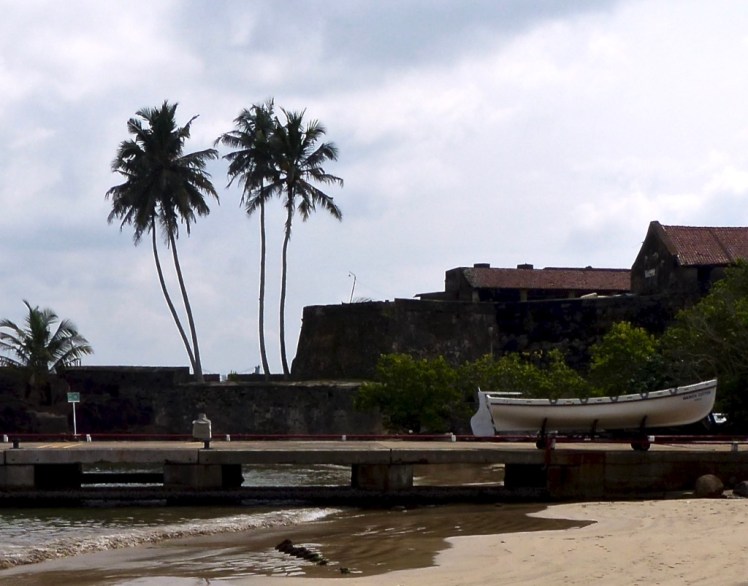
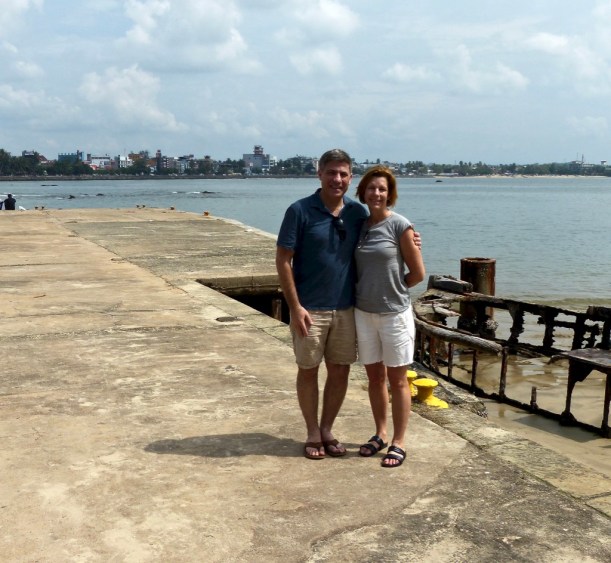
Entry into the Black Fort is restricted but Ganesh seemed to wink and slide quickly by the armed guards so we could explore this old Portuguese ruin. We walked around some old barracks, popped in the small guard post and explored stone rooms that were either used for ammunition storage or as prisoner cells. Bill’s love of history was written all over his face as he poked around and jumped up on the walls pretending to defend against naval enemies. We crept through a well-hidden secret passage from the fort down to the jetties on the sea, admiring the clever construction that would have been invisible to approaching sailors and provided an excellent defensive attack platform for the Portuguese.


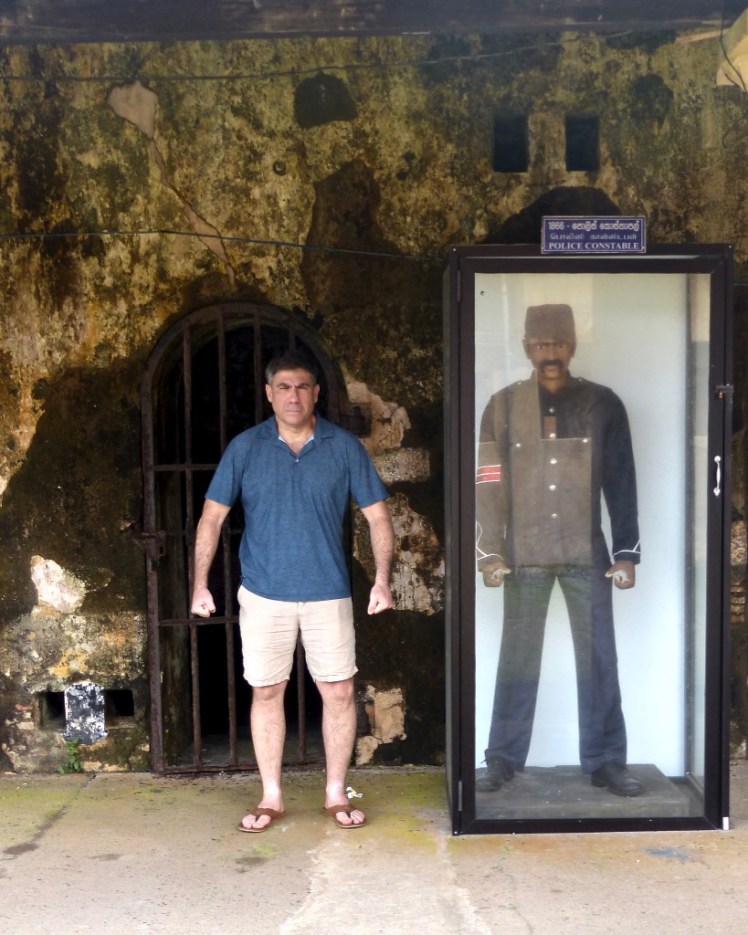
A trip with Bill just wouldn’t be right if we didn’t have a bit of theatrics. Sadly, I’ve actually seen him adopt this pose even when he’s not mimicking a Portuguese police constable…AND is instead a tad frustrated with me?!
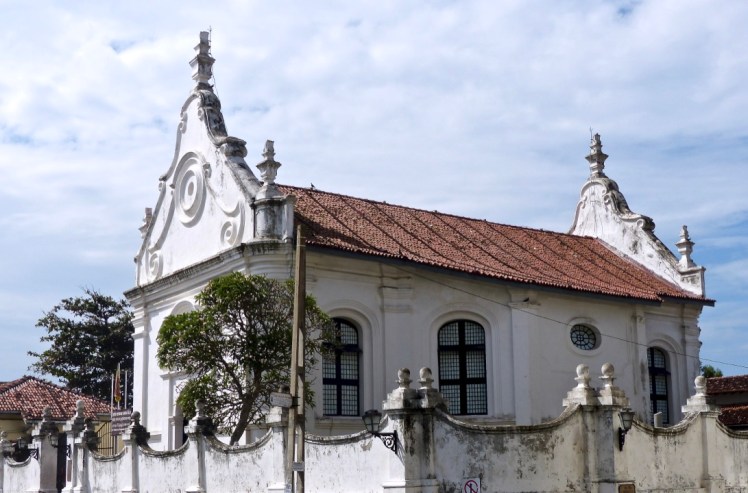
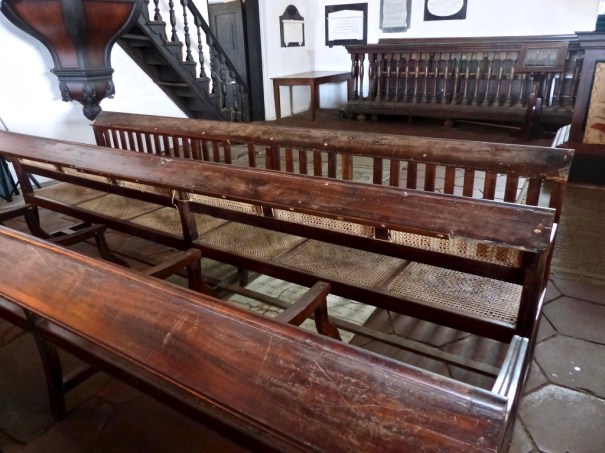
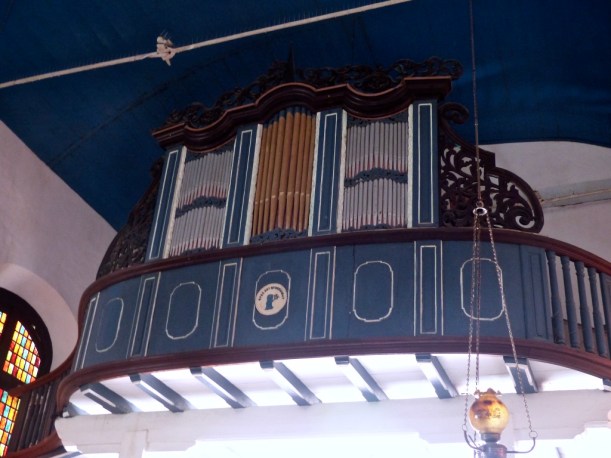
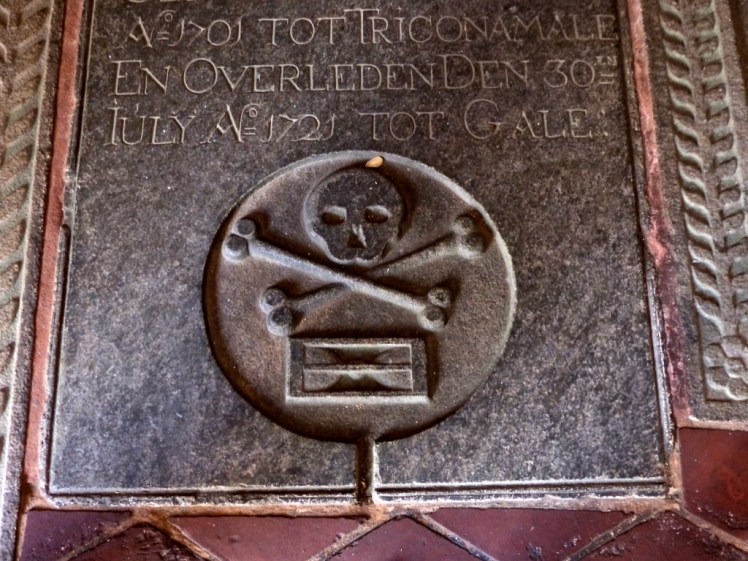
In 1640 after a fierce battle, the Dutch succeeded in wresting control of this southwestern coastal territory from the Portuguese. After capturing Galle, the Dutch expanded the fort’s ramparts adding 11 more bastions including some interior ones to thwart any invasions by local Sri Lankans. Many of the buildings constructed by the Dutch are still standing today, including a beautiful Dutch Reformed church built by a governor to honor his wife who finally conceived a baby girl after many years of infertility. This governor engaged a boat builder as the architect so the church ceiling is bowed and ooks oddly like as ship’s hull. The architect’s use of deft blue paint on the ceiling/walls and imported ebony wood for the pulpit were striking. The huge impact malaria had on the Dutch population was also evident by the numerous graves with skull and cross bones visible in the church.
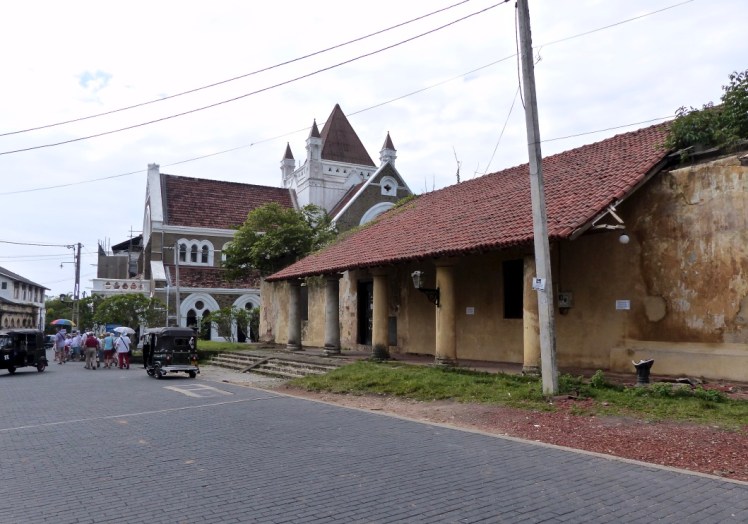
 The Dutch also introduced new architectural design elements to Sri Lanka like the building below with its long, low roof supported by columns and interior veranda. These “new” Dutch features were particularly well-suited to the hot climate and adopted by subsequent architects throughout the country.
 Directly next door is an Anglican Church built later by British in the traditional cross-shaped style, complete with a stained glass rose window…and quite a bit of green mold growing on the white-washed walls.


Nearby, are the huge spice warehouse buildings the Dutch cleverly built on the interior side of the port ramparts to store items for trade (ivory on lower levels and spices/tea above). The Dutch also constructed many buildings for administrative and military purposes, beautiful private homes, roads and a elaborate drainage system that ushered sewage out to sea at high tide. Most of these old buildings have been well-preserved and one often sees the “coq on the rock” symbol like the one below.


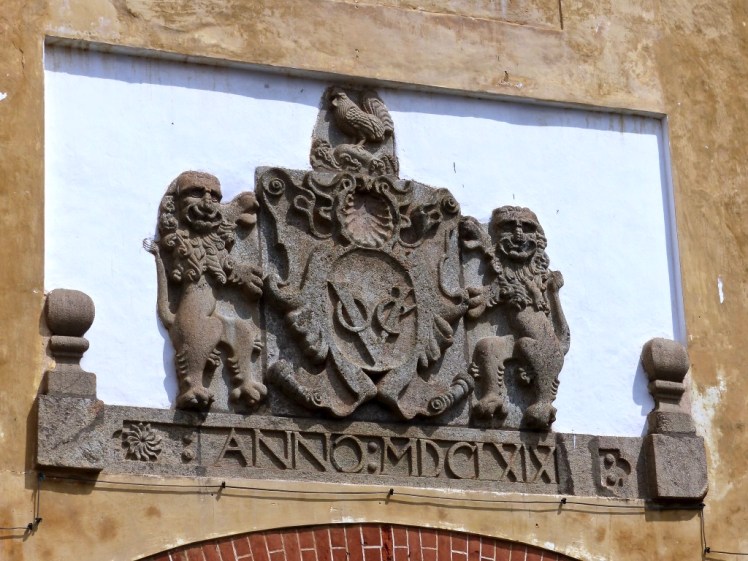
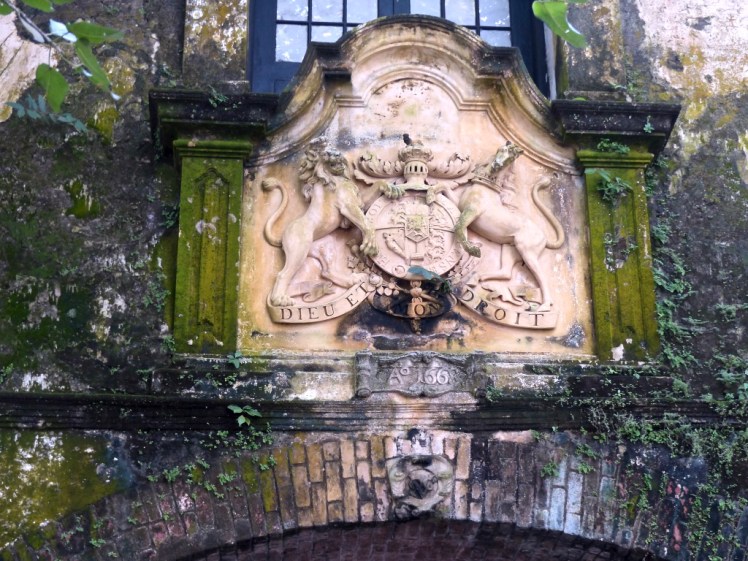
The magnificent warehouse building below has an impressive gate with a huge Dutch crest of arms featuring the VOC insignia of The Dutch East Indies Company. Originally, this crest faced the sea but when the British seized control of Galle in 1796, they replaced the Dutch crest with their own which features the Lion (symbol of GB), Unicorn (Scotland) and Dieu et Mon Droit (France), placing it seaward and relocating the Dutch VOC crest to the interior side of the gate. 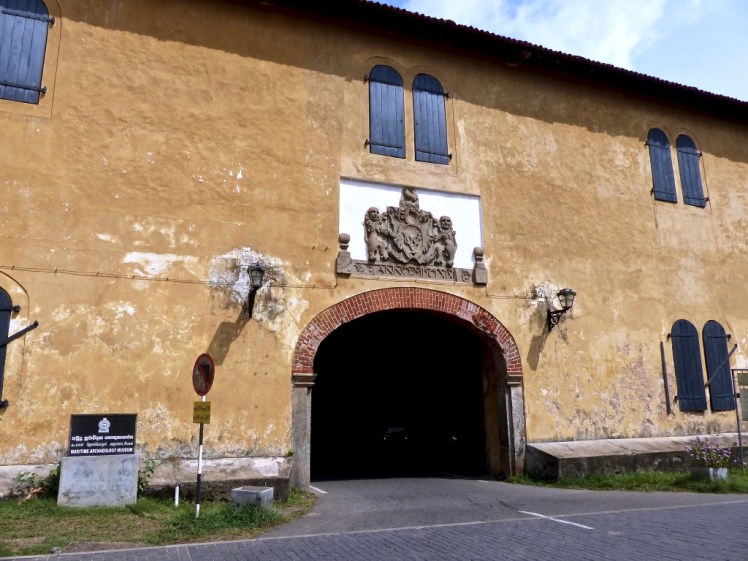
When the British seized control of Galle, they further expanded the fortress, adding an esplanade, a clock tower, more administrative buildings, a lighthouse and several the Law Complex buildings which are still in use today. Swish boutiques, brew pubs and restaurants now occupy some of the old buildings which have been nicely restored.


Despite the heat, we thoroughly enjoyed our leisurely stroll along the fortress walls and quaint streets of Galle and certainly recommend this old colonial city to anyone who travels to Sri Lanka. Bill, the history buff, soaked up every detail Ganesh offered about Galle and was captivated by some old Dutch coins that a local was selling to tourists on one of the bastions. After a brief negotiation, Bill walked away from the purchase, wondering if it was a scam and then spent the next hour noodling on it, seeking the opinion of myself and Ganesh, and then ultimately returning to “seal the deal”. From the interior of the car, Ganesh and I watched the final interaction, as the seller and Bill reunited, both grinning ear to ear, and then engaged in an earnest, somewhat lengthy debate over which coins to bring home as a momento of this wonderful trip. Ganesh and I were also smiling broadly as we witnessed this PRICELESS moment. The coins are beautiful and one even has the VOC sign of the Dutch East Indies Company.

Sri Lanka’s national sport is cricket and the field adjacent to the Galle Fort is used almost daily by the national team as well as club teams.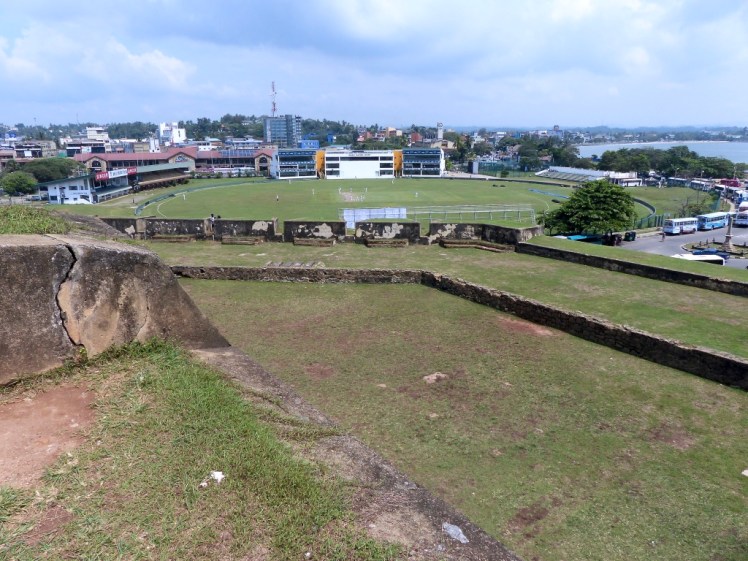
We walked by a school where girls in white school uniforms, hats and sneakers were all marching to orders called out by drill Sargent/PE teacher in the sweltering heat. The excercises were conducted in the middle of the day for well over an hour. NO THANK YOU! Bill and I did however admire the old Benz in the background.


On the way back to the Owl & Pussycat, we stopped to buy Zoe birthday cards at a stationery store (and then sent them via DHL at great expense and hassle to arrive by 2/13. They actually arrived a day late but still in time to bring a smile to Zoe’s far away face at SPS.) We also picked up various scented incense sticks to sherpa back to Seoul for our morning yoga routines. A stroll through a local vegetable marke allowed me to identify some of the various fruits and vegetables we’d been sampling on the trip. 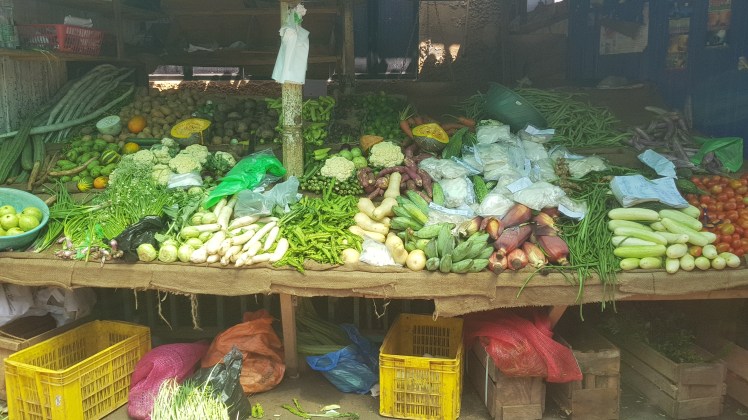 We also stopped at a roadside seller to sample the orange King coconut which is a completely different fruit than the green coconut whose white flesh, encased in a brown hairy nut, is used for cooking and quite familiar. I’ll admit here to thinking the orange and green coconuts were the same fruit, just at different stages of ripeness. WRONG! One only drinks the King coconut’s refreshing juice. I now wonder about the brown coconuts with straws sold to tourists all over the streets of Vietnam…


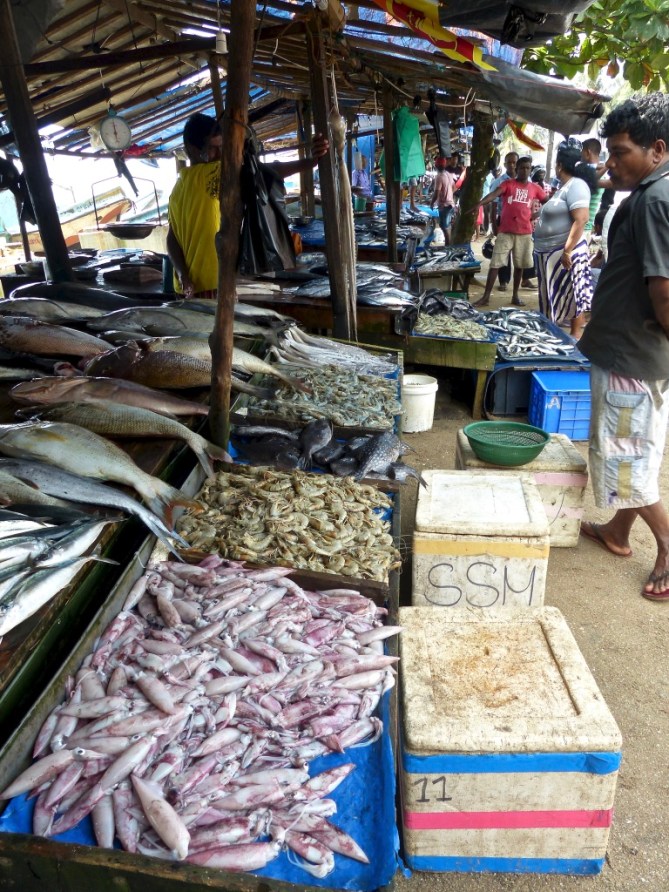
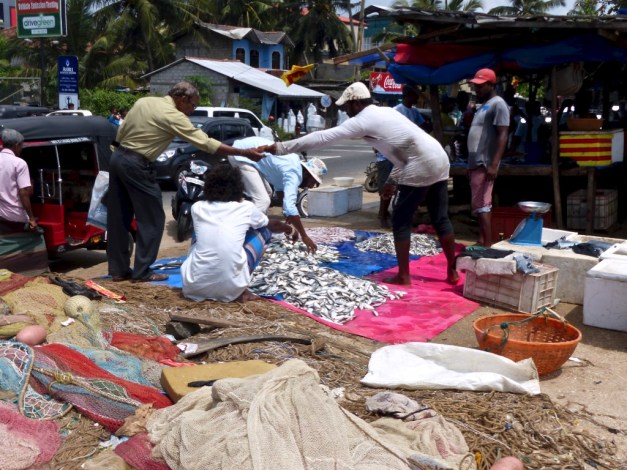
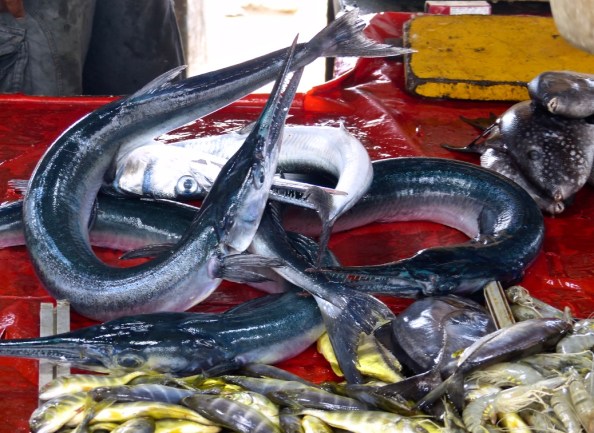
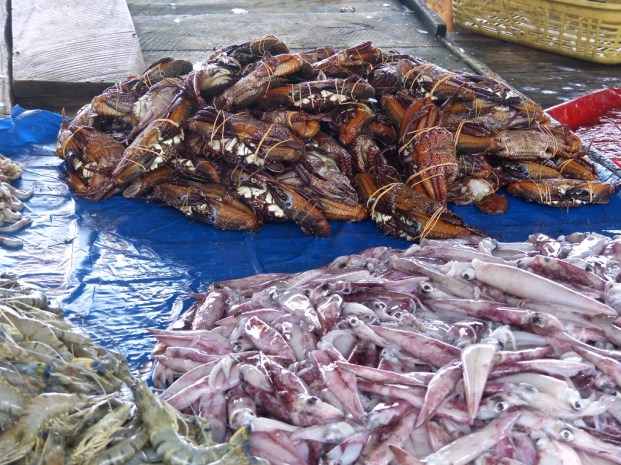
Although we didn’t buy anything, we stopped to peruse the day’s catch at a busy local fish market, marveling at the array of freshly caught tuna, marlin, mullet, cuttlefish, octopus, shrimp, butter (para) fish, shrimp etc. Fishermen were untangling nets on the beach next to the stalls and fishmongers’ knives were flying. It was certainly a very different experience than buying trimmed, fileted fish in the States!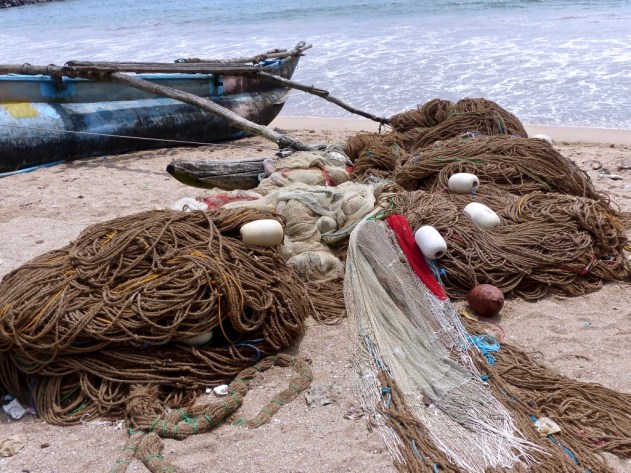
Although the Owl & Pussycat’s pool and lounge chairs overlooking the ocean were inviting, we decided to go off property and explore the beach one afternoon. We strolled along the sand, climbed over rocks and ended up at a protected swimming “hole” where several local children were playing in a more protected section of the beach. With big smiles and friendly “Hellos”, they beckoned us into the water to join them. We soon discovered that this was the only English word they knew so resorted to “high fives”, “thumbs up” and other universal hand gestures that serve us well in Korea and on our adventures worldwide.
We saved the end of the trip for total R & R and were very happy to spend 3 nights at Amanwella, one of two Aman resorts near Galle. For those of you not familiar with the Aman family of resorts, Aman means “peace” in hindi and each Aman resort is uniquely suited to blend into its natural surroundings and strives to incorporate local design elements. Usually, the Aman properties are very large, but only accommodate a few guests so as to afford a peaceful experience.
Situated on 150 acres overlooking the Indian Ocean, Amanwella (wella means “beach” in hindi) has just 30 suites and its design was inpired by Sri Lanka’s famous architect Geoffrey Bawa. Amanwella’s “tropical modernism”, clean lines and simple elegance are stunning, the beach pristine and the resort definitely worth a visit! Here, we swam, read our books, walked the beach, started our day with a private (only because no other guests showed up) yoga under the palm trees lining the beach, got massages and savored our last few Sri Lankan curries, fresh fruits, vegetables and fish, knowing we’d dearly miss these culinary experiences once back in Seoul. We were actually sore for days from the yoga routine which challenged us to deepen various basic poses in ways we didn’t know our bodies could move. We are now cognizant of this new “edge” each time we get on the mat.
The water was so warm and clean, but the waves were quite strong. In fact, as I came down to the beach one day, I witnessed Bill being “rescued” by a life guard. Of course, he denied this at first, but I remarked that the life guard’s close proximity to him and the guard’s hastily discarded shirt on the beach nearby were dead give-aways. A sheepish and very sandy Bill then confessed to having been boiled in a strong wave. I’m just glad it wasn’t me!


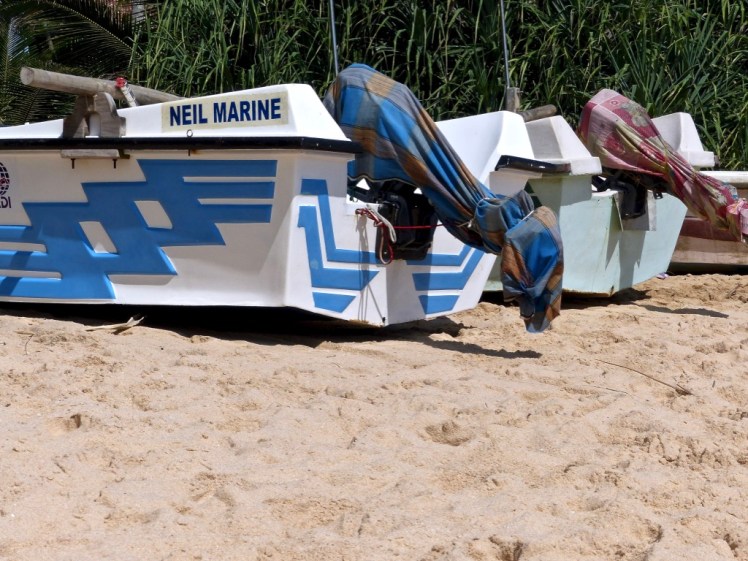
We walked the beach everyday and got a kick out of how the locals “shrink-wrapped” the engines on their boats, noting that it was a whole lot less complicated and expensive than what is performed on Bandit each year!
Although we were tempted to slounge away all three days, we decided to meet Ganesh one of our mornings for a trip to Mulkirigala, a local rock temple nearby Tangalle which is like a “mini Sigiriya”. Again, it was Saturday so there were bus loads of locals traveling from nearby villages to visit this temple whose oldest inscriptions date from the 2nd century BC and whose 7 caves were inhabited by monks during the same time period as the Dambula rock caves. This temple is also home to one of the original 32 Bodhi trees. We slowly climbed the stone staircases so as not to be totally drenched in sweat and were treated to cool breezes and nice views at the top. There were plenty of mischievous monkeys jumping around as well.


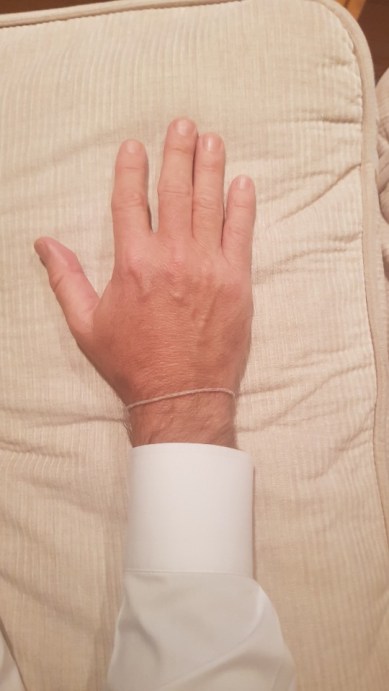
We stopped to make a donation and received simple white blessing threads. Amazingly, this thin cotton string remains on Bill’s wrist even today and makes him a very COOL Citibanker in my opinion!
The cave drawings and artfully displayed cloth-wrapped coins were pretty too. 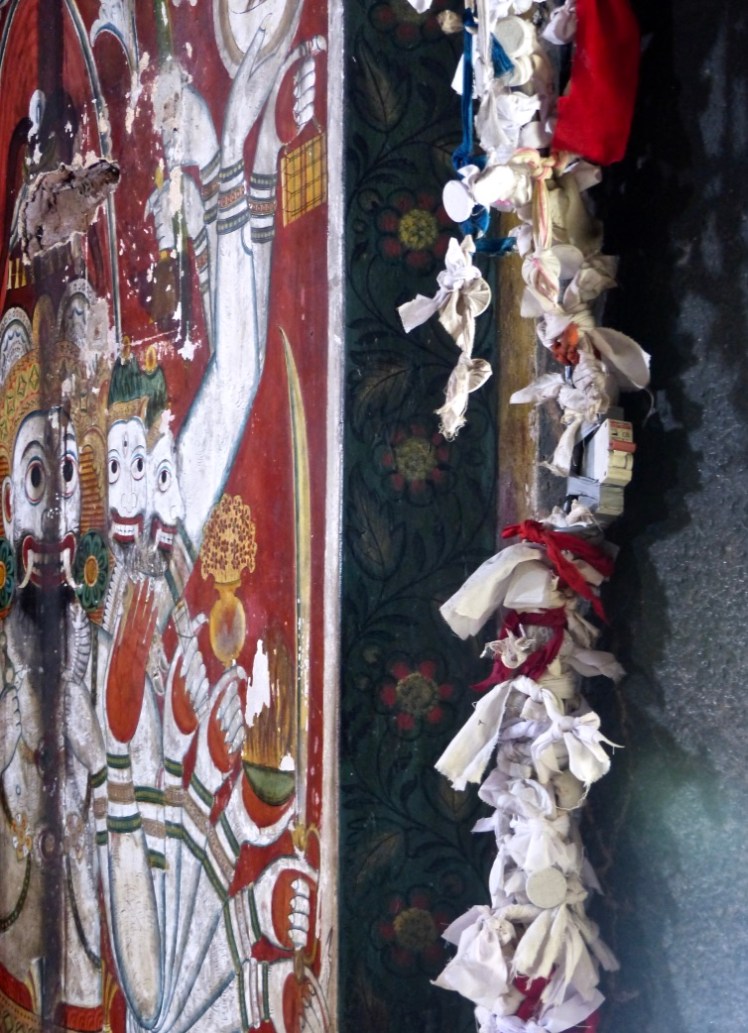 The gardener in me was intrigued by the beautiful flowers growing on vines that the locals were gathering to make offerings at the temple. These magnolia-like blossoms are from the Sanbal tree under which Buddha passed away and are called “cannonball” flowers. Everywhere frangipani trees were in bloom so the air was nicely scented and conveniently disguised our own sweaty body odor.


The service at Amanwella was impeccable and each morning the friendly staff began breakfast service a full 30 mins ahead of schedule just because of our desire for that morning cup of coffee. As we chatted with the staff, all of whom live in the nearby village, we learned how badly Sri Lanka was affected by the massive Indian Ocean tsunami that devastated so many S.E. Asian countries in 2004, including the community of Phuket, Thailand. The waves came up to the swimming pool, but fortunately no one from the resort or village died. 35,000 Sri Lankans however died or are still missing as a result of the 2004 tsunami which was the first ever to hit the country. We were comforted to learn that the spa where we headed each afternoon for treatments was Amanwella’s designated “tsunami shelter”. By the end of the trip, we were quite chummy with Pantelis, the young Greek GM (from Chicago) and he kindly agreed to contact the Aman resort in Turks & Caicos (Amangara) to arrange a special birthday dinner for Zoe on 3/13, a month after her real birthday but when we had plans to finally be together. (Bill and I are fast becoming Aman “groupies” and I’m already plotting our next Aman excursion!)
For our last day in Sri Lanka, we decided to explore Colombo a bit and Ganesh gave us a drive-by tour of the main buildings/monuments. This city of 1.3 million people covers 37 square kilometers and is quite modern. There is a huge lake in the middle of the city with many key administrative buildings situated on its shores, including the new Parliament building designed by Geoffrey Bawa. Once again, we noted China’s influence. In 1907, the Chinese constructed a huge conference hall as a gift to Sri Lanka and more recently China gave a beautiful lotus flower-shaped hall with indoor and outdoor performances spaces. Since 2016, China has also been helping Colombo reclaim land from the sea and funding a massive expansion of Colombo’s port that will become a special finance zone and facilitate international trade in the area. Oh, the reach of China’s Belt and Road Initiative!
We drove by the memorial honoring the 27,000 Sri Lankans lost in the civil war which lasted from 1983-2009 and dominated the lives of so many living there today, including that of Ganesh and his family. During our trip I read Nayomi Munaweera’s wonderful novel entitled Island of a Thousand Mirrors. The novel is a saga spanning the 28 yr. long war. Like a memoir, it details the lives of characters on both the Tamil and Sinhala sides of the conflict such that the reader feels the pain, loss and tremendous impact this long, brutal war had on the country. As I learned more about Sri Lanka’s civil war, I discussed the events with Ganesh who shared with us that some of his own relatives died in the horrible “Black July” 1983 Colombo riots when anti-Tamil forces killed so many, often throwing car tires over people and setting them on fire. Thankfully, Ganesh truly feels this racial tension has dissipated today and the country has healed.
Our final stop was lunch at the Ministry of Crab which Tania Polglaze, our good Australian friend in Seoul whose parents lived in Sri Lanka and were Burghers of European ethnic descent, kindly arranged for us. Started by a renowned chef and two famous Sri Lankan cricket players/relatives of Tania, this restaurant is voted one of Asian’s 50 Best. It is located in a beautiful 400 yr. old Dutch building which was a hospital during the colonial period and is today across the street from Colombo’s World Trade Center. The menu says it all, as does the smile on Bill’s face as we dug into the delicious Sri Lanka cuisine for the last time before heading back to Seoul.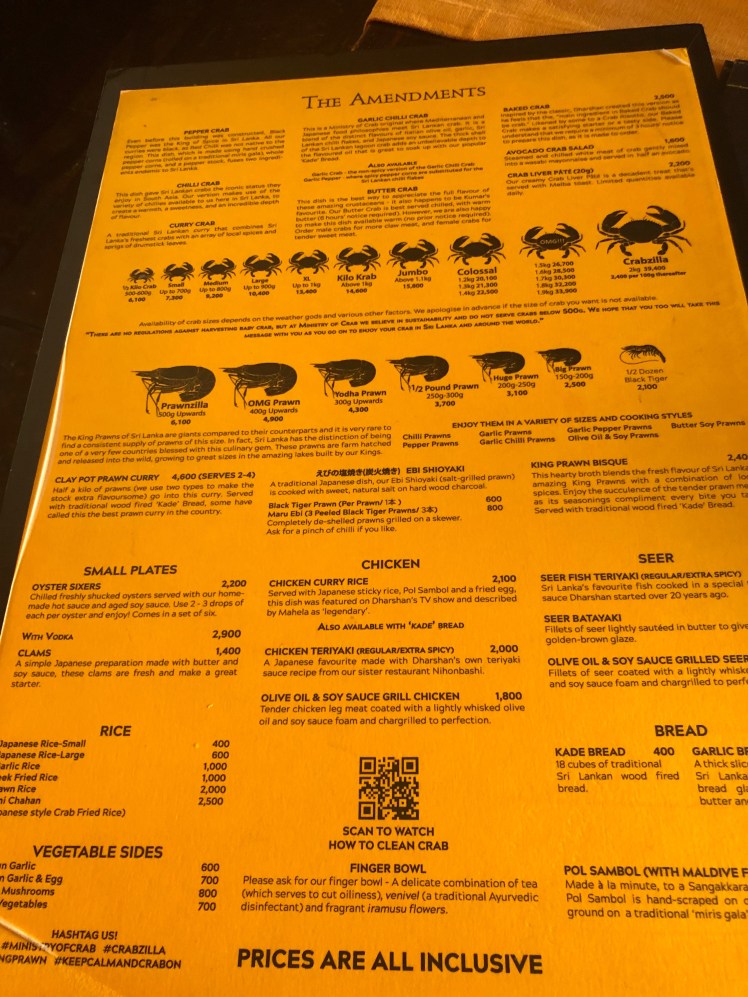
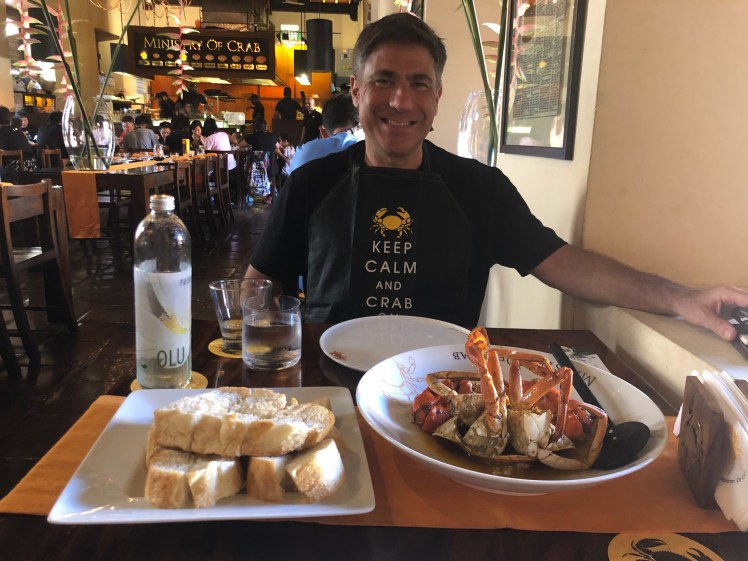
We worked our way through our “Colossal Crab” order, dipped the stack of Kade traditional Sri Lankan wood-fired bread in the yummy sauce and used every single napkin, our bibs and tongues to clean our fingers and faces after the feast. A great finish to our Sri Lankan sojourn!
 seoulfulsojourn.net