Another year in Seoul brought another Chuseok vacation that provided an excuse for us to continue our exploration of Asia. Most folks combine a trip to Cambodia and Laos, but we were late planning the trip and couldn’t get the flights we wanted to/from Siem Riep so decided to explore Angkor Wat another time and just focus on Laos. A visit to this southeast Asian country had been highly recommended to us several folks. Daphne spent a week there on a service trip during her senior year in Seoul and my parents visited Laos during their tour of Laos, Vietnam and Cambodia. Our friends Christine and Sean Guinness trekked and kayaked through a lot of the country’s less-traveled territory and their enthusiastic endorsement of Laos’ beauty just couldn’t be ignored so we “leapt over to Laos” for 5 nights.
We chose to split our time between Vientianne, the capital city, and Luang Prabang, a well-known interior city visited by many tourists each year. Fortunately, we missed the peak season so didn’t have to share our days with throngs of visitors. Nor did we experience bad weather despite visiting during the rainy season. The nearly 5 hour flight from Seoul was easy and we were pleasantly surprised to learn that our hotel was a mere 7 minutes drive from the airport. 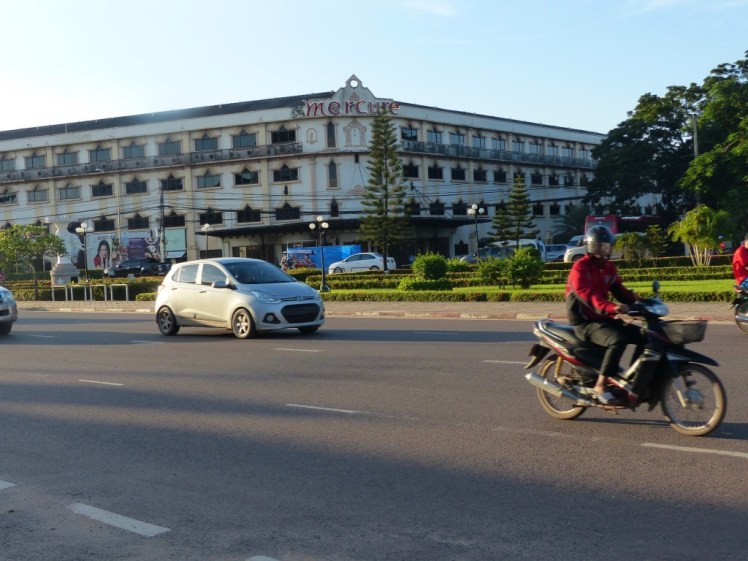 Hotel Mercure was clean, if not somewhat dated, and the staff very pleasant and welcoming at midnight when we arrived. We slept well and awoke refreshed and ready to sample the famous Laotian coffee at the poolside coffee bar. It only took me a few sips to realize just how very strong the brew was and so I backed off while Bill downed cup after cup, becoming increasingly excited about our plans for the day and sweaty in the humid weather. He even contemplated cooling off and joining the old lady who was steadily swiming her laps while we looked at city maps and drank coffee. I wandered around and found a newly planted living wall…inspiration for a project I hope to tackle one day!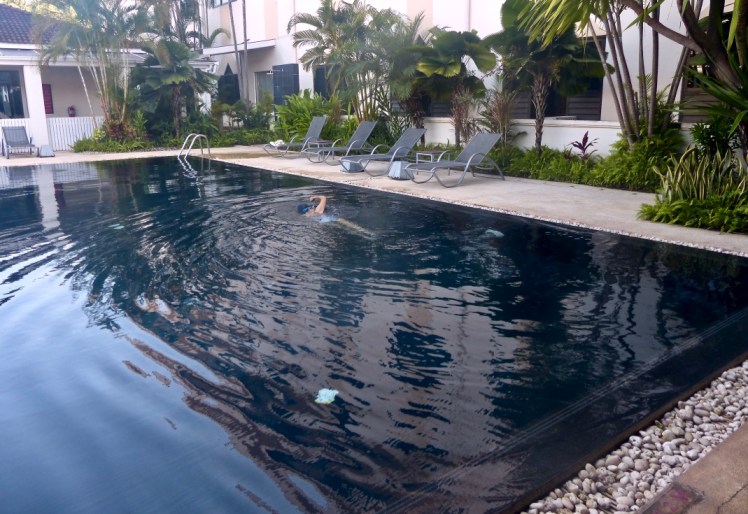


Many of other guests at the hotel were part of large group tours and we had a chuckle as a group of Koreans gathered in the lobby and then boarded a large red Hana Tour bus since these buses are ubiquitous in Seoul and the company is a Citibank client. With the lobby staff, we practiced saying “Suh-bye-dee” (Hello, in Laotian) while holding our hands together but without bowing as we did in Thailand. Sadly, we couldn’t manage much more. With guidebooks, maps, iphones and directions from the concierge in hand, we set off in the heat to find a hightly recommended coffee spot for some breakfast. Benatton Cafe should have been easy to find after a short walk…but we failed miserably, got hot, bothered and opted to hang at Cafe Trio instead. I enjoyed a refreshing iced ginger honey tea and homemade yogurt with mango and chia seeds while Bill sampled some more Lao coffee (iced this time) and coconut puffs.


The streets were quiet and the general pace of life was much calmer than that of Seoul. Lots of motorcycles zipped but without honking so we found the city to be one of Asia’s quieter capital cities. We only saw 3 traffic lights and virtually no stop signs since the rule of the road is “flow” and common sense prevails much as it does in Seoul. Street vendors selling fresh vegetables, fruit and snacks wheeled carts around while monks clad in bright orange intermingled with locals and tourists like ourselves. Noticeably absent were some of the familiar American “exports” like 7-11, KFC and Dunkin’ Donuts to which we we’ve grown accustomed, if not dependent upon, throughout Asia. In fact, we only saw Dairy Q at the airport; fortunately, Bill did find his daily afternoon soda (both Coke and Pepsi were available here) but I missed my Snickers. We were surprised to find a Hard Rock Café and it certainly looked odd in such close proximity to one Vientianne’s many many Buddhist wats (temples).
Vienianne is a small city along the Mekong river and most of its major sites are within easy walking distance, making it a popular destination for many budget backpackers. While we noticed similarities between Yangon (former capital of Myanmar) and Vientianne, Laos’ capital city has noticeably more electricity, with most all businesses and homes using power and A/C. In fact, when Bill needed to buy a phone charger, we had no trouble finding this item…in a shoe store?? 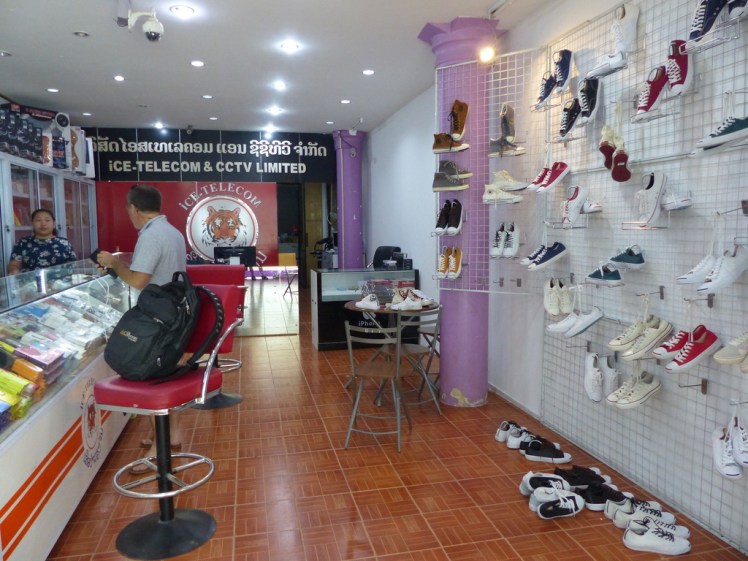 We subsequently learned that Laos is often referred to as Southeast Asia’s “battery” since the Mekong river and its various tributaries have provided many opportunities for the country to develop its hydroelectric power resouces. During the past decade many dams, reservoirs and hydroelectric plants have been built, often with aid from neighboring countries like China, Korea and Thailand. As a result, Laos has pleny of capacity to meet the needs of its population and an estimated 92% of homes have access to electricity. Exploitable capacity is high and has definitely contributed significantly to recent economic growth and development. However, there has also been an environmental cost to the development of this important resource and in July 2018, part of a major dam under constructed collapsed, killing many and destroying homes and small villages nearby.
Although Vienianne was originally settled in the 9th century AD to cultivate the fertile alluvial plains on the banks of the Mekong River, it has had a tumultuous history, thriving at times as a major regional center and at other times, completely overrun by external forces from Vietnam, Burma, Siam (Thailand) and China. In 1867, French explorers from neighboring Vietnam arrived and began reconstructing much of the city destroyed earlier when Laos tried to assert its independence from Siam. The French influence in Vientianne can be felt today, though to a much lesser degree than in other Southeast Asian countries, since within France’s IndoChine sphere of influence, Laos ranked the lowest.
We had hoped to rent bicycles to leisurely toodle around Vientianne but had left our passports in the hotel safe so couldn’t present the necessary ID and wish the guidebook had mentioned this detail. Oh well…another chance to develop our flexibility in our mid-50s! Instead, we nipped into Carol Cassidy Lao Textiles aware that the textile industry is key to Laos. A weaver herself since the age of 17, Carol Cassidy worked for the United Nations as a textile expert and established her own factory in Laos in 1990. Today, Lao Textiles is comprised of a factory, with over 30 weavers, and a gallery/workshop and the fabrics and furnishings produced there are shipped to clients all around the globe, including the Museum of Philadelphia. Unlike the looms we visited in Myanmar, these were very quiet, lacking the clacketty-clack noise that reverberated in the workshops of Inle Lake. Also, the Laos looms were operated by both men and women and the master weavers/designers, as well as the silk dyers, were all male, whereas in Myanmar, the entire weaving industry is female. The silk at this factory is all hand-dyed and the finished product, whether traditional or more contemporary, is truly beautiful.


Most Lao women today wear silk skirts with a woven motif band at the bottom edge like those seen in the photo below. 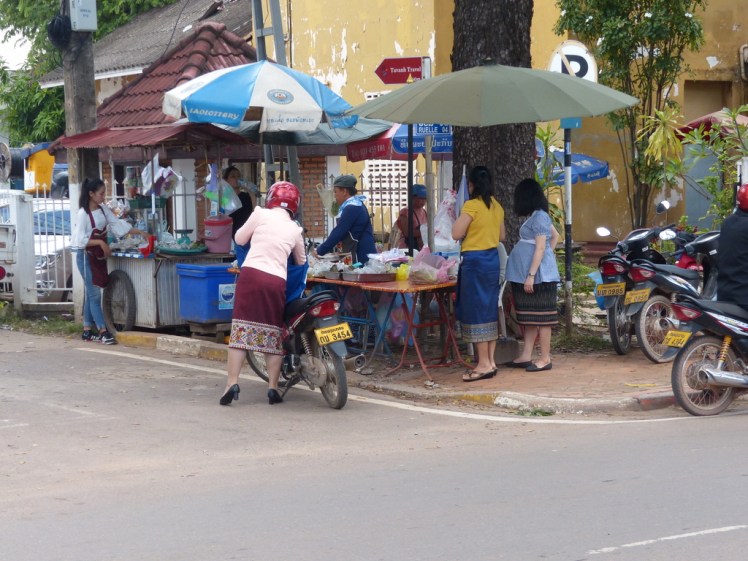 From here we walked to Vienianne’s oldest temple, Wat Si Saket, which is located across from the Presidental Palace in photo below.
  In the early 19th century, Prince Chao Anou, a Lao prince educated in Bankgok and installed by the Thais, attempted to assert Laos’ independence but failed dramatically. During this conflict, Wat Si Saket served as the Thai base and hence it was the only major building to have survived this major conflict that razed much of the city and provoked most of Vientianne’s population to flee.
The mature trees outside the Wat Si Saket temple courtyard provided some relief from the hot sun and we had a good chuckle over this Buddha whose girth and lack of neck suggested that he didn’t really need to receive any more donations!
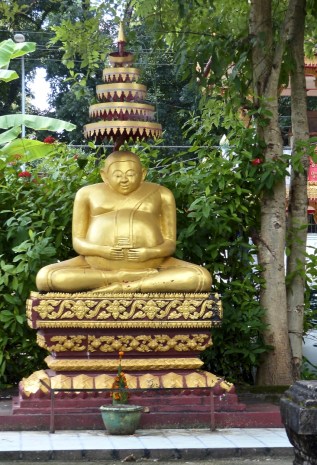
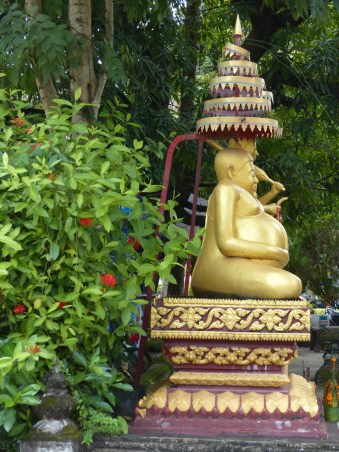
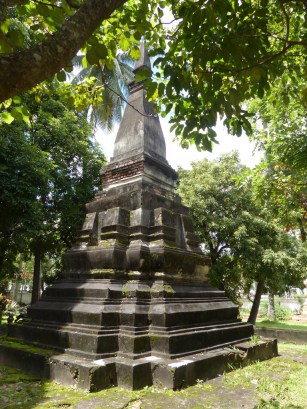
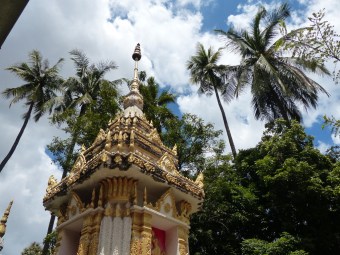
Despite the limited signage, we enjoyed our leisurely stroll around this temple full of nearly 10,000 (!) Buddha statues and old buildings dating from 1818. The cloisture encircling the main temple hall offers nice shaded views of the grounds and was a favorite place for kings to greet the aristocracy.


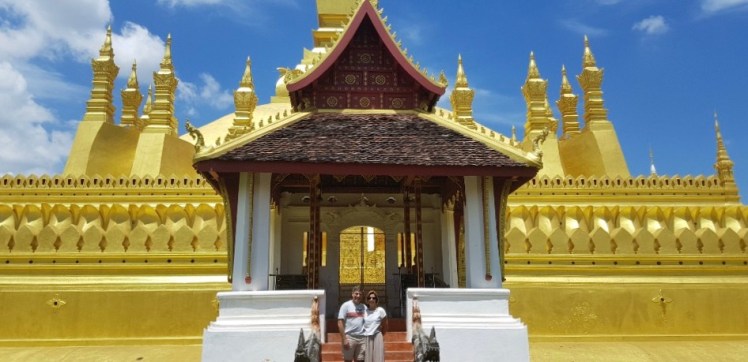
Wat Si Saket is a popular photo spot where many Laotians mark important rites of passage. We saw professional photographers working with several couples who we assume were brides and grooms in traditional dress posing for wedding photos. Military service is compulsory for all Laotians and there were many young folks in their full military uniform posing for professional photographers with certificates/diplomas, again to mark this important moment in life. We bumped into some Korean tourists and performed the usual “picture taking dance”…we will take yours and then you take ours. After three years of living in Seoul, we know full well how much Koreans love to take pictures so we always offer to take group shots for them, whether atop a mountain, on the street, in a restaurant. We are quite good at saying “Hana (1), Duel (2), Set (3)…kimchi!” and our offers are always appreciated and reciprocated…as you can see below!
Hot, hungry…and therefore “hangry”, we nipped into a simple lunch spot which quickly cooked up a yummy shrimp soup with plenty of lemongrass and some spring rolls for us. I could easily see the women cooking and was impressed with how very fresh the ingredients were and how carefully the kitchen was maintained in this tiny, almost pop-up restaurant.
Revived, we strolled around the capital city streets a bit more, exploring some of the many, many Wats around us, including Wat Si Muang which is home to “lák méuang”, the city pillar which has been used for religious purposes for over 1,000 yrs, and is considered Vientianne’s gardian spirit. Apparently, Wat Si Muang is the most frequented Wat of all and yet we didn’t see a single visitor. The juxtaposition of religious life with signs of Laos’ modernization were striking. We made a mental note NOT to ever visit the International Clinic pictured below…for obvious reasons!

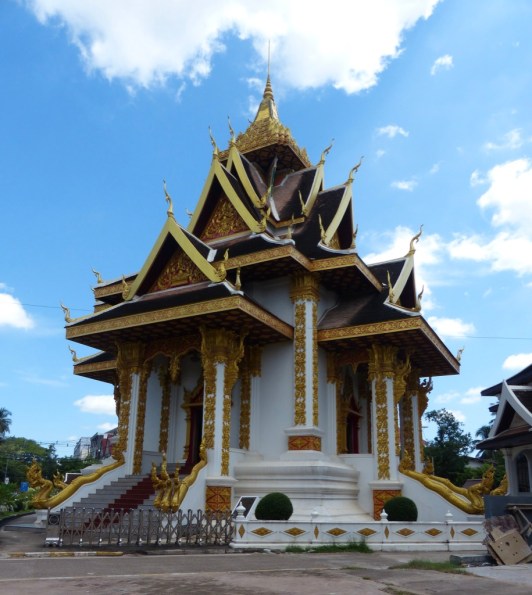
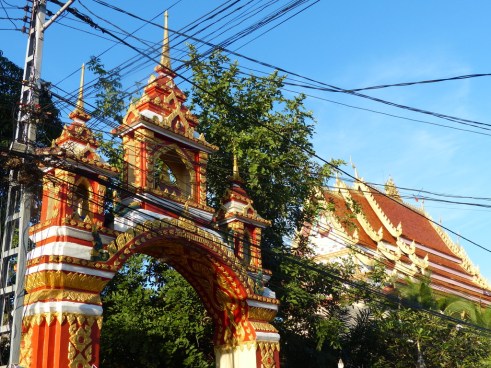
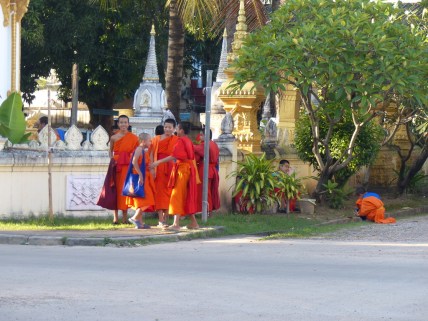
I was flagging a bit and so when Bill suggested we get a midday massage, I took him up on his suggestion and the 90 min. massage we received at the Tangerine Garden Spa was heavenly! We were shown into a room and asked to change into brown cotton shorts and tees, much like the ones we wear in Seoul for massages. The masseurs moved our limbs and stretched up in a manner similar to Thai massage, applied good strong pressure and were particularly good at massaging our hands and heads. AND, we paid less than $20 for both of our treatments, including tip!!
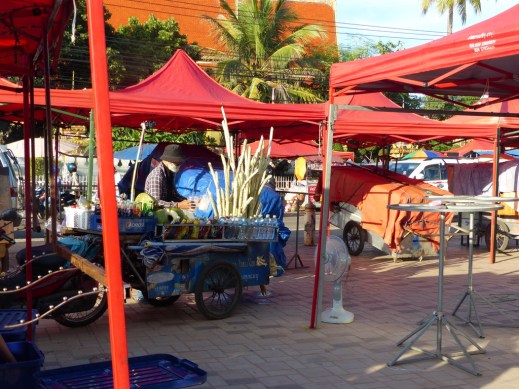
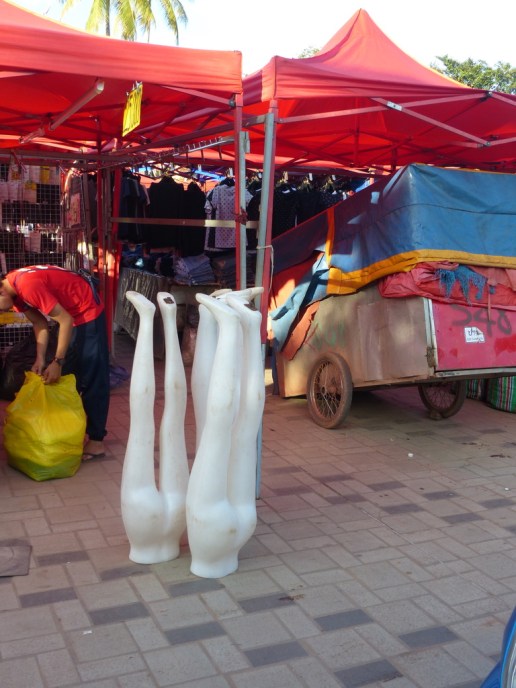
We left feeling refreshed and opted to stroll along the banks of the Mekong river back to our hotel. We are always amazed at the site of the Mekong, since it seems so muddy and unappealing to a Westerner accustomed to blue-green waters, and yet the Lower Mekong Basis, as it is called, is known for its rich freshwater biodiversity. Indeed, the fish living in the silty waters of the Mekong River provide the livelihood for millions of people in several S. E. Asian countries.. This year Laos experienced a particulary severe rainy season so the river was still quite full but we were told that it would soon dry up completely in Vientianne, becoming a giant mudflat beach. 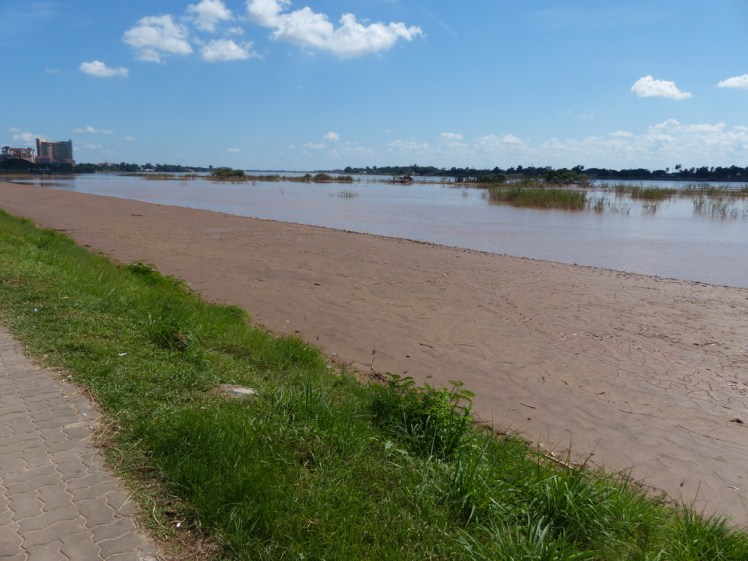 Like most Asian cities, Laos also has a bustling night market which was just being set up as we walked by. The market is assembled each day in the late aftersoon when most vendors arrive by motorbike, with a large cart of goods in tow and then quickly begin erecting temporary tent stands, dressing manequins and stringing up strands of lights before nightfall.
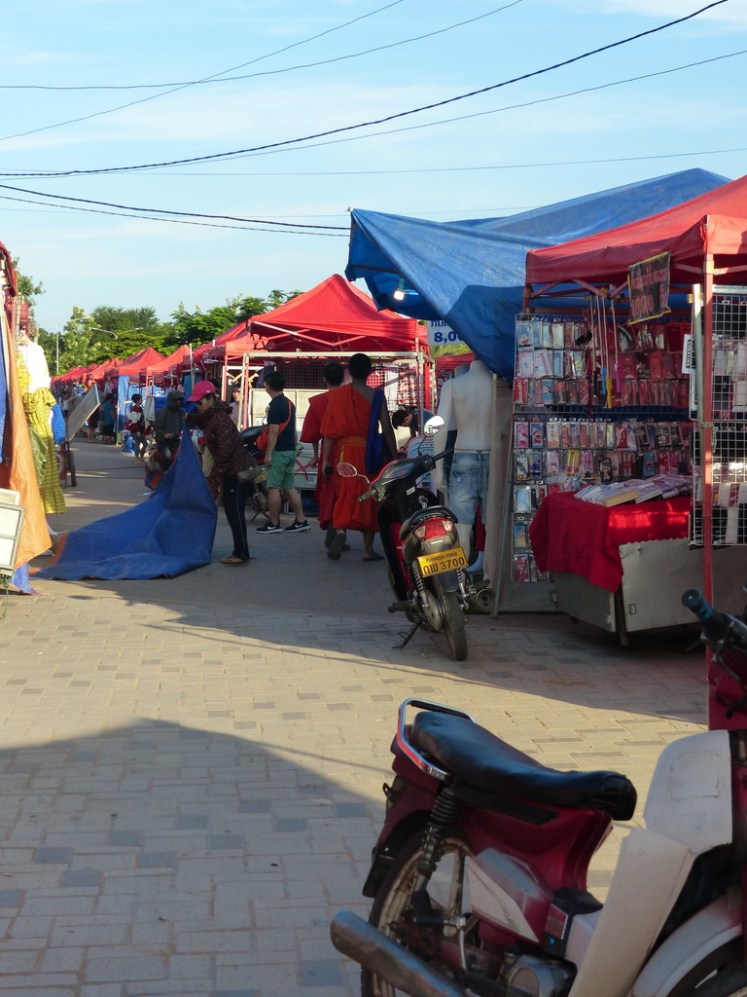
Bill, ever proud of his “efficient, minimal packing” managed to out-perform himself this trip, forgetting all of his UNDERWEAR?! It was easy to find some “tighties” in a variety of designs for Billy Boy, like the “special” ones the vendor is holding in a photo below; Bill opted for some of the CK striped ones you can see in the upper right. Sadly he refused pose for a photo so I can’t share just how SEXY he looked later that evening! Although he assured me they were “disposable”, much to my horror these skimpy items are still in circulation.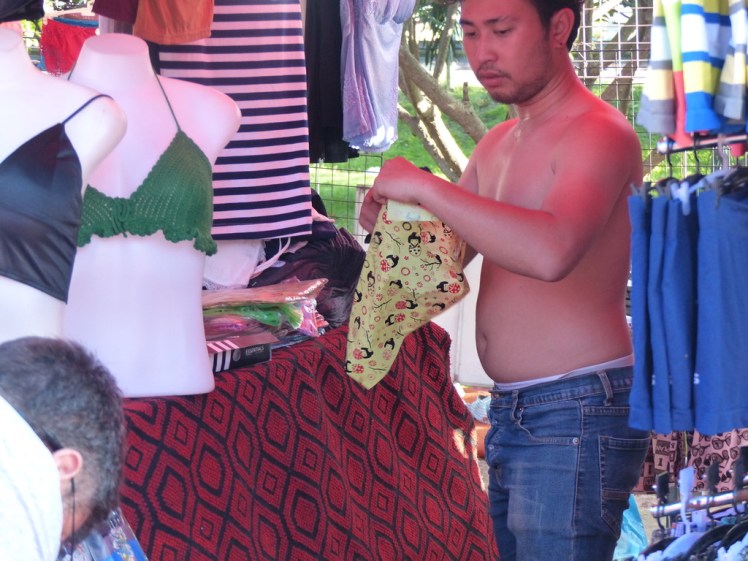
For a relatively small capital city, Vienianne is famous for its sophisticated, global, yet very affordable, cuisine. There were many options that enticed us in the guidebook, and we opted to dine at Bistrot 22 and thoroughly enjoyed several classic French dishes (homemade pâté, chèvre toast with apple, duck and simple crêpes for dessert), all of which we struggle to find in Seoul. C’était vraiement délicieux!
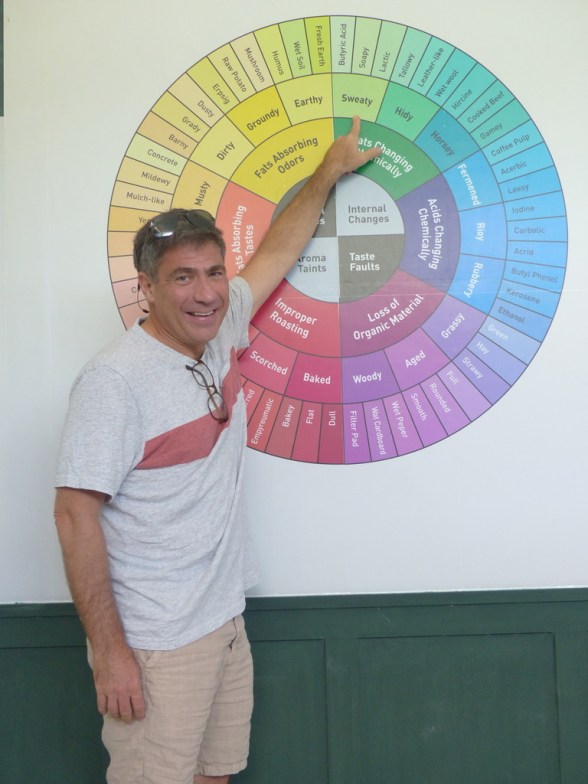
The following morning’s strong cups of Laotian coffee inspired us to hire a car to visit the nearby Sanook coffee plantation that the LP guidebook recommended for its informative tasting tour. Not only did our driver struggle to find this “plantation”, but he was truly perplexed by our desire to visit this “site”. His scepticism was warranted as we soon learned since the “tour” was not in operation and the place was deserted. The nice manager of the coffee shop allowed us to visit the tasting room and suggested we do a “self-guided” tour since there was plenty of English signage…for once. Every eager to perform and a perpetual HAM (that I love dearly!!), Bill offered to give me a “full tour”. I posed as “Amalia”, an American tourist, and listened closely while my “guide” explained how to cultivate coffee, roast and brew the beans, inventing just a FEW facts around the coffee wheel and other charts on display. Needless to say, we ended up in hysterics and only barely managed to learn the difference between “robusta” and “arabica” beans. 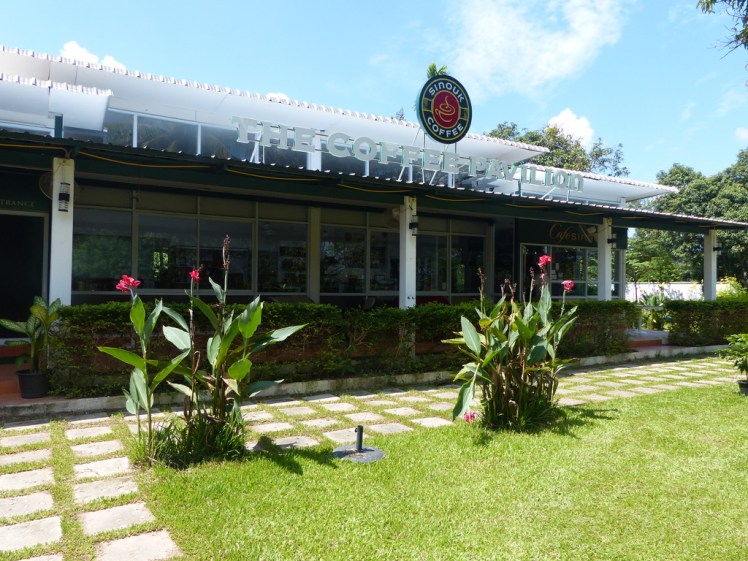
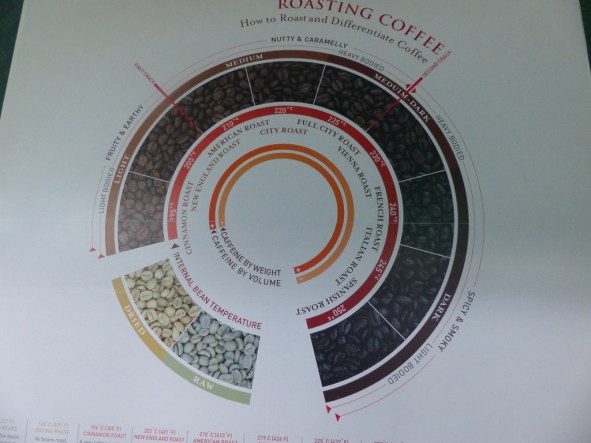
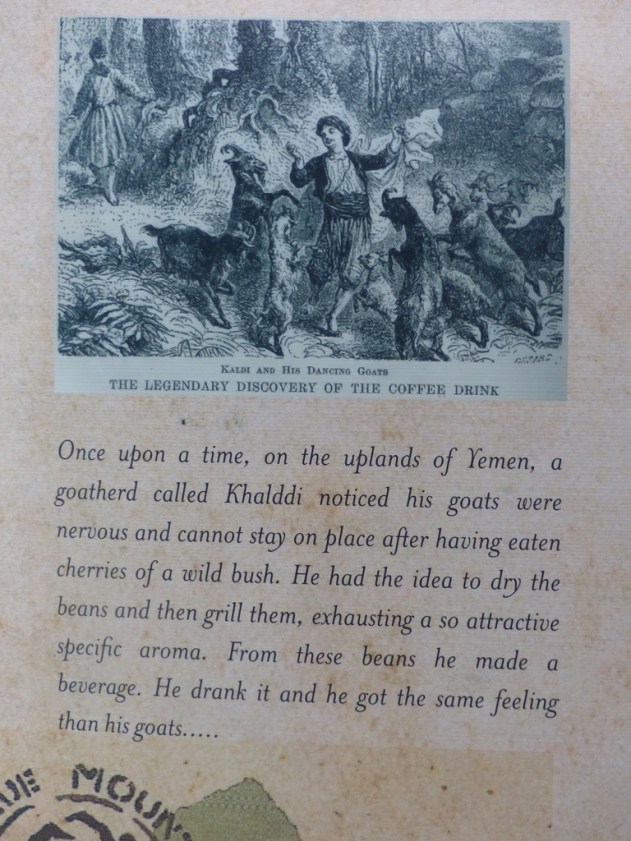 We found the story aboe of how coffee was first discovered in Yemen particularly entertaining. After all…who knew?! We did buy some “Korean” roast beans to bring back to Seoul, remarking on how Korean tourism in Laos is obviously thriving since this was a featured item in the gift shop.
We spent the rest of the day visiting more Buddhist Temples, including Wat Pha That Luong which has the biggest, oldest golden stupa and is reputed to be the city’s most important temple sight. Several folks were selling birds in cages that one could buy and then set free inside the temple grounds. We took a “pass” on this activity for a variety of reasons. Again, there was absolutely no signage whatsover at this sacred site so we just wandered around the various buildings and admired the impressive reclining Buddha. Unlike Buddhist temples in other Asian countries, the ones in Laos never seemed to have any insense burning and we found we missed the aroma.


Lunch was a bit of a disappointment as I found my papaya salad dominated by fish sauce and lacking peanuts, while Bill’s spicy beef stew was at once OVER-whelming (spicy leaf that probably wasn’t meant for consumption as he quickly learned) and UNDER-whelming (beef that was way too chewy for his taste). We also learned why sticky rice is called STICKY rice since we could barely wrestle it out of the little woven basket in which it was served. Below are the “culprits”:


Sometimes I wish I wasn’t such a priss who always obeys rules because the views from the airplane as we flew across Laos’ mountains in the late afternoon were SIMPLY MAGNIFICENT! All around us, folks were snapping pics but I had turned off my phone like a “good girl” and was just too darn slow to turn it on. Roughly 70% of Laos is made up of mountain ranges, highlands, plateaux and various rivers and tributaries of the Mekong. Just before we landed, I fired up my camera to get one shot of the mountains below and then quickly snapped a few more photos before the sunset.


 Located in the northern region of Laos, Luang Prabang is surrounded by mountain ranges and located on the pennisula formed by the convergence of the Mekong and Nam Khan rivers. It has been inhabited since 8,000 BC and is the center of Buddhism is this region. During the 14th-16th century, it was the capital of the powerful Lang Xang kingdom and was known as the City of Gold in the Land of a Million Elephants. Subsequently, the city and Laos monarchy fell into demise when the country split into 3 independent kingdoms and went through much turmoil. When the French Protectorate was established in Laos in 1893, Luang Prabang once again became Laos’ royal and religious capital, remaining so until 1946 when Vientienne became the capital city. During the post WWII period, Luang Prabang enjoyed intermittant popularity and prestige. Ever since it received UNESCO World Hertitage Status in 1995, however, the city has truly thrived and is today a very popular tourist destination.
The architecture of this quaint city is charming, full of narrow streets along the Mekong and Nam Khan rivers, and reflects both its deeply Buddhist and European heritage. Fortunately, our visit was post-peak season so we, and this tiny city, were not overwhelmed by crowds. La Residence Phou Vau where we’d booked our stay was a 5 minute ride out of the city center. We didn’t mind a bit though as you can probably tell by the “view” that greeted us when we were shown to our room:


Part of the Belmond family of hotels, this luxury hotel’s rooms were beautifully appointed in a “revivalist Indo-chic” manner, using teak wood and simple white linens. The property has a stunning infinity pool that overlooks the surrounding hills, a renowed spa and delicious Euro-Asian poolside dining. Definitely a step…or two…above the Hotel Mercure.


We were also one of only 2 parties at the hotel that evening so experienced exceptional service and plenty of friendly chatter from the wait staff as we dined on the poolside patio. My dinner was a pork curry which was PINK because of the fish eggs while Bill opted for a more tame grilled chicken with fresh tomato chutney. Delicious!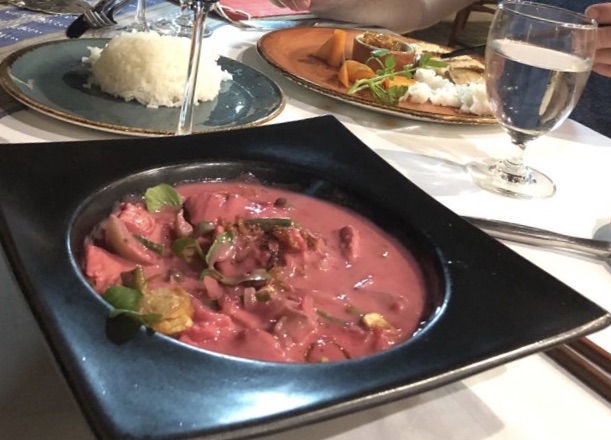
While checking in and reviewing the various suggested activities by the hotel, we decided to jump right in and participate in Luang Prabang’s famous “Tak Bat”, the ritual of giving alms to monks, which occures daily at dawn all around the city center. This meant a 5am wake-up call but Sean and Chris Guinness found participation in this daily ritual to be quite memorable and we figured we could relax poolside and at the spa later.
The hotel made our participation in the Tak Bat very easy, providing us transportation to a street along the monks’ procession path, a blanket, stools, shawls…and CRITICALLY baskets of sticky rice to put into the monks’ alms bowls as they silently walked by. The shaven-head monks clad in saffron robes walks in groups, each group belonging to one of the 32 monasteries in Luang Prabang. They file according to age, with the eldest monk leading his group of fellow monks. This is definitely a religious “event” so silence and respectful observation are demanded, though these days during the peak season, the tourists apparently outnumber the monks. Fortunately for us, there were very few other tourists on the streets and we saw mostly Luang Prabang residents participating in this quiet ritual just as light dawned on the streets. We were warned to dress conservatively, refrain from taking photos of the monks and avoid making eye contact with them. Fortunately, for us the hotel driver asked to borrow Bill’s phone and managed to snap a few pictures of our Tak Bat participation.
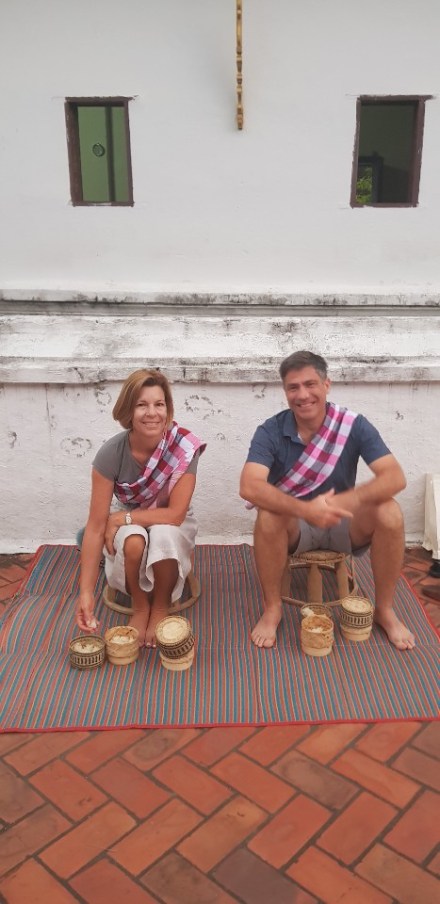
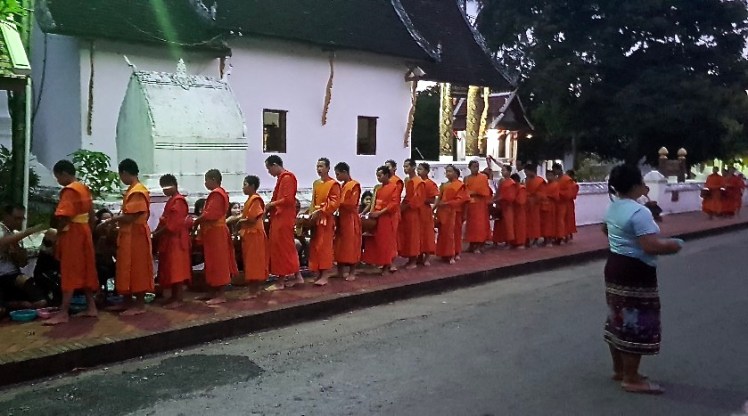
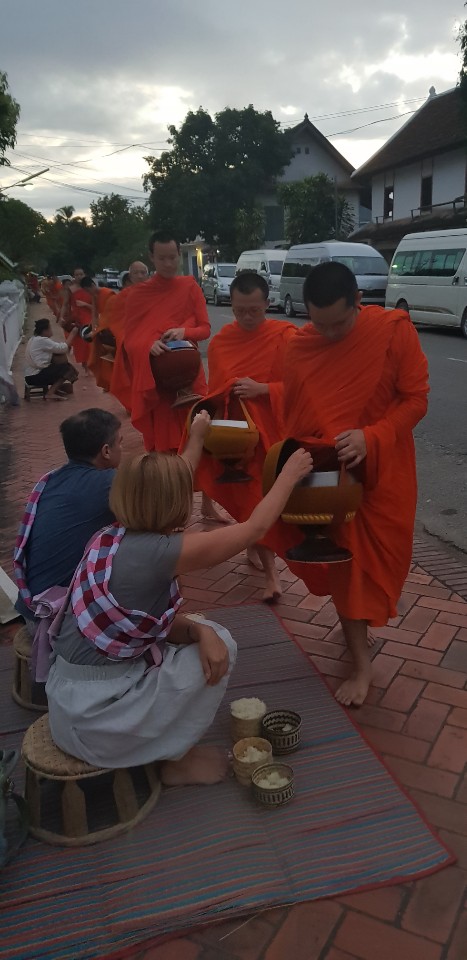
It was very peaceful, all over within a half an hour, and we did NOT run out of sticky rice though this was a concern for both of us midway through our hand outs. Now, we certainly have a clear understanding of why Laotian rice is so very STICKY: the stickiness enables one to easily and quickly to grab handfuls of rice as the hundreds of monks file by. The streets emptied quickly after the last of the monks collected their rice donations and we were left to take in the early morning light along the streets and riverside of this quaint city. The little plastic chairs, mats and rice baskets were carried away and residents went about their morning routines, tending gardens, hanging laundry, sweeping, etc.


We love the garbage baskets outside homes where trash is placed and the attention to detail that many residents take to entice tourists like ourselves.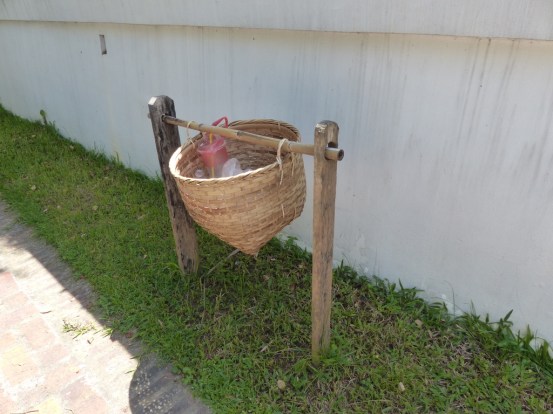
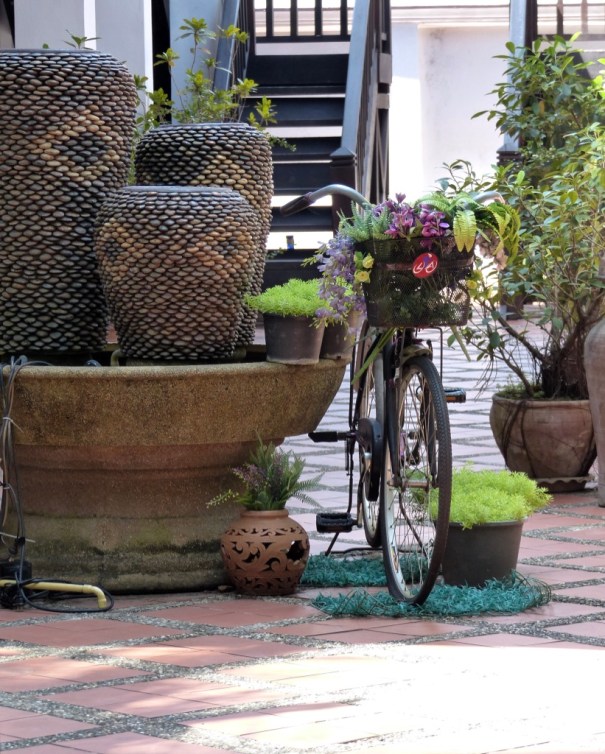
Virtually every shop and restaurant were still closed since it was only 6:30am, but we managed to find one cute coffee shop and settled in to a much needed cup of coffee and snack. After awhile, we caught onto the fact that the shop played the same 3 Elvis tunes over and over again, prompting Bill to get up and perform a “ditty” on the 3rd time round which made cute baristas giggle. Sadly, he was too quick for me to capture on video.
We decided to hike up to the top Mount Phousi in the heart of Luang Prabang to see the golden That Chomsi Stupa which one can see from nearly everywhere, particularly at night when its beautiful dome is lit up nicely, The 300 steps are steep, but there was plenty of shade and it was still early so not very hot. We enjoyed poking around the several small temples built into the hillside but didn’t buy any of the flowers for sale to donate. The 360 degree views from the top offer a nice perspective on Luang Prabang and the convergence of two rivers that surround the city.


During our descent, we walked through a temple where the young monks were just finishing their morning washing and grooming.
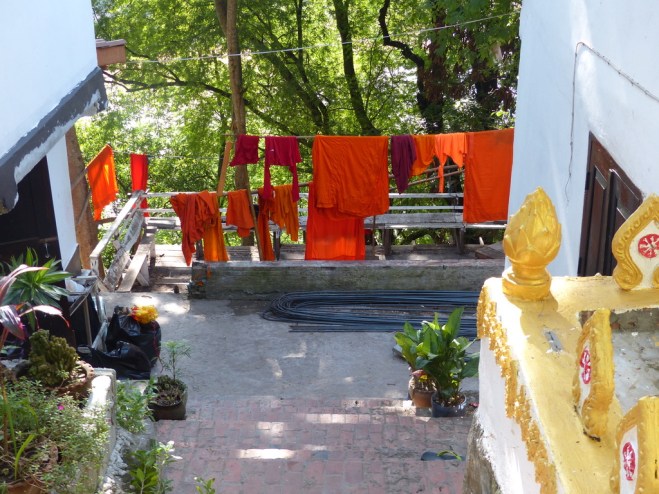
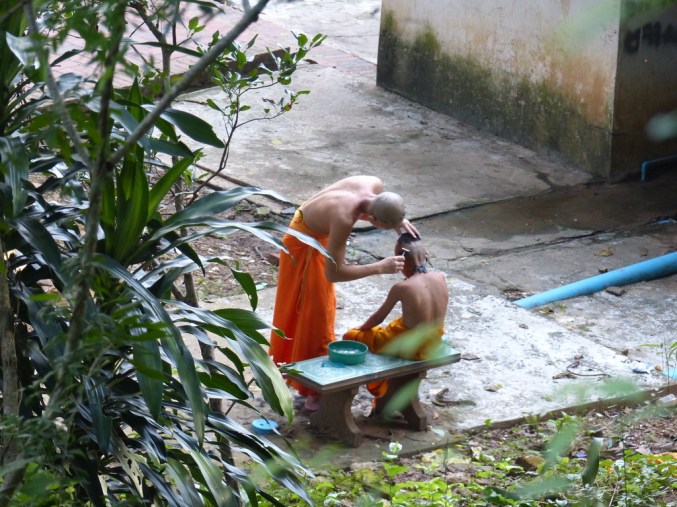
Fortunately, the city was finally beginning to stir upon our return and we were able to find a nice breakfast before touring Luang Prabang’s royal palace.
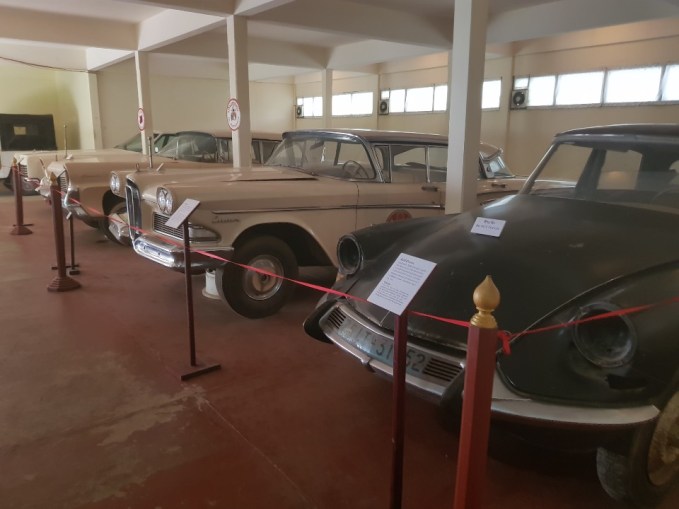
LP Guidebook in hand we meandered through the palace grounds and museum. Although I have no photos to share since photography was restricted, we found the furnished royal rooms, costume collection full of attire worn at coronation and other important ceremonies and the royal art collection all very interesting. We especially enjoyed looking at the various gifts presented by heads of state to the Laos king over the years. The US gave a model of an Apollo spacecraft that landed on the moon and it made us wonder what Trump is handing out to all of his friends…and enemies?! We also really enjoyed the royal car collection which featured 2 Lincoln Continentals and one 1958 Edsel Citation…lemon gift again?…and two massive pallaquins that required 16 men each to carry the king. And it wouldn’t be an “official” visit by the Stantons without a statue picture from Bill!
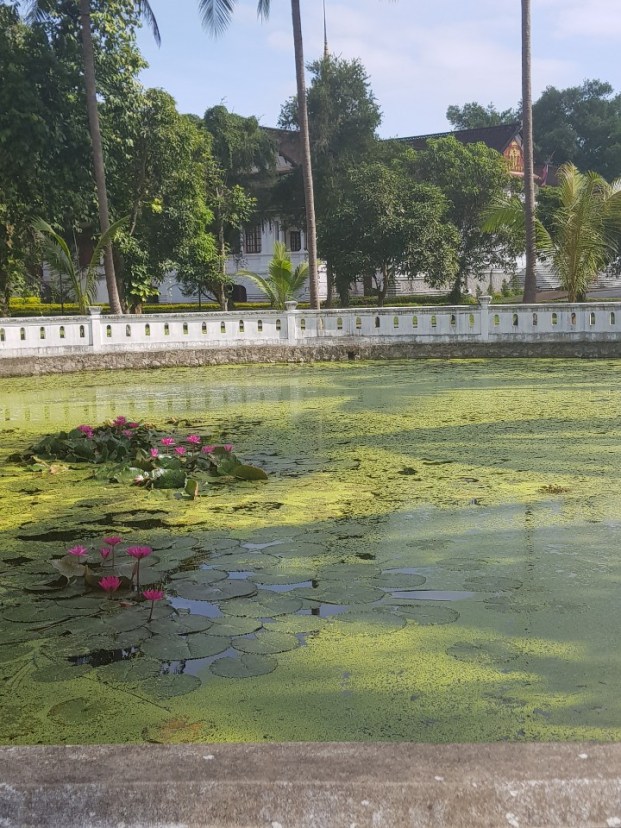

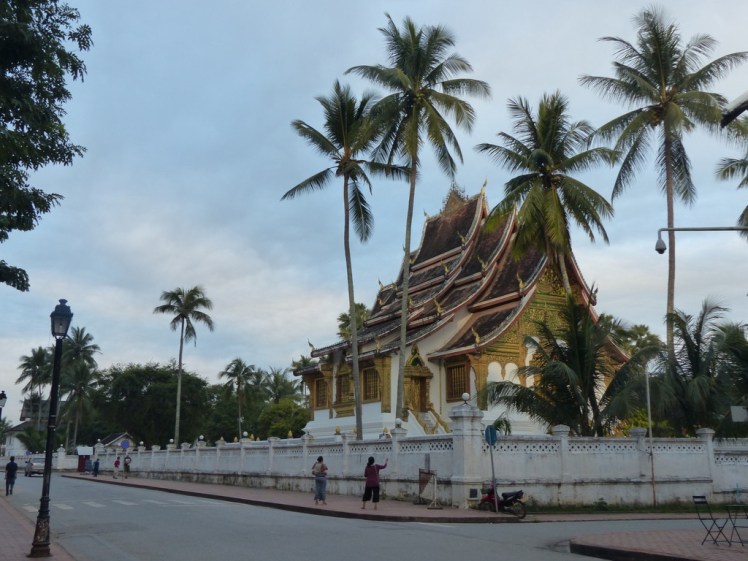
We finished our tour of Luang Prabang with a visit to Wat Xieng Thong where we admired the Tree of Life painted on one of the buildings. We then “copped a squat” before Buddha and meditated on how very happy we were to be exploring Laos together. Bill was just a TAD excited when we finally climbed in a tuk tuk for a ride back to the hotel for some R&R.


We ate on the patio and I sampled the noodle bar which drew me in with all of its fresh ingredients. One word: WOW! 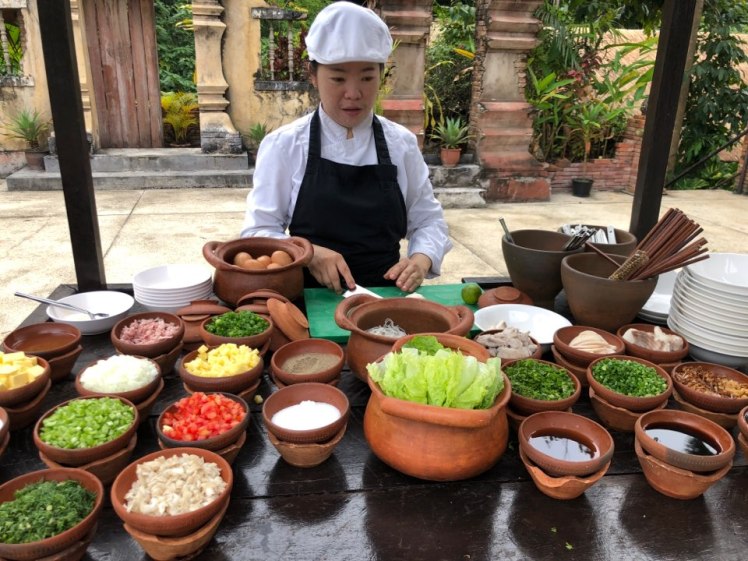 After some downtime by the pool and yoga, we found our way to the spa to sample this hotel’s version of a traditional Hmong massage. As we began the treatment and I was slipping into bliss with my eyes closed and my feet in a warm foot bath, I was surprised to smell something familiar but unexpected. When curiousity overcame me and I opened by eyes, I was shocked to see Bill’s calves and feet covered in deep brown, gritty water! We were getting a brown sugar COFFEE scrub…a variation on the sugar/salt scrub…and the odors were certainly familiar, if not a bit out of context! The masseurs used warm polstices of lemongrass and basil to relieve tension and spent a nice long time on our heads. It was VERY difficult not to drift off after such a full day.
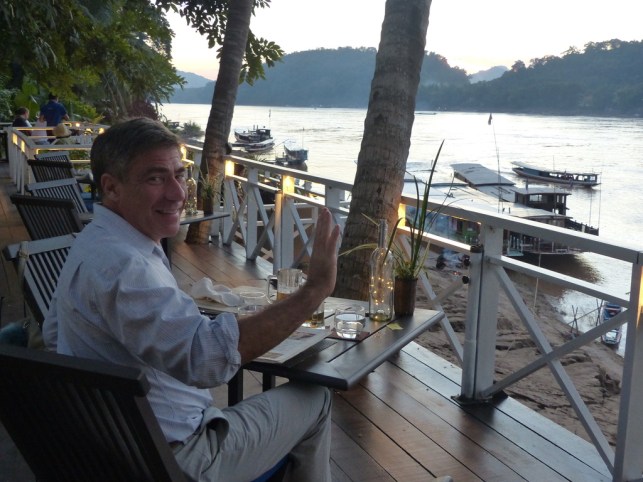
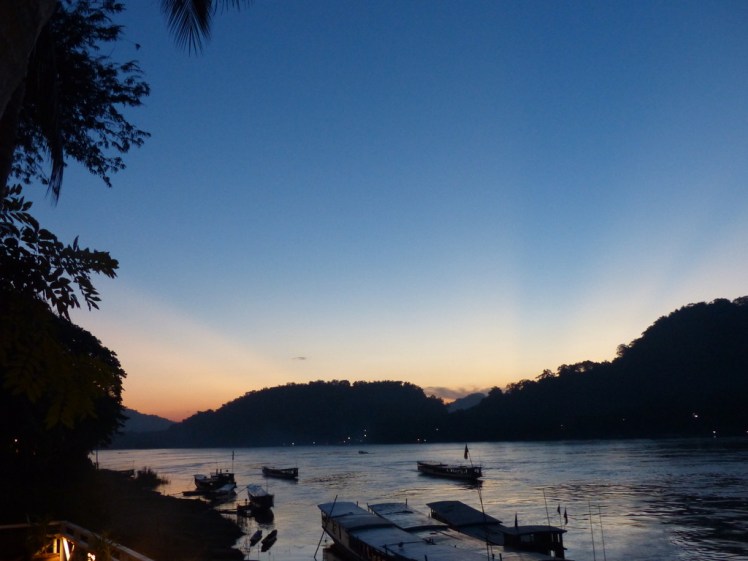
We finished the day at La Belle Rive, a cute riverside restaurant we’d spotted earlier, arriving just before sunset to take in the views over our Beerlaos and delicious local fish curries, sausages and shrimp fried rice. We tried to find an iconic bar mentioned in the guidebook after supper, but arrived too late which suited us just fine actually.
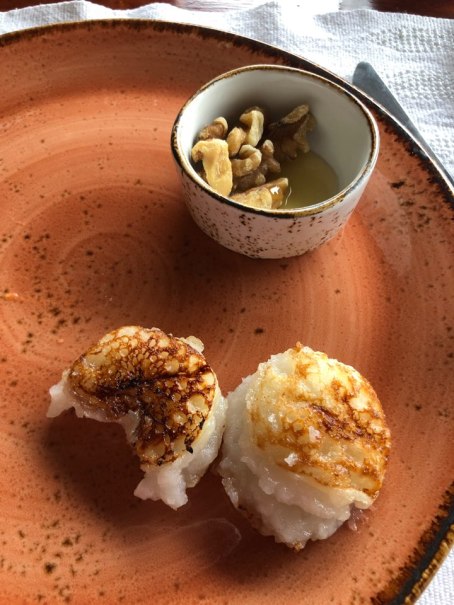
The next morning, we awoke to the sound of roosters crowing and Buddhist monks chanting in the distance. Still dreaming of the delicious noodles I had for lunch the day before, I decided to go right back to the “trough” at breakfast time….happily slurping up the savory broth that I could season with vegetables, meat, fish, egg and spices according to my mood. Bill stuck to a more Western approach while I went “local”, enjoying the little coconut rice pancakes as well. SOOOO sooooo soooo delicious!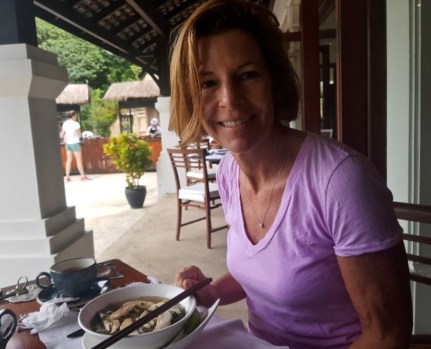
Laos and Luang Prabang have made a significant effort to cultivate eco-tourism in the past decade. This makes a lot of sense given the lush, mountaneous and largely undiscovered landscape of this previously over-looked country. For us, this meant that there were plenty of enticing outings we could easily arrange during our next two days in Luang Prabang. We opted to trek a bit and then kayak along the Mekong river with Bunsoo, a guide from a local outdoor activity company. As we drove along very bumpy, sometimes paved, but often not, dirt roads, we were surprised to pass many large trucks and active construction sites where huge swaths of the jungle had been cleared. Bunsoo explained that all the construction activity was related to a joint Laos-Chinese high-speed railroad project begun in 2015 and due to be completed in 2021. It dawned on us as Bunsoo described the project that were witnessing Xi Jinping’s famous Belt and Road Initiative that will connect China to the rest of SouthEast Asia and transform life for millions of people in these countries. This railway will be the first and only rail service in Laos and it will run the entire length of the country, rendering otherwise extremely slow, difficult, and even non-existent, public transportation not only accessible but also affordable for the entire population. We passed entire pop-up villages of Chinese itinerant workers who are living in trailers while this massive construction project is underway. Land and small businesses (restaurants, farms, etc) too are owned by Chinese who have immigrated to Laos and their presence is forever changing the country. For the first time, we really felt the scale and impact of China’s ambitious Belt and Road Initiative despite having read about it aplenty.
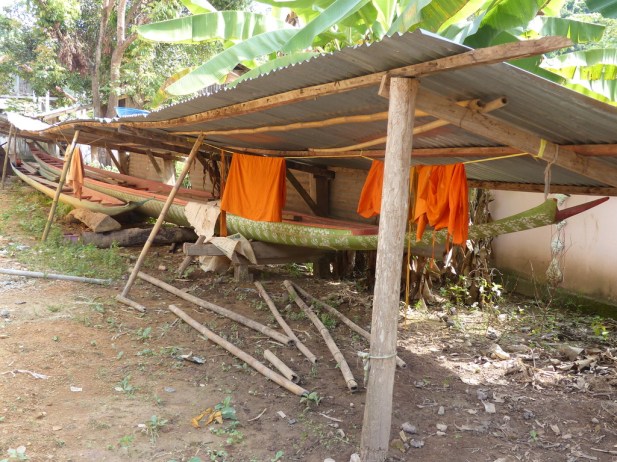
We began our outdoor adventure by crossing the Nam Kong river in a small motorboat that ferried us to a nearby farming village. Here, many of Laos’ various ethnic tribes were now living together in harmony, including the Hmong people, who fought on the American side of the Vietnam War while the rest of Communist Laos supported North Vietnam. Historically, the Hmong people occupied the more mountaneous and remote regions of Laos, but these days they are now being “encouraged” by the government to live in the lowlands, closer to developed cities and towns so as to access education and social services. In this village, three different ethnicities, the Hmong, Lao Tai and Kamous people, all interact peacefully, attending the same schools and slowly inter-marrying with each other. As we walked through, many village residents were gathered next to the local temple which was closed for temporary reconstruction, making offerings and praying to Buddha on the Full Moon Day. All the villages along the Mekong participate annually in a long boat race and last year’s champion boat was proudly on display next to the temple.

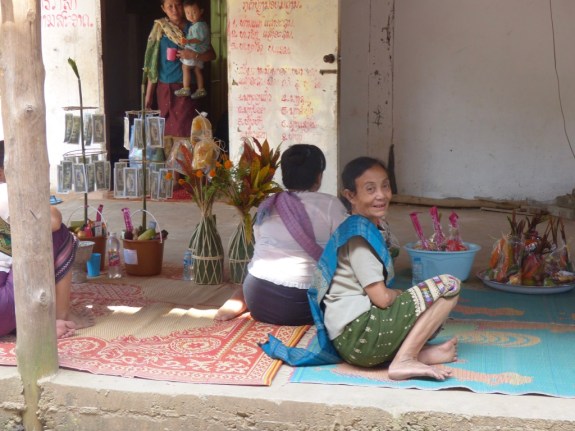
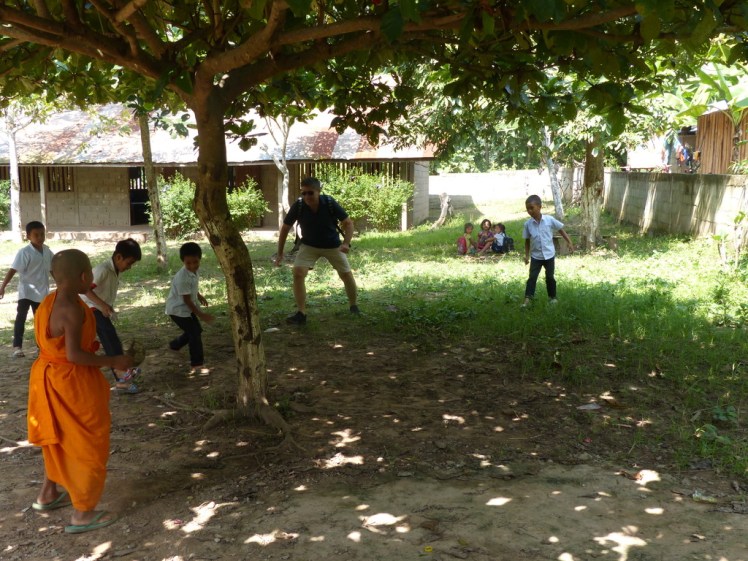
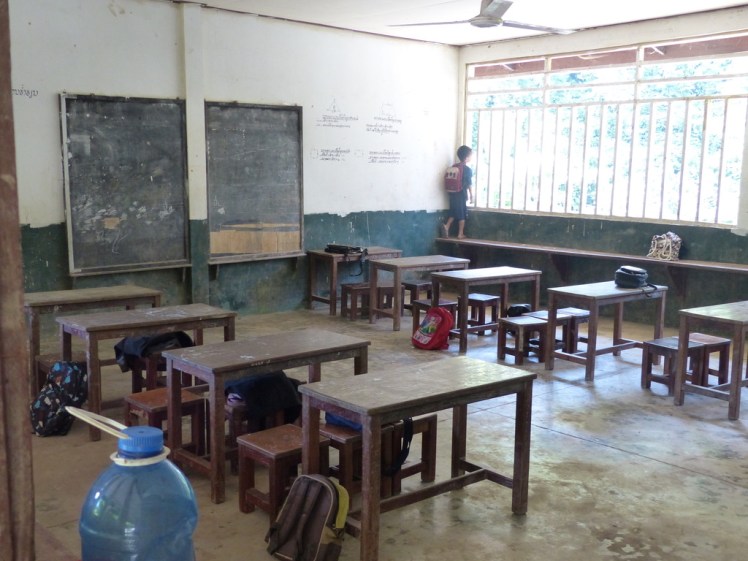
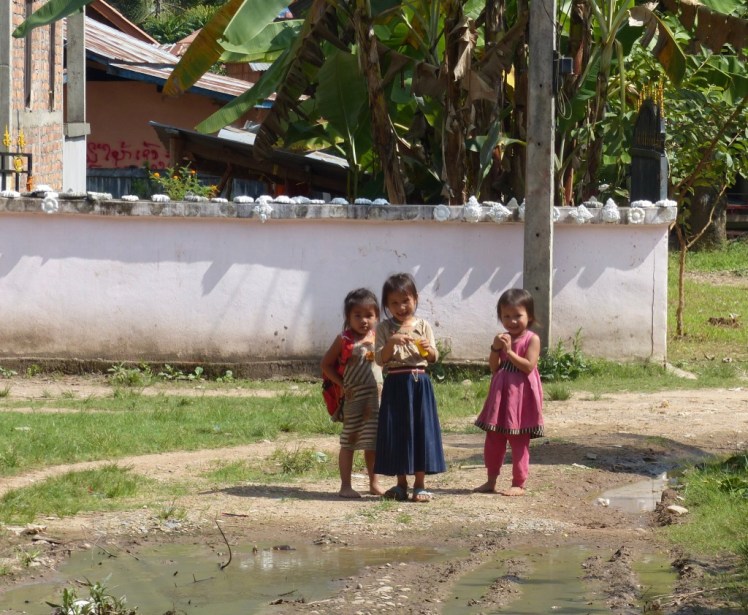
We were able to visit the local grammar school and Bunsoo explained that throughout most of Laos all children are taught English; however, at this obviously resource-scarce school in a remote village, English was not offered. In the school yard, a few kids were lazily kicking a soccer ball, but Bill quickly rallied them into a fast game of “keep away”. Flying around with a giant backpack, sweating profusely and making silly faces, Bill quickly had all the kids joining in on the fun or giggling from the sidelines. He then switched to “Bang Bang shoot ’em up”, an American classic (?) which was perhaps a tad inappropriate but the kids certainly found entertaining. I wondered if perhaps this wasn’t the best “cultural exchange”, but like a pied-piper, Bill soon attracted most of the kids, including these adorable pre-school girls followed us shyly while we meandered through the rest of the village.
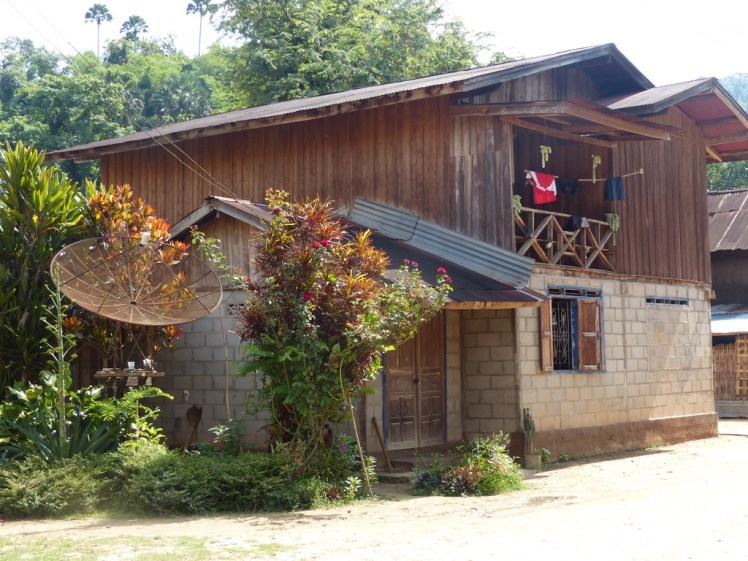
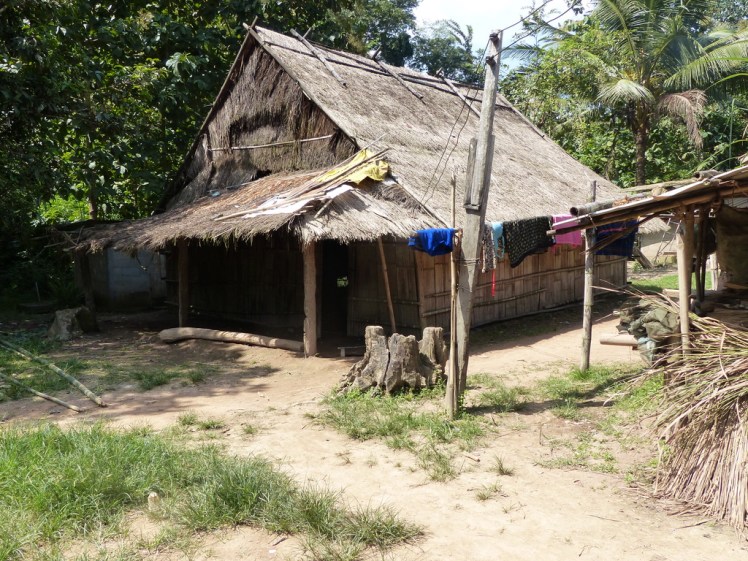
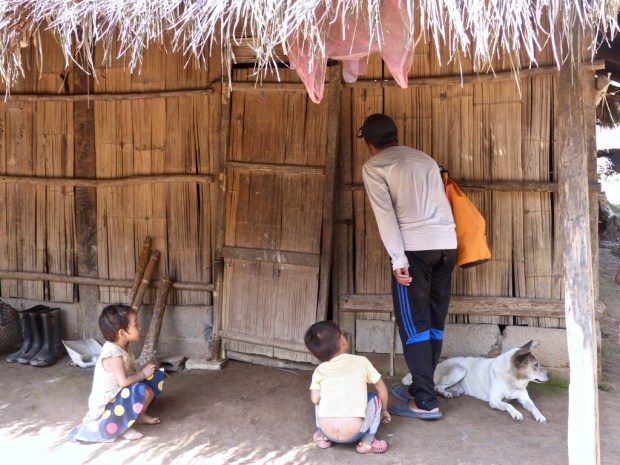
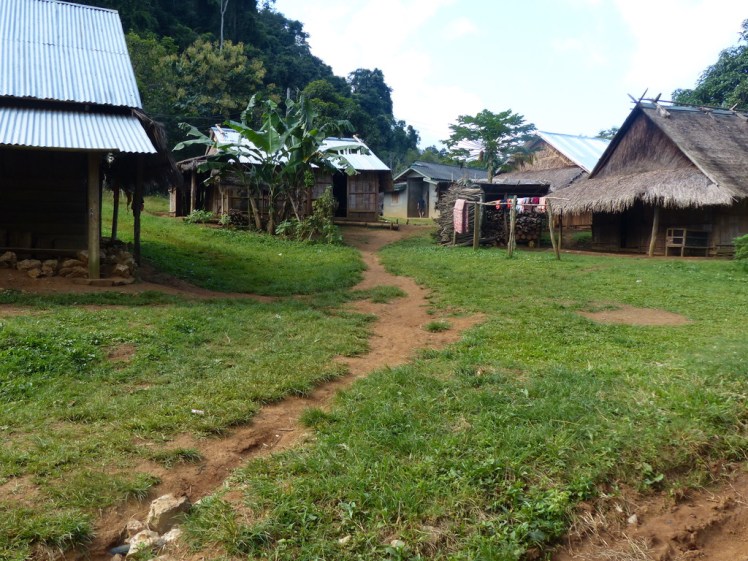
Bunsoo described some of the basic differences in the architecture of the dwellings. The Kamous people live in thatched, two-story, box-like structures while the Lao Tai homes have separate kitchen areas at the rear of the house. The Hmong huts by contrast are single-story and have no windows and only one large door. When they lived in the hills, or for those Hmoung who still do, this architecture suits the colder hill climate in the winter and allows them to bring their livestock indoors during the winter. In the summer, when the jungle is full of mosquitoes, the solid walls deter these pests from entering the living space.

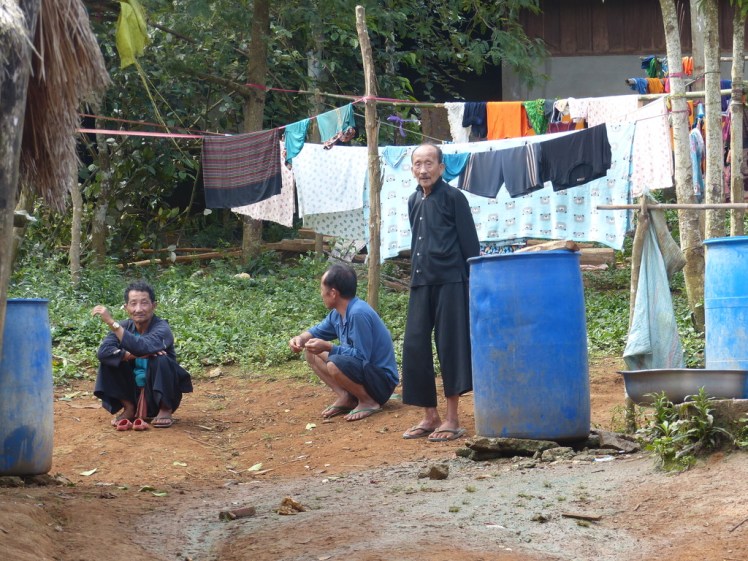
The facial features of these three ethnicities too are quite distinct. The Lao Tai generally have paler skin and more narrow/fine features like Thai people, whereas the Kamous have definitely darker skin and the Hmong have rounder facial features that reflect their Chinese heritage. The living conditions in this village were clearly poor, but every home had electricity, was kept tidy and the villagers were actively doing laundry, laying rice out to dry in the sun or caring for their children.


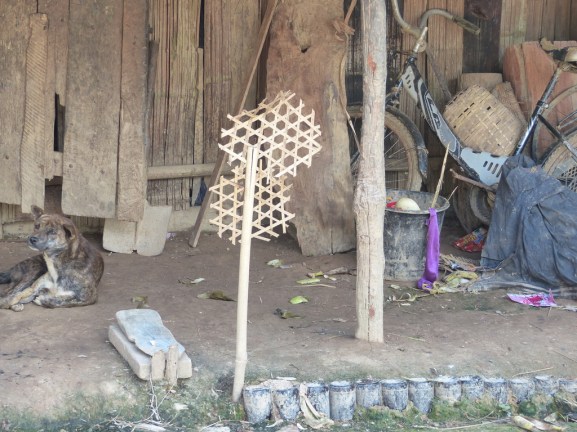
Unlike the other two ethnicities, the Hmong people are not Buddhists, and instead believe in Shamanism. As we walked through, a shaman was visiting this village and leaving his woven signs (see below) outside homes he had blessed or from which he had chased away sickness/evil spirits. Bunsoo peeked into a Hmong household where the shaman was performing a ritual and asked if we could quietly observe. Photos were not an option, but hopefully you can imagine the image of the shaman dressed head to toe in a black robe, eyes covered, and bouncing up and down on a suspended board while he chanted and played a tamborine-like instrument. Behind him stood a young man who made sure he didn’t fall off the suspended blank of wood while blindly bouncing while another person played a drum in the corner. This unique scene remains indelible in our minds.
We passed a “convenience” store on the way out of town and were surprised to see the two young shop girls glued to cellphones, despite the poor standard of living in this village. Bunsoo remarked that virtually all Laos villages have access to electricity and cheap phones from China these days. The first girl asked Bill for 8,000 Lao Lak (roughly $1) for the flavored water he’d selected when Coke Zero wasn’t an option. Her shrewd “side kick” quickly doubled the price at the sight of her customers. Bill shared a wink with her and handed her 16,000 Lak, impressed by her aggressive marketing strategy.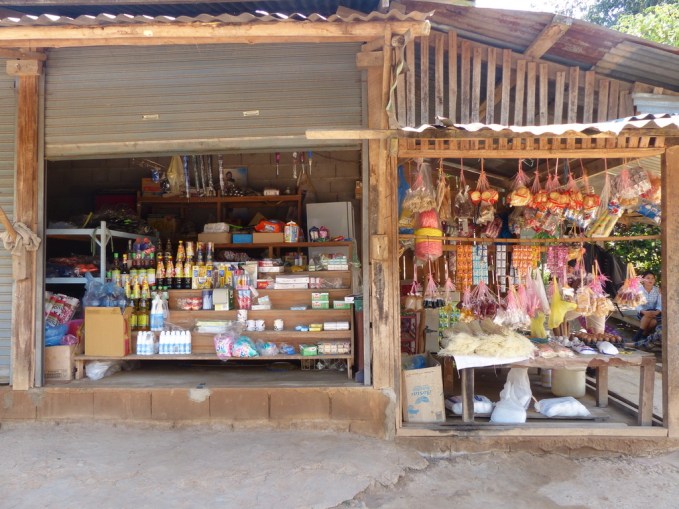
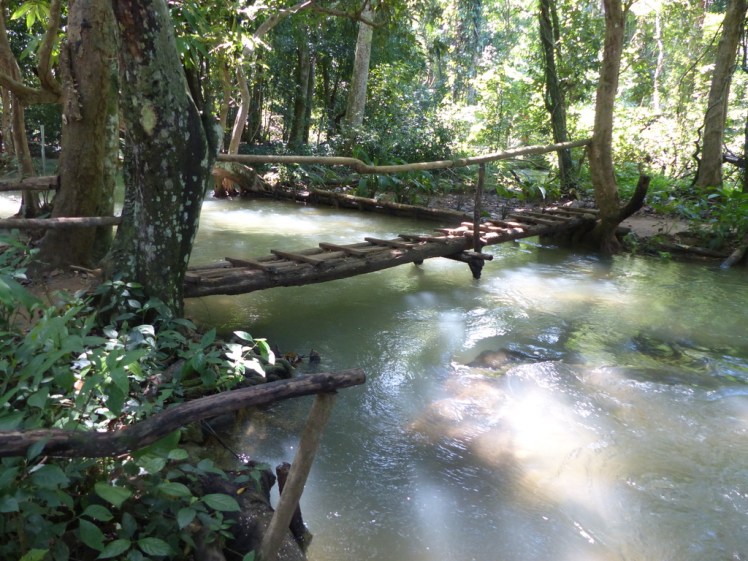
We then left the village behind and began a trek up into the village’s planting fields across many ricketty log bridges such as this one, as well as hectaires of jungle available for sale (?!).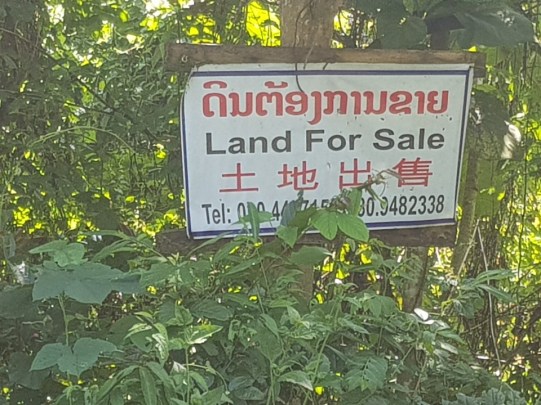
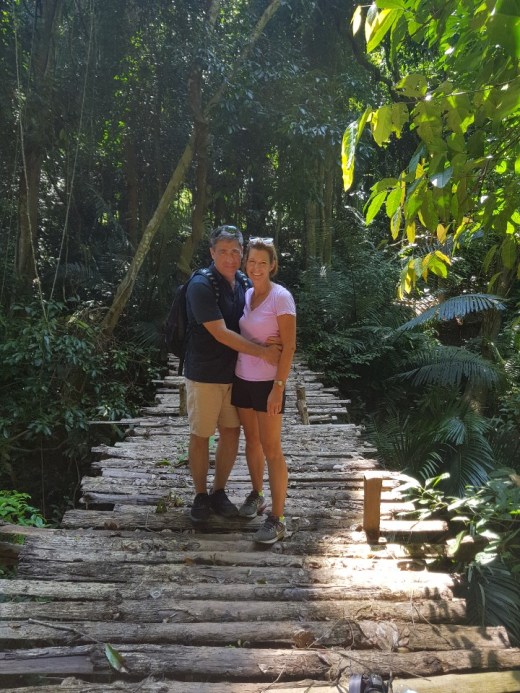
We walked through large teak forests, in and out of the jungle, until we reached clearings of the mountainside where rice, coriander,eggplant and other vegetable crops were planted, tended or harvested. The views were scenic, but the work and living conditions obviously difficult.


After a leisurely trek in these fields, we came to the river’s edge where we were once again ferried to the other side and outfitted for the kayak portion of our adventure. After just 10 mins of paddling we rounded the bend and came upon the Tat Sae Waterfall Park and Elephant Preserve. We “docked” our kayaks on the riverbank and walked up to this famous site near Luang Prabang that features rushing waters cascading down over limestone hills. There are platforms and walkways built around the area so visitors can enjoy the scenery or take a dip. We were really hot and sweaty so took no time disrobing and enjoying the refreshing water. These videos give you a sense of the gushing waters that surrounded us.


We ordered lunch in the little restaurant and I decided to have my second bowl of noodles for the day…and third for the trip. No regrets either as the noodles were so tasty yet again. We were quite entertained by a lively group of Vietnamese tourists who were obviously enjoying their time at Tat Si Falls. Soon they were joined by some Israeli tourists who couldn’t resist the dancing. We just love the unabashed enthusiasm, singing and dancing we often witness throughout Asia. Bill almost jumped in too, but opted to buy a Suh-bye-dee tee shirt instead…and he’s wearing it now as I pen this blog!
Refreshed and refueled we got back in our kayaks and spent the next 90 minutes leisurely paddling downstream. Bunsoo was in a single kayak and Bill and I “jointly” paddled a double one, though as Bunsoo’s photo of us below demonstrates, ONE of us worked considerably harder than the other. But then again, Bill has always been like “Frederick” in Leo Lionni’s children’s classic; he feels and thinks deeply, absorbing the world around him while I flit about, worrying about logistics and get “lost in the trees”. He is often “working” when I think he’s just staring off into space and his memories/ impressions bring our adventures to life when he shares them with me. Sometimes, though he is just plain on HIS PHONE when he should be taking in the gorgeous scenery or at the very least paddling the kayak!
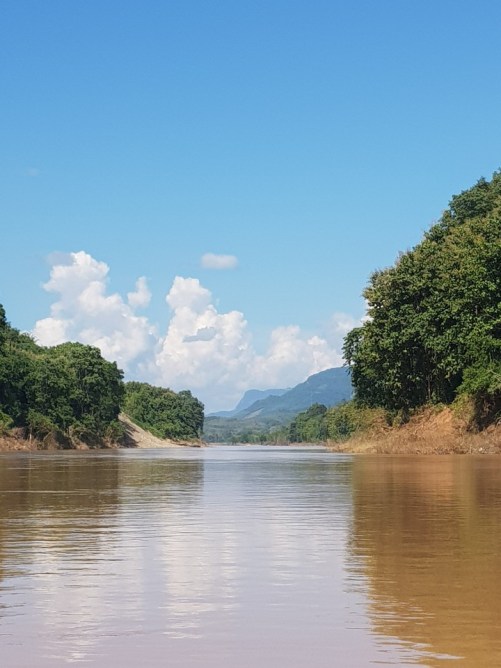
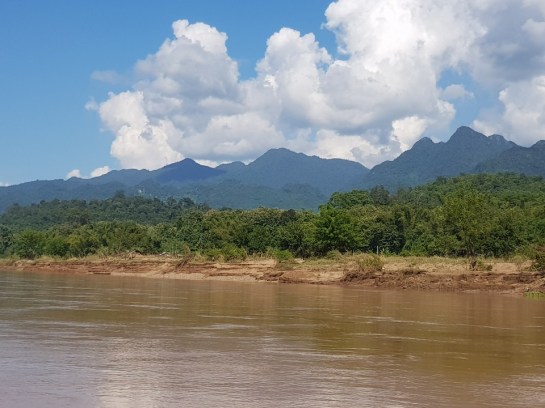

Our first outing with Bunsoo was so enjoyable we asked him to create a trekking excursion for us the next morning so we could maximize our last day in Laos before the night flight back to Seoul. So for our final day, we met Bunsoo early and spent a somewhat uncomfortable hour as the van maneouvered potholes, bottoming out several times, on the dirt road. (We could easily understand why the 40 min. flight from Vientianne to Luang Prabang is well worth the additional expense to avoid the 9 hour bus ride Australia tourists reported was downright awful!) We climbed up through the mountains and the views as the morning clouds and mist cleared were stunning.
 We began our trek in a small village of 80 families, of both Hmong and Kamous heritage, that live together and farm the surrounding hillsides. This village often hosts backpackers out on extended treks, or service trips like Daphne’s from SFS, and we saw the simple kitchen and patio where the village prepared food for larger groups of people. The homes in this village all had electricity and even house numbers. There were adorable children everywhere and once again, Bill was quite the magnet, high-fiving most of them as we went by. Pigs, goats, chickens roamed freely and we wondered how one family could tell his livestock/flock from those belonging to another village, but fortunately this was not really our concern. After yesterday’s trek, we could easily distinguish Kamous houses like the two-story, box shaped one below.


The kids were mostly in class as the local school we dropped by so Bill wasn’t able to show off his soccer skills here. It stuck us how even in this little Laos village, clothing is so often a visible indication of socio-economic status no matter where we are. Here, the students dressed in uniform were undoubtedly from families who had enough disposable income to pay for uniforms while others could not.


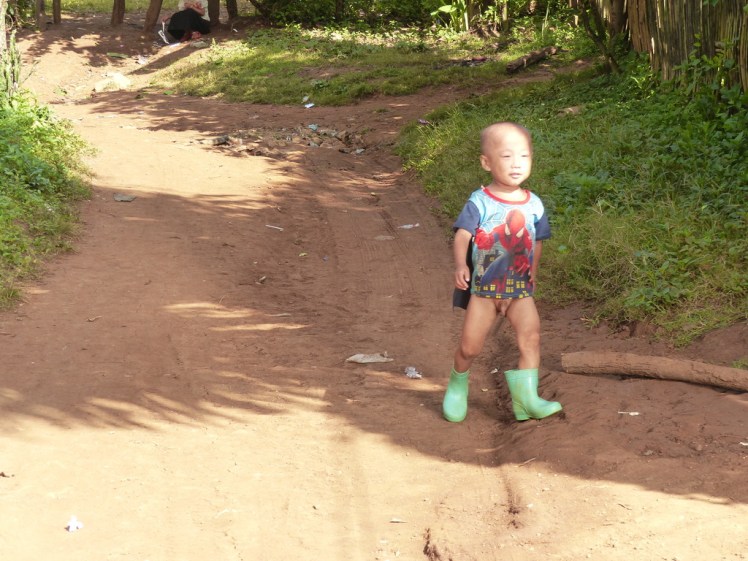
Clearly our faces were more interesting than the math lesson for some of the pupils so we didn’t linger and let the teacher continue with his lessons. Many kids were dressed in superhero tee shirts, reminding us how ubiquitous exported American culture is around the world. This little Spiderman in full cape and boots really caught our attention and followed us everywhere for awhile. Adorable!
 As we hiked Bunsoo shared his personal story with us, in perfect English no less. He is from an extremely remote village high in the mountains and for 7 years, each morning he walked 3 hours downhill to school and then 4 hours back uphill in the evening. He was accompanied by 6 other kids from the same village and they would talk, sing and play games along the way. When he turned 15, he decided to become a novice monk and live in a monastery in the lowlands, a 10 hour trek away from home, in order to receive a better education. This is a common scenario for many Loatians who live in the mountains. A Buddhist monk can never spend the night out of the monastery so Bunsoo was unable to go home for years and was only rarely visited by family members. He then went on to University in Luang Prabang and doesn’t regret the years he spent away from home. Only one other friend also chose to leave the village so today he feels a bit out of step with his childhood friends who now have many children versus a college degree and career. Hearing Bunsoo’s stories certainly gave us pause as we considered his drive and perseverance relative to that of many students in the US today.
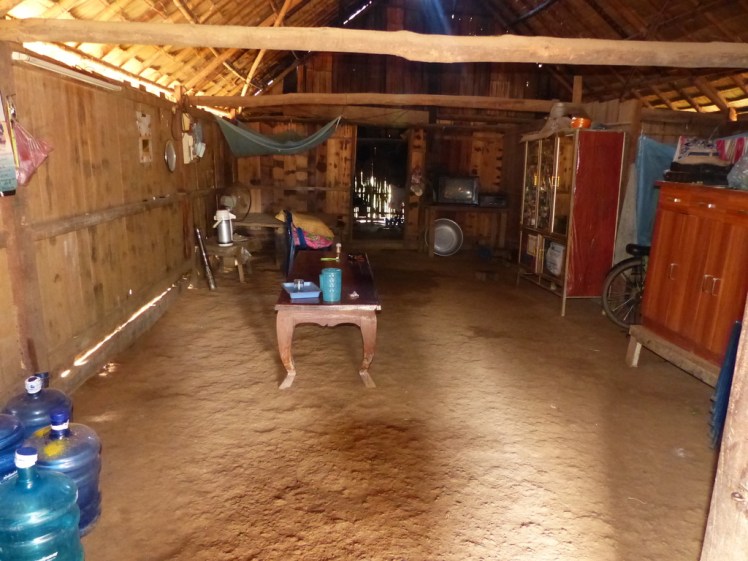
On the other side of the village school was a cluster of Hmong homes, again distinct in their architecture from those of the Kamous people. The Hmong men too were distinquished by their dark blue pants and jackets reminiscent of Chinese attire during Mao’s leadership. We were even allowed to peek inside one home.
 Here, we picked up a local guide who accompanied us half way to our destination, earning a small fee for his “escort” services. We were a bit perplexed by this task, and then downright nervous after Bunsoo explained that his job was to watch closely for snakes, tigers and black bears as we trekked through the jungle??!! AND, Bunsoo as offered this “tidbit of info” he was busy cutting down some bamboo to serve as walking sticks (aka self-defense weapons in a pinch!). I thought for a minute Bill was going to faint and he spent the next 10 mins walking cautiously with his eyes darting all over for potential threats. He then decided to get “frisky” with his stick and began knocking my stick from behind so I jabbed him, drew blood and quieted the “menace” instantly.
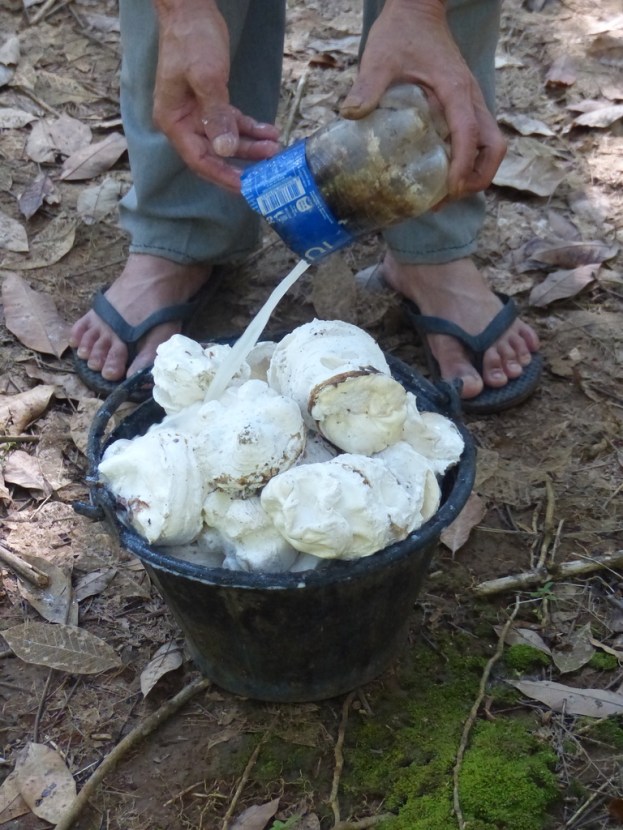
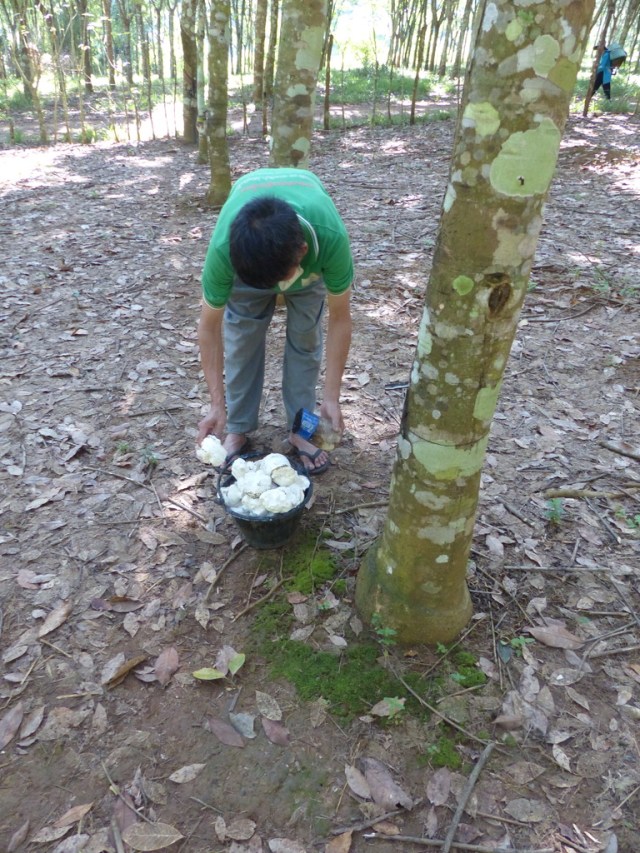
As we left the village, we walked through a rubber tree plantation. Each tree had a bucket collecting the tree sap much like maple sap is collected for maple syrup. The farmer carries the sap to a nearby market and sells it to Chinese buyers. I was so surprised to learn that rubber is actually WHITE but then dyed black when it is processed. I guess this makes sense since white tires would quickly turn black on the road and look dirty so why not just start out black. I love learning facts like this as the ripe age of 55!
We climbed up gentle slopes under the shaded cover of the jungle for an hour of so and this afforded me ample time to pepper Bunsoo with questions while Bill (aka my “Frederick”) took IT all in…and kept an eye out for snakes, tigers and bears. We discussed the Vietnam War and the devastation Laos suffered from the 260 million cluster bombs weighing roughly 2.5 million plus that were dropped on the country. We even walked by several large bomb craters still visible today. During the war, the Hmong people were recruited by Americans because they know jungle/high mountain terrain well, are fast/strong and, according to Bunsoo, give simple yes/no answers to questions so the American forces found it easy to communicate with them. Bonsoo’s father (a Kamous and therefore allied with Communist/North Vietnamese forces) was alive during war and remembers hiding in caves while bombs were falling. While hidden in caves, crying children had to be “silenced” so enemy Hmong soldiers wouldn’t discover their cover. This thought certainly made this mother of four shudder! Even after the war Bonsoo’s father was attacked by Hmong people in jungle one day since the animosity among the various Laotian peoples did not dispell overnight. Bunsoo believes present relations are much much better, though some human rights groups still argue to the contrary. The legacy of the Vietnam War is long and deep in Laos just as it is in the US and Vietnam.
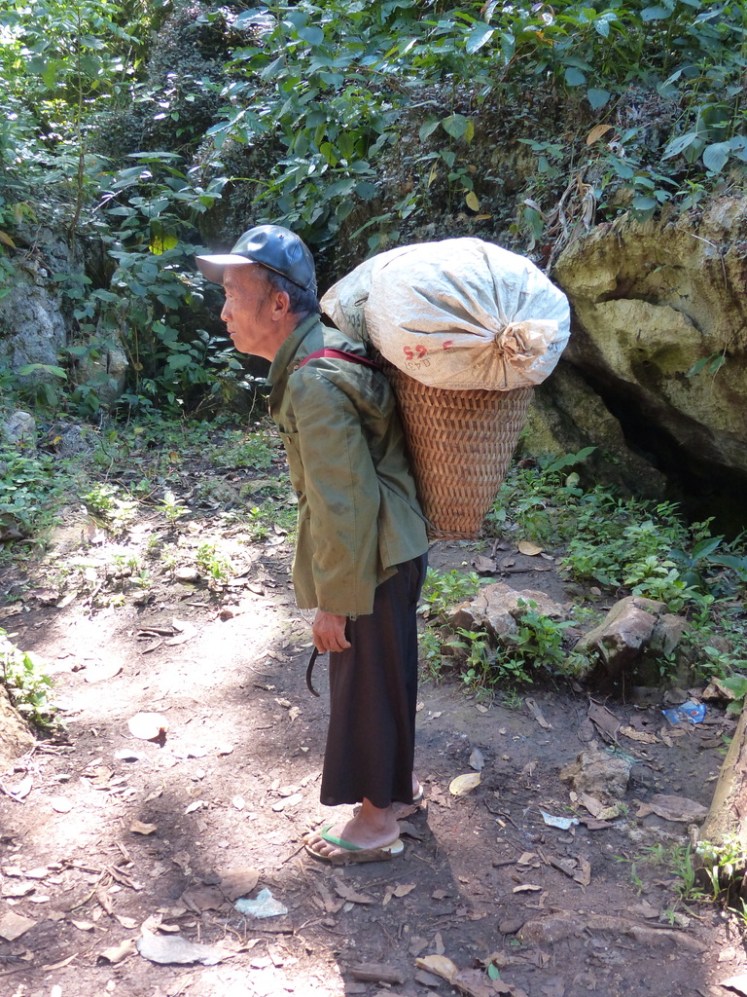
We walked through the hillside plantations where the locals were harvesting various vegetables and herbs and walked by this old man carting produce down to the market. Amazingly, he had been to Portland, OR where there is a large population of Hmong people.


 After a few hours we reached our luncheon spot: a natural spring high in the hills which is the source of the famous Kuangsi Waterfalls. The water bubbling out of the ground was a pretty blue/green and certainly more inviting than the waters of the Mekong river. On a small raised platform by these springs, we ate a simple rice, chicken and veggie dish prepared by the family-run restaurant, admiring the calm waters and pretty jungle flora and fauna around us.


We then continued our walk up towards the top of Kuangsi Waterfalls, arriving at this impressive 80 meter waterfall in less than 15 minutes. We were not very hot and didn’t want to have to cart wet clothes home in our suitcases so elected not to swim and just took in the lovely views.

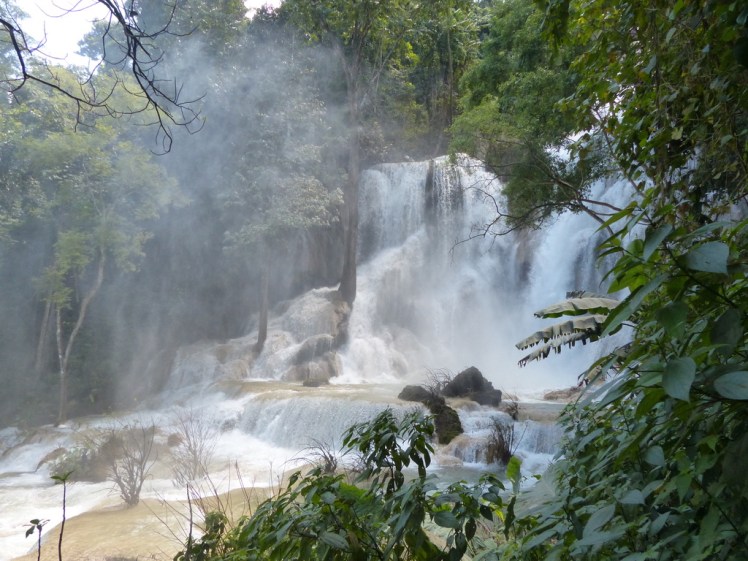 Unlike most of the visitors to Kuangsi Falls, we approached the waterfall from the top and then descended alongside to reach the viewing platforms and swimming holes below. This is definitely the prefered way in our minds, since the sweaty, panting hikers who were climbing the trail/stairs up to the top while we trekked down looked absolutely miserable in the humid heat! Daphne remembered visiting these Falls too and how refreshing the spray feels at the bottom.
We chose not to linger at the black bear camp/zoo also at the base of the Falls since only 2 of the 48 bears in captivity were visible but they were both sleeping; they are after all noctural!. Memories of being similarly disappointed by the bears at the Philadelphia Zoo when the kids were young came flooding back to us!
After a quick flight from Luang Prabang to Vientianne and a rather heated “discussion”, we decided NOT to hang out for 5 hours in the airport before our return flight to Seoul and hopped a cab to city for nice Italian meal. The nice Tuktuk ride back along the night market was a perfect ending to this little “leap to Laos”!
 seoulfulsojourn.net