Not that I’m competitive or keeping score or anything, but I have been vaguely aware that Bill, Daphne and Zoe have all visited mainland China while I’ve yet to make this short trip from Seoul. AND, the 10 year visa to China has been burning a hole in my passport for nearly two years now! As empty nesters, we promised ourselves we would take more long weekends to explore this part of the world before moving on and so when Bill planned a business trip to check in on his customers in Beijing (all suppliers to Hyundai), I decided to tag along. The flight time is only 2 hours and so I didn’t mind traveling coach while Bill, on Citibank’s nickel, flew in style. Also, Beijing is only an hour behind Seoul so truly the trip is very manageable for even a 3-day weekend.
President Trump and Melania had been in Seoul earlier in the week and then continued onto to Beijing, leaving just before we arrived Friday evening. Given the recent tension on the Korean peninsula, Bill and I had been carrying our passports and had our bags packed just in case things became unstable, but the visit to S. Korea seems to have gone smoothly. Nonetheless, there were serious military exercises planned with aircraft carriers, bomber jets and nuclear submarines between the S. Korean and American forces and we were happy to “skip town” at this time just in case these exercises provoked “Rocket Man” up north. As we learned over the weekend, China too had prepared for the Trumps’ visit by cleaning up its air….literally! Over 700 factories, especially coal factories, were shuttered by the government as of the previous Monday as well as limitations on construction sites and use of certain trucks. Cloud seeding was also used to produce rain and clear the skies just as has been done before the Olympics, Party Congresses and other important political events. All fine by us and we certainly benefited from the Trump show and had glorious weather, with clear blue skies and no smog all weekend.
As we approached Beijing, we had a great bird’s eye view of the countryside and Tianjin, China’s 4th largest city with a population of 11.5 million that lies just southeast of Beijing and was home to our French friends for 6 years prior to Seoul. First impressions: this part of China is VERY FLAT…certainly by comparison to Korea and it made me realize how precious agricultural land is in Korea as we flew over rows and rows of greenhouses and planted fields in the valley southeast of Beijing. During our 3-day visit, I also noticed a much greater variety of fruits and vegetables in the markets and on restaurant menus owing to the bounty of arable land.
Beijing is different from Seoul and that was immediately apparent when I stepped off the plane and went to the restroom and found only “squatter” toilets. I had forgotten this “fun fact” about China, but instantly remembered my friend Cristina’s frequent appreciation of fancy Korean toilets vs. the ubiquitous squatters in China. Many Asians feel the squatters are more hygienic, but I just don’t like being that close to the “action” myself!
The chaos in the airport parking garage and honking horns, too, were instant reminders that we weren’t in Korea where everything is orderly and people park neatly in rows and patiently wait when necessary…though this hardly ever happens since Korean drivers generally scurry around quickly to make everything move as efficiently as possible. The standoff between our driver and another going the opposite way down the same lane, along with some beeps and rolled down windows said it all. The roads are filled with cars of all different colors so it felt more like America instead of Korea where ALL cars are either black, white or grey/silver. There are also tons of bright red and yellow/gold (picture the colors of the Chinese flag) signs above businesses/restaurants. These are NOT colors we see often in Korea, nor are there Communist banners with slogans heralding the Party’s merits and goal of realizing its “Chinese Dream” of greater prosperity, on display throughout the country like we saw everywhere in Beijing.
Our priority this weekend was, of course, to see THE GREAT WALL. To this end we were sailing along nicely in the taxi until we came to a complete stop. Several cars ahead of us even turned around and many drivers got out of their cars to smoke. At this point in the trip, we were in the foothills of the mountains and could see the Great Wall in the distance as well as the pretty Fall foliage against bright blue skies so we weren’t very bothered by the delay. Suddenly, our driver handed his phone to Bill, putting the general manager of the hotel to which we were headed on the line. The GM explained that all traffic was temporarily stopped because MELANIA TRUMP was on the Great Wall!! Too funny! He said the delay could be as long as two hours so we settled in, suddenly noticing just how deserted the roads actually were around us. We’d be told to expect to see bus after bus of tourists headed to the Great Wall. since we’d heard Luckily, the blockade was brief and we then we drove the remaining 12 km, passing uniformed policeman and policemen who were positioned on both sides of the road about every 1/4 mile. We did NOT pass Melania’s motorcade and can only surmise that she left via helicopter or a secret route. Oh well…the clear air and minimal tourist traffic was plenty evidence of the Trumps’ close proximity!
At the advice of several friends in Seoul, we decided to travel directly to the small village of Mutianyu, which is just 65km north of Beijing and hosts the longest restored section of the Great Wall (3.4 miles) with 23 watchtowers distributed along the way. The Mutianyu Great Wall section is known to be less crowded and afford gorgeous views of the surrounding mountains and valleys below. In this village, and again at the recommendation of our well-traveled friends, we arranged to stay at The Brickyard Retreat. For those of you considering a similar trek to China’s Great Wall, this eco-retreat housed in what was originally a glazed tile factory, is a MUST! Beijing expats, James Spear and his wife Liang Tang, discovered Mutianyu Village 20+ years ago and decided to invest in this northern Beijing district that was a center for producing the glazed tiles used in palaces and temples during China’s Imperial times. An architect by training, Spear and his wife have acquired several properties (collectively operated by the Schoolhouse Hotels), carefully and sustainably restoring them so that they capture the original feel and structure of the Chinese village and incorporate as many original elements as possible. At the Brickyard Retreat, the original factory footprint was preserved as were several kilns and interior spaces. Throughout the property, original glazed tile fragments and other salvageable tools are incorporated into the buildings and grounds.


Having stayed at several boutique hotels around the world, we found the Brickyard with its 23 beautifully appointed rooms, floor-to-ceiling glass doors and windows, thoughtfully landscaped grounds, to be a real gem. Of course, being upgraded to the “Chairman Suite” upon our arrival helped, as did the massages we received at the spa before dinner. (For those who are beginning to think we are living like the rich and famous, a sidenote about massages throughout Asia are generally very, very reasonable and easy to arrange. I am also doing “blog” research for a future post.) Here’s a photo of the Chairman Mao statuette that kept us company as we relaxed in the room. 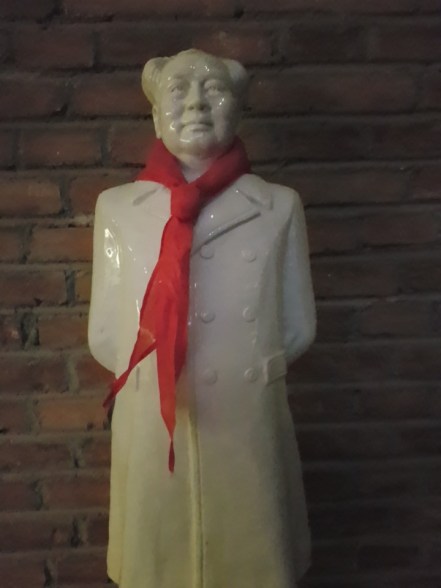 Every twist and turn along the brick walkways, led us to intimate spaces with fountains, a kitchen garden, a game of bocce, the casual dining cafe and lounge with its fireplace and library of books left from visitors from all parts of the world. Had it been summer, we would have lingered in the private patio just outside our suite, dined outside in the brick courtyard or taken a dip in the small pool after our massages, but it was COLD so we chose instead to light the two fireplaces, nicely laid with dry wood, in our Chairman’s Suite, and leisurely shower in the spacious bathroom, listening to reggae off Apple Tunes and sipping Chinese beers. There was a brief panic until we located the chimney flue….
The menu in the cafe featured homemade Chinese and more Western dishes made with locally grown produce as well as several decent wines. We split some yummy pork dumplings to start and then I decided to stay “local” and ordered grilled tofu with a spicy tomato sauce and grilled cabbage while Bill opted for more familiar fare (yogurt marinated grilled chicken). Both entrées were delicious, as was the homemade Belgian chocolate, vanilla bean and caramel walnut ice cream we “split” for dessert. We were initially surprised to be thwarted in our efforts to load Netflix on Bill’s laptop since we had forgotten about that restriction in this Communist country. Behind the Chinese firewall, the internet didn’t really work all weekend and especially in this remote village. Oh well…lack of connection is blissful at times!
The down comforters kept us toasty warm all night and we sipped Nespresso in the room while dressing warmly for our excursion on the Great Wall. After two and a half years of living in Seoul and slowly, slowly learning to speak rudimentary Korean, I had forgotten how difficult it can be to accomplish simple tasks–like ordering eggs for breakfast–in a foreign country from someone who doesn’t speak English. Despite my elaborate and I thought, quite specific, hand gesticulations (2 eggs over easy for each of us), we were served breakfast clearly prepared for 4 guests. The spread laid out included eggs (hard-boiled) , piles of potatoes/Home fries, sautéed mushrooms and grilled half tomatoes with garlic. It was all freshly prepared and accompanied by a nice basket of Western breads. I gobbled it all up, but Bill refused to try the mushrooms claiming that wasn’t a color he liked in the morning.
A hotel driver drove us 5 mins to the town center to buy tickets to go on the Great Wall and then another 5 mins to the bottom of the cable car entrance. Bill wisely bought hats and fleece gloves for both of us since it was a tad brisker than we’d thought. Again, at the advice of friends, we were determined to get on the Great Wall early so our pictures would not be filled/blocked with other tourists. Hence, the “cable car cop-out” and decision not to take the footpath up the Wall. We were amused to find a Subway store, blasting familiar tunes as you can hear in the video below, and were once reminded of the strength of this brand worldwide. I apologize for the film crew’s ineptitude in advance…
We were plenty early and truly did have The Great Wall to ourselves for the most part. Every now and then we would pass another tourist…all different nationalities as well as many Chinese tourists. “Ni-hao” is the only Mandarin Chinese we speak, and I’m SURE we don’t have the correct tone when we utter these simple syllables, but nearly everyone said hello or hi back to us!
How in the world do I begin to articulate the splendid beauty and magnificence of the Great Wall, let alone choose among the 100+ pictures we took during the 3 hours we spent walking on it. It was a clear late Fall day and the leafless trees made it seems as if the mountains were covered by a coat of fur. We both agreed that we could have stayed ALL DAY on the Great Wall and would have enjoyed hiking to the neighboring villages we could see in the distance.
Below are some photos that hopefully give you a sense of the landscape around us, the expansive views and the sheer length of the Great Wall as it snakes and stretches from mountain peak to mountain peak along the ridges . 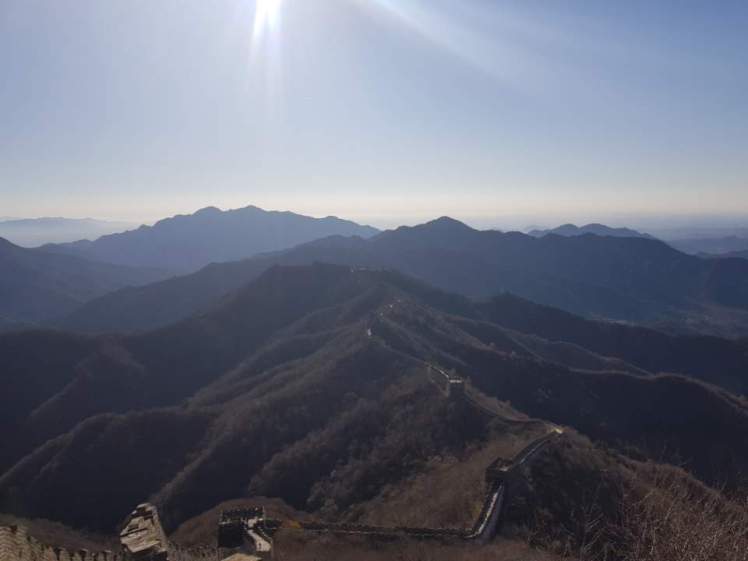
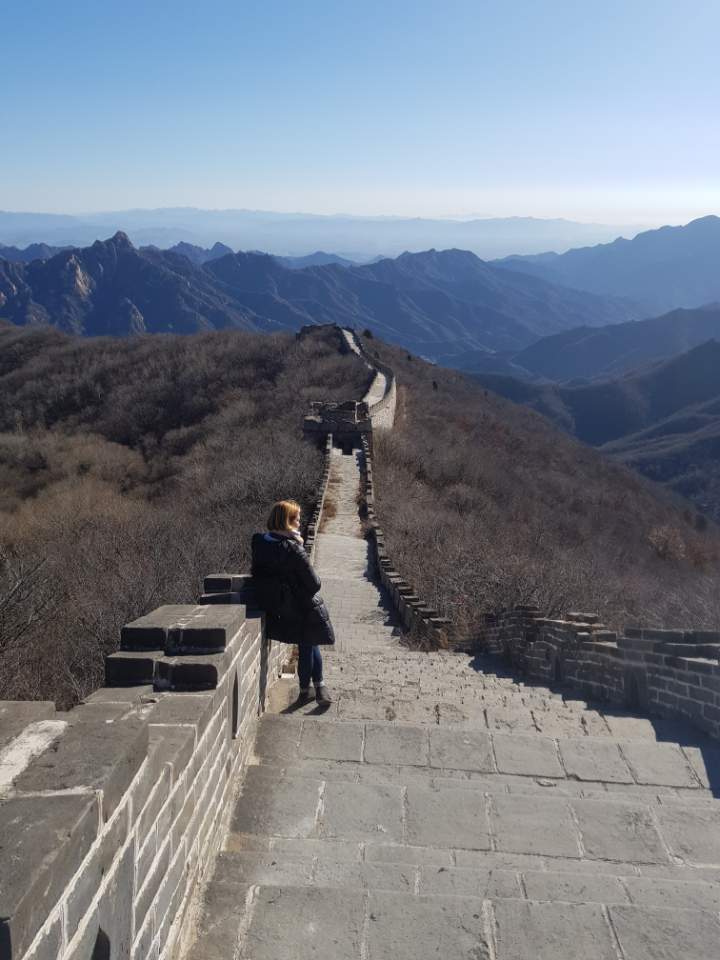
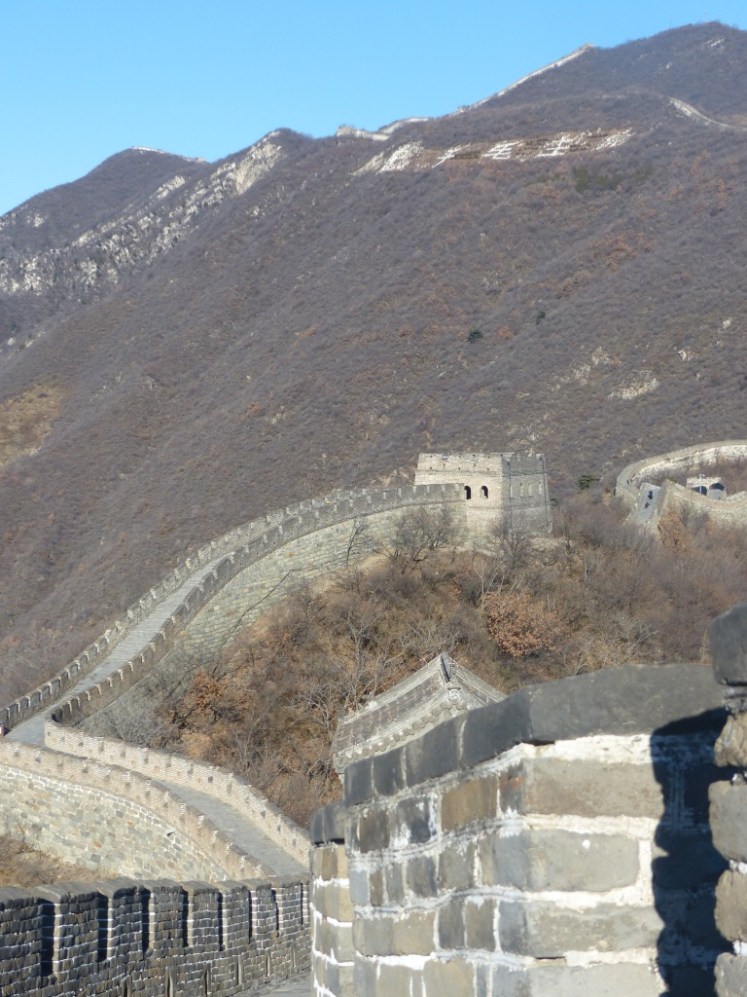
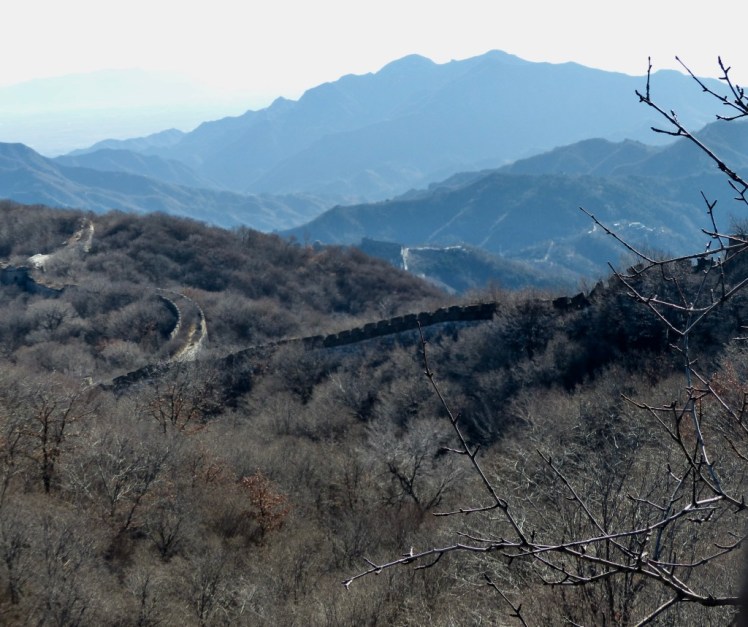
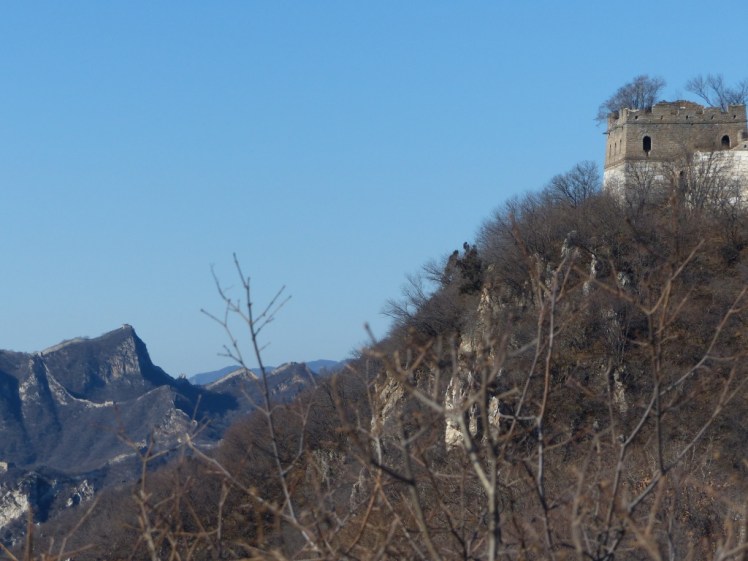 The Great Wall has a long, complicated history and certainly was constructed all once, but rather in sections by various towns throughout the country as fortification from invaders was needed. Parts of the Great Wall date from 220 BC and a variety of different building materials, including earth, wood, stone, brick were used throughout the centuries. The exact length of the Great Wall is estimated to have been over 10,000 miles by the Chinese government, but this is debatable since over time, much of it has disappeared and been absorbed by nature. However, it is known that much (5,500+ miles) of the Great Wall was rebuilt during the Ming Dynasty (1368-1644) and this includes the Mutianyu and Jiankou sections where we were. Here, the Great Wall is built of granite, is 7-8.5 meters high and 4-5 meters wide. The walls themselves have merions or small openings on either side so as to permit guards to fire upon enemies from both the inner and outer sides of the parapets.
 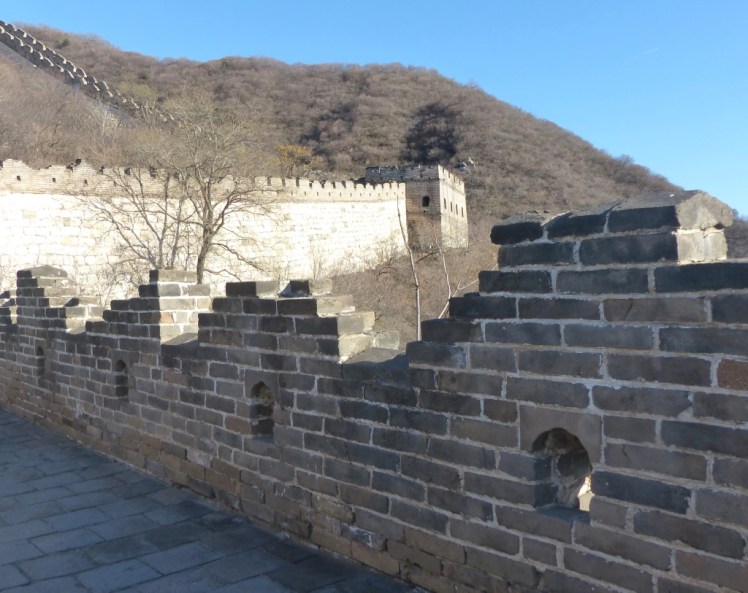 There are numerous watchtowers along this stretch of the wall, like the one visible above, each with steep steps, open “doorways” from which to soak in the stunning views and interior spaces which served as guard barracks. The stairs here were often daunting, especially on the way down!


I had fun taking pictures through the merions and watchtower “doors”, including one I snapped of Bill “seeing a man about a horse”!


Right after Bill had his chat with the horse, a drone flew over us and laughed hard at the thought on the faces of the government officials reviewing the footage we assume for security purposes. To the northwest of us lay the “Sleeping Buddha” section of the Great Wall and these mountain peaks offered striking vistas for us all morning. 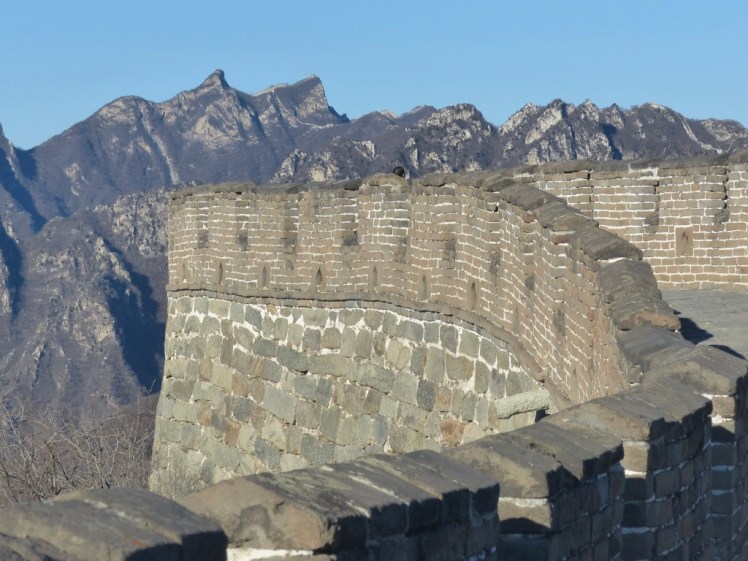 I think Buddha’s nose is too pointy, but we “yogis” certainly enjoyed his company as we strolled. Here are few of the many pictures we took of these magestic mountains on our left. I particularly liked looking at Buddha’s head through the merions in the wall.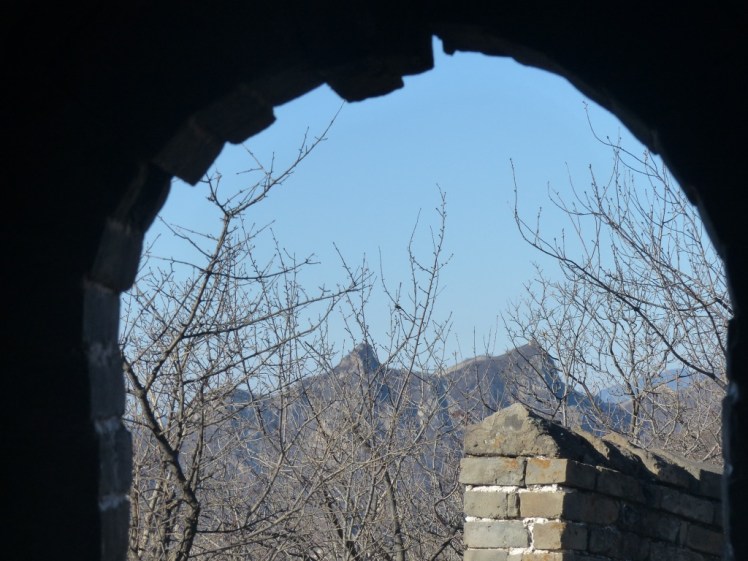
Korean hiking had us well prepared for the steep steps, but nevertheless as our hearts began to pump, our hats and gloves came off. After an hour of so, we reached watchtower 23 which marks the end of the Mutianyu section. Here, there was a guy selling souvenirs, cucumbers, bananas and drinks who spoke rudimentary English. As his only customers, we felt compelled to shop and so bought a postcard pack and a small Buddha statue for Bill’s collection. He kindly offered to take our picture:
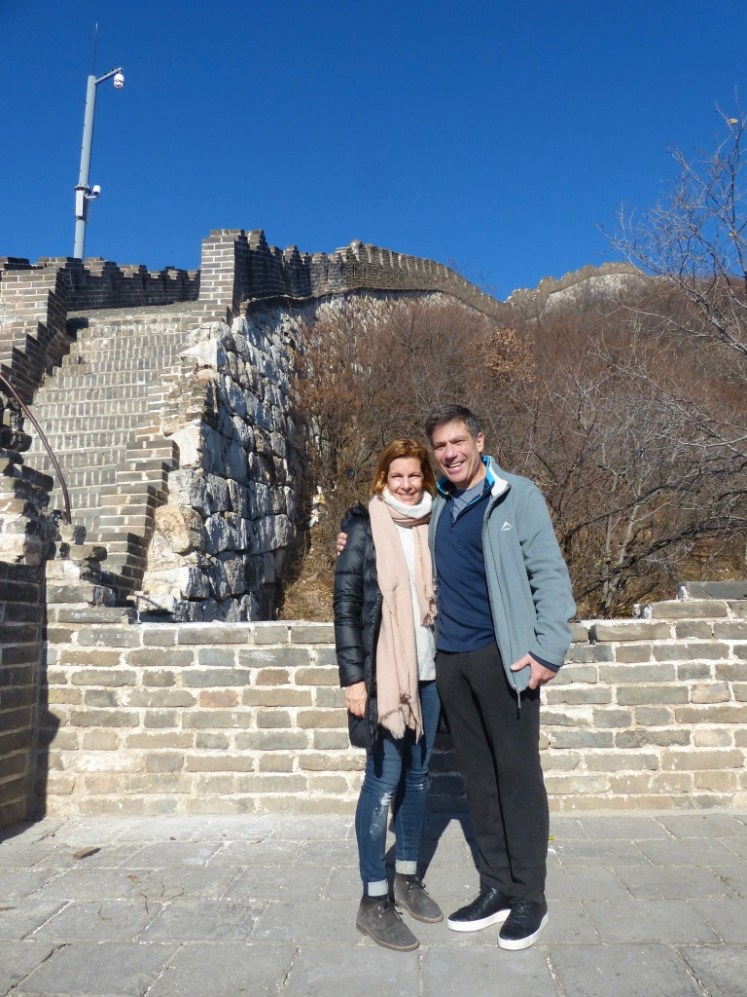 Earlier, the Brickyard concierge had mentioned that we could climb around this watchtower and keep going on the Wall but Bill was skeptical and the Chinese vendor kept saying “no”. I was frustrated since the Wall in all its glory was calling me and just a bit above us, I could see evidence of visitors (trash sadly) and a lady who also appeared to have set up a snack stand set up. For a few tense moments, there was a “Stanton Standoff” on the Great Wall! Fortunately for our marriage and only a few minutes later, we noticed a man descending down towards us, clearly indicating that we could indeed hop over the side wall of the watchtower and carry on trekking!
We traded “Ni-hao”s with the lady I had noticed from below and she taught us how to say “Xie Xie”, roughly pronounced as “sheshe”…or so we think. She was shy but I was able to snap this picture of her pink glory as she counted out our change. 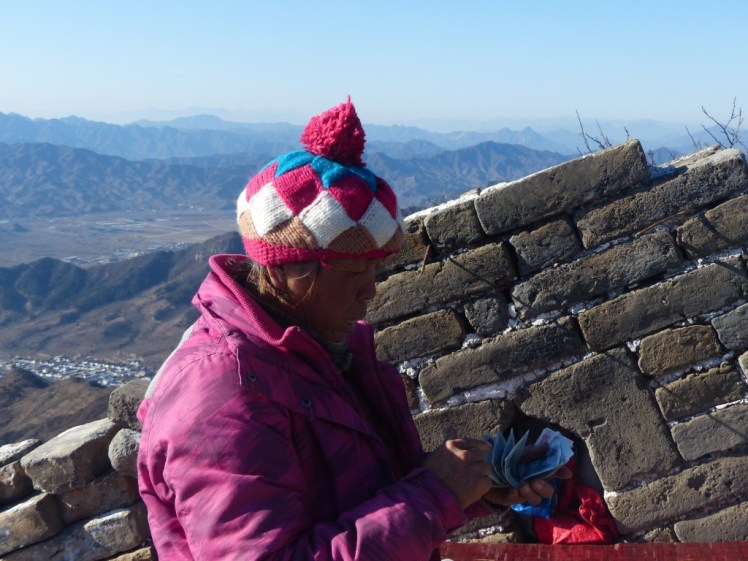 This section of the wall had not been as well-preserved, was much more narrow and lacked the side walls with merions.
It was interesting to see the contrast and easy to envision how the Great Wall had actually been built by different villages at various times rather than as one comprehensive national project. We met a few other intrepid tourists along this more remote section, including evidence of the mayor of the City of Ekaterinburg (Russia) who asked us to reach out if we visit his city and he and Bill exchanged business cards and will perhaps connect via LinkedIn. There was a group of Swedes who had a private guide and were trekking further and faster which only made me jealous. We did encounter one American woman from San Diego who was tagging along with her husband on his business trip to Shanghai where he was hoping to begin exporting WD-40 to China. Counterfeit versions of this product do exist in China with similar packaging but the product is inferior…or so she says. From her we learned that the Chinese government had begun cleaning up Beijing’s air early in the week prior to Trump’s visit by shuttering factories, seeding clouds, etc. They’d been in Beijing for two days and said the air was poor until yesterday when Trump left…but now it was gorgeous! So we really did benefit from Trump’s visit.
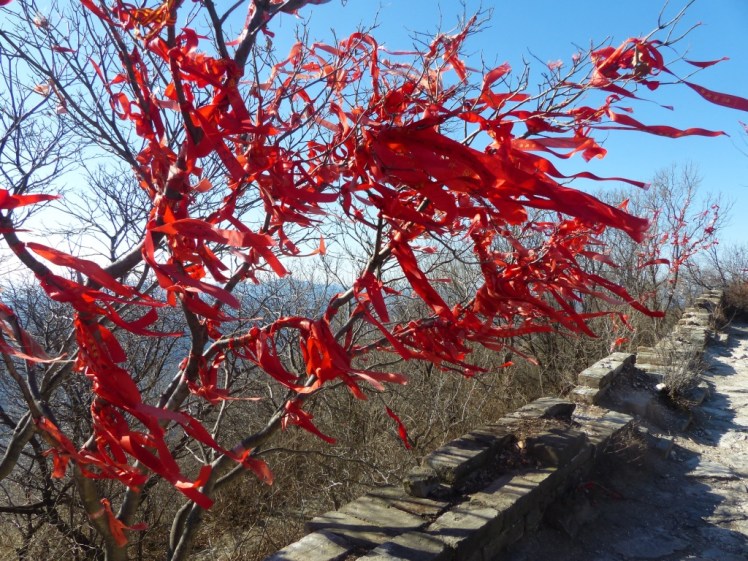
At one point, though we couldn’t decipher exactly why, the trees were decorated with lots of red Chinese prayer flags. The fluttering bits of red and faded pink ribbons were simply beautiful against the otherwise barren winter landscape. 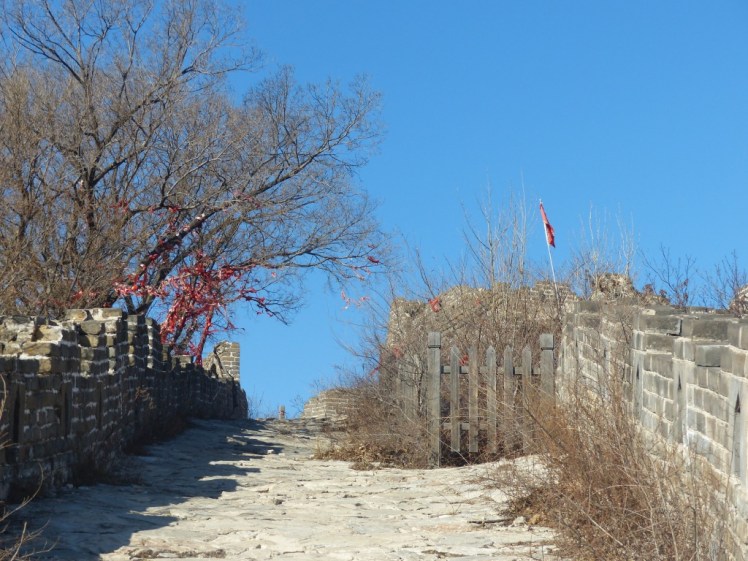
By the time we began our descent, the busloads of tourists from Beijing had arrived. Here’s video Bill shot from one of the watchtowers which will give you a sense of the expanse around us as well as the other visitors. 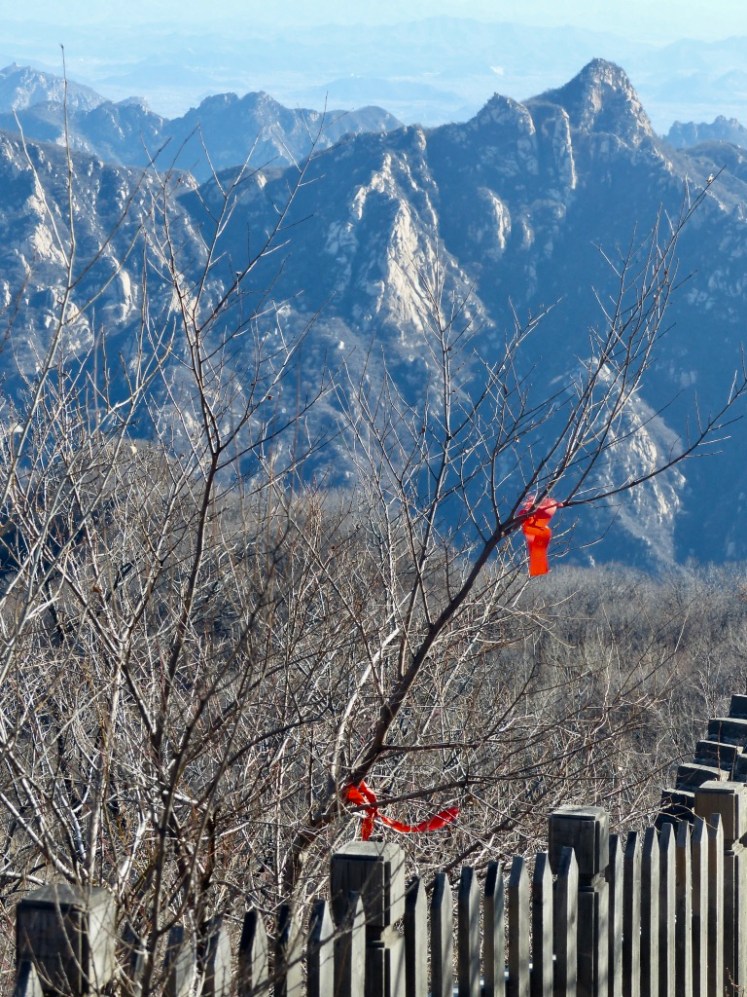
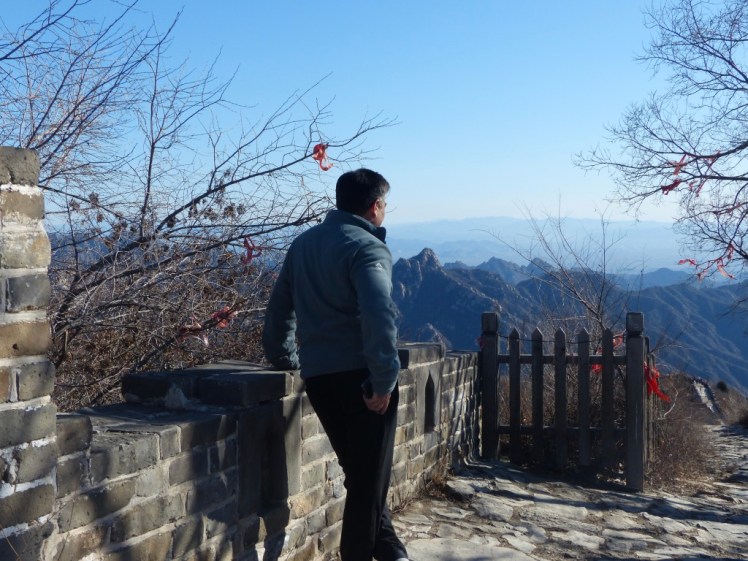
We had arranged a noon pickup time with the driver and needed to head to Beijing in the afternoon so reluctantly had to turn around at one point. We could have hiked for hours and hours from peak to peak, contemplating the grandeur and serenity of the world around us, and recommend to those of you considering a similar visit, that you do in fact start in one village and hike to another one so as to really soak in all of the Great Wall’s glory. Here’s a view that shows just how far into the distance the Great Wall stretched out before us and hopefully entices you to spend a long time up there: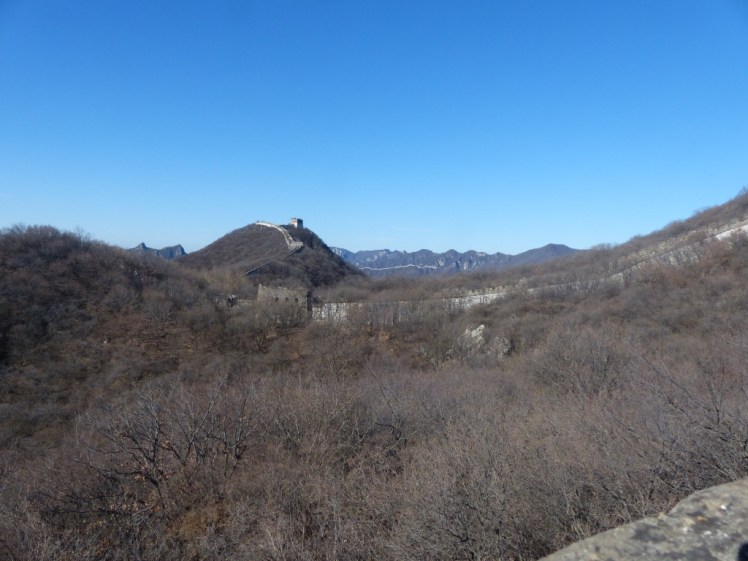
By the time we began our descent, the busloads of tourists from Beijing had arrived. Here’s video Bill shot from one of the watchtowers which will give you a sense of the expanse around us as well as us:
In a few of the watchtowers there were now souvenir vendors and I made Bill purchase a nice t-shirt to add to his collection despite his minimal cash reserves. This came back to bite us soon after since we didn’t have enough RMB to buy cable car tickets down and had to descend via the footpath despite our now-quite-weary legs. Bill got a bit grumpy (hangrey perhaps?) but fortunately a coke and ?? (can you guess from the image below what often saves the day for both of us all over Asia?) revived him. If only he had eaten his mushrooms at breakfast…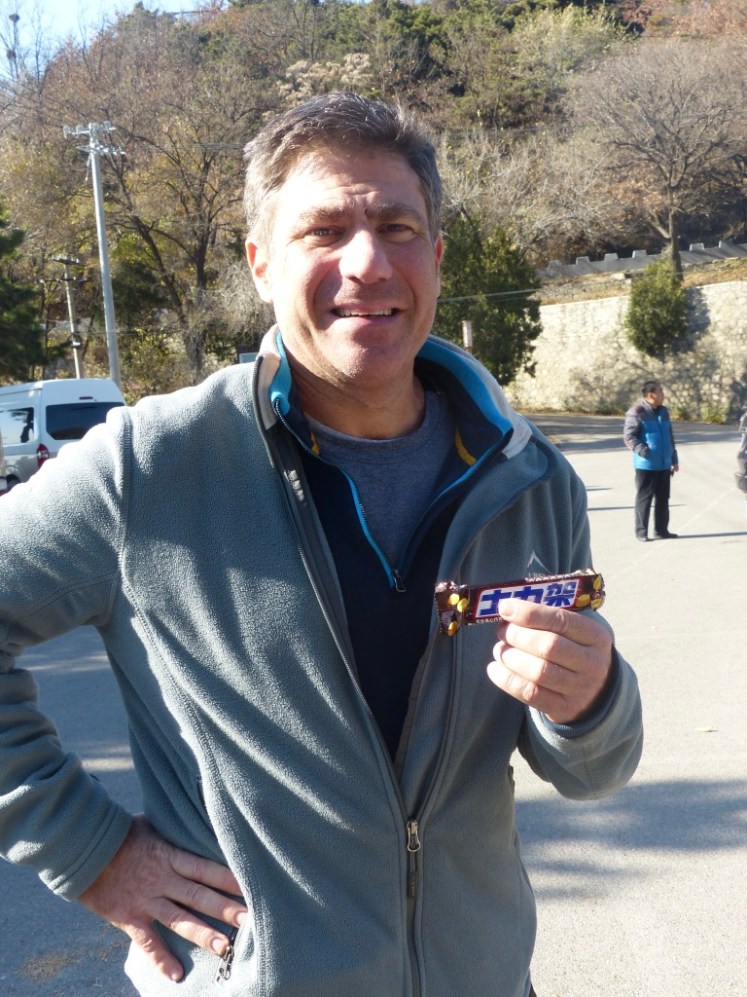 Truly all of the accolades (A fantastic morning! Once in a lifetime! A MUST!) apply. Should anyone plan a trip, let us know as we would love an excuse to go back!
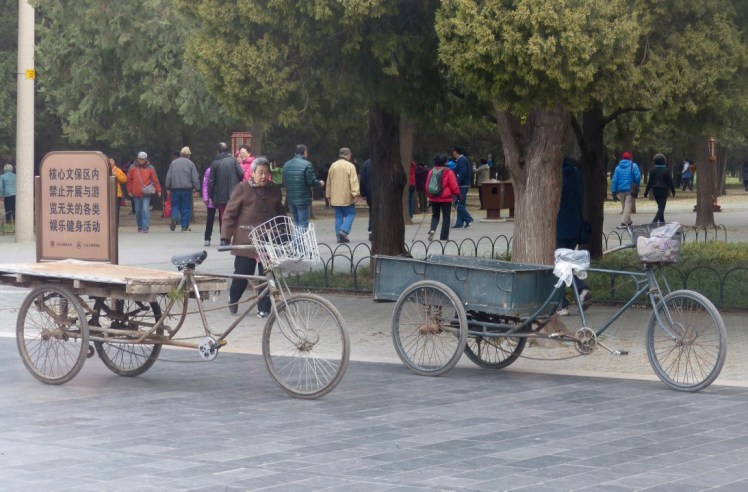
We did encounter a lot of traffic as we made our way to the St. Regis Hotel through the concentric ring roads of Beijing BUT we were fortunate to have beautifully clear blue skies and there is plenty to observe in this sprawling city and suburbs of 23 million people. Here’s a view through our hotel window of the Z15 building currently under construction. Completion of this 530 meter, 108 story tower is expected within the year; it is already the tallest building in Beijing and quite distinctive. 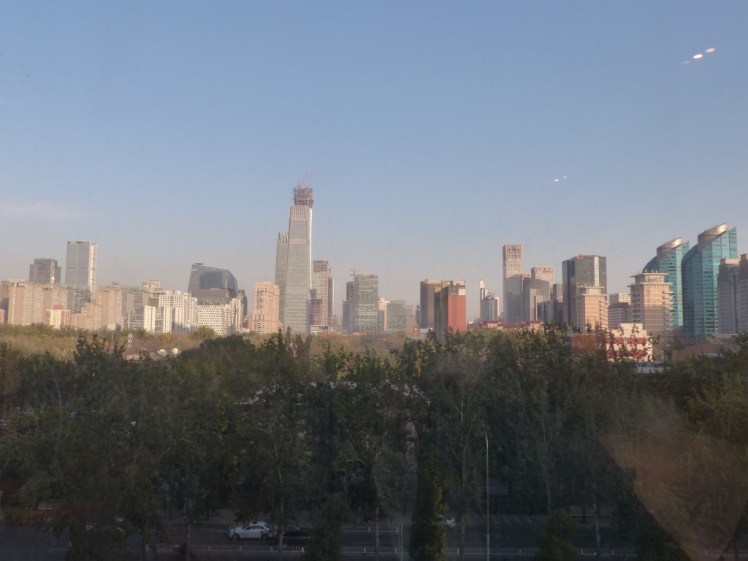 Many sidewalks are lined with public bicycles available for rent via several different Apps at low-cost. It is estimated that Beijing has over 40,000 such bikes, the newest of which have solar power, GPS systems and burglar-proof locks activated via phone apps. Helmets aren’t used and laws protect riders vs. drivers so accidents are minimal (or so our guide told us). I must admit though that we saw far more cars than bikes on the road but perhaps this was a weekend phenomenon. We did see old folks bicycling around with loads of cardboard and other recyclables on such carts as the ones below. In Seoul, old folks pull similar carts on foot whereas in Beijing they bike. Second option seems much better to me!
 After the 2 hour ride, we decided to do some yoga to stretch AND get deep tissue massages…after all we HAD HIKED THE GREAT WALL ALL MORNING! At the St. Regis, we experienced some particularly good abdomen and ear massages which I surmise reflects the Chinese belief in acupuncture and its Eastern approach to the body’s health. Really nice.
For dinner, we decided to follow Cristina and Guillaume’s recommendation since they take food VERY seriously and often provide us with great recommendations in Seoul. Here I am at Xiao Wang’s Home restaurant where we enjoyed Gong Bao Chicken (SO different from any Kungpao Chicken I’ve ever had in the States), sautéed green beans with minced pork and then shrimp balls with pineapple chunks in spicy mustard sauce…all with Chinese draft beer. 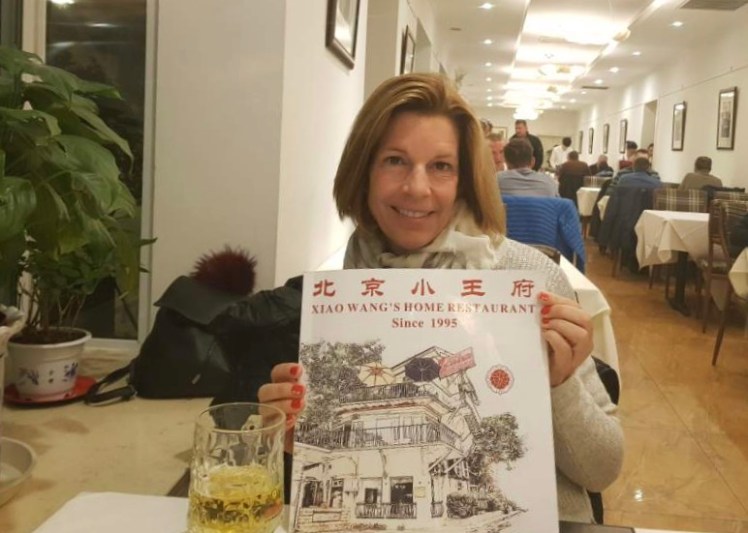 It was certainly the best Chinese food I’ve ever eaten and a perfect end to a spectacular day!
We arranged to have a tour guide on Saturday and met Cynthia and her driver at 9am in the lobby. At her recommendation, we first headed to the Temple of Heaven which is just outside of the Forbidden City (the first ring of the city) in Old Beijing which is located in the second ring. Many of the buildings within Old Beijing date from the 1400s when the Ming Dynasty moved its capital here. It was also during the Ming Dynasty that naval trade between China and the rest of the world was established and the gradual opening of China began. When Imperial China was dissolved in 1925 and the Republic of China was formed by Dr. Sun Yat Sen and his followers, the capital moved south to Nanjing. In 1949, Mao relocated the capital to Beijing where it has remained ever since.
Begun in 1420, The Temple of Heaven was built to serve as a place for the Emperor to worship the god of Heaven and pray for a Good Harvest. It was subsequently expanded and became the world’s largest architectural complex for rituals to pay homage to Heaven, encompassing over 675 acres and numerous buildings. In 1918, it became a public park and in 1988, a UNESCO World Heritage site that today attracts many visitors.
The Emperor was the only person who ever visited the Temple of Heaven and he only came twice a year, once in the spring to make sacrificial offerings to the gods and to pray for a good harvest and then in the fall, to give thanks for the bounty. The two distinct parts of this temple complex adhere to the ancient Taoist belief that the Earth is square and Heaven is round. The southern part of this Temple of Heaven is a large square plaza with large poles from which banners were flown to announce to the Emperor’s subjects his presence at the temple. Here, incense was burned in large cauldrons (see below) and animals were sacrificed to the gods while the Emperor himself stood at the Earth Altar, a central mound in the middle of the square and prayed.


One then proceeds from the southern Altar through large walls with pretty gates into the northern part of the complex towards the Altar of Prayer for Good Harvest, passing several ceremonial Halls and outer buildings along the way. Here are some pictures that attempt to give a sense of the beauty and scale of this complex one experiences on the way to the northern Altar.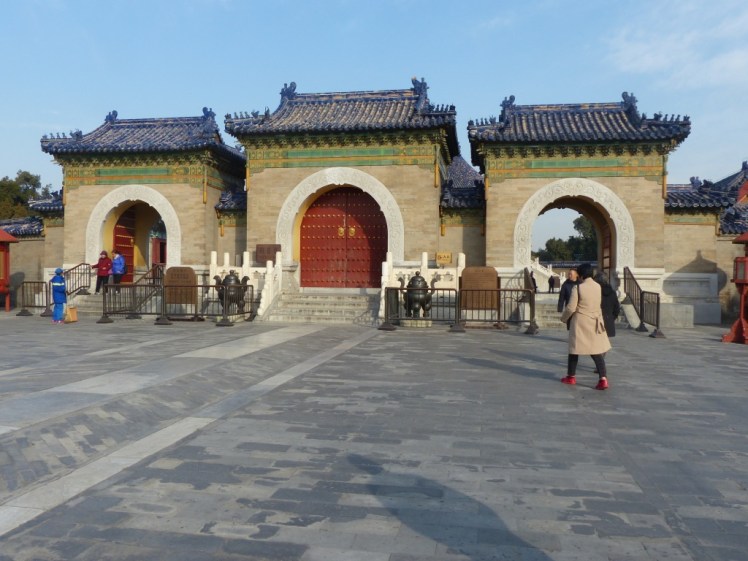
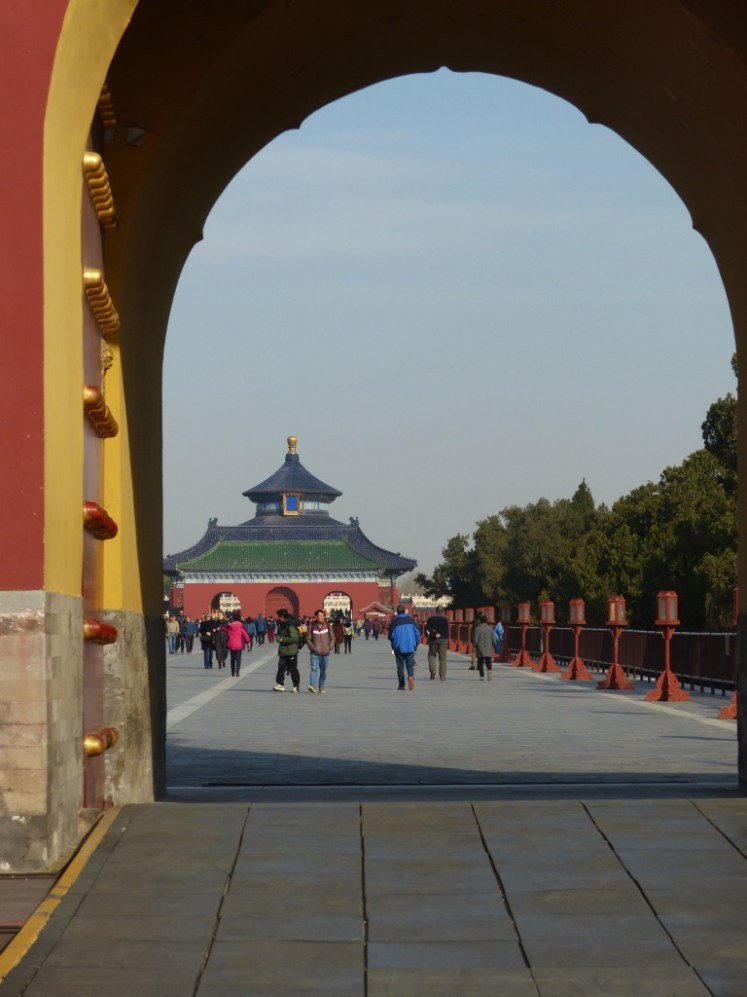
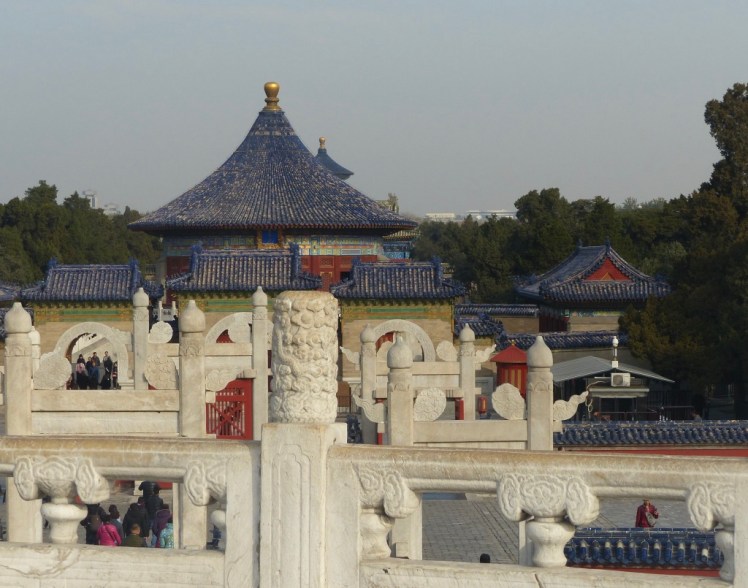
As you can notice, there are only 5 colors used throughout the complex. Yellow is the imperial color and could only be worn by the Emperor or used to adorn his objects/buildings. Blue and green represent heaven and the ground/land, respectively. Red connotes fire (and sometimes blood) and symbolizes good fortune and joy. The grey stone everywhere represents water. Nowhere is there an image of god since the Chinese are quite superstitious and believe that one should only honor the 5 feng shui elements of wood, fire, earth, metal and water by hanging wooden prayer tablets.
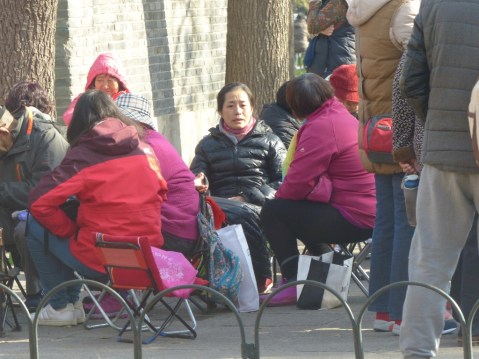
The large Temple of Heaven complex also incorporates large green spaces, with lawns and mature trees, most of them very old, beautiful cypress trees. Many of the cypresses are over 300 years old while the grandfather tree is over 500 yrs. old. Everyday, under these trees, elderly locals gather to exercise, socialize, play games and arrange marriages. We meandered along the side paths and through a large open square where many locals were playing jianzi, a game dating from the Han dynasty over 2,000 years ago that involves balancing and tossing a shuttlecock among teammates. If you look closely at the photo below, you can see a blurry white shuttlecock in the air between players gathered in circles to play. 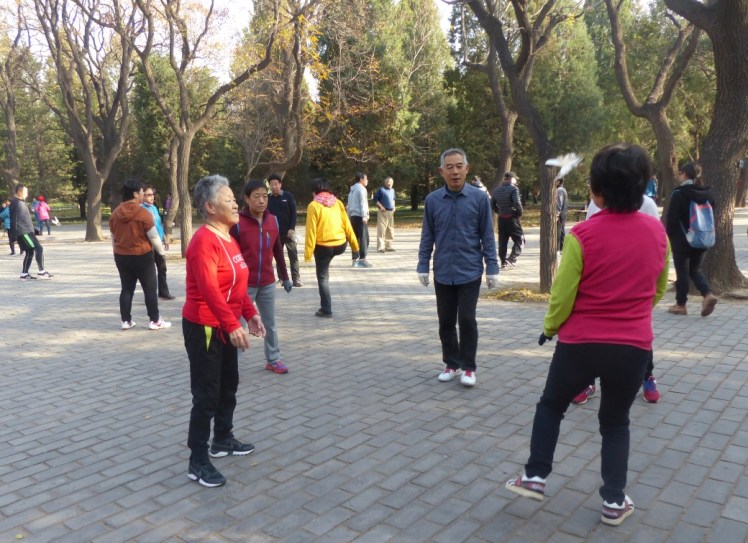 A few locals invited me to play, but I wasn’t nearly brave enough to try, and Bill, who probably would have jumped in, was busy filming the dancing going on nearby. Cynthia explained that folks meet here as early as 8am to dance/exercise for several hours, take a break and then often continue into the afternoon. Some practice traditional martial arts like Tai Chi, but many today prefer a modernized version with music. We found it very peaceful to listen to the rhythmic music and watch the un-choreographed, and certainly non-competitive, dancers around us as they gently exercised and communed with each other. I was even tempted to join in as the moves hardly seemed complicated and looked far easier than Zumba (which I find competitive, intimidating and down-right impossible!). Given the pace of life today in the age of connectivity, and often the ironic isolationism that comes with it, this moment was a nice anecdote.
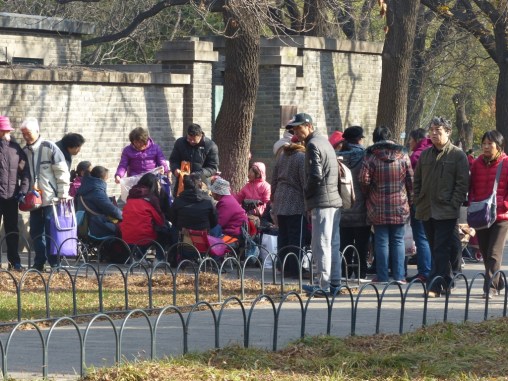
Huddled nearby was a large group of mostly women who Cynthia explained are strangers to one another but gather to share concerns, offer advice and arrange marriages. Once again, we were struck by how this type of communal gathering is sadly fading in America, but maybe our 4 daughters are relieved that we don’t meddle in this fashion.
We next began to stroll along the long covered corridor that leads to Inner Altar. Animals that had been sacrificed in the Outer Altar were carried along this corridor to the Altar of Prayer for Good Harvest. Cynthia explained that this long approach to the Inner Altar deliberately zigs and zags unlike evil spirits which are believed to travel in straight lines. This Eastern belief perhaps explains why Asian communication feels more indirect/subtle/confusing and even hypocritical to us at times. Does this also perhaps mean that when Americans are described as “very direct” , this actually means we are “evil”?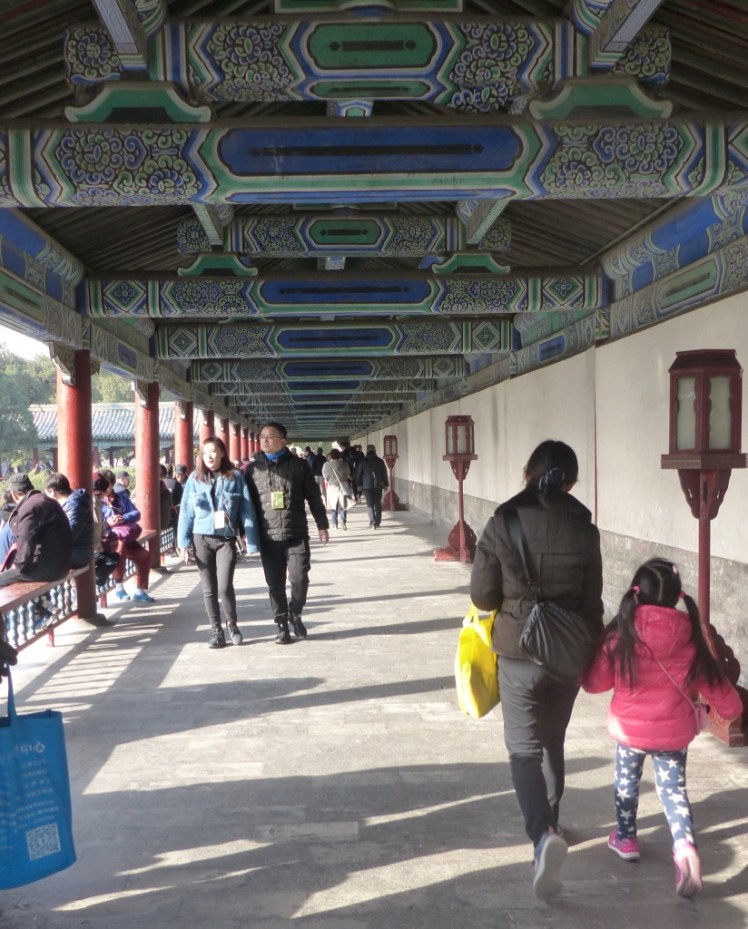 It was interesting and peaceful to walk by the local elders here, observing them as they played cards, Chinese chess or knit with friends.


The corridor eventually led us to the Inner Altar which is housed in a round temple, (signifying Heaven) that was constructed in a tongue-and-groove fashion without a single nail. There are two Halls like the one below on either side and inside the temple, there are statues of sacrificial rams.


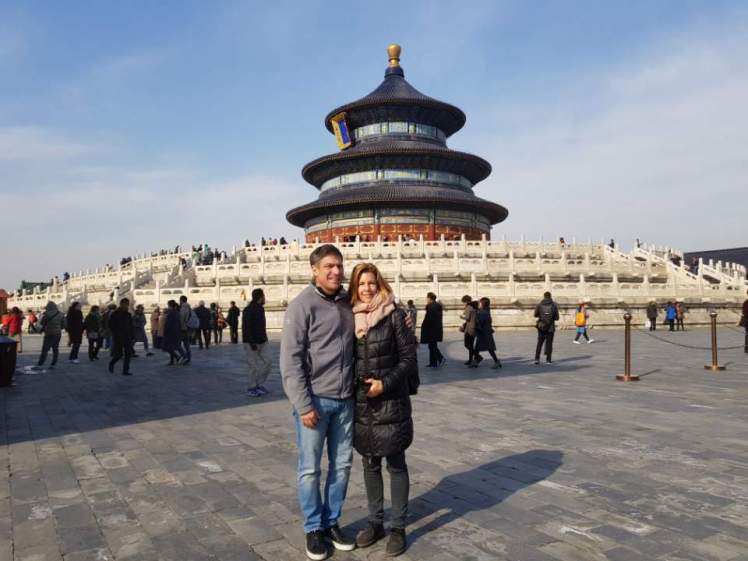 After briefly losing each other, which given the color of our hair must be hard to imagine, we followed Cynthia out the rear of the compound and jumped in the waiting car. A few minutes later, we got out to explore Tiananmen Square and the Forbidden City.
Almost overwhelming in its sheer size, Tiananmen Square is one of the world’s largest city squares and is bordered on the south by the large Qinamen Gate (below) that originally guarded the southern entrance into the Inner City (Old Beijing area today) just outside of the Forbidden City.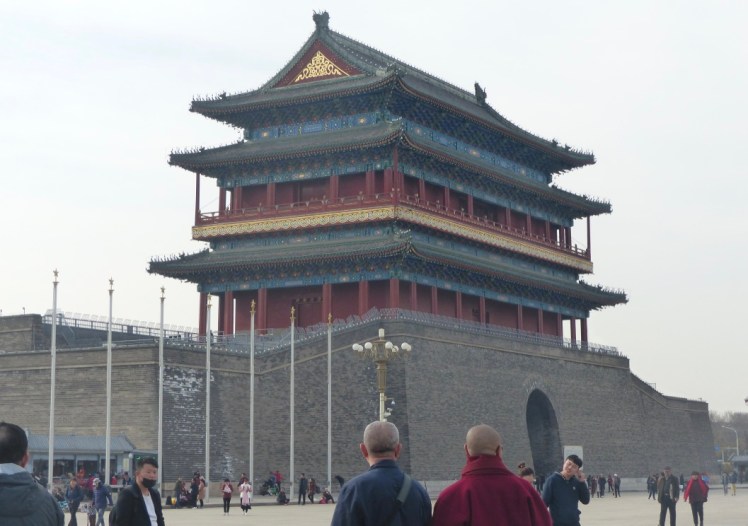 Just opposite and across this enormous city square lies Tiananmen Gate (the Gate of Heavenly Peace) leading into the Forbidden City (the first ring of Beijing City) where only the Emperor, his family and affiliated aristocrats, concubines and eunuchs lived. Commissioned by Mao Zedong in 1949, the Square was meant to be a spectacular gathering place for roughly 500,000 people. Tiananmen Square has since been expanded; today it occupies 535 sq. yds and is said to handle 1 million people, many to be sure but only a fraction of China’s population of roughly 1.4 billion!!! On all sides, Tiananmen Square is surrounded by majestic buildings. On the western side, one finds the Great Hall of the People where the People’s Congress and other important political events are held; to the east, stands the National Museum of China. In Tiananmen Square, there are other large statues as well as Mao’s Mausoleum in which his embalmed body is on view. I was game but the line is usually 3+ hours long and Cynthia didn’t offer it up.
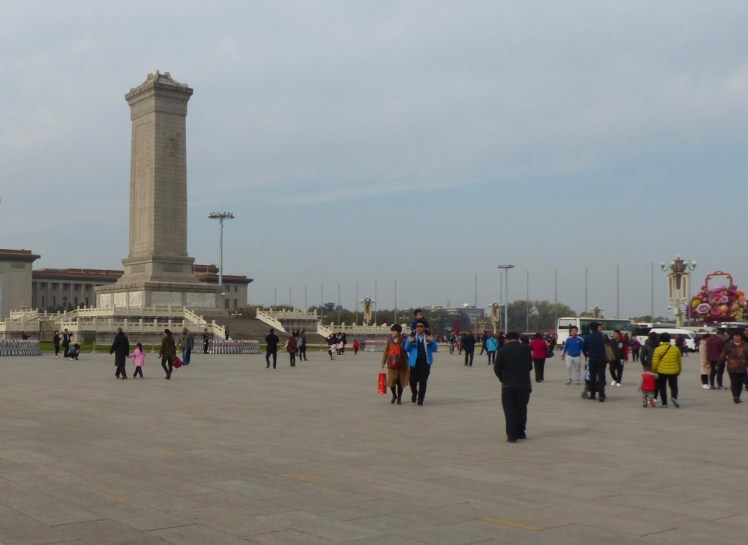
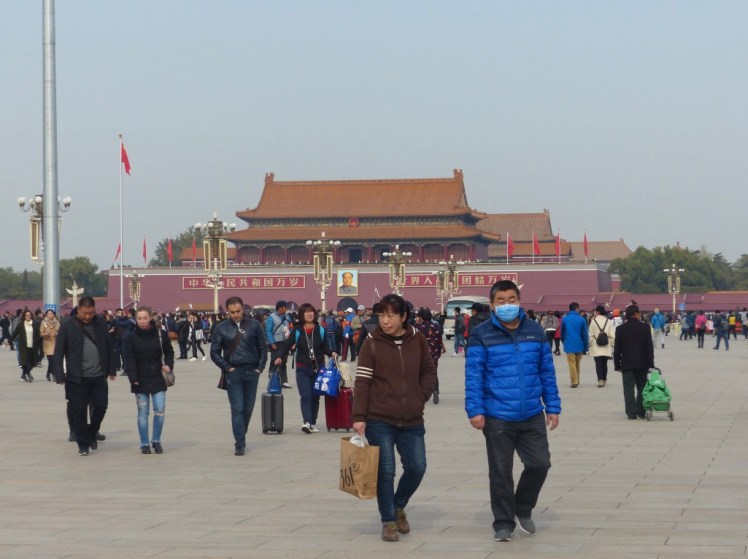
Our Beijing visit was just a month after the recent People’s Congress convention so the Square was still decorated with banners and a huge floral basket display commemorating this important event. We were intrigued by a group of Chinese who appearance and dress was distinctly different from most others we’d seen. Cynthia explained that these people were from Tibet and, that while this part of China was previously very isolated, it is now more connected due to the train service begun in 2006. Can you tell who is who in the photos below?


There weren’t any posters of China’s current leader Xi Jinping…yet…but we wouldn’t be surprised to see his image alongside Mao’s portrait one day given his newly acclaimed status within the Party. We crossed Chang’an Avenue which runs directly in front Tiananmen Gate and serves as an important processional route and then proceeded into the Forbidden City via Tiananmen Gate, nodding to Mao’s portrait and squeezing some Justin’s portable peanut butter in our “hangrey” mouths as we went by.
The Forbidden City is VAST and the scale of its buildings HUGE! We were greeted by the grand city wall with its thick red, angular walls that were impossible to scale and a formidable defense. Even though I tried to back way up, I still couldn’t capture all of this impressive entrance in my photo frame but it should be recognizable. 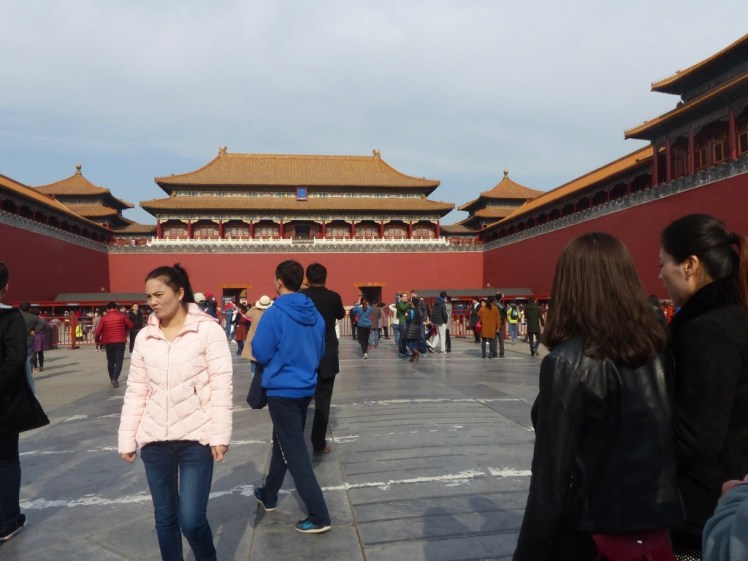 Here, the Imperial Family lived and ruled for 491 years, through 24 different emperors and until 1924 when the last Emperor abdicated to the rebel forces led by Sun Yat-Sen. Construction on the Forbidden City began in 1406. Over 1,000,000 workers and 10,000 artisans helped to complete the Imperial complex and its interior palaces in just 14 years. There are many fascinating details and I only retained a fraction of what Cynthia provided during the hours we strolled around the Inner and Outer Courts, through the many interior palaces, pavillions and halls. I’ll just share a few details and hope that one day you’ll go yourself to this treasure.
In China, the number Nine is felt to be the luckiest since it is the highest single number in base ten and is believed to stand for completeness and eternity. It was therefore the Emperors’ favorite number and the number Nine resonates throughout the Forbidden City. There were 9,999.5 rooms in the Forbidden City, the maximum number of rooms allowed on Earth, since only the “palace in the sky” (Heaven) could have 10,000 rooms. The dimensions of the main Halls are all based on the number Nine as are the number of steps in staircases and figurines on rooftops. We loved the doors, each with 81 brass “nails” in 9 rows of 9 nails, that everyone knew to rub for good luck as they passed by. I was a quick adherent I must admit. 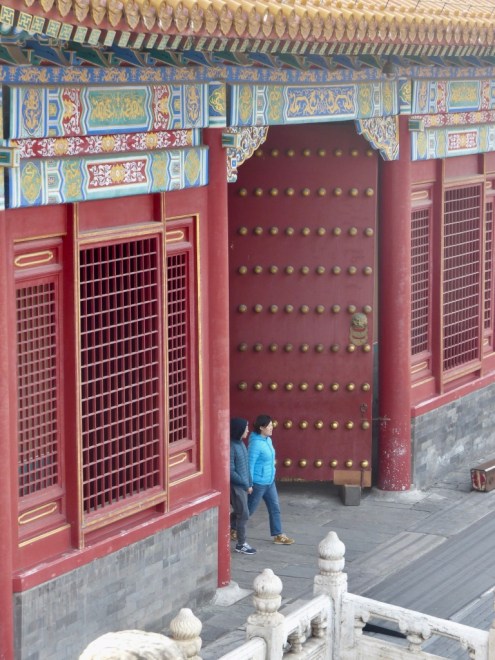 The yellow color of the glazed yellow tiles and ornamentation was beautiful and it is not a color found on Korean palace roofs.


The expansive plazas on which we walked were at least 15 layers of brick thick so as to prevent tunneling. 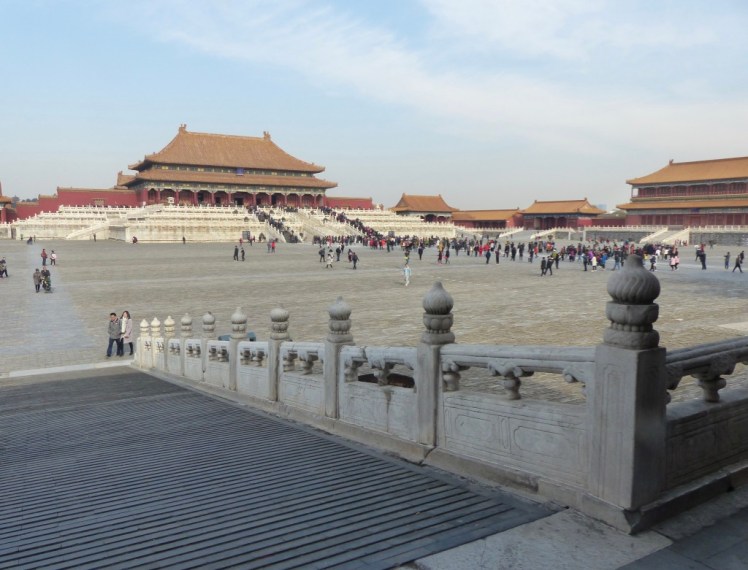 It was mind-boggling to learn about the transportation of the huge slabs of marble used for steps, bridges or intricately carved staircases which involved the digging of canals from remote areas in China all the way to Beijing. Along these canals, the marble was floated on barges during the summer or slid on ice during the winter. There’s even a gigantic 239 ton stone slab than required 20,000 men to move it! We posed alongide one of the majestic bronze lions and admired the crane (symbol of longevity in China) statue against the white marble.


The man-made moat was pretty and offered a calm reflection of the surrounding buildings. 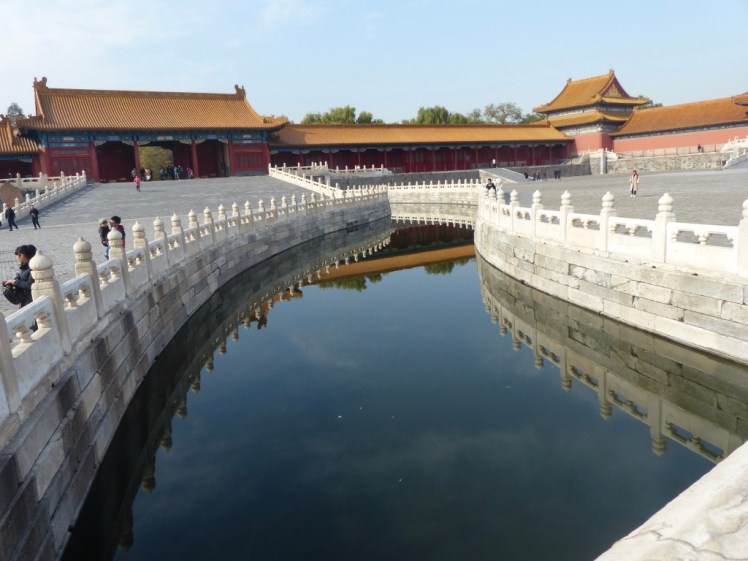 The scale of the palaces within the Forbidden City is impossible to capture all at once, but I did ask Bill to take a video while we were standing within just ONE of the interior palaces. It truly was a City not only for the Imperial Family, but for all the aristocratic families, eunuchs and concubines (an Emperor chose new ones every 3 years and upon his death they were sacrificed to the gods!) granted permission to live within its walls.
As we got deeper and deeper into the Inner Court the spaces became more intimate and we learned all about Empress Dowager Cixi who effectively ruled China for 47 years until 1908. Despite her enormous power and influence, she is widely felt to be responsible for the demise of the Qing Dynasty.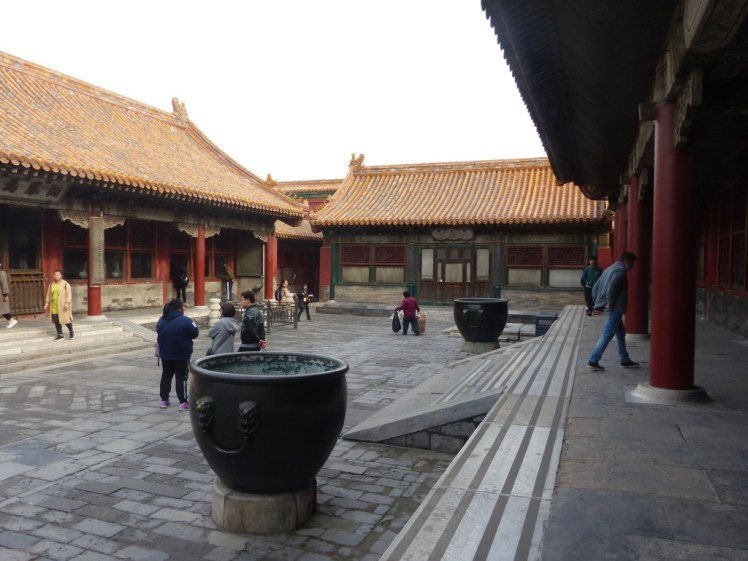 Many of her personal possessions were visible inside these buildings, including a bejeweled rococo style clock from France and an equally sparkly elephant from India. Empress Dowager Cixi’s compound also had an interesting garden just behind these buildings full of unique rocks shaped (damaged?) by water over centuries. Here, I was able to snap a picture of a proud elderly couple (notice the Mao Era Party cap he is wearing) posing in front of these famous rocks.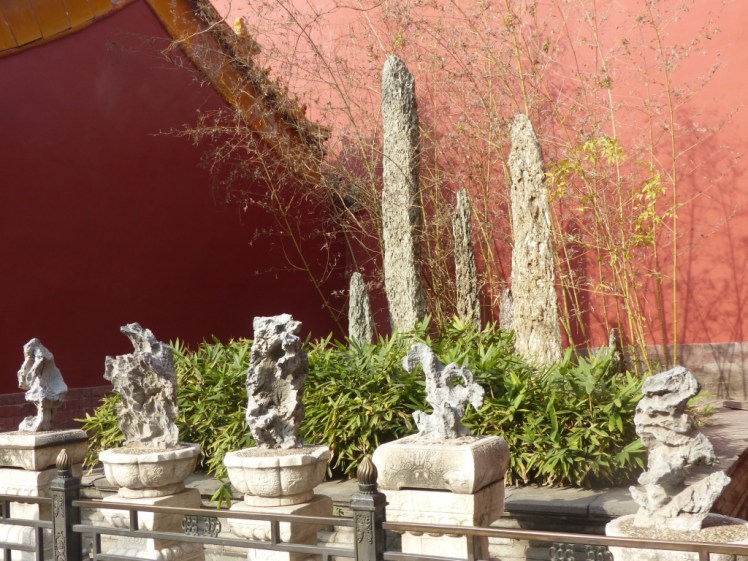
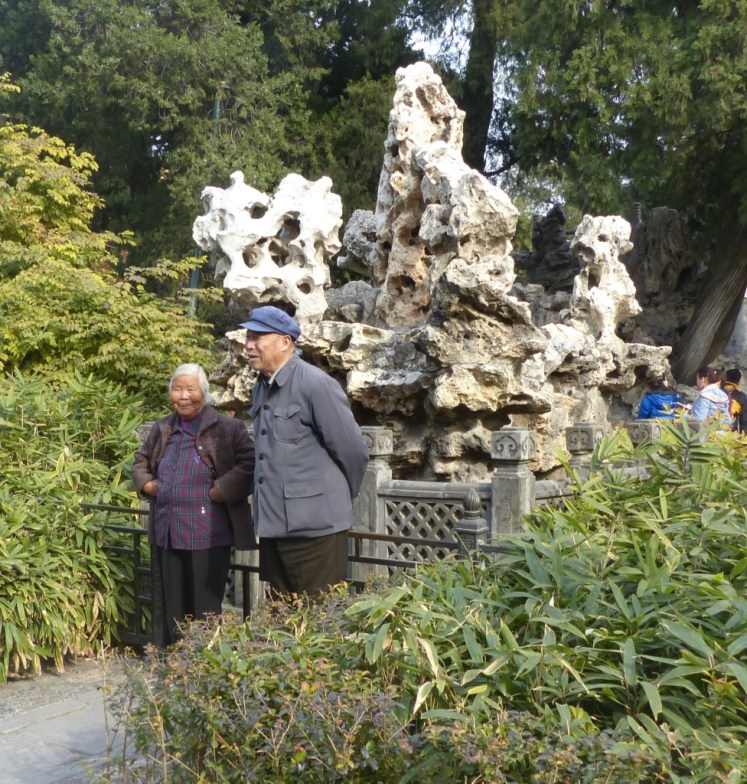 In 1925, the Forbidden City was opened to the public but it wasn’t until 1980 when capitalism began to take hold in China that the throngs of visitors started to come. Today, it is estimated that 9 millions folks visit the site annually, though this number seems a bit “lucky” to me so don’t quote me on this fact.
By now you’re probably tired, so try to imagine how WE FELT! Cynthia found a simple place nearby that served authentic Beijing cuisine and we happily gobbled up all the yummy dishes she ordered. Revived we set off for a walk through some Hutong neighborhoods. A hutong is an alleyway formed by lines of siheyuan or traditional courtyard residences and the oldest ones date from the 13c. For centuries, most of Beijing’s population lived outside of the Forbidden City’s walls in these courtyard residences. Hutongs were constructed out of grey brick and were required to have grey roof tiles, the only tile color allowed for commoners during the Imperial times as yellow was reserved for the royal family and green for officials’ roof tiles. There was variety within these siheyuan neighborhoods because one’s social status determined the location and scale of one’s dwelling. Aristocrats were allowed to live east and west of the city center, while merchants, commoners, etc. lived to the north and south. The nicer siheyuan had walled gardens and elaborately carved entryways. These larger siheyuan residences and neighborhoods also had wider alleyways running between them to allow for horse and palaquin carriage traffic, whereas poorer hutongs were only wide enough for pedestrian traffic. Some of these hutong alleyways were only 50 cm wide. Both the main gate into the courtyard and the actual residence within the courtyard faced south for the best light. For centuries, hutongs did not have running water or central heating. Instead, communal toilets and bath houses located outside the siheyuan in the hutong alleyways. Responsibility for these common spaces was shared among groups of siheyuans much like a condo/neighborhood association cares for public areas used by several different residences.
Under Mao’s communist regime, the idea of different social standings was abolished and wealthy siheyuan owners were actually forced to move out of the residential portion of their courtyard complex to the less desirable northern side and to open up the large yard to other families. At this time, virtually every inch of the property, the central courtyard and its perimeter, were built upon such that the original siheyuans ceased to have interior courtyards and became instead multiple rooms/homes within the exterior walls. Population in hutong neighborhoods swelled and these areas became like rabbit warrens and many fell into disrepair.
During the 20th century, most of the siheyuan/hutong neighborhoods were demolished to make way for new high-rise construction and it wasn’t until fairly recently that the Chinese government has decided to preserve certain hutongs. Several close to the Forbidden City are being preserved and those residents are actually sitting on extremely valuable land as a result. Some even refer to this area as “gold town” which we found unfathomable! Also, one is allowed to have pets in these hutong areas, though this poses a problem for car owners who need to discourage peeing on tires by placing pieces of wood by each tire. Below is a typical street scene in “gold town” and you can see the wood by car tires. 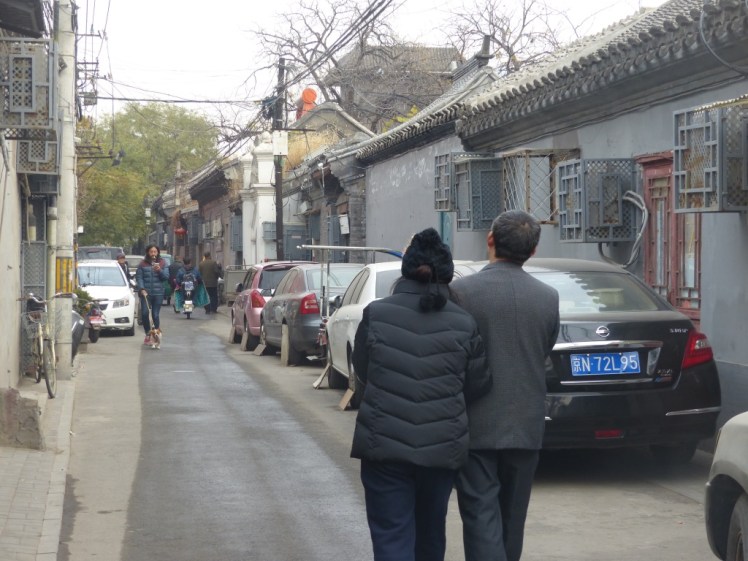 Coal was the only source of heat until the 2008 Olympics when Beijing so desperately needed to clean up its polluted air and thereby abolished coal-burning and retrofitted hutong neighborhoods with central heating. Today, some hutongs have running water, but still no toilets, so hand laundry is possible albeit inconvenient and cold in winter!
These days, when the government does decide to demolish a hutong neighborhood, the property owners can now demand significant compensation or relocation to a nice new high-rise apartment. With the rise of capitalism, some folks have acquired these properties for investment purposes only and act as landlords. We even saw a BMW parked along the small alley. There are even a few “boutique” hotels springing up for those travellers wanting the “real Chinese” experience, much like the hanok hotels popular in Seoul. As Cynthia explained, the rules for hutongs continue to change and just this summer the Chinese government decided to prohibit retail space in these neighborhoods. Consequently, the few cafés, bars and mini marts that sprung up in this area have been forced to close. Also, new building restrictions now limit all structures to a height of 6 meters/one story only and basement excavation is prohibited.
One would never know this, however, when walking down these alleys. We toured one of the wealthier hutong neighborhoods with alleys wide enough for horse/palaquin carriage travel long ago, and for smaller cars these days. Also, the doorways were nicely cared for, often painted in the traditional red rust color. Several doorways still had the important stones on either side indicating the owner’s status; round stones (connoting drums beaten when marching into battle) were placed in front of military family homes while civil servants’ doorways had square stones echoing the chop (stamp) they used to “sign'” documents.


While the front doors of many residences were open, a barrier wall just inside had usually been built to block the view and provide security. As a result our view was obstructed and we usually only saw bicycles, hanging clothes and utility meters as we walked by. Most hutongs are still occupied by numerous different families as is evident by the number of utility meters visible on the outside of the buildings like you can see below.


Despite the depressing grey color, several hutongs had nice plantings or brightly colored quilts airing out in front. These details only marginally brightened up the area in our eyes however. 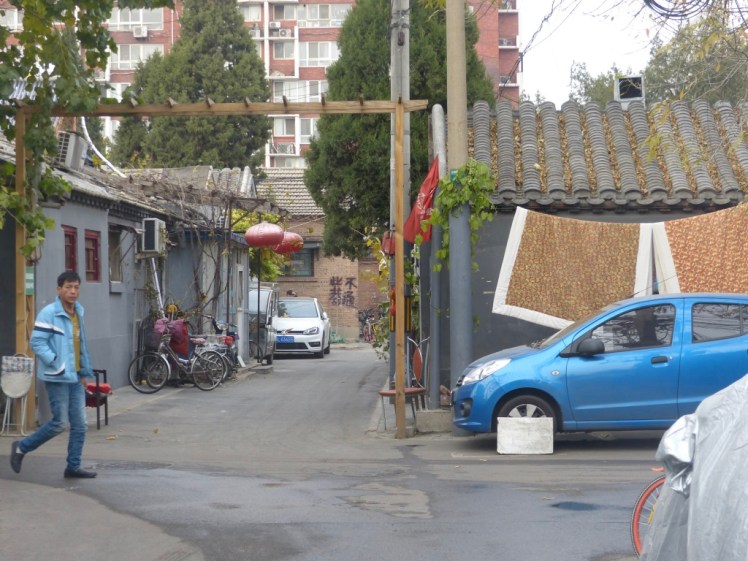
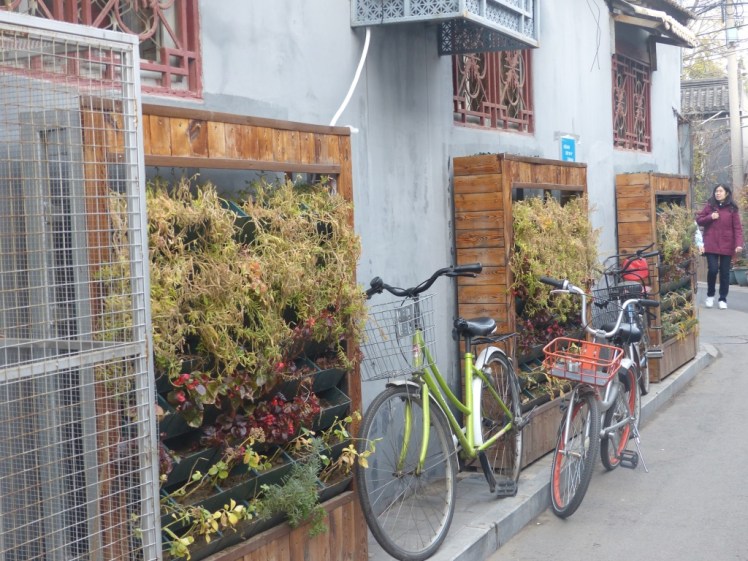
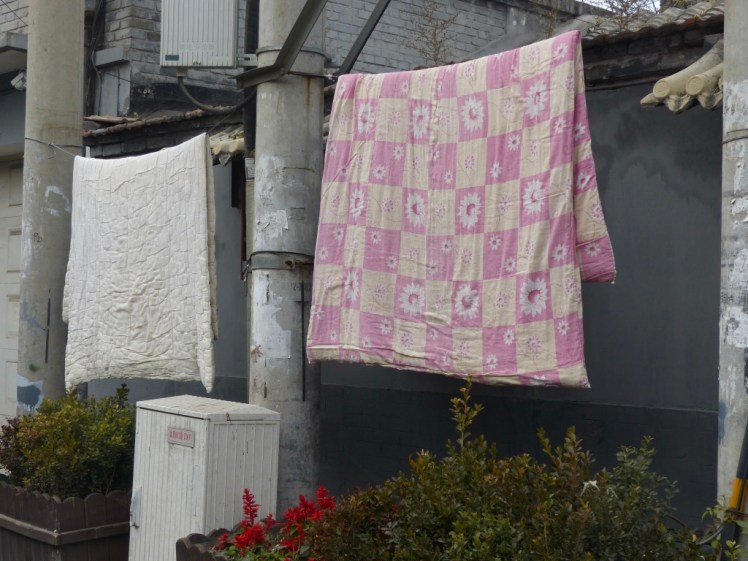 Cynthia herself chose to rent a hutong for a few years since the proximity to the city center seemed to outweigh the inconveniences. Amazed, we queried her about this experience, suspect of why anyone would actually opt to live in a home/room without a toilet, shower or kitchen?! She said the public toilets and baths in nearby alleys were “fine” and that it was more convenient and less-expensive to eat out than to cook at home so she didn’t mind the absence of a kitchen. (This is true for many in Seoul today by the way.) Some hutongs even have solar-powered showers/laundry areas and/or a communal kitchen area shared by several families. Once she had saved sufficient money, however, she relocated to better “digs”. NO…DUH!
On the whole, Bill and I did not find these hutong dwellings remotely appealing, especially after we learned that many alleyways are too narrow for proper garbage collection or street cleaning unlike the “nice” ones where we had been strolling. Too many of the “basic” necessities lacking in our minds although one night in a hutong airbnb might be interesting for the adventurous traveller. I must admit Bill and I were pretty happy to return to the creature comforts of the St. Regis after this hutong tour!
With our stomachs still full from lunch we decided to cancel our plans for Peking Duck and sought out Italian food in a hotel restaurant. A bit of a cop-out, but we suspect we’ll go back to Beijing again one day!
 seoulfulsojourn.net