How do I even begin to write about our trip to Myanmar?! This post will be a long one so fasten your seatbelt, grab that second cup of coffee, glass of wine and feel free to take breaks if my chatter becomes tiresome! Not only were we fortunate enough to spend 8 full days in Myanmar, but for the entire trip, we had a guide (the infamous U Zaw Min…aka Mr. Sidney who ended most of his sentences with “in here”, meaning “in Myanmar” which took us awhile to understand), as well as a second, local girl (Ayemar…who Bill called “Emma” despite repeated attempts to correct him) during our time in Inle Lake.


Claire joined us for the trip, but Eloise was in pre-finals, crunch mode at Duke and just couldn’t skip out. We consoled ourselves with memories of our trip last Fall to visit her in Sydney which Claire had to miss. As we are quickly learning, it is very difficult to plan family trips now that the girls are older, working and at different schools. For those of you who havent’ reached this moment in life, don’t miss opportunities to travel together!
A bit of perspective for those of you who haven’t (yet!) explored Myanmar or given it much notice like ourselves before the trip. Known as Burma until 1989, and wedged between India and China but also bordering Thailand and Laos, Myanmar today is a country of roughly 55 million people. Conducting an accurate census however is next to impossible for many reasons, including lack of electricity, roads and or access to much of the 68% Burmese folks who live in rural areas. The country is so poor that the ink and paper used to conduct the most recent census (first in over 30 years) were donated by Indonesia and Norway, respectively. Monks voluntarily conducted the count for the most part.
There are roughly 135 different ethnicities within Myanmar, each with their own language, but today roughly 60% of the country’s population speaks the official Burmese langage. Written, the language is pretty to look at as you can see below but hardly decipherable to the Western eye…unless there are other universally-recognizeable clues!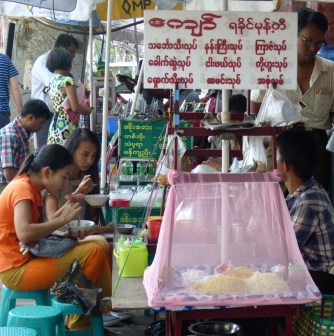
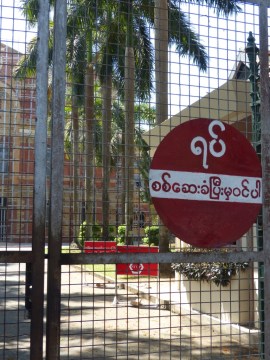
This didn’t help us much and we only mastered “mingalabah” (basic greeting used at all times of day/evening) and “cheyzubah” (thank you). The Burmese alphabet has 33 letters, but each of the 8 vowels have 3 tones apiece so these 8 vowels become 24 vowels and together with the consonants, one would have to learn 54 different sounds. In the northeastern, and most populous Shan state, the predominant local language has 6 tones. English is spoken by only slightly more than 5% of the total population, so our guides were CRITICAL every moment of the day.
We got a big kick out of the fact that Westerners are known as “Hello People” among the Burmese. Obama was the first ever American President to visit Myanmar in 2012 and the Burmese still recall his visit with great fondness since it validated their efforts to break the junta miliary rule and move towards democracy. Today, the political situation is still hard to understand. It is considered a hybrid-military civilian government, with Aung San Suu Kyi leading the National Party for Democracy, acting as a sort of Prime Minister and representing roughly 85% of the population. The former junta make up the remaining military party. During the transition to democracy, Suu Kyi spent over 15 years under house arrest and in 2011, she was awarded the Nobel Peace Prize for her efforts. Today, however, she’s under heavy scrutiny for her treatment of the Rohingya people, a Muslim minority people living in horrible camps on the border with Bangladesh. The issue is very complicated, the government is not transparent, nor is the press totally “free”, and tourism is heavily regulated to ensure that no tourists like ourselves see/experience any of the violence currently occuring in outer parts of the country. Fine by us!!
Tourism as an industry is just beginning to take off and the inflow of tourist dollars is having a dramatic effect on the average household income, though today 60% of the country is still estimated to live below the poverty level and Burma remains one of the poorest countries in S.E Asia. Obama’s lifting of all economic sanctions in 2016 has also had a big impact on the country’s develpment. Nevertheless, Myanmar remains the second largest (behind Afganistan) opium producer and the largest amphetamine producer in the world. These drugs find their way out of Myanmar along the Laos-Thai border which remains a very dangerous area of the country and access is prohibited by the Burmese government which is well aware of how crime/violence can quickly squash tourism.
MONKS ARE EVERYWHERE! Approximately 88% of the Burmese people are Theraveda Buddhists which means Myanmar is the world’s most Buddhist religious country in terms of monks/general population. This is immediately evident wherever you are since there are roughly 500,000 monks and 300,000 nuns walking around the country, collecting rice donations in big bowls. Together, the total monk population is essentially equal to the 800,000 soldiers who still exert visible control over the Burmese people. Below are young female monks, carrying smaller than adult-size bowls, that we saw in a Yangon marketplace. Each of them had a bowl though this is not evident in the picture I hastily snapped.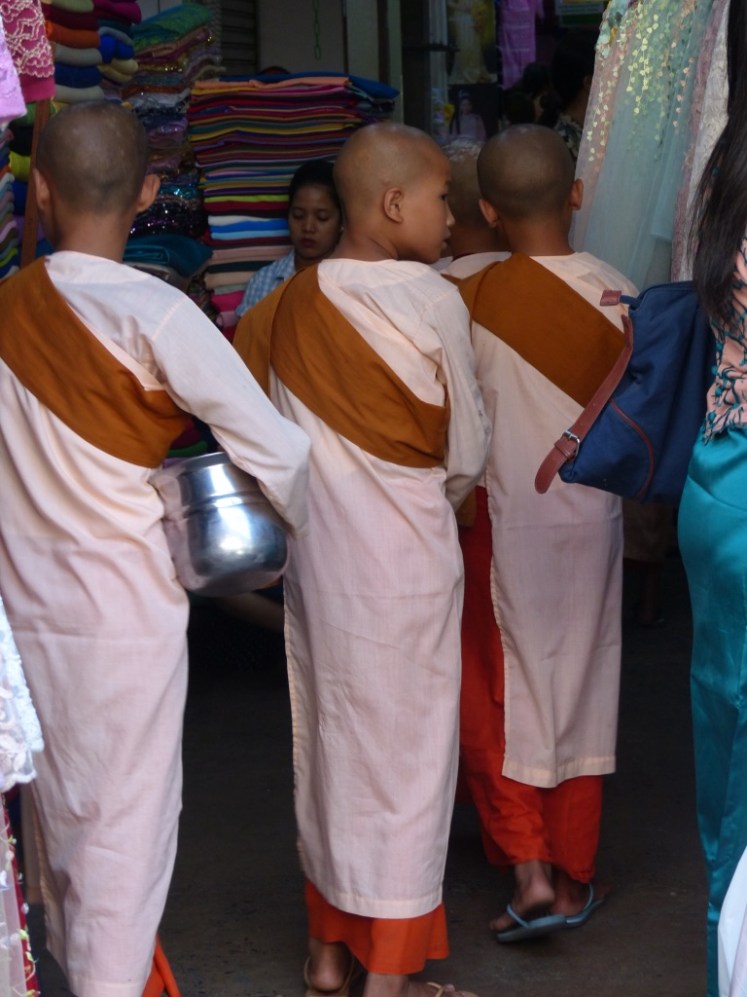
In cities, monks generally receive money as donations. In rural parts however, everyone living in the village is expected to contribute a bowlful of rice to a monk’s alms bowl. The alms bowls are designed to hold exactly 40 small bowls of rice, the daily amount each monk is expected to collect through donations. Once the population of a village exceeds 40 people and one alms bowl is insufficienct, another monk is assigned to that village’s monastery. Hence, one can easily guesstimate the population of a village by counting the number of monks in its monastery and multiplying by 40…easy math!
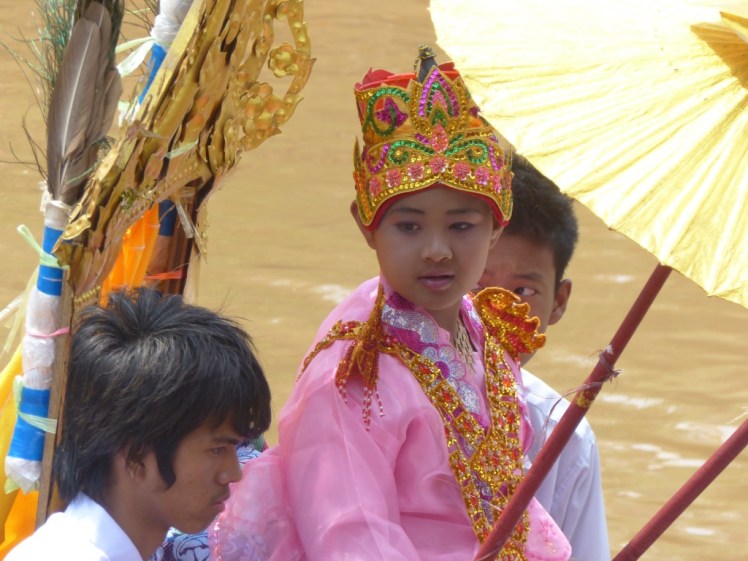
Several times we witnessed novitiation ceremonies which are an important rite of passage for all boys aged 7 and older. These ceremonies are a big deal, require costumes and fancy dress attire as you can see below and are expensive undertakings for the family. All young boys before the age of 20 are encouraged to enter the monastery as novices for a brief period of time, ranging from one week to a full year. This tradition is hard to follow since no food is consumed between 10:30am and 5am the following day…a real challenge for a growing boy! Zaw told us that today, some families “bribe” their boys by offering them a toy in exchange for a 7 day stay (“in here”). Amazing how cultures around the world are so alike when they appear so different. In the Buddhist faith, males are again expected to become monks and enter the order again after they turn 20. Like most Burmese, Zaw himself did this in part to show respect for his elderly parents/ grandparents. The processions vary throughout Burma. In Yangon, we saw car parades of families headed to monasteries and some noviates at a temple we visited.

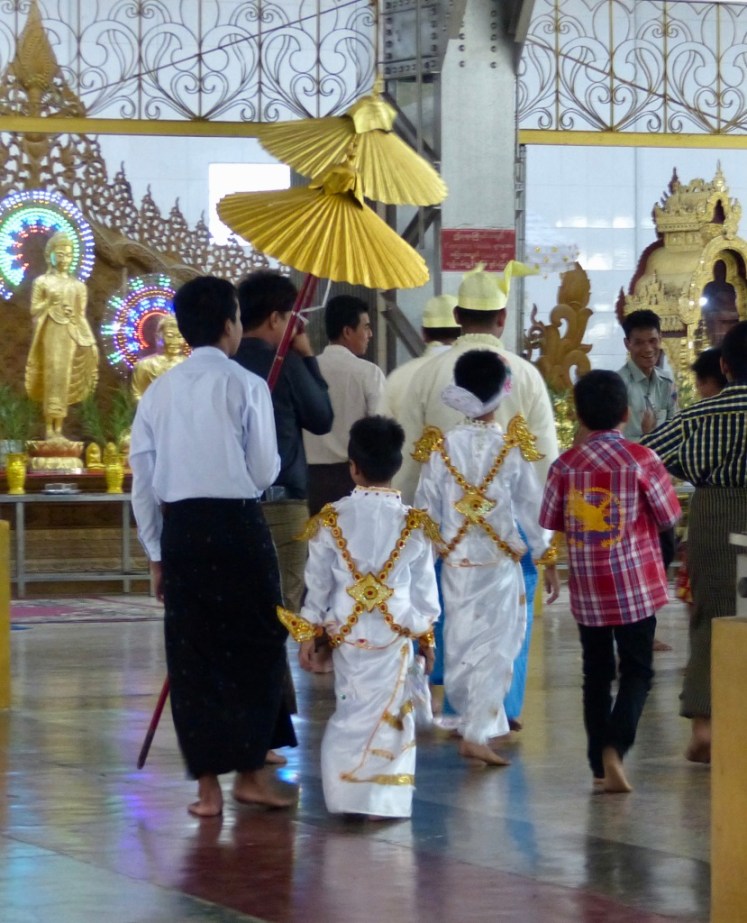
At Inle Lake, we saw boat processions, including one that had some challenges as you can see in the video below. In Bagan, young boys often ride elephants or horses though we didn’t see any processions there…only lots and lots and lots of stupas. More on that later.
 I was fascinated by all the monks constantly surrounding us and peppered Zaw with questions. Here are some facts I gathered:
- One cannot become a full-time monk until the age of 20 yrs., although we saw lots of young kids dressed as monks such as the adorable ones on the shores of the Irawaddy river in Bagan. Dressed as such they can eat/sleep/bathe at monasteries and this is one way poverty is alleivated within Myanmar. Essentially, the 800,000 monks in Burma survive because of the care and food they receive at monasteries; otherwise, many of these monks would be hungry and living on the streets.
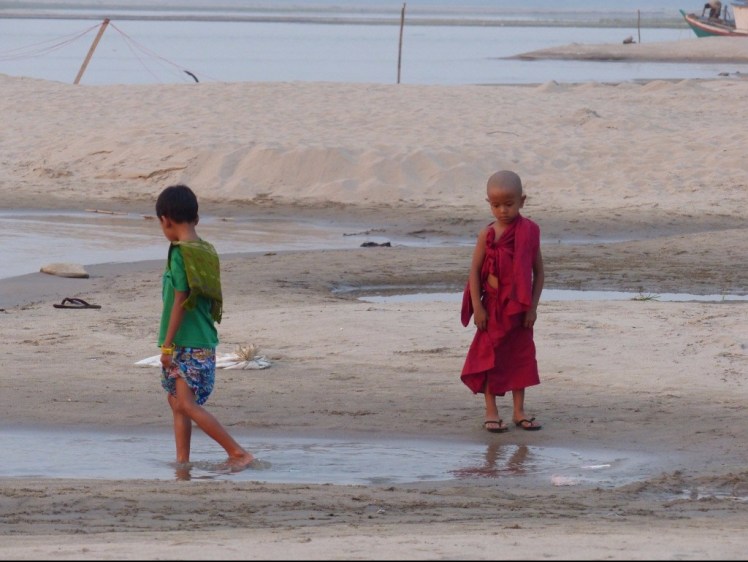
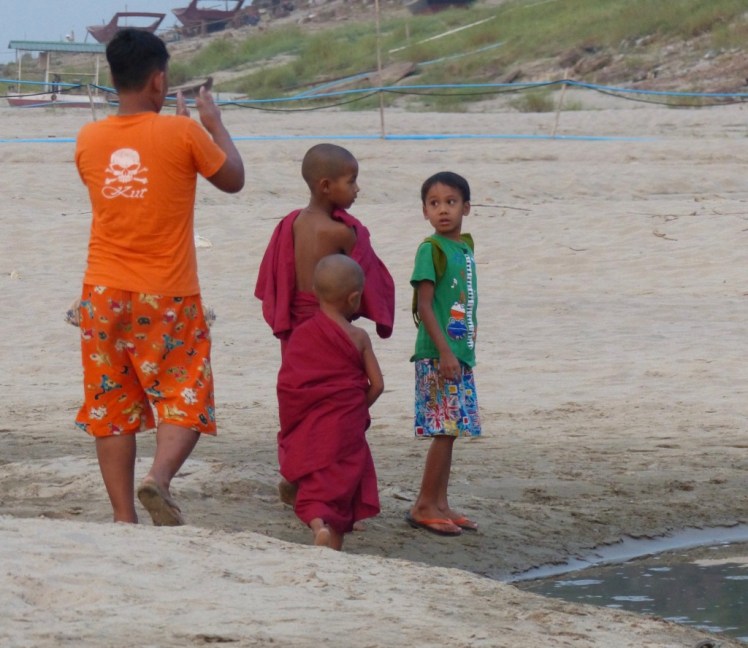
- A Buddhist monk is only allowed up to 10 possesions: a robe (actually three distinct pieces of cloth usually sewn together from 108 pieces of donated material), a belt, an alms bowl, a water filter, needle and thread, a razor and approved medicine. Razors were recently added to the list when it was discovered the communal razor previously used by all monks at a given monastery was the contributing to the spread of AIDS/HIV blood. Nuns are allowed two additional possesions: a bodice cloth and a head scarf. The color of the robes varies country to country and even within Myanmar, the robes in Bagan were a deeper rust color like that of the local soil, than the rust-orange ones we saw in Yangon. Women wear a dark red cloth under pale pink shoulder wraps. As Zaw explained very delicately, this is because monks don’t wear underwear and menstruating female monks need to disguise stains. TMI, but interesting for this inquiring mind! We rode a local train with an older female monk who was leading a group of young girls and I just love the pictures I took of the little one sleeping next to Zaw and another one who spent the train ride with her arm hanging outside the car. The girls were quite shy but we were allowed to snap some pictures once we made a small donation into the alms bowl. The older female monk was deep in prayer at Shwedagon Pagoda and certainly didn’t notice her photographer.


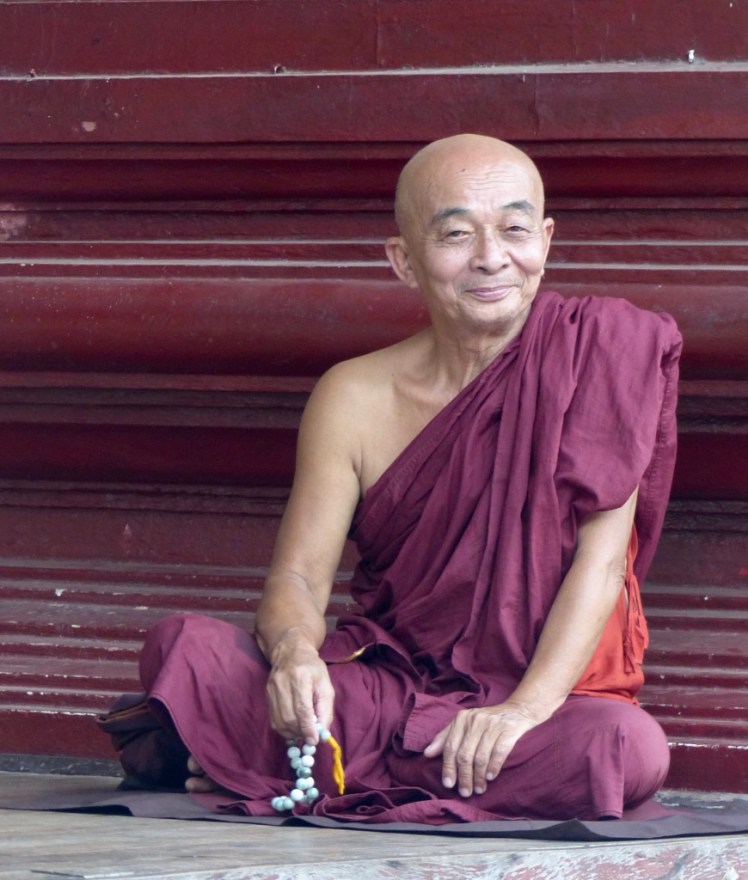
- Traditionally, monks don’t wear watches and as a result we often saw rather garrish clocks next to beautiful Buddha statues which didn’t make any sense until Zaw explained this tidbit. Today, however, more and more monks are seen carrying cell phones, or wearing glasses like the ones pictured below, which makes for quite a juxtaposition of modern culture and the 2,500 year old Buddhist one.


- In rural Myanmar, secular primary education is free and often takes place in monasteries. Education through 4th grade is required. Secondary and tertiary education takes place at government schools.
- Monks play an important social/political role in Burma and Zaw refered to them as a “government within the government”. Official government nformation is often disseminated through the monks since the people are more inclined to trust a monk than a member of the military junta. In 1988, for example, the monks, by turning their alms bowls upside down in a gesture of condemnation, finally helped to over-throw the former military leader General Ne Win whose failed efforts to nationalize/socialize the country was crippling the economy and its people. On a daily basis, monks help with delicate issues such as sex education to young girls or the dissemination of medical supplies and accurate information.
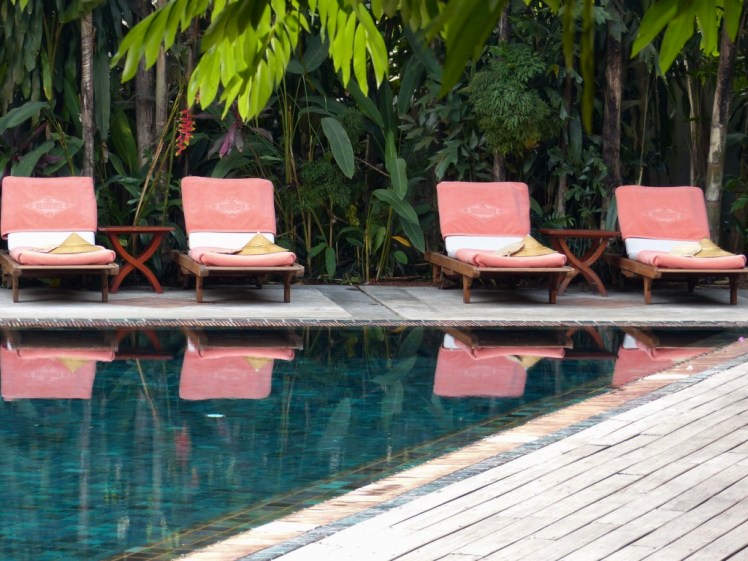
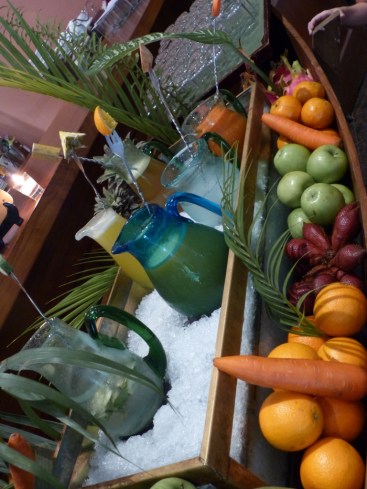
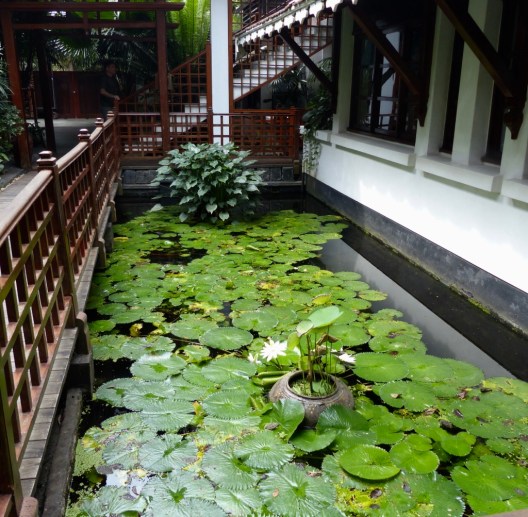
Enough fun facts about monks and onto our amazing adventure which began in the old capital city of Yangon, formerly Rangoon. (Nay Pyi Taw, the new capital as of 2005 which we did not visit, is centrally located in therefore felt to be less vulnerable to attack,) We flew into the brand, spanking-new, absolutely empty airport which opened earlier this year. Zaw was easy to find and escorted us to the first of the three stunning places we stayed, the Belmond Governor’s Residence. A beautifully preserved colonial building built in the 1920s and located in the quiet, Embassy quarter of Yangon, this gem of hotel with its teak beams, verdant plantings, open-air porches and gardens for dining and early morning yoga sessions (which Bill, Claire, I and even Zoe attended!), offered a peaceful respite at the end of our busy days touring Yangon. The juice bar at the beginning and the massages at the end of each day were some of the best we’ve had in Asia!
Zaw’s Myanmar lessons began bright and early when we headed to Chauck Htat Gyee Pagoda, known for its 65 meter reclining Buddha which didn’t begin to fit into my camera frame. 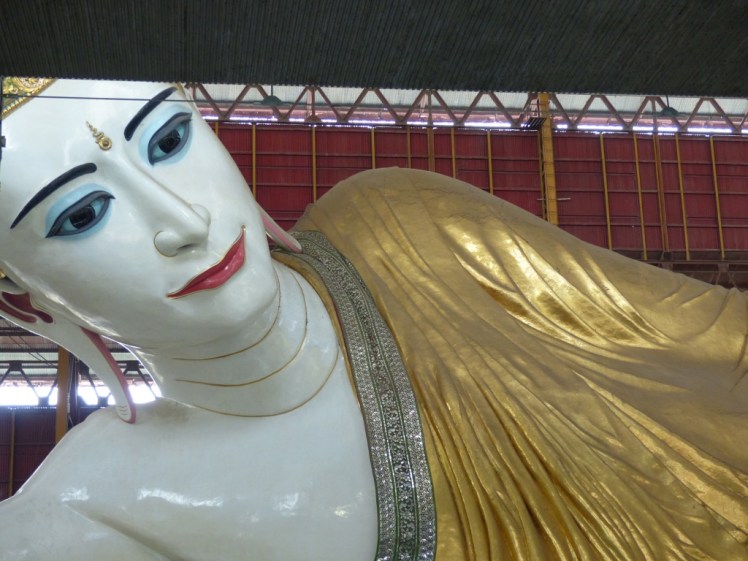 Carved into this Buddha’s feet are the 108 lakshanas (symbols of the auspicisous characteristics of Buddha A philosopher who lived in 500BC, Buddha asked that all images of him be destroyed upon his death. Consequently, his true likeness is unknown and all Buddha statues reflect the people who commissioned them. Further, since Buddhism was spread throughout Asia by merchants (vs. governments), it grew along the Silk Road and the image of Buddha can reflect all of the countries that traded along this important route. Around 300BC Alexander the Great swept through Asia, from India to Afganistan, and he was fascinated by Buddha who had such an enormous influence on the Asian people. Buddha statues from this period, like the reclining one above tend to have very square jaws, like Alexander the Great. Zaw showed us how we can recognize Cambodian, Thai, Chinese (fat and jolly) and Pakistani Buddhas, as well as how within Myanmar, the image of Buddha changed from one century to the next. Over the centuries, Burmese Buddhas’ earlobes became longer, joining the shoulder and the number of neck folds (yuck!) decreased. These “design” changes were actually an effort to enable the Buddha statues to better withstand all of the earthquakes Burma experiences, rather than artistic decisions made by the sculptors. Lips, hand position, eye shape and eyebrows all provide important clues to the age of a Buddha sculpture. Here are a few of the MANY Buddha statues we saw in Myanmar so you can see the wide range of images.


By the way, there will be a short quiz at the end of this blog so if your attention is flagging at this point, maybe take a short break?
At this pagoda, we also witnessed lots of folks spilling water on various statuettes and got a brief lesson on how important one’s “birth day” (day of the week) is in Burmese culture. When visiting a pagoda, one finds the statue representing the day of the week on which one was born. This is, of course, a bit different in the Buddhist faith since there are 8 days to a week, but I digress… Homage is then paid to that particular statue, water poured, prayers offered. There are soft rules about marriage too that influence society and non-complimentary birth-born couples are discouraged. For example, Monday-born people should not marry Wednesday-born people, just as Saturday-born and Thursday-born are considered an unsuitable match. I checked, and fortunately, Bill (Friday-born) and I (Sunday-born) are a suitable match…but we knew that after 35 years of being in love!


After this rather dense introduction to Myanmar Buddhism, Zaw senstively saw our need for a mental break and sustenance! He took us on a stroll through the busy streets of downtown Yangon near the old port to Monsoon, a yummy restaurant we recommend. The young man who was our waiter spoke several languages and greeted us with “Ahnyeong ha sey yo” when he heard we were from Seoul. Claire, Daphne and Zoe had fun chatting about K-dramas with him as well. All of us loved the Burmese cuisine which generally includes delicious vegetarian, meat and fish curries that weren’t overly spicy and salads made with vegetables we’d never heard of (penny wort and pickled tea leaves in particular) but found to be refreshingly delicious. Rice and peanuts are a constant and none of us every developed a “traveller’s tummy” the entire trip in case you’re interested…?
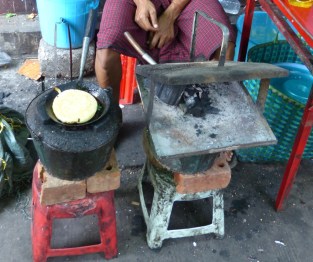
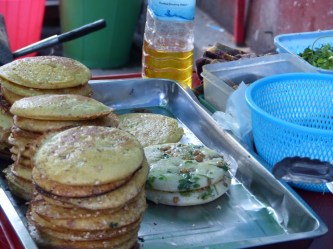
On the streets, there was a lot of sugar cane, fruit and other snacks being sold and we scarfed up some particularly yummy veggie pancakes that were cooked up on a rudimentary stove shown in the picture below.


We DID NOT try the fried grasshopers though they were readily available and are gaining popularity we understand around the world, including here in Seoul. 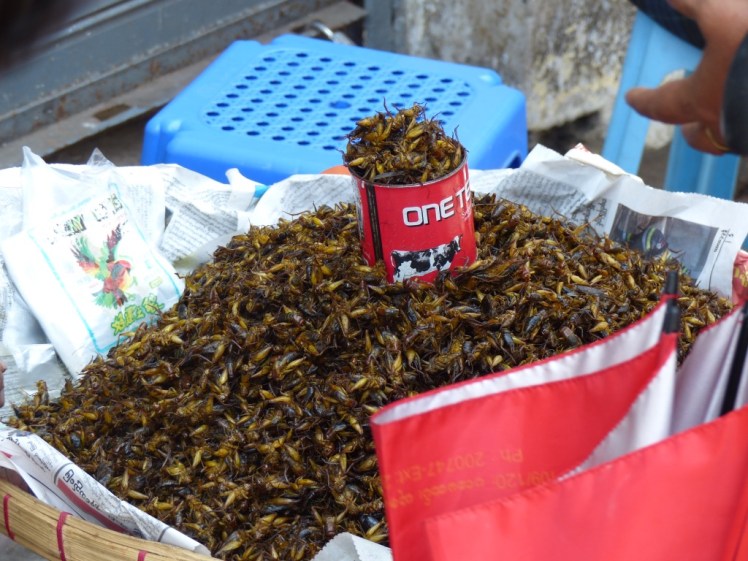
Medicinal plants and mini-pharmacies, like the one below, were interesting and Zaw explained which plants were used to promote hair and growth and dye one’s hair black. The ladies asked Zaw why I wasn’t buying anything and were quite distressed that I wasn’t preventing Bill’s hair from turning grey. Ah…the ubiquitous dyed hair…another similarity to Seoul! 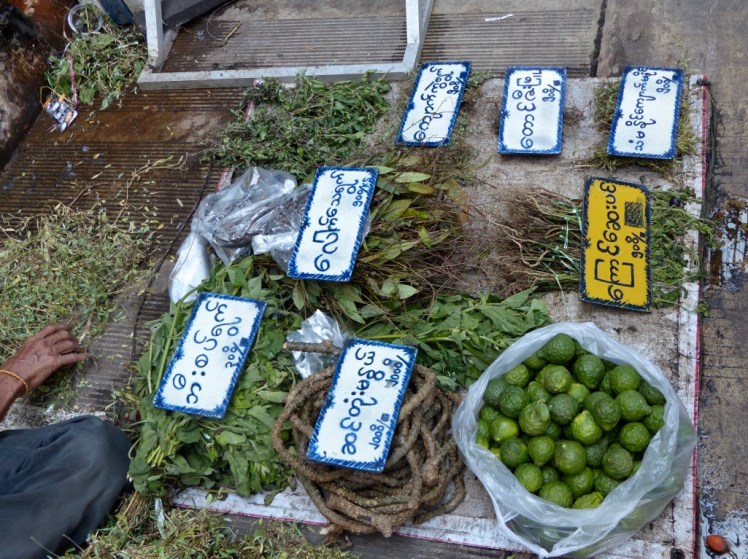
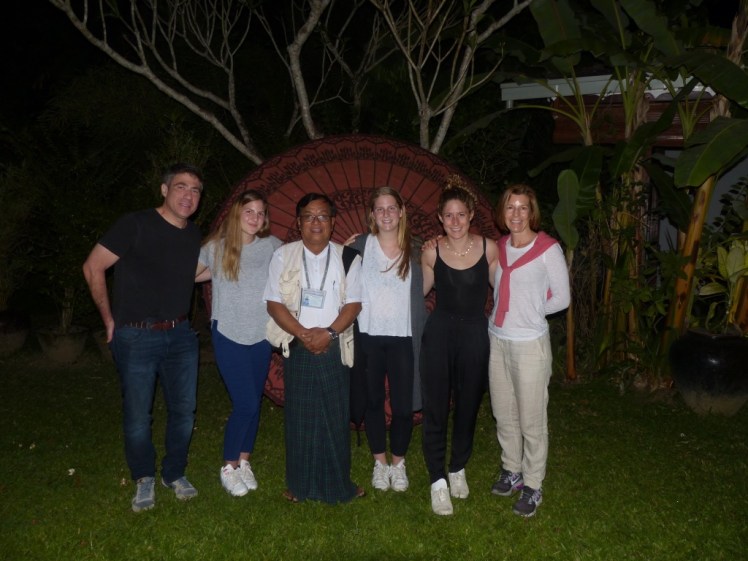
Throughout Myanmar, longhis are widely-worn by anyone over the age of 10 or so. Longhis are sarong-like, wrap-around cloths generally made from 2 meters cotton; silk are worn for formal and business occasions. The men knot their longhis, while women tuck the longhi ends in on the side for a more sleeker look..of course! The longhis are apparently more comfortable in the hot climate than pants/long skirts and easy to wear when riding side-saddle on a motorbike, or squatting (and negotiating cattle purchases), or carrying heavy baskets, or tending to twins. They also look sharp when posing for a formal picture with the Stanton family! By the end of our trip, Bill was seriously contemplating getting his own longhi since his own clothes were rather smelly at this point and he had been convinced of the longhi’s benefits. Fortunately, reason and collective Stanton female opinion on the matter prevailed.


 Everywhere, Burmese were chewing betel nuts, spitting out the juice or smoking rolled tobacco-betel cigars. We stopped to learn how these cigars are made as some locals ordered up their “flavor”. Daphne, who is MUCH more adept at surreptiously shooting videos than I, captured this on film for your viewing pleasure!
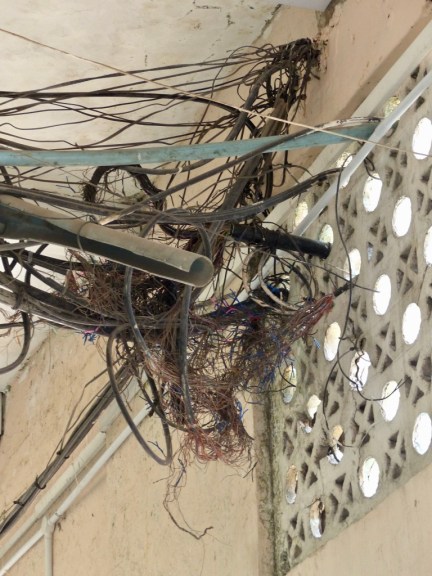
Life in Yangon (Myanmar’s main city), is a TRIP! For starters, the power supply is unstable and outages are still frequent, nightly in fact during the hottest season. You can see the maze of power lines that dominate the landscape as well as the lovely old colonial buildings still standing in central Yangon.


Samsung, much to Bill’s satisfaction, dominates the electronics market and those who have cell phones, generally have previous generation Samsungs. There are very few “high-scrapers”, as Zaw called any building with more than 3 floors. This is partly because electric elevators are virtually non-existent and in this hot country, lots of stairs are distinctly unappealing! Clever ways around this were visible on the streets and we often almost bumped into pulley-like contraptions used by residents on upper floors to haul mail/merchandise/food up and down from the street. 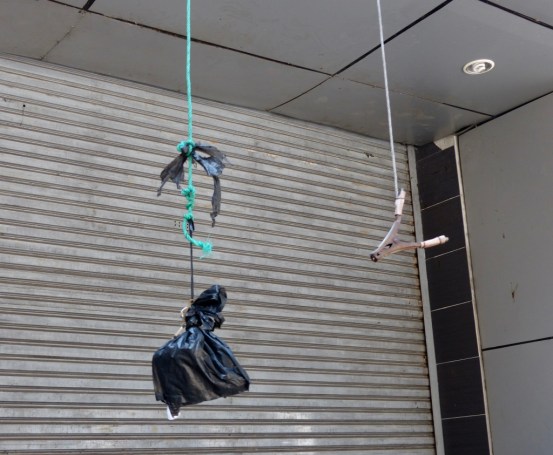 As Zaw explained and we began to notice, Myanmar is filled with used and/or previous generation consumer goods, whether this be old models of cell phones, bicycles with side car seats for paying customers, motorbikes, cars and even buses. Like many developing S.E. Asian countries, Myanmar is a huge market for Korean companies such as Hyundai and Samsung who need to off-load product whenever a new version is introduced.


The buses looked particular tired, but fortunately (and to Zoe’s great relief!). the planes we took seemed to be modern and safe. The railway, on the other hand, dates from when the British colonized India and then Burma. It is inefficiently run by local Burmese who struggle with the foreign (British) equipment and signals and often manipulate the system for their own benefit (ie. print fake tickets, accept bribes, etc). There are only two, rickety trains that encircle Yangon, one going clockwise and the other, counter-clockwise. Rail travel is very cheap (about 10 cents for the full 90 min. ride) and is readily used by the locals despite it’s inefficiencies and decrepitude. For tourists like ourselves who enjoy a leisurely ride with plenty to observe out of the open windows, the railway is lovely.
After a mid-afternoon break and pool time at the Governor’s Residence, we set out for an evening visit to Shwedagon Pagoda, Myanmar’s most famous pagoda located in the center of Yangon. This gilded pagoda stands 325 ft. tall and according to archeologists was built roughly 2,600 years ago, making it perhaps the oldest Buddhist pagoda in the world. Shwedagon Pagoda is also quite “bejeweled” with the real stuff: over 4,500 diamonds and 53 metric tons of gold leaf cover the umbrella top. As a result, it glitters in the bright sunlight and has a beautiful luminosity at twilight. 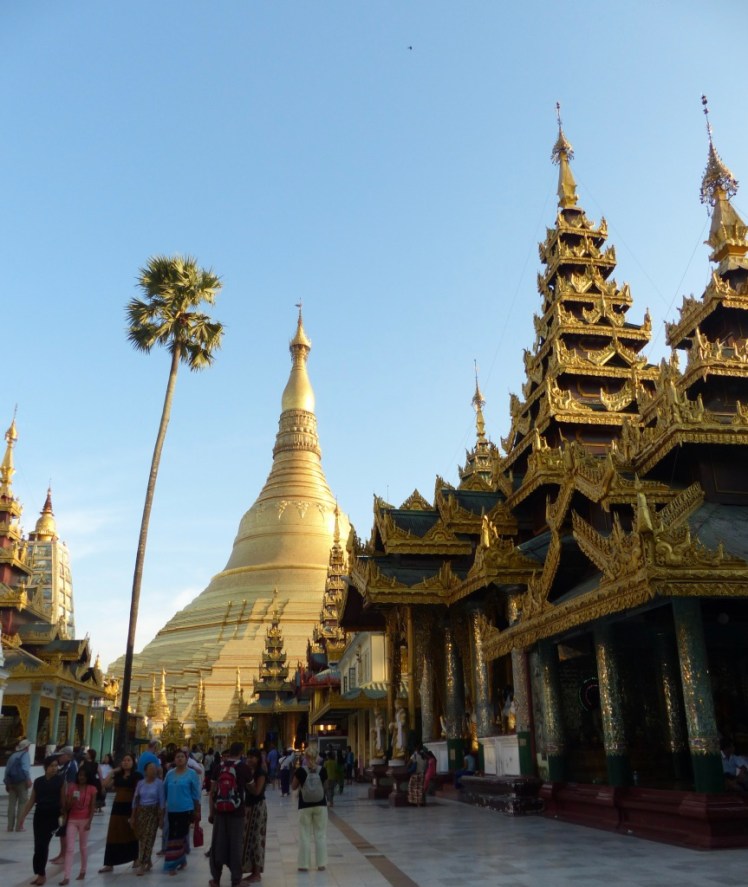 Considered a “must” (akin to Mecca for Muslims) for Burmese Buddhist, Shwedagon Pagoda is always full of visiting monks, Buddhist persons on a pilgrimage and tourists. Locals, too, like to socialize here and let their kids run around the spacious marble platform surrounding the pagoda. In Myanmar, one of the few places adolescent boys and girls are permitted to mingle is at a pagoda so these sites are also a sort of dating venue before a match being arranged by elders. Zaw insisted that we visit Shwedagon in the late afternoon so as to be there at twilight when the gilded buildings look magnificent and the oil candles that encircle the pagoda are lit. Here is my attempts to capture the thousands of candles that ring Shwedagon Pagoda “before” and “after” sunset.
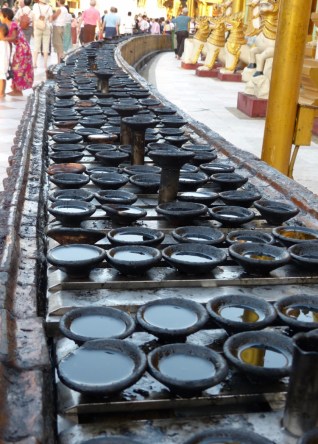
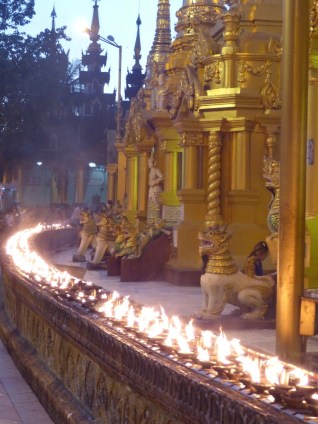
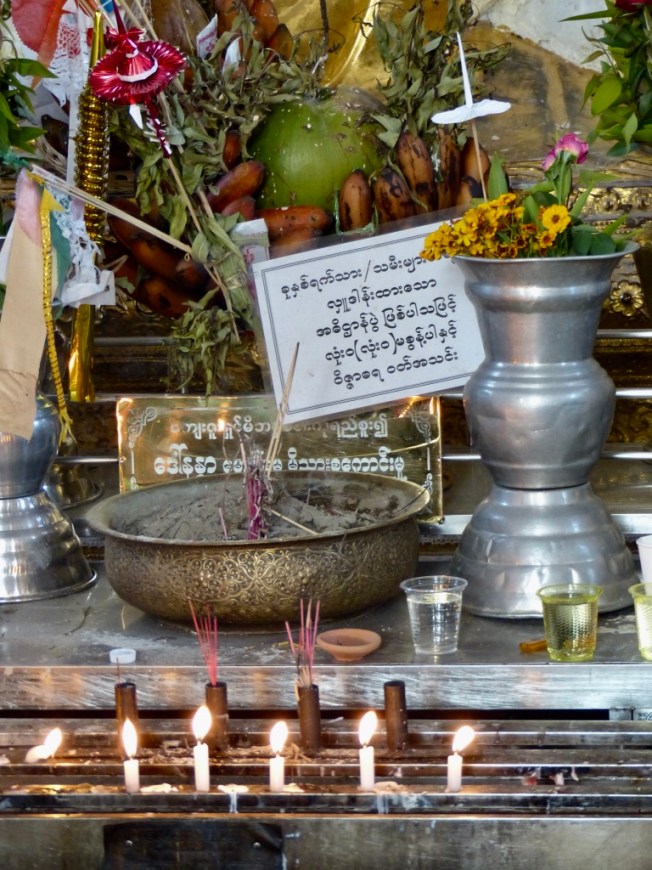
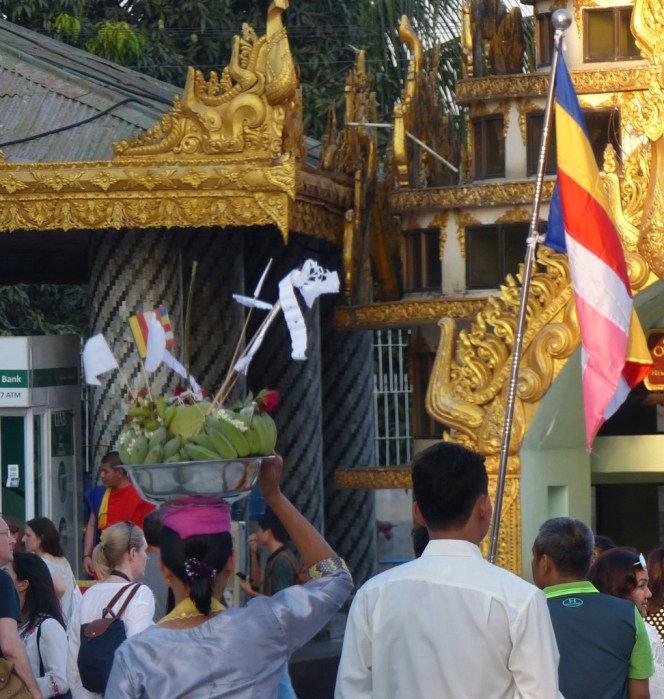
Like most of the pagodas we visited in Myanmar, the entrance was jammed with various items to purchase as offerings. Tending the stands was not a stimulating job as you can see by the girl snoozing amidst her merchandise. Everywhere around us, offerings of everything imagineable were being made, all which all feels a bit chaotic and garish at times to one who is used to how offerings are made in an Episcopal church.
Another aspect of pagoda visiting that happened at Shwedagon Pagoda (and practically everywhere on our trip) was the “worship” of our girls by the Burmese!! Our blonde, pale-skinned, beautiful girls were treated like celebrities…people stared, pointed, snapped photos and repeatedly asked to have their pictures taken with our girls. At first this was somewhat amusing and endearing, but by the end of our trip, the girls were rather tired of the frequent requests. As Zaw explained, many of the visitors to Shwedagon had come from remote rural villages and had literally NEVER SEEN a Westerner before. Here’s an example of the “rock star” status our daughters experienced. 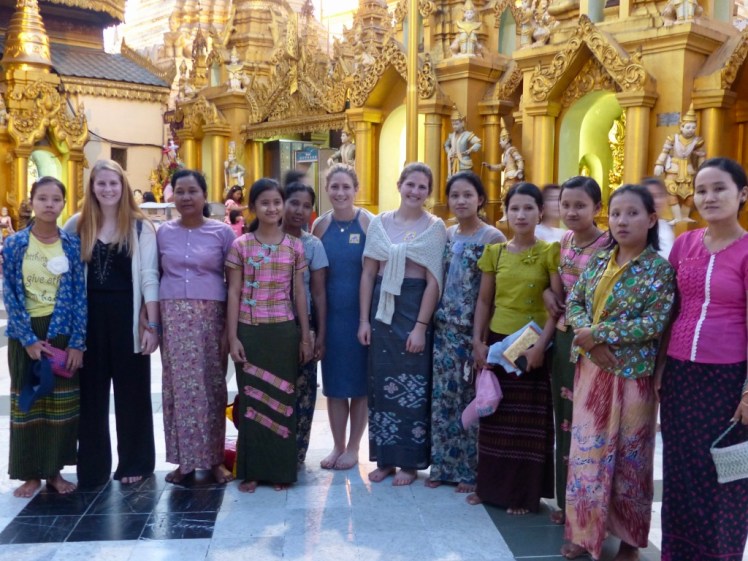
As we strolled around Shwedagon Pagoda, we noticed a path on the marble esplanade that encircles the entire structure. Zaw explained that monks visiting pagodas will walk clockwise around the pagoda so as to be sure their left hand (“dirty” hand) is not near/facing the pagoda. Below is a photo of some monks on pilgrimage (Zaw thought from China based on their robes) who were processing alongside of us. 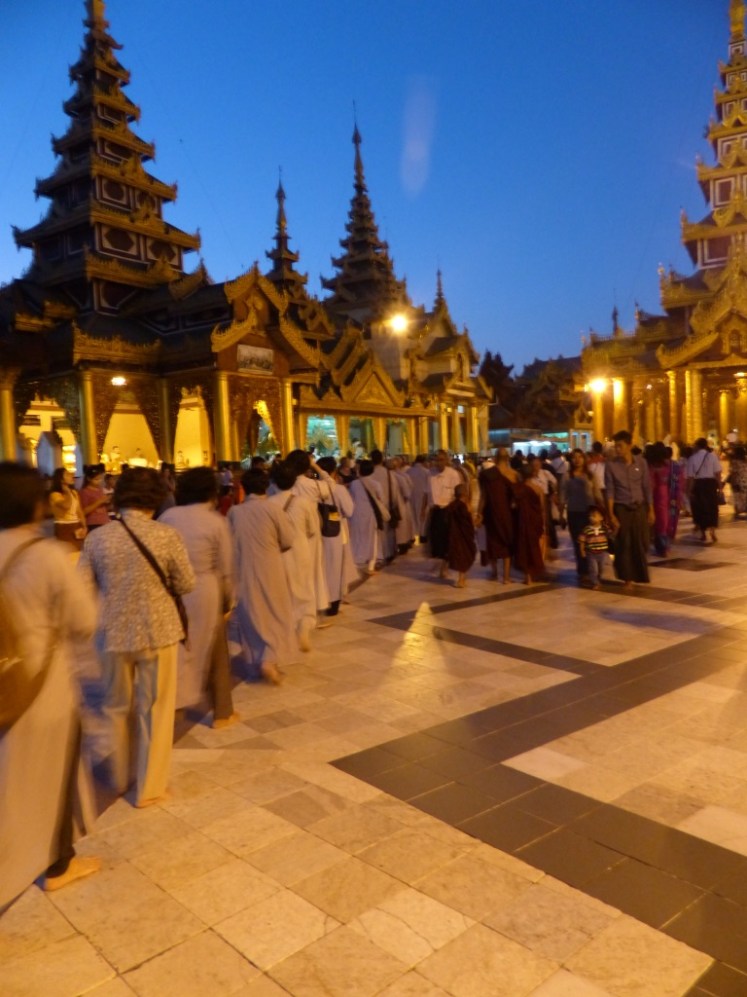
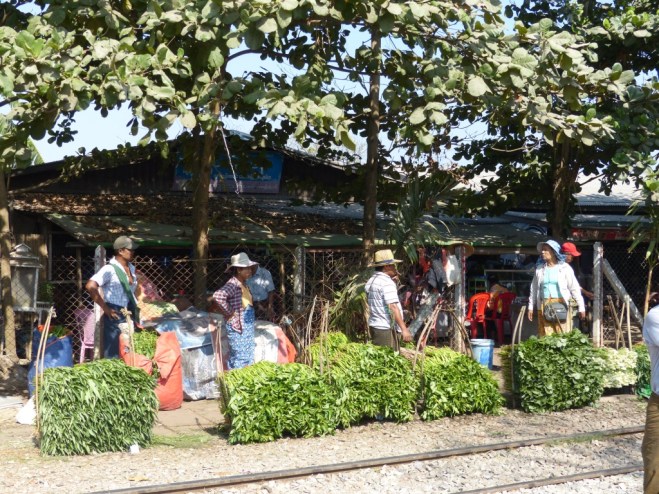
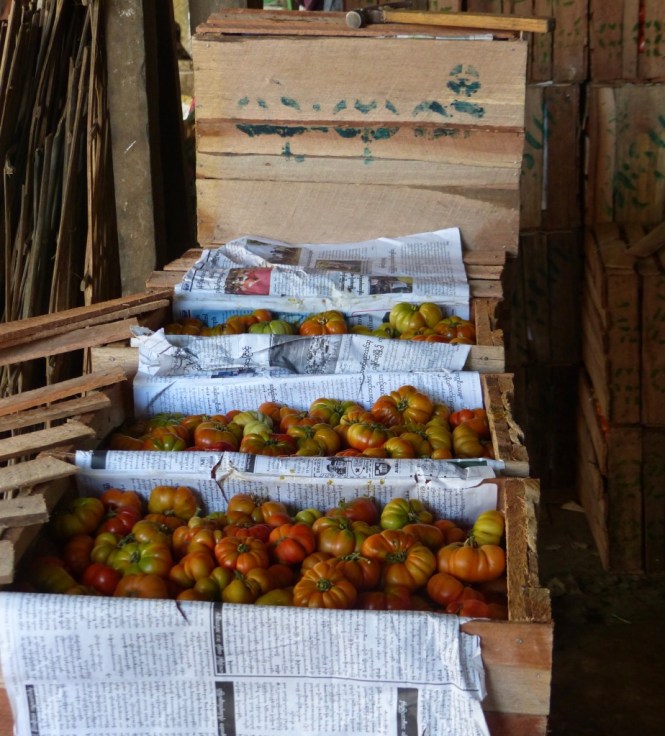
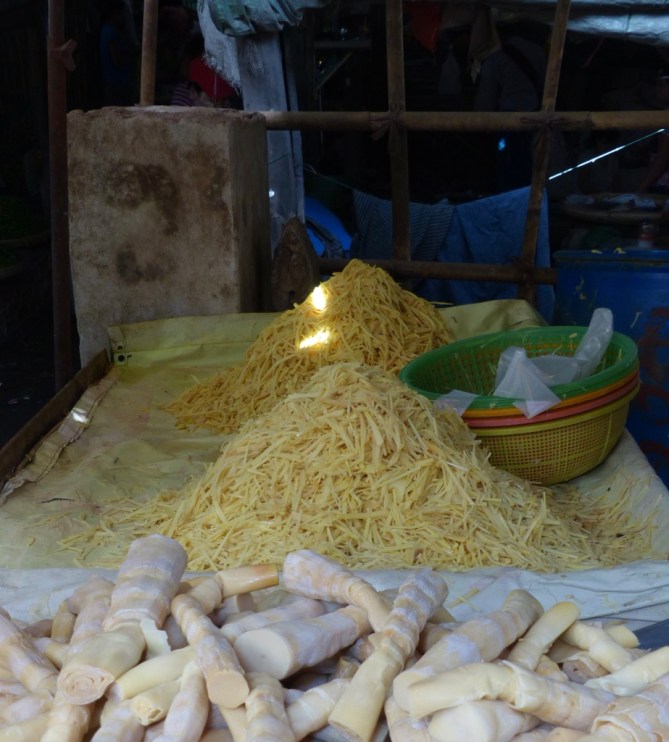
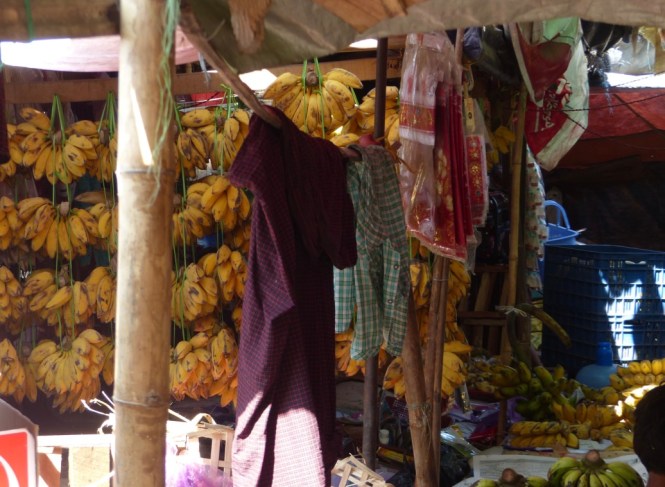
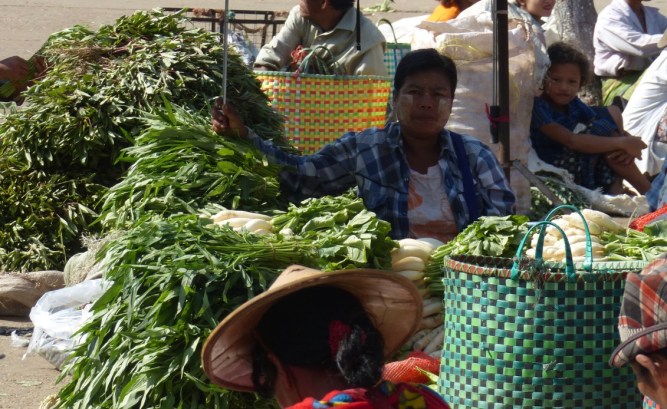
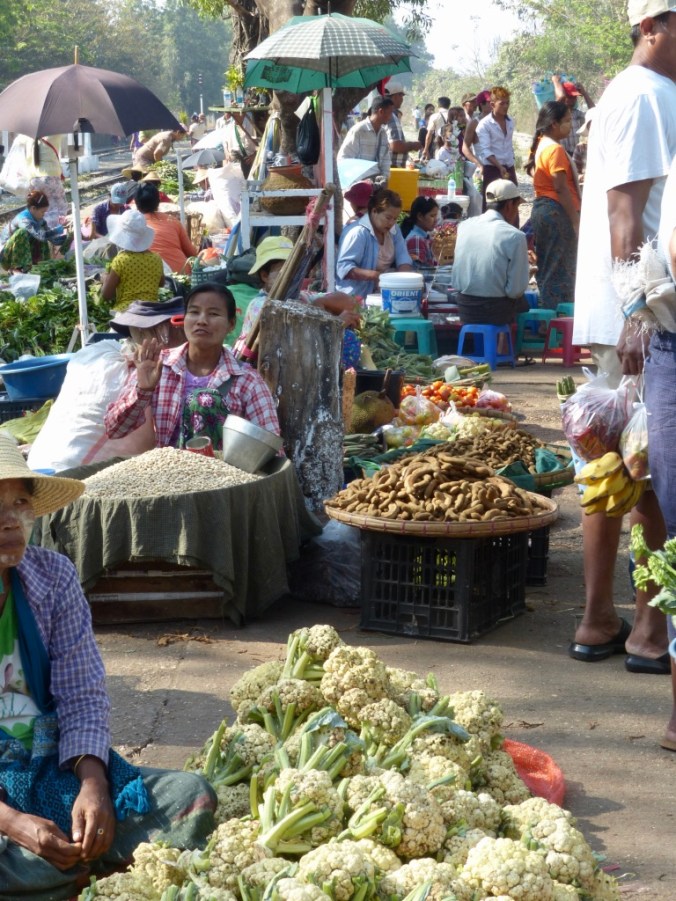
Day 2: Early morning yoga on a breezy second floor porch, followed by delicious coffee and a delicious breakfast spread…who could ask for a better morning in Yangon?! Zaw and his driver picked us up and we headed to the Central Yangon Train Station to ride the circular train to a large outdoor vegetable market at Danyingon Station. Produce from this market supplies all of Yangon and farmers from the surrounding countryside were there selling a wide variety of fruits and vegetables outside on the railroad platform. Adjacent to the outdoor produce market were covered, more permanent stalls which charge rent and serve as homes to many whose livelihood is this market. We wandered around these stalls too, amazed at all the colors, smells, bountiful harvest and hardship of this agrarian lifestyle. Again, my pictures don’t begin to do justice to the visual extravaganza we experienced. In the pictures you’ll see huge bundles of lotus stems and tea leaves being carried and displayed for sale as well as many of the fruits and vegetables, such as tamarind, limes, shallots, sugar cane, mangos, etc, that are staples of Burmese cuisine. 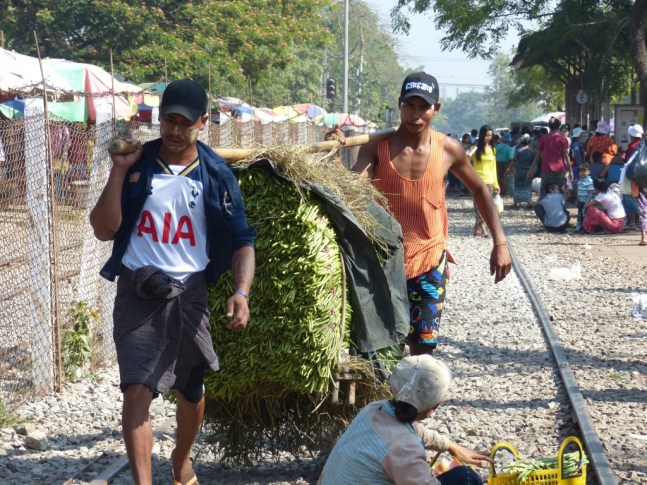
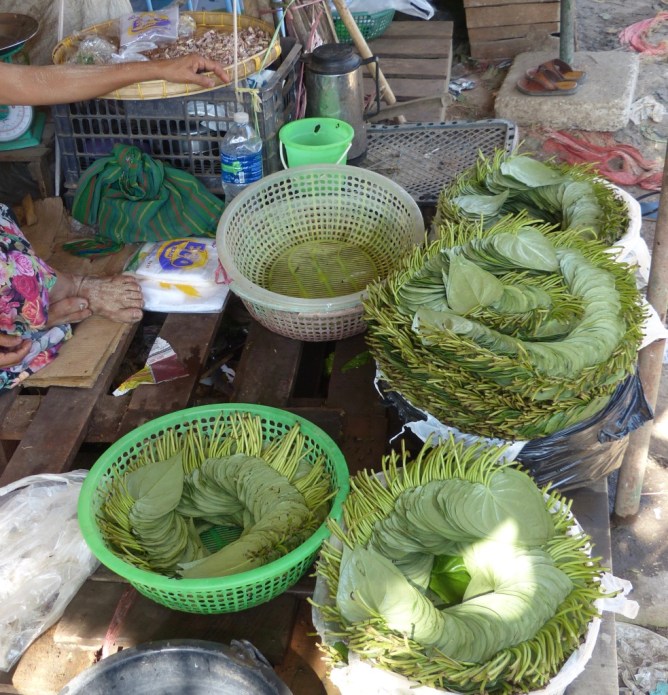
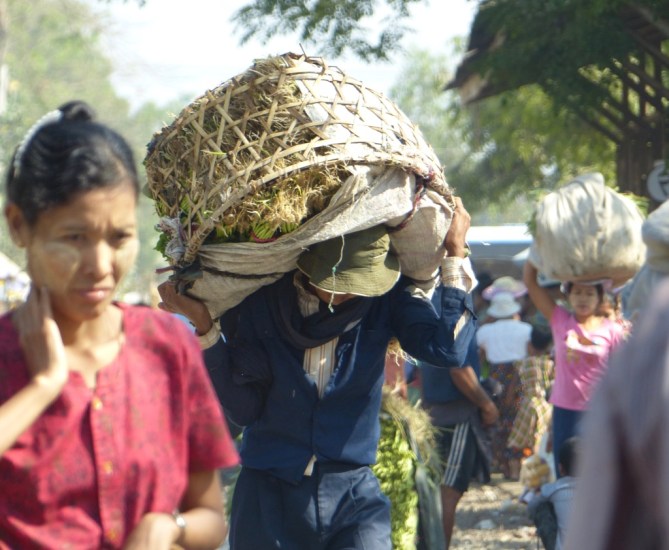
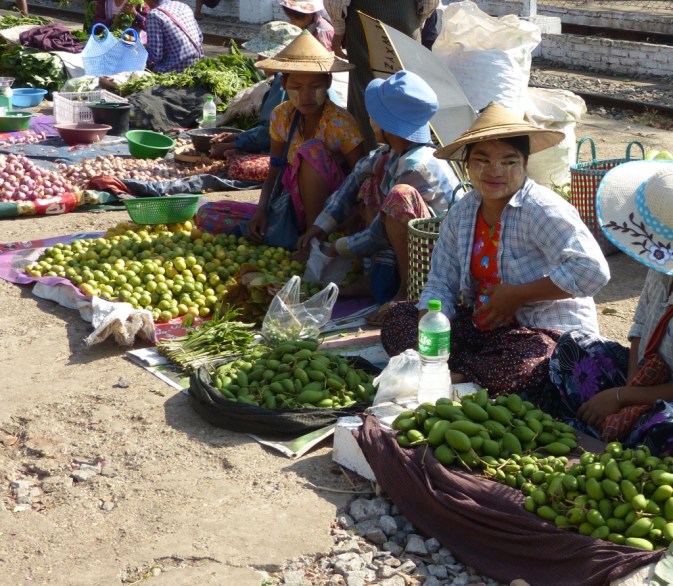
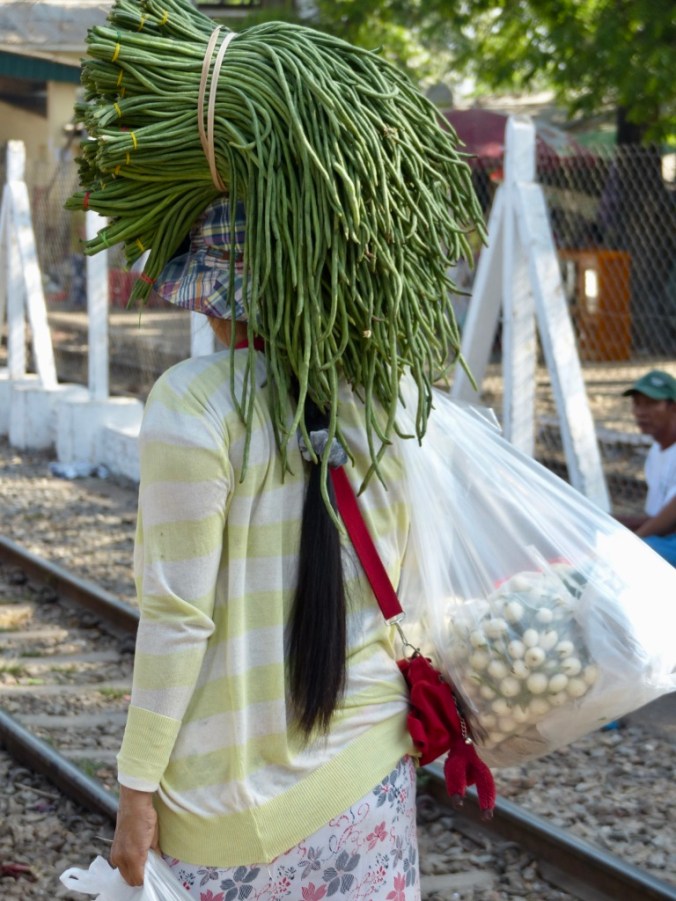
Virtually all Burmese women wear thanaka cream on their faces (and arms sometimes) sun protection and make-up. Made from ground up wood bark of local trees, this yellowish-white cream paste is mixed with water on a stone slab and then applied daily to the forehead and cheeks and often with a simple combed-on design. Men also wear the cream but mostly at night only since it also lightens skin. The wood bark is sold everywhere throughout Myanmar (see below) and has a gentle, sandalwood smell.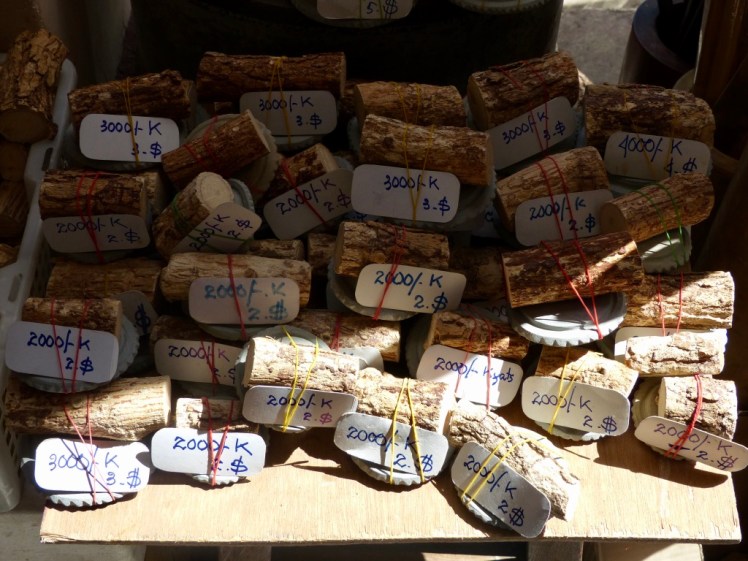
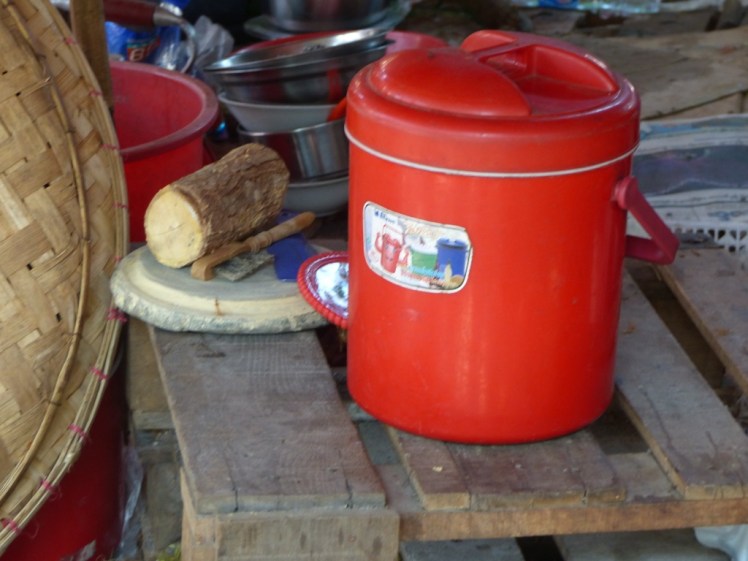 Zaw asked a few questions of the locals while we toured and shared with us a sense of their lifestyle. With the exception of those who live in Yangon, Burmese earn a daily wage (versus a salary) and just live day to day. Certainly, this was evident in Danyingon. where life is hard and the daily wage for a platform produce seller is only $8/day. This is well below the $12/day poverty line for an average family of 5. (Farmers have large families to ensure there are enough family members to tend the fields, care for the house, cook, sell food at the market each day.) The Danyingon market opens at 4:30am everyday and closes at noon before the heat becomes too unbearable. Prices are fixed so there’s no negotiating and any weight/quality disputes are handled by a municipal office within the marketplace. One can often get a small discount as noon approaches, however. There’s no waste whatsover as leftover goods, peelings and spoils are sold to pig and chicken farmers as feed. Breastfeeding is communal so mothers bring infants to nursemaids for hire at the market as well. Despite the poverty that was readily apparent and the rudimentary stalls, the produce was often beautifully displayed, the mood social and everyone was friendly to us, offering samples and letting us touch, smell and eat some of the unfamiliar items.
Below however are some of the “less than pretty sights” we walked by, trying not to shudder at the filth, lack of sanitary living conditions or imagine the marketplace during the rainy season when muddy water flows everywhere.
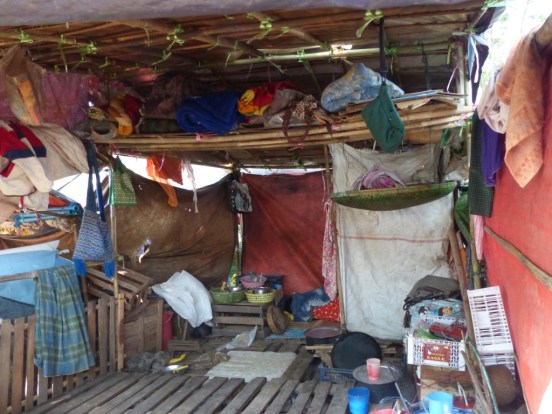
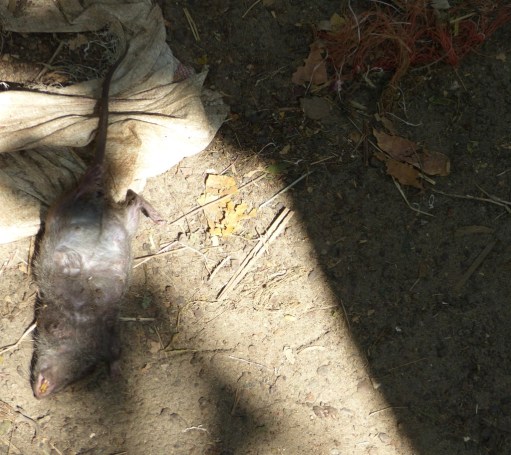
Daphne spotted this particularly gruesome sight which we quickly stepped over!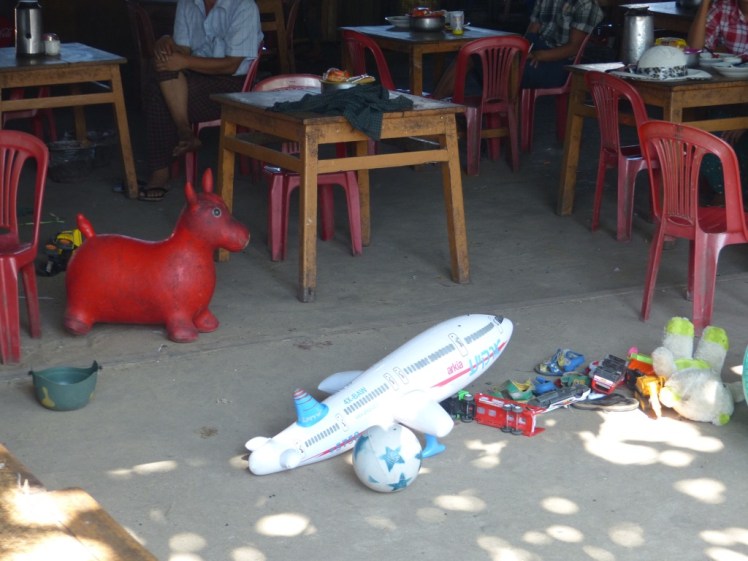
During the afternoon we returned to Yangon and explored the port where visibly exhausted laborers were carrying heavy bags of rice and other goods off a barge and an indigent girls was sifting through the spilled rice she had swept up off the ramps. A lot of rice is grown in Burma and the least desirable is sold to N. Korea. The small boats used to ferry people across the Yangon river reminded us of the long-tail boats in Bangkok with their noisy outboard engines…as did the color of the muddy water.


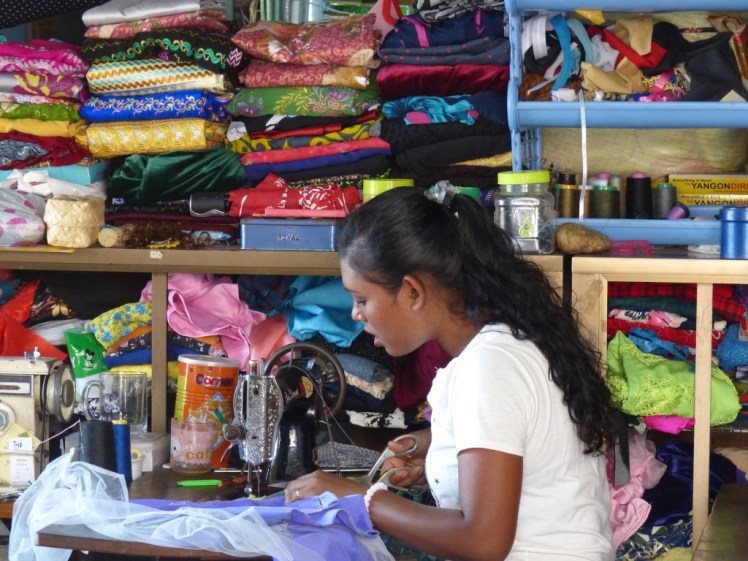
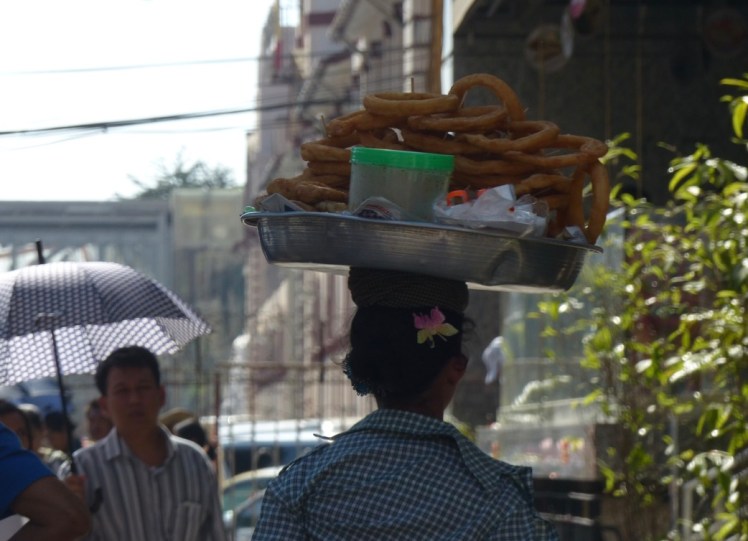
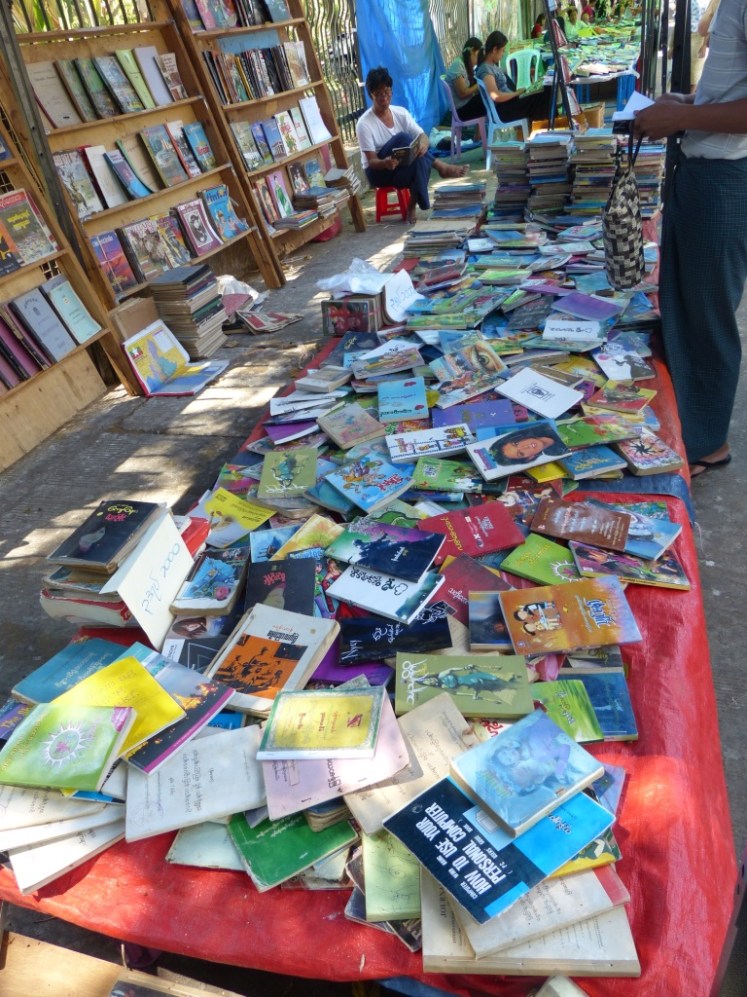
Next we strolled around the large indoor Scott market, where lots of jewelry was for sale, artists worked, women sewed using foot-pedal machines and the electrical wiring was a bit concerning. Next, we lazily perused an outdoor book stall, all the while soaking in the Burmese culture and sipping on the rich coffee and marvelling at the size of the onion rings walking by!
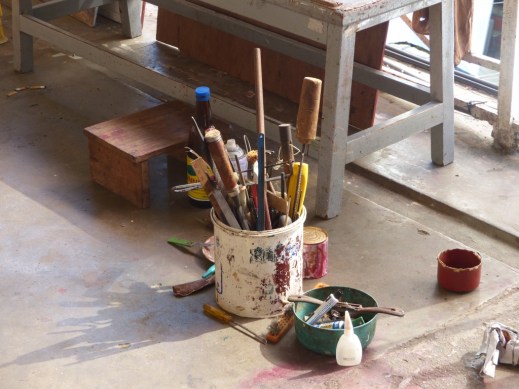
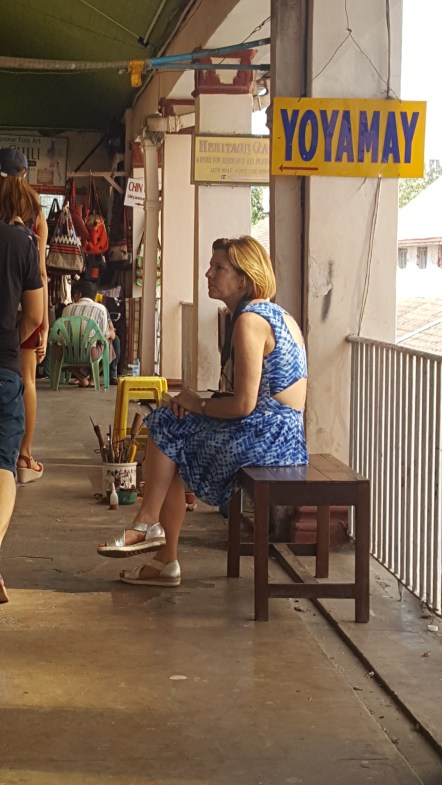
After another relaxing afternoon by the pool and more massages in the spa, we met Zaw for dinner at a historic restaurant called House of Memories. Formerly the offices of General Aung San (Suu Kyi’s father and Myanmar’s national hero) during the Japanese occupation during WWII, this restaurant offered a bit of history, most which I will spare you now. The key take-away fact: Gen. Aung San switched sides during WWII! First he befriended the Japanese, but after experiencing the domination and violence of their occupation, he decided to support the Allies instead and helped defeat Japan towards the end of the war.
We were up and at “em early again for our flight to Bagan on Day 3 and a tad sorry to leave the lovely Governor’s Residence. The flight to Bagan was just over an hour but it is distinctly preferable since Myanmar has very few paved roads and the drive takes 18 hours by bus. (Yet another “fun fact” even though you may be sick to DEATH of them by now: Myanmar lacks adequate infrastucture and paved roads because one of the items restricted/prohibited by the economic sanctions put on Myanmar by the US, EU, IMF, etc. was tar, as well as funds to necessary for major civic/engineering projects.)
Zaw flew with us to his “hometown” of Bagan where he has worked as a civil engineer for UNESCO for nearly two decades, helping to preserve the archeological sites, promote tourism and raise the living standards of those living in this ancient city in the Mandalay region of Myanmar. Originally called Pagan and the capital of Myanmar during the 9-13th centuries, Bagan is estimated to once have been the home to over 10,000 stupas (dome-shaped structures erected as Buddhist shrines by Bagan rulers and their subjects), of which ONLY (HA!) 2,000 remain standing. After repeated Mongol invasions, the Pagan Empire finally collapsed in 1287, though the town survived as a human settlement until the late 15thc. Since then, it has remained an important pilgimmage destination and highly frequented temples were patronized and maintained. However, Bagan lies in a highly active earthquake zone (400 alone were recorded between 1904-1975) and most of its temples have been damaged/destroyed over the years. Most recently in February 2016, 400 pagodas sustained heavy damage and 33 are currently closed for repairs.
The temples and stupas come in all different shapes and sizes and greet you at every turn in the dirt roads. Don’t worry, I haven’t include pictures or fun-facts on all of the hundreds of stupas we saw in Bagan despite all of the information Zaw readily supplied (TORTURED, even) us with about his hometown. His knowledge of Bagan was extremely helpful because there’s virtual NO SIGNAGE in Bagan despite its historic significance…and yet Bagan aspires to be a UNESCO World Heritage Site??!!
Once again, we were delighted with our accommodations, the Aureum Palace Resort, and we practically had the place to ourselves since we chose to visit Myanmar at the end of the peak tourist season. We recommend this hotel for its setting both day and in the evening.
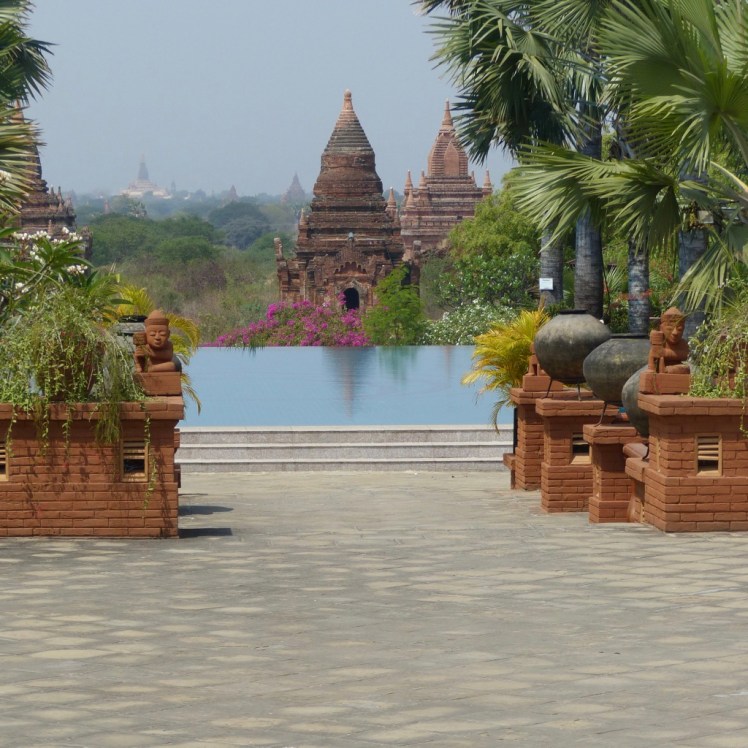
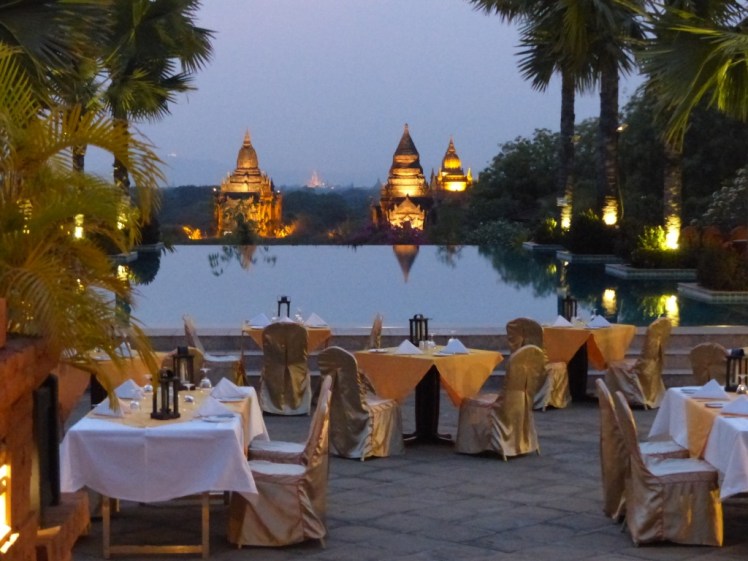
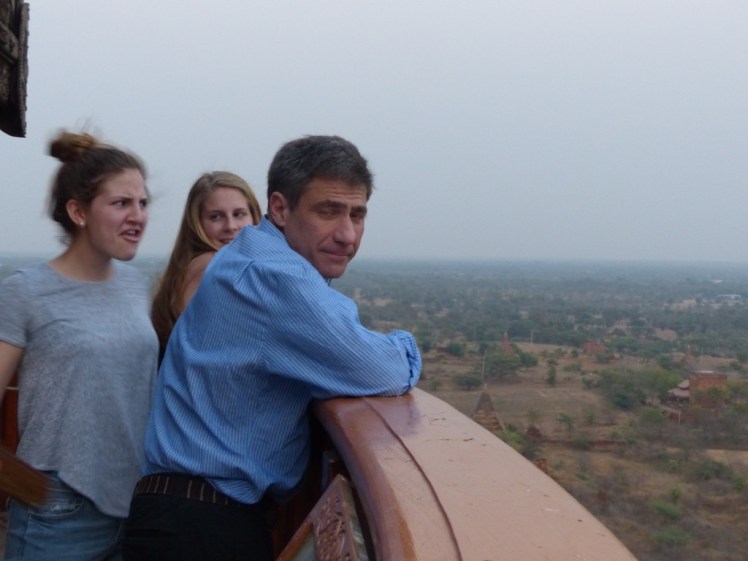
 Directly above is the view behind our villa…not bad! The resort also has an observation tower which we visited at sunset to get a view of Bagan’s stupa splendor. You can see a bird’s eye view of the resort and large villas we enjoyed as well as get a feel for some of the family antics that took place atop this tower.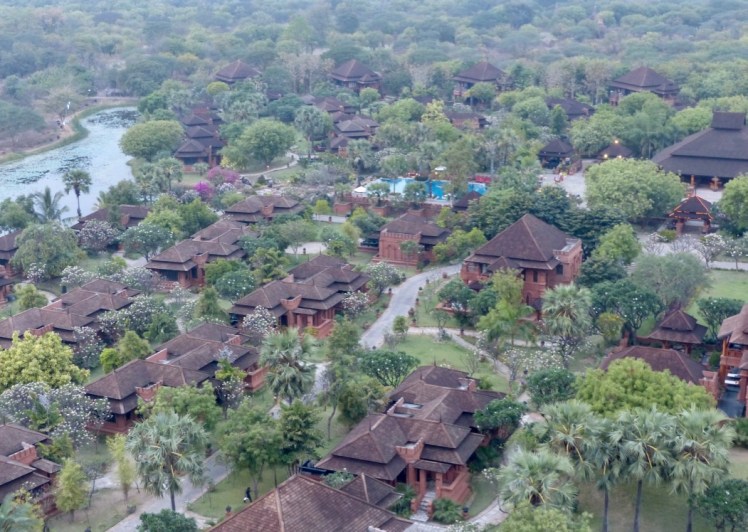
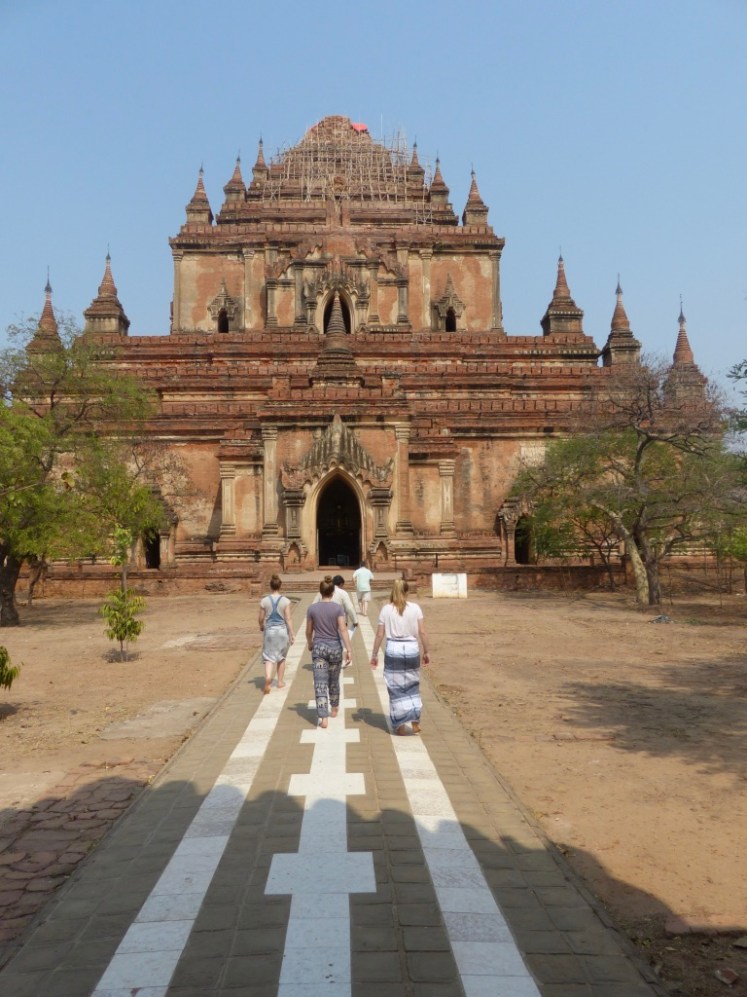
Our first day in Bagan was spent visiting the earliest temple in all of Myanmar, Ananda Temple, which dates from 1071AD. Unfortunately, it sustained considerable damage during the recent earthquake and is under elaborate scaffolding. Even the repairs were intriguing and nicely decorated with Buddhist flags, though the pulley system the workers used to convey items up and down a bit rudimentary.


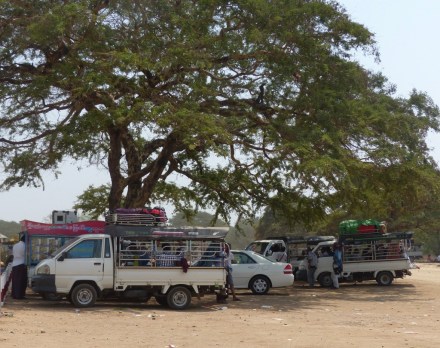
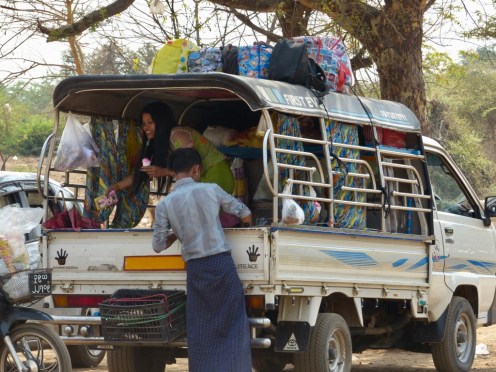
Considered the mother temple by Burmese Buddhists, Ananda Temple is visited by thousands of pilgrimmers each year and like Shwedagon Pagoda, considered a lifetime “must-see”. Everywhere in Bagan we saw truckloads of folks making this trek, each group accompanied by a monk. At times, these caravans reminded me of images of hippies going to Woodstock.
.
Ananda Temple is famous for its 4 large wooden Buddha statues, one of which secretly smiles at you if viewed from a certain angle. I’ve included pictures of the same statute, first as if seen by the king up close at a 60 degree angle and then seen from a greater distance where the Princess was permitted to pray. According to Zaw, Buddha statues should always appear humble and solemn, but the artist who carved this Buddha accommodated the Princess’s desire to see a smile on the Buddha’s face since he knew the king would never view the statue from a distance. Clever!


Pilgrimmers made donations, prayed and took pictures of the Ananda’s glory…AND…of the pretty, pale girls who also came to visit this temple. I could barely see over the crowd gathered around our girls as you can see below:


These photo session happened over and over again and as the heat rose and our energy flagged, the girls’ smiles became, understandably, more forced and Claire outright refused to pose by the end of the day. I think they know understand how movie stars tire of paparazzi!
Next stop was Sularmani Temple, which was completed in 1183AD, and served as a military hospital during WWII for the Allied Army Forces because of its air ventilation and natural light. In exchange for this favor, General Aung San was able to convince also Lord Mountbatten NOT to bomb the Japanese near Bagan and thereby preserved this beautiful ancient city.
 Here, we saw the influence of China on Burma in the Buddha statue faces, the acrobats, hairstyles and elephants in the wall murals. Zaw even showed us how the UNESCO restoration team left its mark on Sularmani Temple: a dalmation dog was added to the mural in honor of re-make of Disney’s famous movie!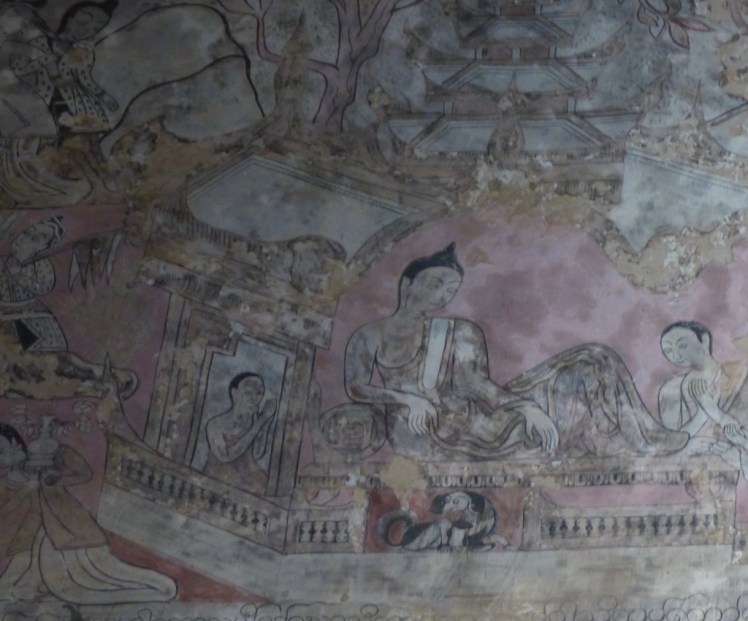
That evening we asked Zaw to take us to a local restaurant rather than a one frequented by large tourist groups. He happily introduced us to a small outdoor cafe run by young girls, explaining that generally women are not allowed to own businesses but that this cafe is an exception and he’s doing all he can to promote it. The food was delicious and we headed home just as all the electricity in Myanmar cuts out at 9pm. Hotels (ours included, thankfully!) and some restaurants do have generators, but it is generally very dark at night in Bagan. There’s only one hospital for the entire community and it does NOT have a generator, nor does it supply bedding or food for its patients so families gather outside and provide these necessities/comforts on their own until the loved one is released. Due to the lack of an adequate power supply, refrigeration for medicine and blood banks is scarce. Zaw himself has one of only two refrigerators in Bagan designated to store critical medical supplies, such as snake anti-venom. Blood typing has not been widely done so when emergencies do occur and blood is needed, patients often suffer/die before proper care/blood can be supplied. There’s only one dentist in all of Bagan and only 8 GPs according to Zaw so we were very careful not to have any unnecessary accidents!
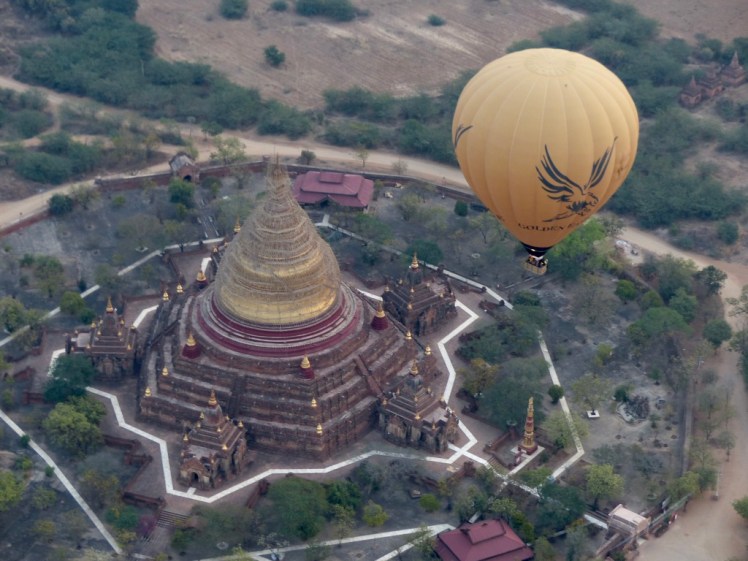
Yes…we did it! We took a hot air balloon ride over Bagan’s valley the following morning, waking up at 4:30am to take flight as the sun rose at 5:30am. Bill was VERY concerned that there would be no coffee for him, but he was pleasantly surprised by the nice breakfast spread and rich coffee we were served during our pre-flight briefing. I was far more concerned about the lack of access to a bathroom than my caffeine addiction so did not partake….
Rain was forecast for later that evening so the morning was not crystal clear but I think you’ll be able to tell from the photos below that this experience did not disappoint! Sailing quietly at dawn over this ancient city is a wonderful way to take in the 2,000 or so temples/stupas/pagodas and we highly recommend this excursion to anyone who visits Bagan despite the price tag.
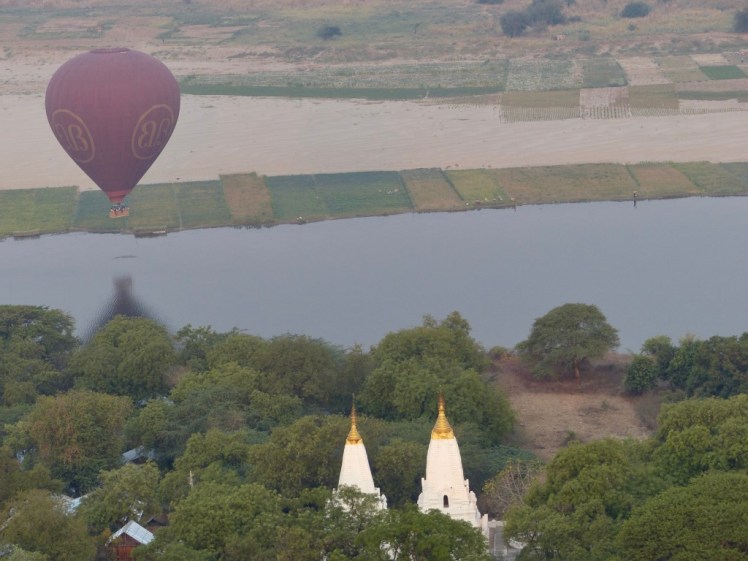
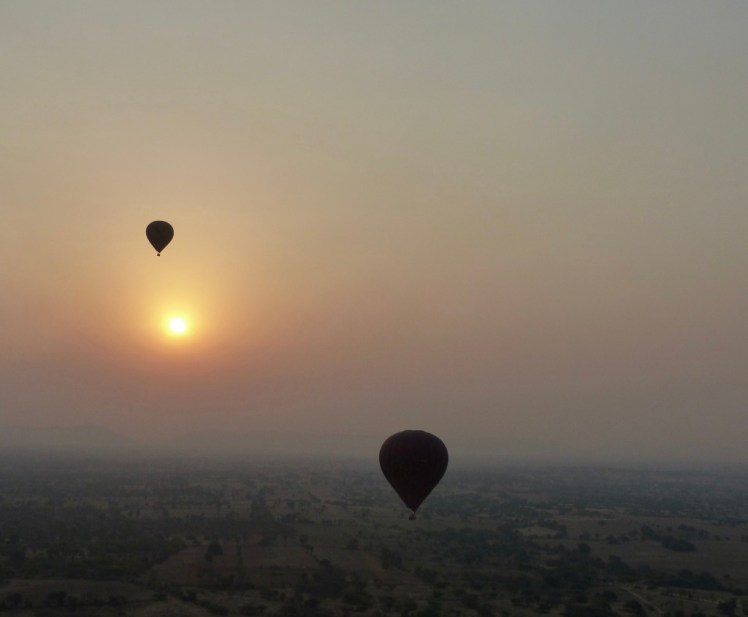
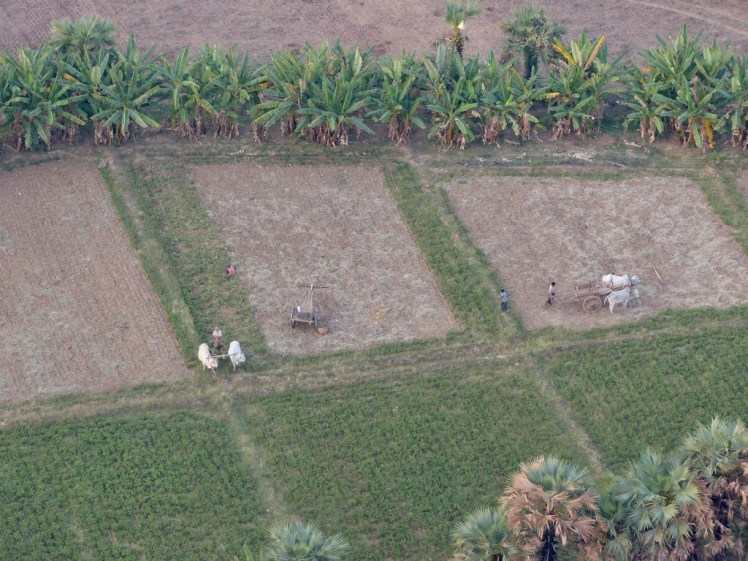

 In our balloon basket were 6 others and during our flight one young couple got engaged so when we made our (rather bumpy) landing and the balloon tour company served us champagne, we were truly celebrating a special moment as well as our safe flight. You can see the new ring on her finger below Ever ready for a sports challenge, Bill tried (and succeeded) to catch the cork that the tour team fired in the air. Just love my “young” groom of 28 years!!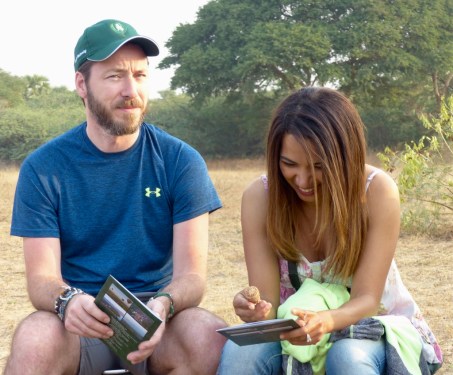
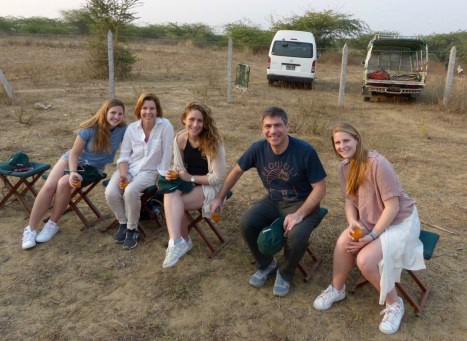
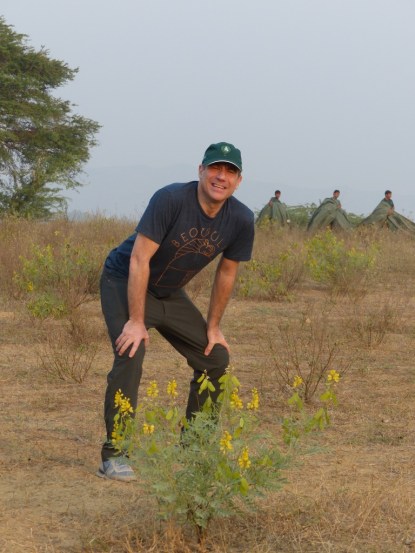
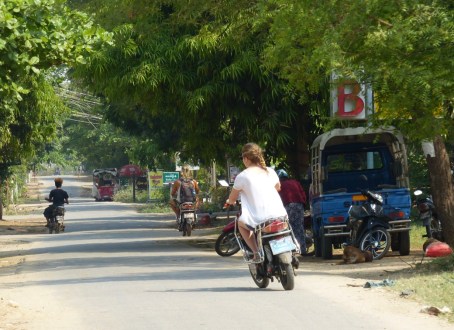
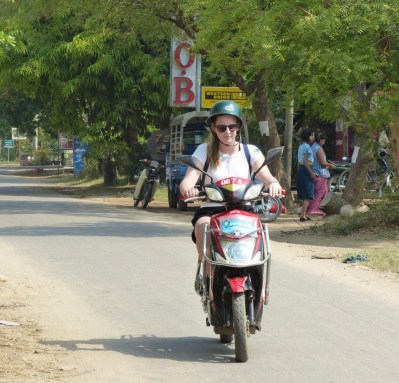
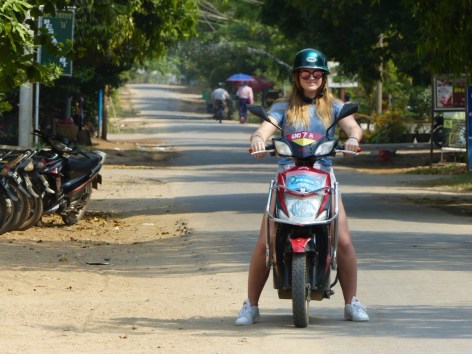
After enormous breakfast and much needed coffee break at the hotel and a bit of downtime, Zaw picked us up for Day 2 in Bagan. At his suggestion, we decided to give the girls a bit of a break from the “history lesson” and rented 3 e-bikes for them to cruise around on for a couple of hours. After a brief lesson, Zaw set them off with a hand drawn map with instructions to meet us in an hour at a designated pagoda. Bill watched wistfully as they were let “free” and he was led back to Zaw’s “school”.
The e-bike adventure was the best idea ever and the three sisters had a blast exploring the stupas on their own for a bit. Daph quickly figured out how to remove the speed restriction Zaw had placed on her bike and took off. At one point, Zoe took a wrong turn and led her sisters to a tiny village where everyone was very friendly, but clearly surprised to see the girls. Nevertheless, the girls “got it up” as Zaw would say and relished their “pagoda pause”.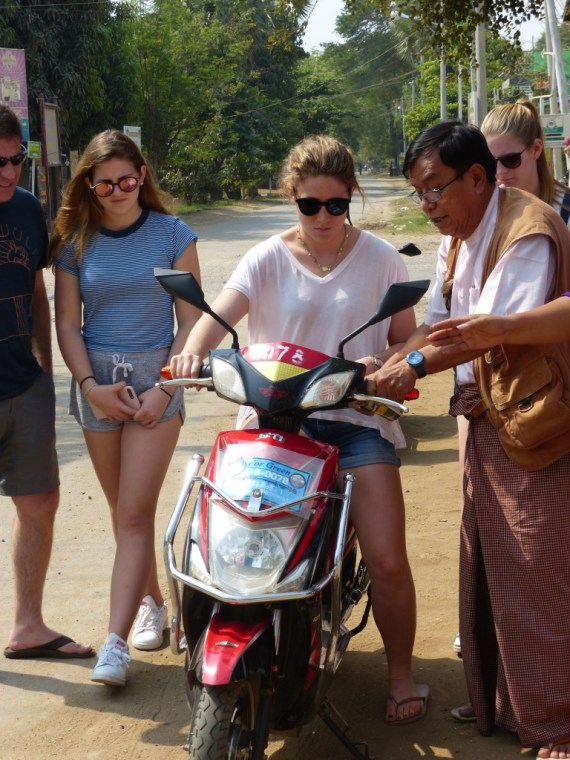

While the girls were allowed to roam free, Bill and I leisurely explored Shwe San Daw Pagodapagoda, climbing up steep stairs (somewhat reluctantly as you can tell by Bill’s expression below) to take in the gorgeous view and debate which stupa shape was the prettiest. Which do you prefer…tall and thin or …?


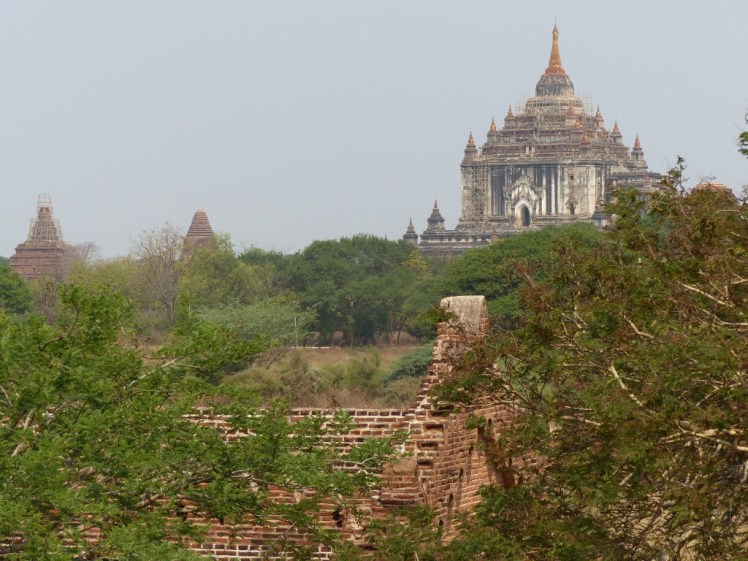
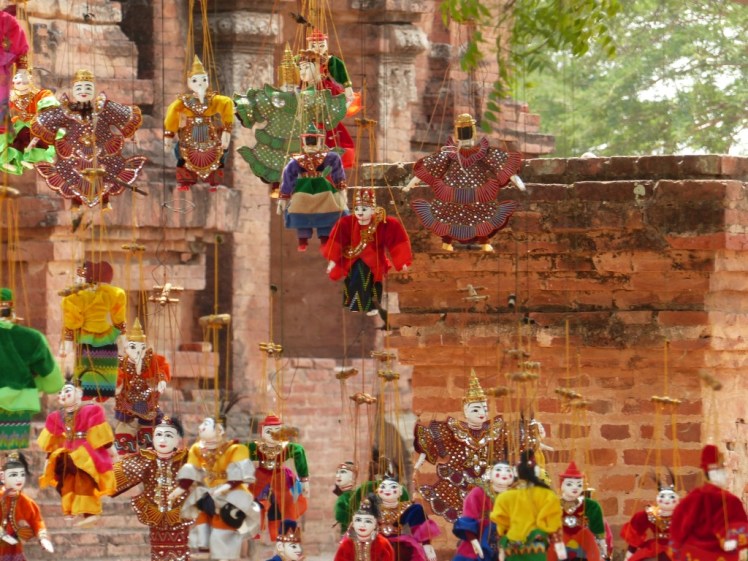
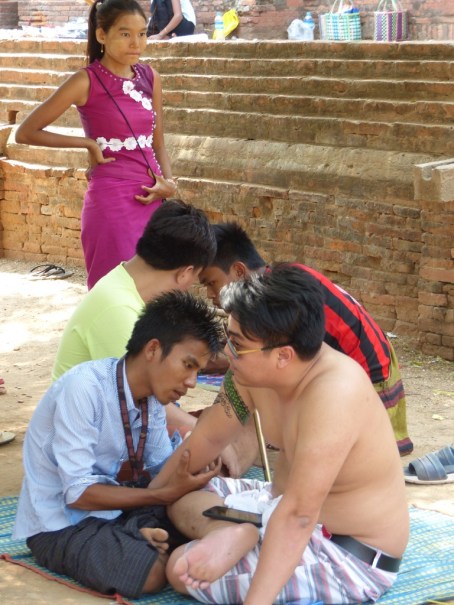
We visited one last temple, Dammayangyi Pagoda (1170AD) before “crying Uncle” and begging for a “Buddha break”. Built by a notorious king who murdered his father and brother to gain the throne, this pagoda was actually never completed and today is the only one that doesn’t fully “close” at night. Consequently, it is home to numerous cats, dogs, homeless families…as well as BATS as we quickly learned from the guano stench and droppings on the floor. I, for one, could barely stay inside Dammayangyi Pagoda and was happy to keep the tour brief! We enjoyed the souvenirs and home-made postcards on display and tattoo “parlour” outside as much as the relics inside.
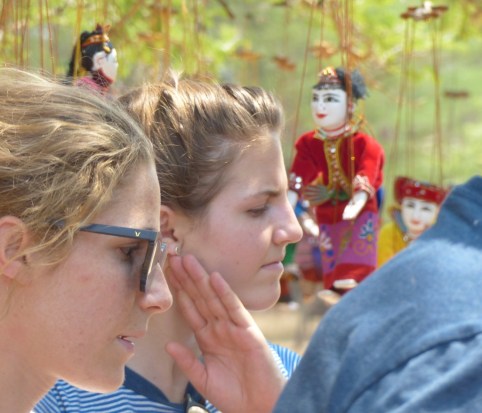
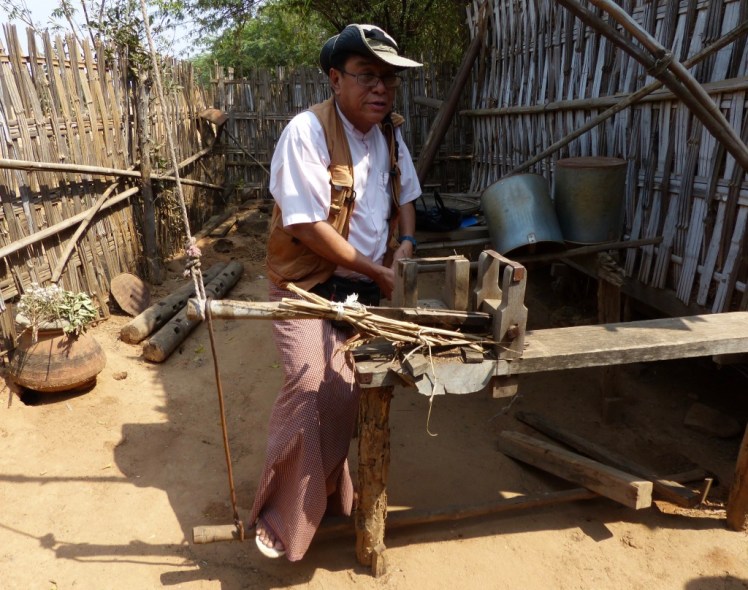
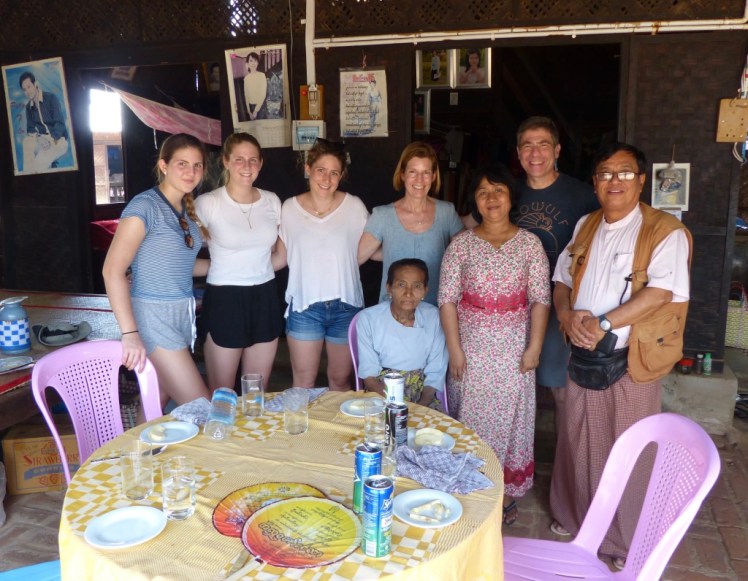
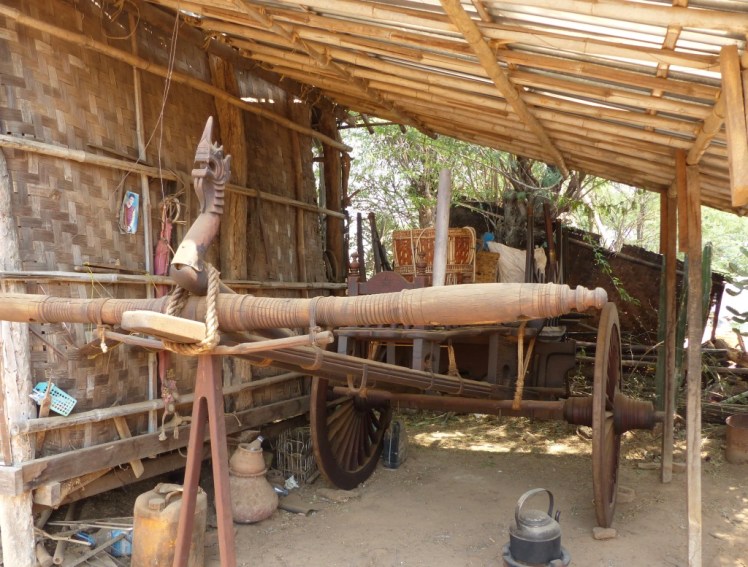
Reluctantly, the girls returned the e-bikes and we headed to a nearby village where Zaw had arranged for us to have a lunch at the cottage of a farmer’s widow…again, in an effort, to help those in need in his Bagan community. The peanut farm was modest to say the least, with rudimentary tools such as the one Zaw used to demonstrate how grain stalks are manually cut to make hay for the oxen stalls. The wagon below has a snake ornament which serves as a warning that there are snakes in the village. The widow and her family members quietly served us various local dishes while Zaw chatted away with the elderly grandmother, sneaking her a bit of extra cash. Zaw explained that salt, which is produced in the regions nearby, is one of the reasons Bagan has been able to survive Critical for food preservation in the hot, power-deficient cultures of S.E. Asia, Burmese salt is traded to countries on the country’s eastern border. White sugar, on the other hand, is not sourced in Myanmar. Instead, jaggery (a form of brown sugar made from local tree sap…but not nearly as delicious) is widely used. We felt lucky to have had a glimpse of how locals live in Bagan and headed back to Aureum Resort with a bit more humilty and gratitude.
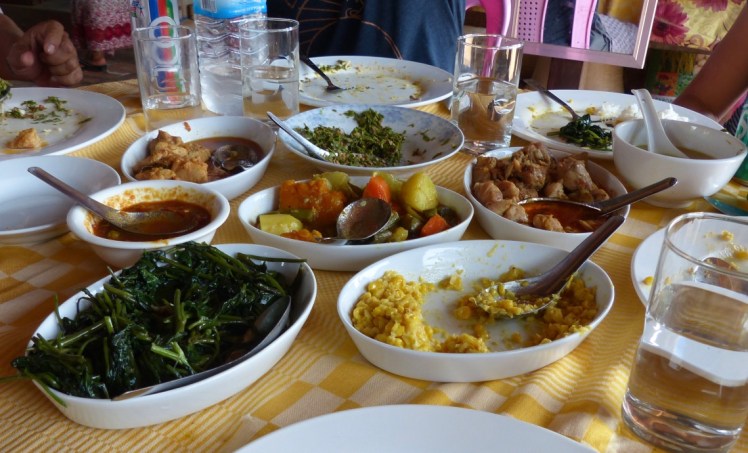
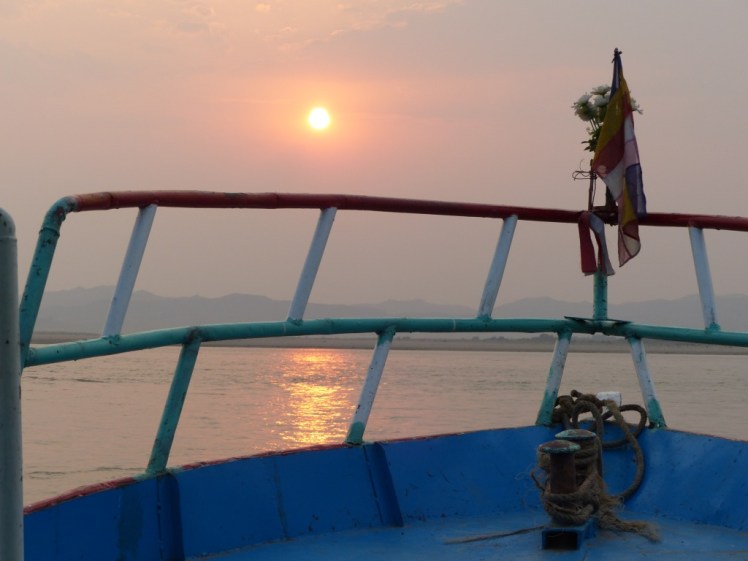
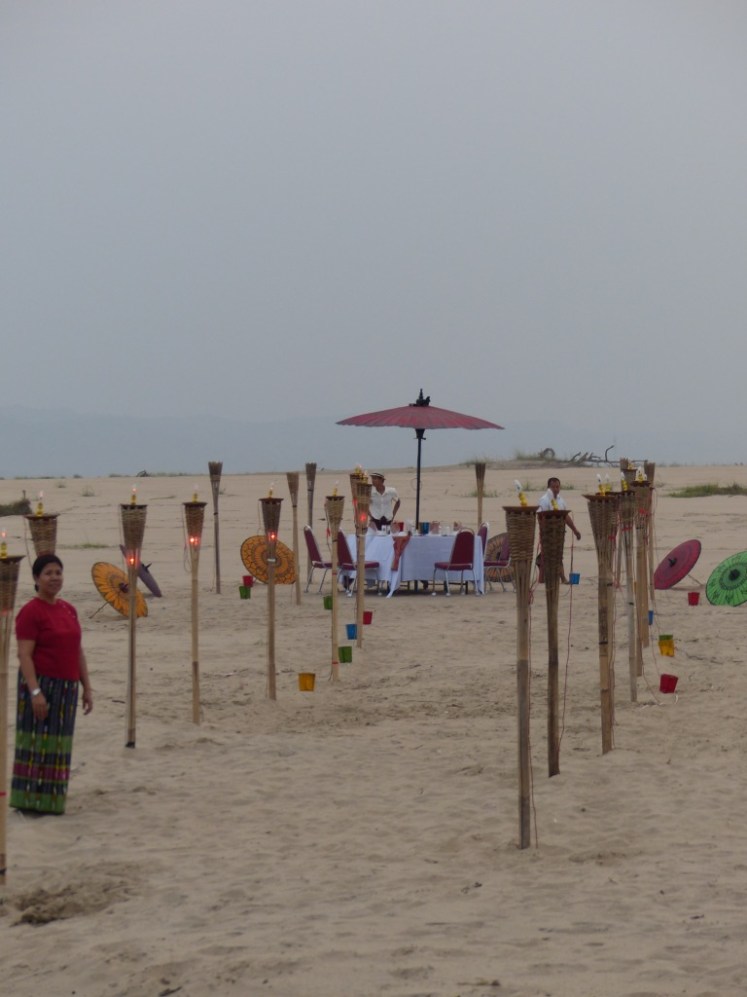
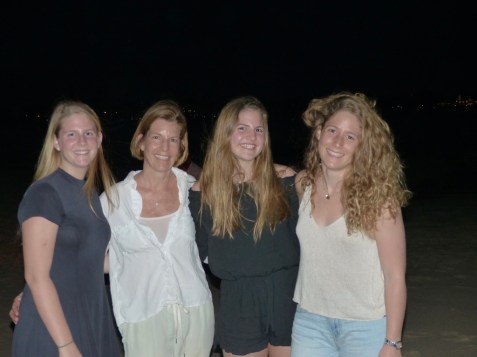
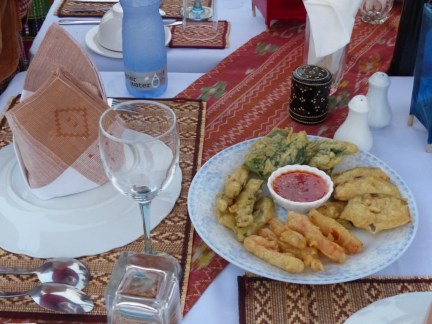
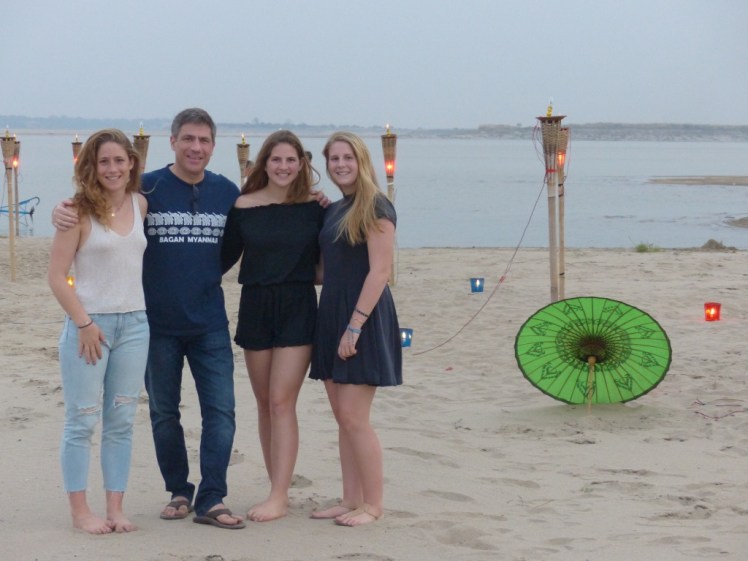
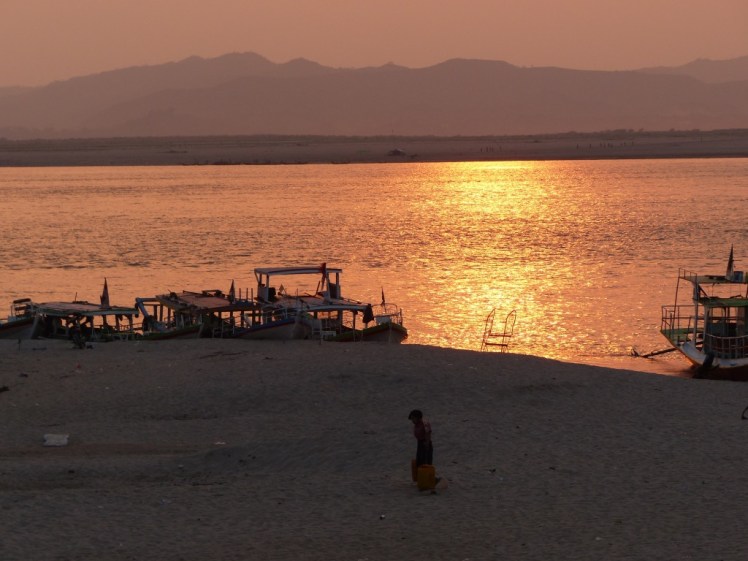
This amazing day that began so very early in the morning concluded in an equally spectacular manner. At sunset, we visited the Ayeyarwaddy River banks, boarded a small motor boat and were shuttled across to a private dinner set up on a sandbank. It was a family-operation, with the brother as boat captain, the mother as chef and her children as servers/helpers. As the sun slowly set, we enjoyed course after course of freshly-caught grilled river prawns with garlic ginger lime chili sauce, chicken kabobs, fresh salad, local vegetable and curries. Banana fritters over sticky coconut rice topped off this delicious and very memorable meal. We even enjoyed the tamarind candies that were offered as palate cleansers between courses. Zaw told us funny stories of elegant dinners that ended with drunken guests falling in the river and tried to explain why he was prepared with flashlights. When he dropped his flashlight and then had to put on a headlamp to find his flashlight, Zoe teased him quite a bit and he laughed heartedly. Much to our amusement, he kept his headlamp on long after “the emergency” was over.
After a much-needed full night’s sleep, we headed to the airport to begin the third, and last phase, of our Myanmar vacation. I was secretely wondering if the next stop would disappoint since everything thus far had exceeded our expectations. Suffice it to say, Inle Lake was the best of all, according to everyone. This area is truly a MUST!!!!
Maybe it is a good time for a stretch, a third cup of coffee, a power-down? I know this is a long blog entry but the trip was so rich and interesting that I have a hard time skipping over anything…in case you couldn’t tell!
The short flight from Bagan to Heho airport was on a small plane and became VERY turbulent at the end as we climbed over mountain ranges that surround Inle Lake. Zoe survived the flight…barely. We keep hoping that her fear of flying will abate through frequent “exposure therapy”, but a month after this trip, she and Daph experienced “the worst flight ever” when they flew to Bejiing for a soccer tournament. As a result, she is very eager to be back in the States for the rest of high school and not bouncing around Asia anymore. We will miss her (and Daph) terribly next year though….:(((
Since Zaw is less familiar with this area of Myanmar, the Authentic Asia tour people who helped us design this “trip of a life-time”, put a second guide on task: a lovely young woman named Ayemar who grew up in the Shan State where Inle Lake is located. Married with two young sons, Ayemar was a secondary school teacher before becoming a guide. Like 40% of the people living in the Shan State, the largest in land mass, but least populated of Myanmar’s 7 states, Ayemar has a mixed ethnic background. Her mom is half Karen-half Shan and her dad is Pa-O and she speaks all three of these languages, as well as the official Burmese language and English. Soft-spoken, intially shy and reluctant to lead discussions with Zaw, the elder statesman, nearby, Ayemar gained confidence and began to show her vast knowledge of the area and sense of humor. She had a gentle manner of interacting with the locals and opened many “doors” for us so that we could better understand this unique part of Myanmar.
Inle Lake is Myanmar’s second largest freshwater lake, covering nearly 50 square miles and situated nearly 3,000 ft. above sea level on a plateau between two mountain ranges. Roughly 150,000 people live in 4 cities bordering the Lake and in several small towns on the shores and lake itself. To access the lake, we drove an hour east from the airport to Nyaung Shwe or Jetty Town, as the local Intha people say. Here, we set out in 2 long tail boats (our luggage in a third) with a captain in the stern and a second oarsman at the bow. Our seats were comfortable, complete with blankets, sun umbrellas and water bottles and the views beyond our wildest imagination. We traveled along a canal to the northern end of the Lake and then to our lodging, located on the eastern shore. Here are some of the initial images that greeted us as left Jetty Town, sped along the canal and then approached the magical Inle Princess Resort.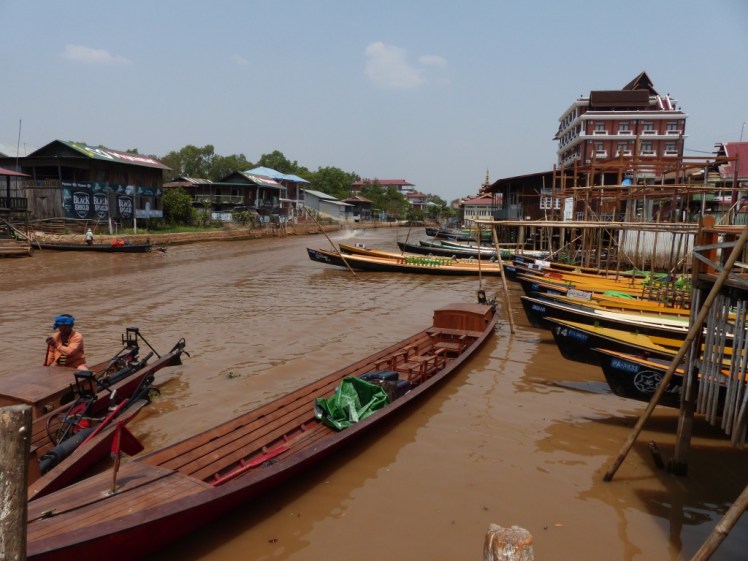
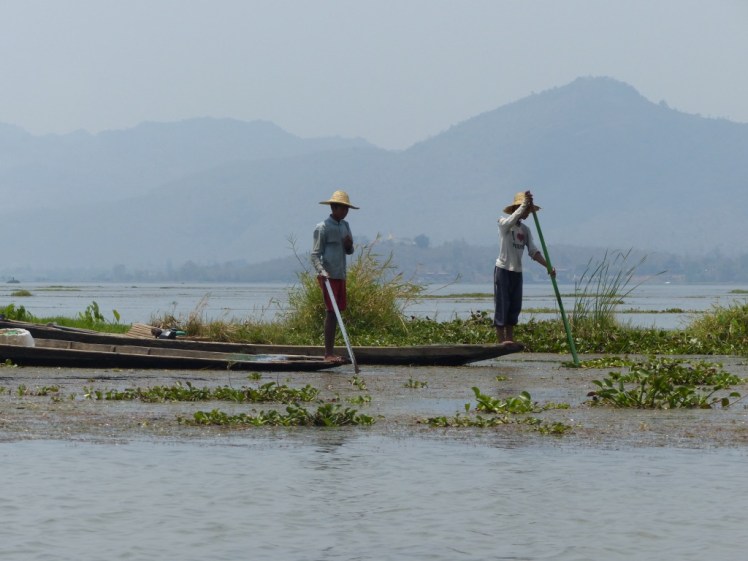
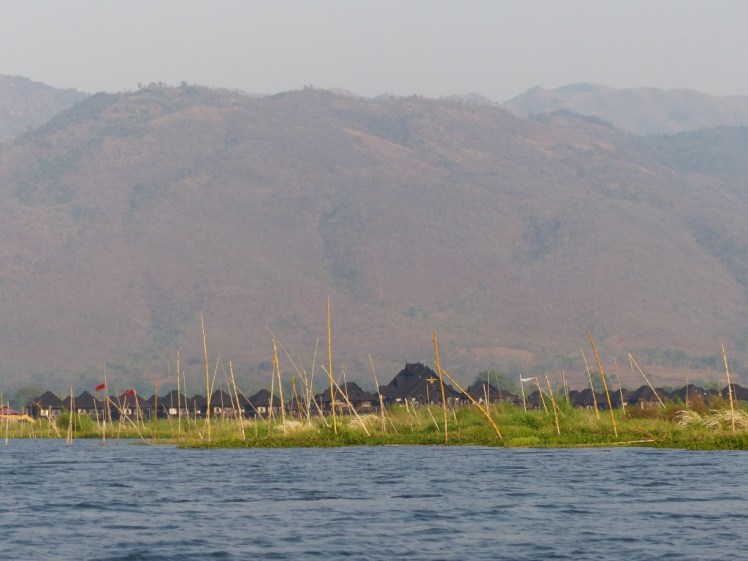
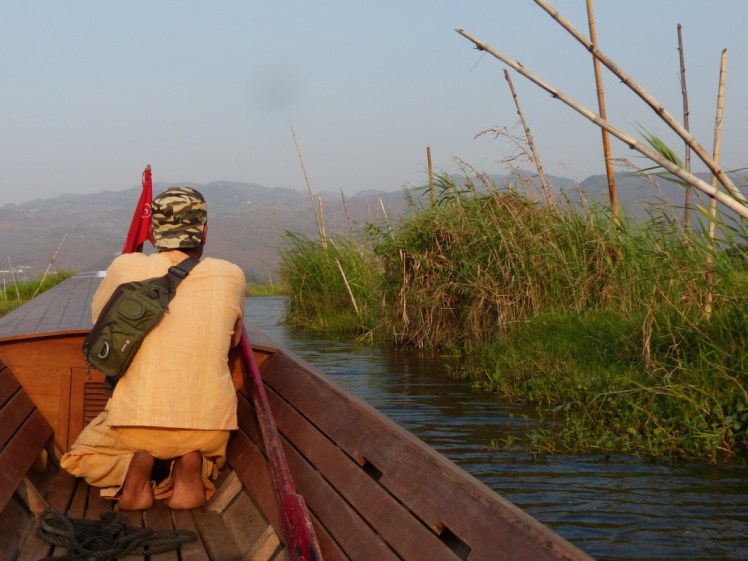
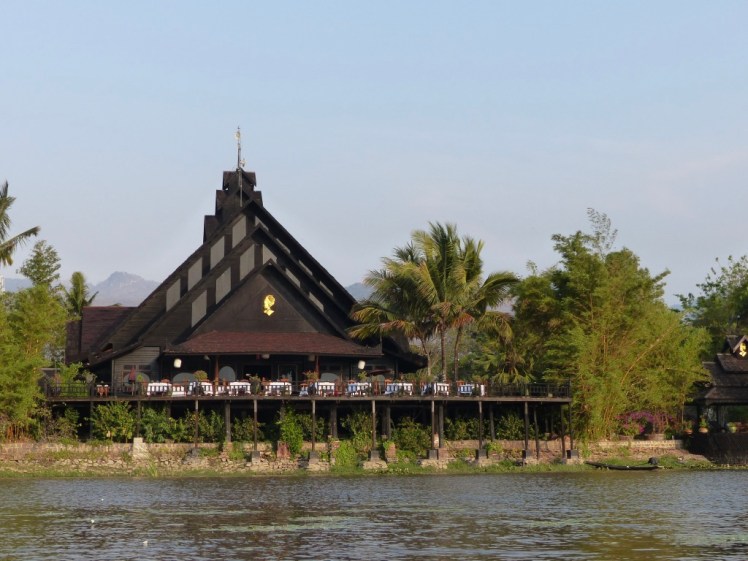
As the motor was silenced and the oarsman began their unique form of “leg rowing” to bring us through the reeds to this stunning resort, we began to sense that this third leg of our trip was not going to be a disappointment afterall. The creosote soaked roof timbers, the teak buildings and furniture in our villas, the lush and colorful tropical flora, the water gardens with gentle bridges and wooden carvings all over the resort made each path on this property a special experience. Breakfast on the porch overlooking the lake and sunset off our villa porch were stunning sights we enjoyed each day. I apologize ahead for all the pictures that follow but I just can’t help but savor these sights!


Our rooms were spacious with outdoor showers, sunken tubs and mosquito-netted beds and there was a nice pool but I can’t capture it all so please, please go see for yourself this bit of paradise on Inle Lake!
We spent each day travelling in these long tail motor boats and loved every minute of this water transportation which afforded a cool breeze and peaceful views as visited various sites and villages on Inle Lake. On the open waters of the lake we passed many fishing and seaweed harvesting boats. Working in pairs, the leg-rowers on these flat boats were either fishing for the local carp or gathering lake-bottom weeds to be used as building material for the floating gardens. As we quickly learned, these bucolic scenes of graceful fishermen balancing on their narrow skiffs and belied the back-breaking, arduous labor they perform. Ayemar explained that of all the manual laborers within the Inle Lake community, the weed/algae gatherers work the hardest. Their heavy loads certainly looked precarious at the end of the day and we often saw them scooping out water to prevent their skiffs from swamping entirely.


The acrobats performed by these fishermen are one of Inle Lake’s most famous attractions. Somewhat staged, these fisherman use their conical nets to catch the local carp and tilapia, as well as entertain tourists like ourselves. 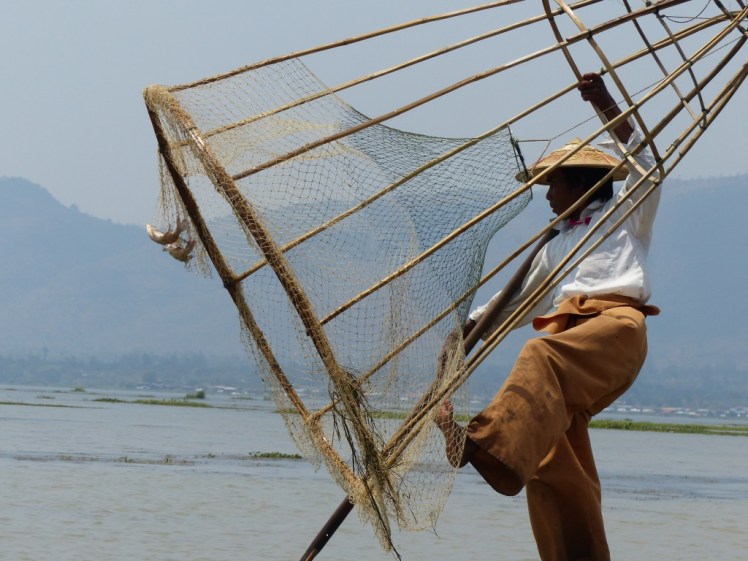
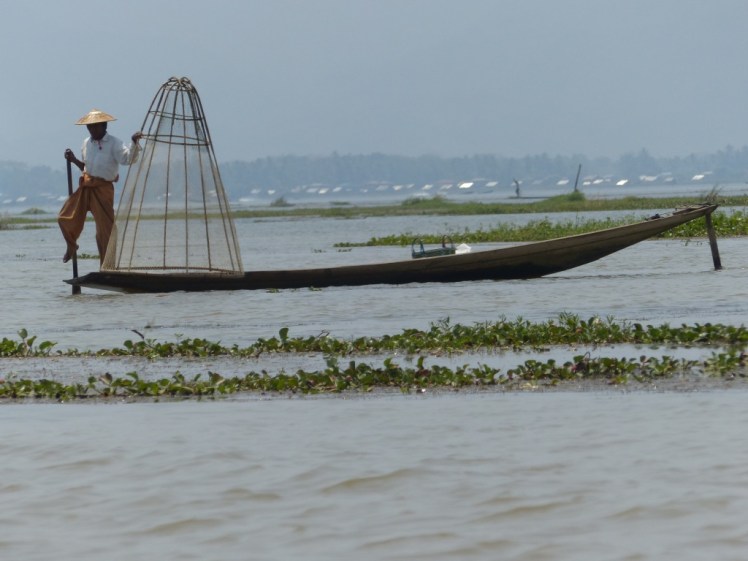 We, on the other hand relaxed on the boat rides, basking in the sun and splashes of cool, clean water. Bill, in particular, rode in STYLE!


We first visited Indein Village which is located at on a long narrow creek at the southern tip of the lake. We travelled through a crude lock system made with the omnipresent water hyacinth, other plant material and bamboo poles. We went under bridge after bridge, gliding by locals playing/bathing/laundering/delivering drinking water and watering their oxen in the canal.


As you can see, life in these villages is quite simple and many houses didn’t have running water or electricity. We did go through one village that had numerous UN-donated solar panels, but otherwise the country-side is power-deficient. Consequently, in rural parts of Myanmar such as this, only 6% of the population is estimated to have a mobile phone, THE life-line for people living in the developing nations of S.E. Asia as we’ve come to understand in all our recent travels. Just 5 years ago, cell phone penetration throughout Myanmar was less than 10%, but the government has eased regulations on foreign SIM card providers, prices have come down and an internet/mobile phone revolution has ensued such that penetration is now estimated to be 50%. Any cell phones we did see however were older generation Samsung and Android phones. Most of these users, however, live in Yangon, Mandalay and Nay Pyi Taw. The 36 million or so folks living in rural areas with limited or no electricity, however, are missing out on this “revolution”. Ayemar explained that in the Shan Hills area, a few enterprising folks with access to electricity have set up “charging stations in their homes, charging up to 200 phones each night a collecting a fee for this service.
Banks, too, are not to be found in rural Myanmar so there’s no risk our next Citibank posting will be near here! It was only in 2011, in fact, that the junta granted foreign banks license to operate in Myanmar. Today there are 13 foreign banks helping to lift this emergent country out of poverty. Much of the population doesn’t trust the banking system and prefers to deal in cash. Any extra cash is spent on jewelry (gold mostly) and then this jewelry is worn at all times to keep it safe. Smaller jewels are traded in for larger ones as one’s fortune accummulates.
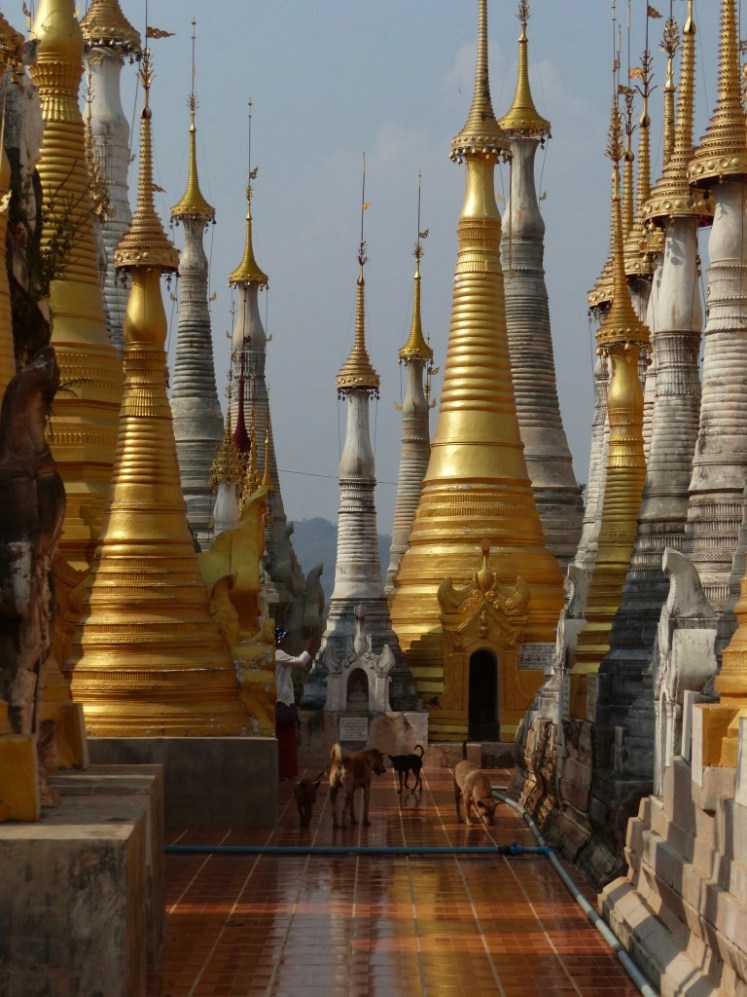
Daphne and Zoe loved the lunch we spent in an outdoor cafe where lots of stray dogs played underfoot. In fact, the girls might have snapped more “dog” pictures on this trip than Buddas. Here’s one of Zoe’s favorites: 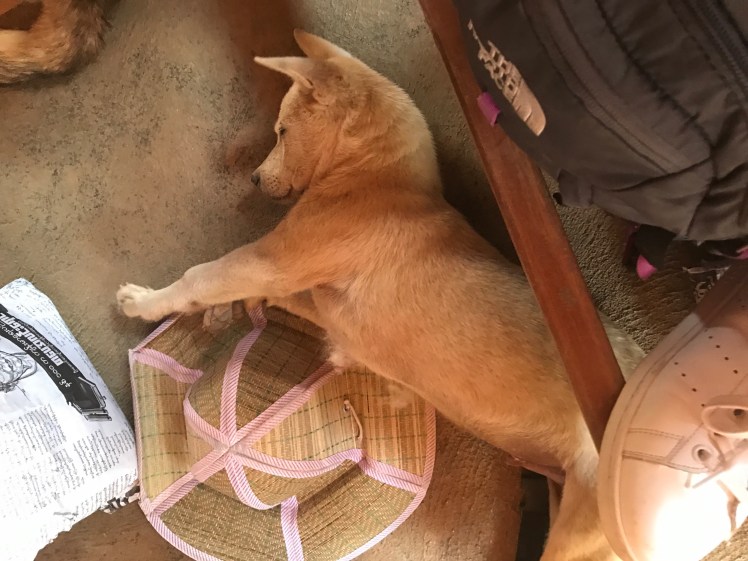 Claire and I were less enamored with the strays. After lunch, we set out for a stroll among many hundreds of abandoned pagodas, collectively known as the Shwe Inn Thein Pagodas. Thousands of little bell ornaments that decorate each stupa twinkled in the cool breezes and provided some gentle music as we meandered. At the peak of this summit was a large temple with several pagodas that have been patronized and restored. Can you tell which ones have been funded in the pictures below?


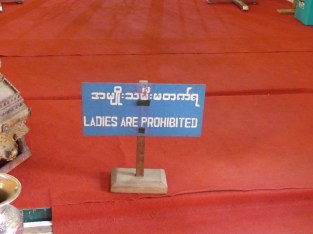
A bit immune to the site of pagodas by now, and definitely suffering from “stupa-stupor”, Daphne and Zoe were far more interested in the adorable puppies roaming the grounds than the temple and didn’t mind at all the signage preventing them from entering the main hall.
For Bill, Claire and myself, the second morning on the lake began with a “private” (but only because no one else showed), yoga class taught by an insanely flexible young girl who we couldn’t really understand but happily followed along as she led us through somewhat familiar, yet definitely different, yoga poses. A leisurely breakfast overlooking the lake with scrumptious red papaya followed. We watched the resorts’ daily workers arriving by boat and marvelled at the leg-rowing.


Ever-ready Bill attempted this distinctive rowing technique later when we set out. Check out his performance in the video below…not bad!
During our second day on Inle Lake, Ayemar introduced us to the unique floating gardens and farming communities along the shores. We rowed along water paths in this Heya ywama garden region of the lake so as not to disturb the plantings. Centuries ago, the government forced the Intha people into the Shan Hills region which has only steep hillsides, a lake-covered plateau and virtually no arable land. The Intha came up with the clever, floating garden, solution and today the produce grown on the lake supplies communities as far away as Mandalay, Yangon and even China. Weeds/algae are harvested, then compacted into planting beds which are then secured to the bottom of the lake with bamboo poles. Each garden has a gate and crude hut where workers can eat/rest a bit during the day, though these structures may not be occupied at night. The military patrols Inle Lake tightly because of nearby ethnic tension in the Shan region. No motors or lights are allowed on the Lake at night. If there is a medical emergency, locals will row a boat bearing a red lantern to signal to the military police the need for transport/escort to a local clinic. There are however no dentists or doctors on the Lake, only village “medicine women/men”.
Lightweight crops with shallow root structures, such as peppers, tomatoes, eggplants, beans, and squash, are grown in the nutrient-rich lake water all year long since crops cultivated on these floating beds which are not susceptible to flooding during the rainy season. Women plant, weed and harvest the crops while the men perform the heavier labor of constructing the beds, fences and moving/disposing of them after they’ve outlived their fertile, 7-year life. Ducks and chickens are kept on the gardens as well, while pigs are kept in floating sties.
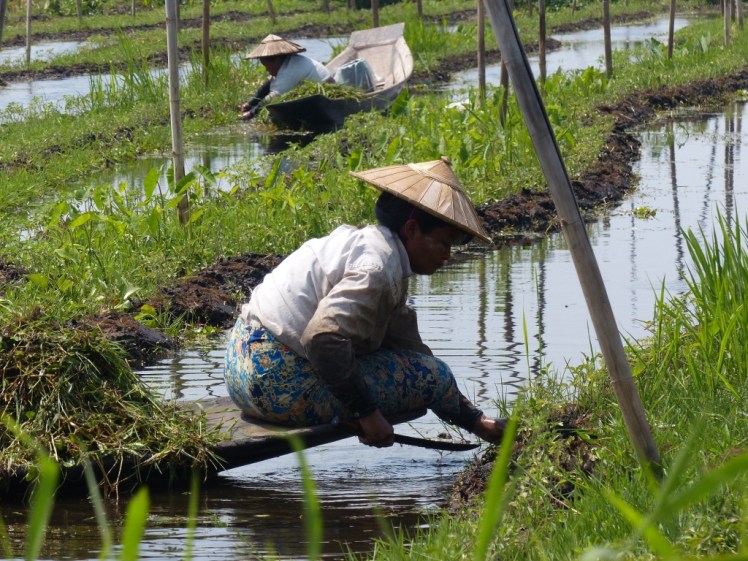
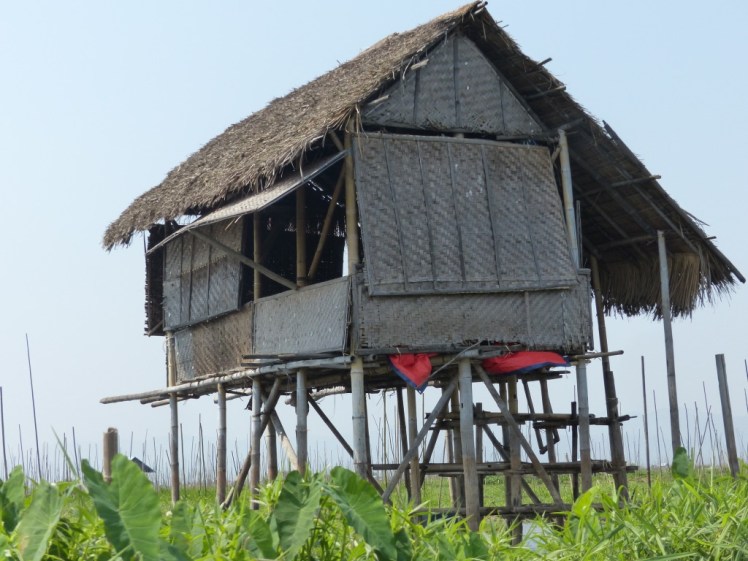

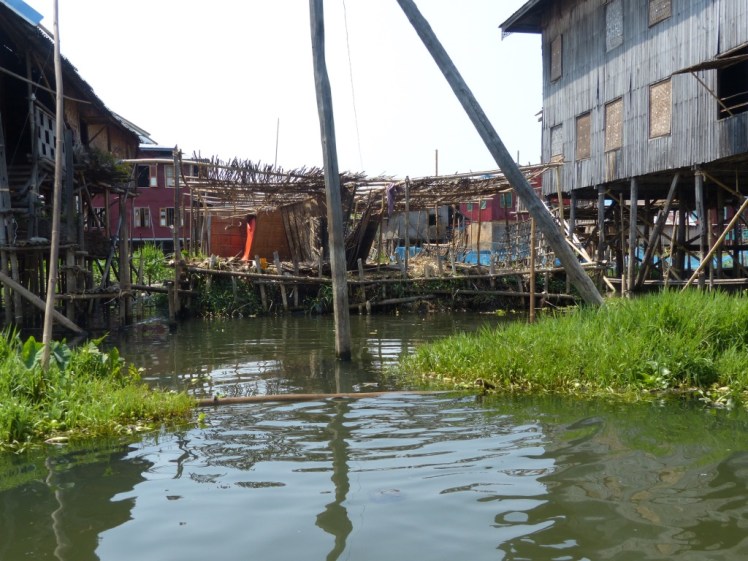
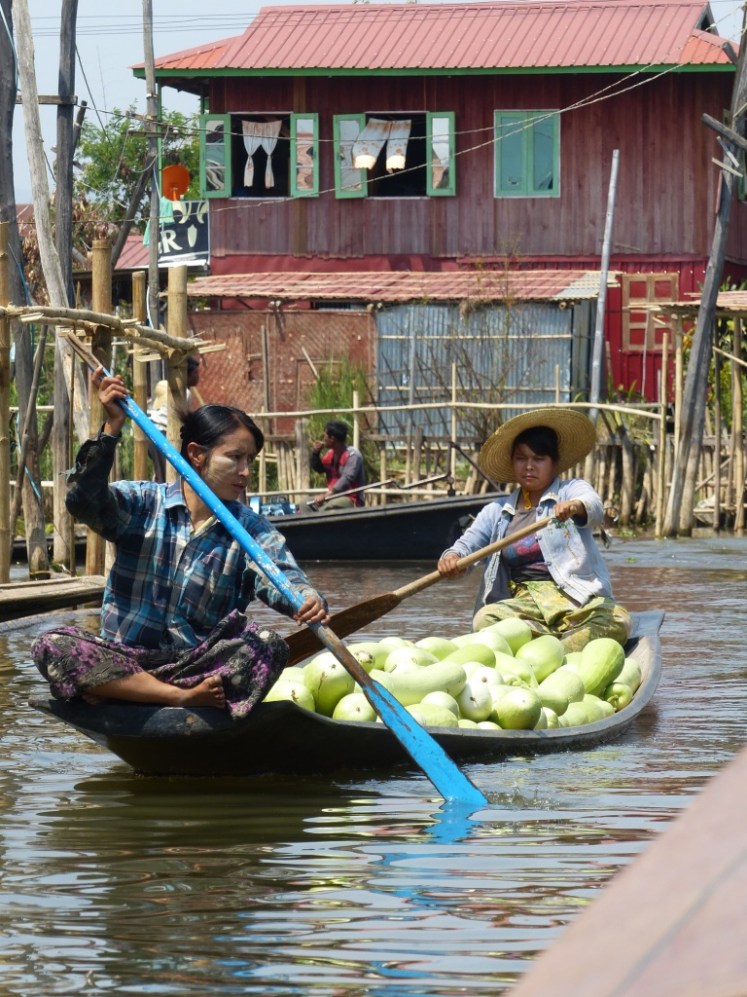 All houses on the lake are also suspended on wooden and bamboo stilts since during the rainy season, the lake level rises as much as 15-20 feet. The simplest structures have woven bamboo sides whereas “wealthier” homes have wooden walls, tin roofs and sometimes even home-made limestone brick facades. During the past 7 years, many of the lake villages have been connected to the power grid and so now have limited electricity. Most homes, however, still don’t have potable water and thus need to buy water which is sold in yellow plastic jugs like the ones seen below.


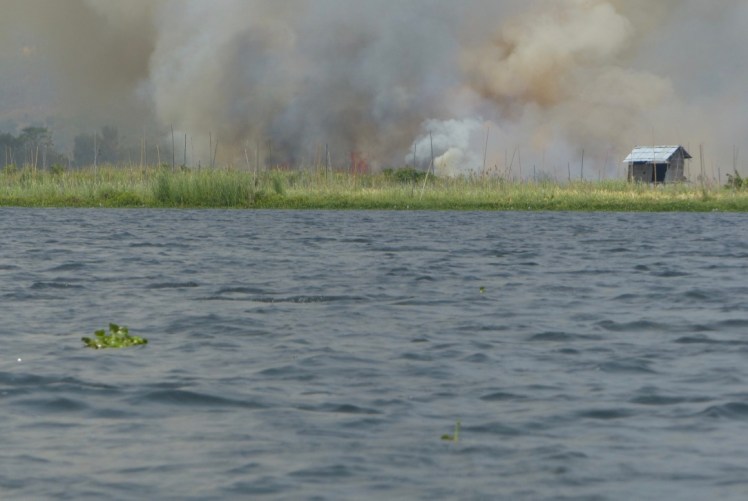
Although there’s no plumbing and the outhouses (see photo below) and pig sties empty directly into the lake, the water in the lake is surprisingly clear and certainly doesn’t smell. Ayemar told us the first that any extra money a family accumulates is first donated to the local monastery, but then next used to build “pleasure house” as these outhouses are called.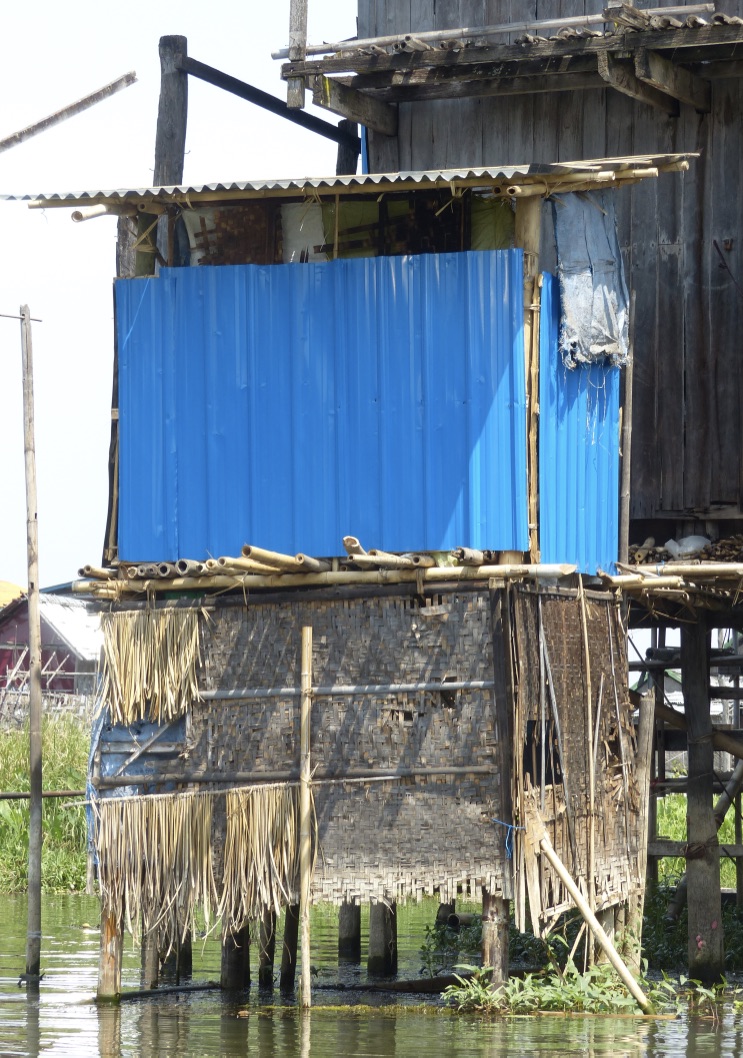 Apparently, the ever-abundant water hyacinth, fish and water flowing in from the surrounding hills all function to purify/filter Inle Lake’s water. Reluctant to completely trust this “fun-fact”, we opted for bottled water to quench our thirst. Waste is burned in controlled fires such as the one we saw one afternoon.
 Next, we visited a few craft stores selling locally made jewelry and learned about the ethnic Padaung people, a sub-tribe of the indigenous Karen people. The Padaung people are known for the distinctive copper and brass coils woman wear around their necks . According to a custom that dates from the 11-12th century, Padaung girls don these coils at the age of 7 and wear them as symbols of wealth, position and beauty. These coils can be up to a foot in lenth and give the illusion of having stretched the neck when in fact the collar bones and ribs slide down under the weight of the coils. Women wearing the coils cannot move well, can only use a straw to eat and lose all muscle in their necks over time. The two Padaung women we met are actually from a village over 5 hours away from Inle Lake but they prefer to stay on Inle Lake earning money from visiting tourists like ourselves who come and gawk. It was as if we were visiting a “human zoo” and truly uncomfortable for several reasons!


We then motored to Innpawkhun village which is known for its hand looms and beautiful weavings. We loved this pit stop, not only for the colorful weavings that surrounded us but also for the gently clacketty-clack noise of the looms in motion. Here, silk, cotton and lotus root threads were used to produce scarves, table linens and other pretty textile goods. Below are images of the tools and raw materials used in production.


The following two videos demonstrate how the lotus stalks are turned into thread and the weavers operate the machinery, all to sound of the looms in action.
Claire had fun selecting pillow cases and a dresser runners for her SF apartment while Daphne picked out a shawl, purchases which we hope will remind them forever of our magical time in Myanmar. I personally could have spent hours here and I tried to investigate every nook and cranny of the 3 story building full of dyes, looms and finished product. Even the views out the factory’s windows captured my attention. Claire, too, loved this stop and chatted with Ayemar at great length about the female owner of this factory, whose family has run the business for almost 90 years without much change at all.


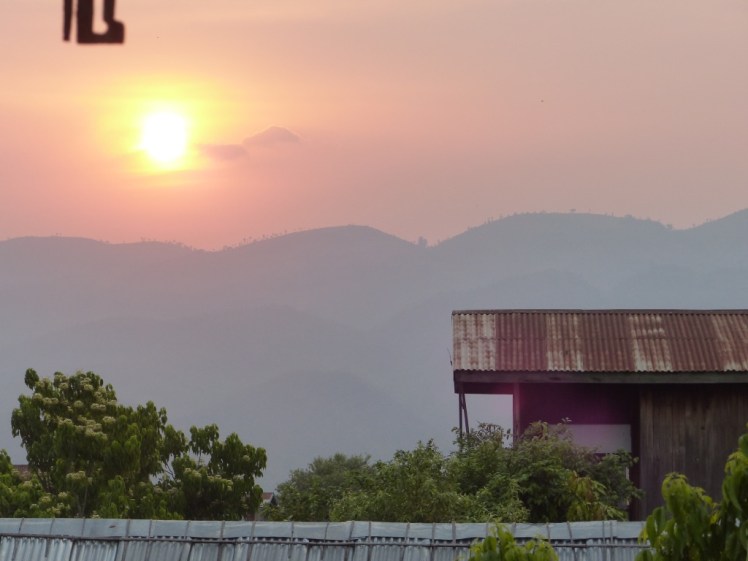
After some downtime at the resort, we set out again in the early evening to attend a private cooking class that Ayemar and Zaw had arranged for us in the home of one of the resort employees, Pau. This experience was truly special since we were invited into his home, met his extended family, made a meal together and then ate the delicious food fare, all the while soaking in as much culture and kind hospitality that we could. Not only were all the ingredients locally sourced, cleaned and laid out for our us, but we were given gentle guidance as we chopped, de-boned, fried, steamed the various items. Claire loved this ethnic cooking lesson and hopes to try to re-create some of the salads if she can source the ingredients. Neighbors peeked from their windows at the western family visiting the house next door, the younger family members shyly watched, slept or played around us and we were encouraged to explore the house and view the sunset from the upstairs rooms.


The sunset didn’t disappoint as you can see below!
 Ayemar gave Daphne and I lesson on how to make and apply the traditional Burmese sunscreen.


The table was decorated with flowers by the young girls and the meal was unforgettable!! It was a team effort and one we memorialized with a photo!


At the end of this memorable cooking class we were each presented with a certificate of completion and warmly escorted back to the resort by Pau and his young wife and children. The next day, we went to a market in Jetty Town to buy some toys and gifts to bring to Pau and his family to show our appreciation of his generosity. 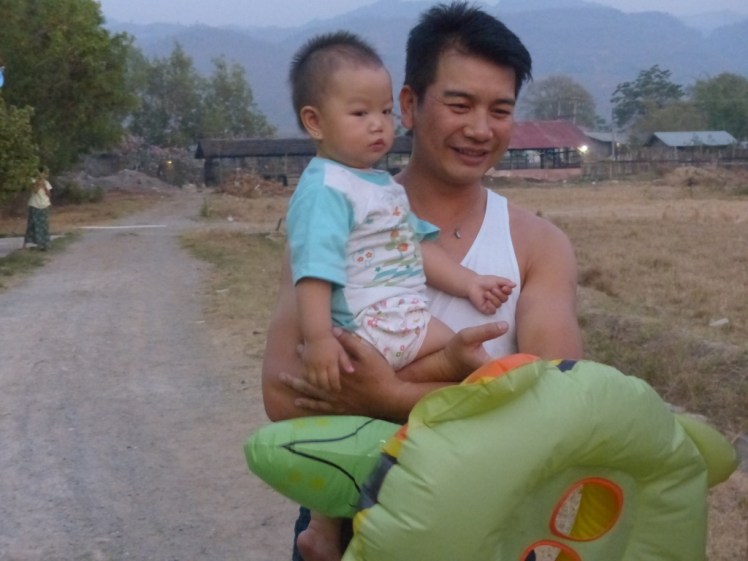
For our last day in this region, we traveled by car back to Heho market to experience market day in this region of Myanmar. Referred to as the 5-day market, this itinerant marketplace moves each day around the region so that local minority groups can shop and sell goods. Although the 5-day market does actually come to Inle Lake itself, we were not staying on the lake at the time and so we visited the one being held in nearby Heho instead. Thousands of vendors travel with their produce, livestock and wares to the market location, erecting stalls/cooking stations early in the morning and then dismantling by early afternoon to move onto the next location. It is an impressive operation in every respect, from the amount of goods transported, to the items beautifully display and cooked for consumption.


Just loved this baby and colorful combination!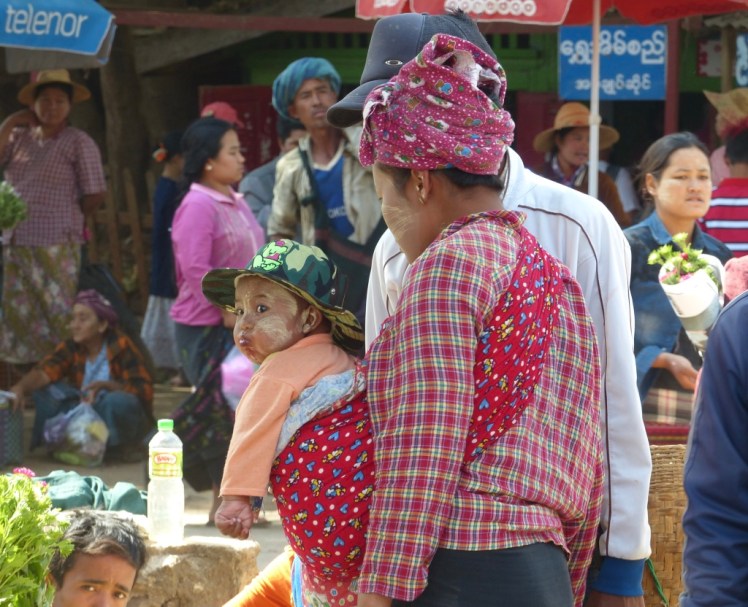 Folks living in remote hill villages walk great distances to reach the closest market every fifth day and their fatigue was evident, as well as their poverty, as they ate simple packages of rice wrapped in bamboo leaves, and rested after their weary treks.


There, we were able to see the colorful Pa-O tribe people with their distinctive checkered bright orange headresses and dark robes as well as take in countless other sights and smells.


Within the marketplace there are money lenders who extend intra-day credit, carrying around ledgers and settling up with everyone before the itinerant market is disassembled and moves onto the next village. Used batteries served as counter-balancing weights for scales and a jewelry “store” served as a bank where folks could trade up and down their wealth to make purchases/secure profit. Medicinal herbs to promote breastfeeding and health after childbirth were for sale as well chicken innerds, with undigested corn and not-yet-formed egg sacks??!!!!! Who in the world eats that??!!!


I had to step away and take some deep breaths after leaning in way too close to see what the heck was for sale…my own damn fault! Hence, viewer discretion is advised for the image below! 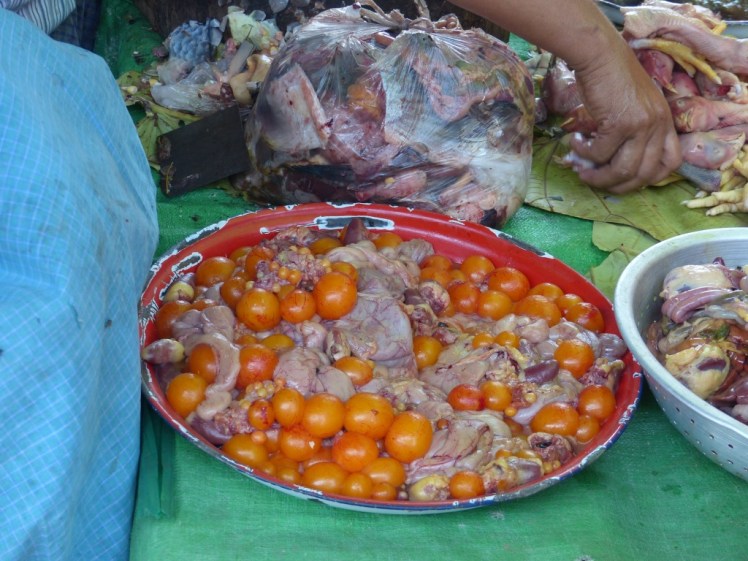 We sampled and bought food, asked questions galore and learned all sorts of things that are far too numerous for even me to relate now. Again, we urge you to visit Myanmar yourselves!
Across the road was a traveling livestock market where oxen and cattle were being bought and sold. Only men frequented this marketplace, either to drink under the tents, trade beasts or play cane ball. We found this market interesting as well and I’m pretty sure the men found our party of 5 women/2 men mighty interesting as well!


Cane ball, or chinlone, has been played in Myanmar for about 1,500 years. It is Myanmar’s traditional, national sport and the country’s teams are very competitve in S.E. Asia regional competitions. Originally developed as a means of entertaining Burmese royalty, the game is highly acrobatic and uses various martial arts maneovers to pass the rattan ball to teammates and opponents. We found the game far more fascinating than the smelly cattle, certainly. Here, you can also see men wearing the Burmese sunscreen.


Our final stop (yes…you’ve almost made it through this blog!!!!!), was Pindaya Cave which is a Buddhist pilgrimmage site and tourist attraction (notice statues of kitschy spider and its legendary slayer at the entrance) in the town of Pindaya. We drove up to the entrance which sits above the town and offers nice views of Pindaya Lake below. After our visit to the cave, we walked down the covered stairs you see in the pictures and then to a nearby hillside village.


There are actually 3 caves, but the major one is home to over 8,000 Buddha images, most of which date from the 16th century, though new ones are being added to any free space on the upper walls of the cave. Inside, there is a 490 ft. path that allows one to meander amongst the thousands of Buddhas. My camera couldn’t begin to capture all the Buddhas around us, each with their own hairstyle, wrap, expression and even name (see the one below we particularly liked). I figure you might have a bit of the “Buddha Blahs” by now too.


We were rather punchy by the end of our visit here and, in true Bill Stanton fashion, started to imitate some of the statues.


Crazy place indeed!
Always eager to get as close to the local culture as possible, (and since we weren’t allowed to bathe according to the sign below?!) we asked Ayemar to see some of the nearby hillside villages. We had to hike up a bit first which brought the “sillies” and competitive streak in Bill who insisted on racing his daughters uphill.


Not a good plan…but we love this playful side of him! Little did we know that Ayemar would literally knock on doors and ask if we could come inside for some tea and a visit. Like our lunch at the widow’s peanut farm and our cooking class with Pau’s family, the visit with a family who makes fermented apple snacks sold at the entrance to Pindaya Cave here was memorable. Once again, we were encouraged to explore the simple farm, ask questions and sample various foods with our tea. Family members watched soap operas while peeling apples, the kids played games and watched us and the hostess explained the ingredients (preserved apples, garlic and chili peppers) and packaging of these snacks that are her family’s livelihood.


After tea and expressing our gratitude for the visit as best we could with repeated “chezubahs”, we set off up the hill only to “pop in” on another small farm. This one was a family who farmed tea leaves and then fermented them to be sold commercially. We certainly knew this item by now on our trip since we had been enjoying salads almost daily made with these tea leaves and peanuts. She proudly informed us her product was completely organic and therefore in high demand. She had a severely autistic son and was clearly scraping by, but still welcomed us into her home and explained the items we saw strewn about. She even gave Claire a bag full, explaining that they will keep for a year if weighted down with a heavy item such as a bag of rice.


On our way back down the hill, Ayemar noticed that one house appeared to have been recently constructed by the age of the bamboo used to weave its walls. The cute young girl peering out of the lone window told Ayemar that she had just moved in yesterday and excitedly showed us the (completely bare except for Buddhist flags strung up) interior.


We had a lovely last dinner overlooking Inle Lake back at the resort and found it very hard to leave this idyllic world within Myanmar. As more and more tourists find their way to Inle Lake, and the hillsides surrounding the lake are cleared for development, pollution is becoming a problem. Fortunately, the government is starting to take steps to protect the unique biosphere of Inle Lake. We hope you can visit it while it remains relatively unknown to much of the world’s travellers.
Even our ride to the airport was noteworthy. Along the roads, were lots of rice paddies which provided a pretty spectular view I think you’ll agree.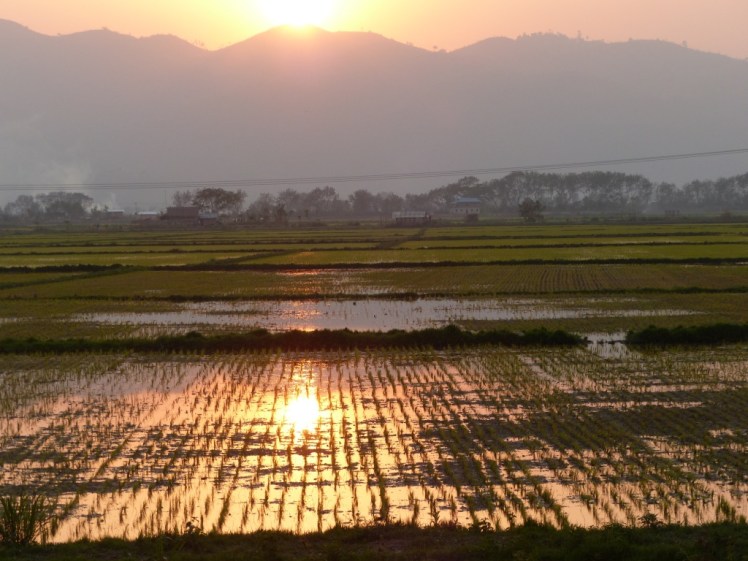
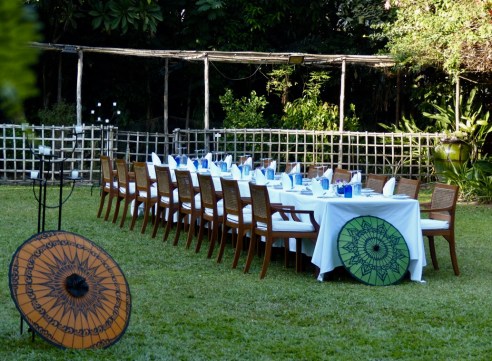
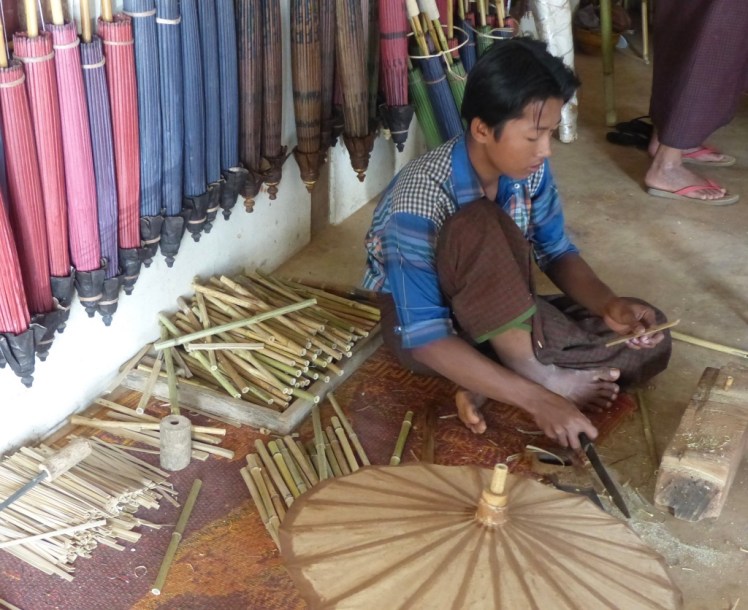
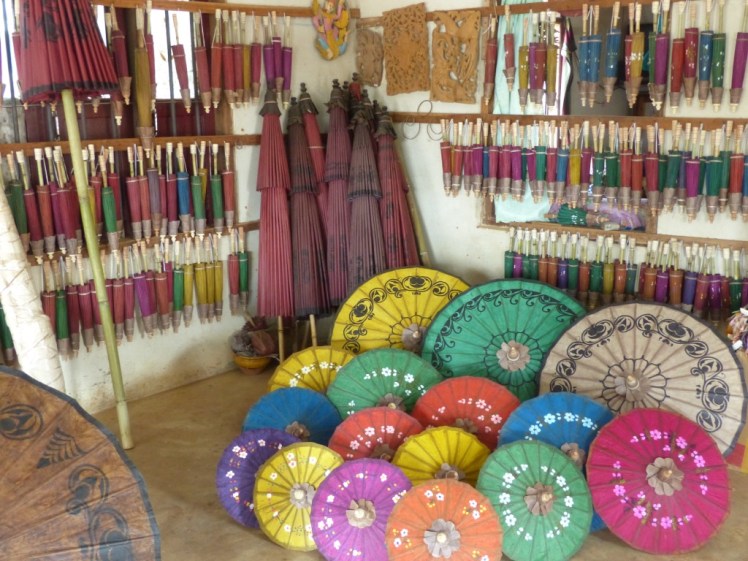
On final pit stop at a mulberry paper factory near Heho airport prompted us to buy a parasol that now decorates our dining room in Seoul and kindles memories of this trip. We learned how the paper is made and enjoyed the pretty parasols on display in this roadside shop. I hope you enjoy the last video. You’ve made it through this Myanmar term paper and I feel as I’ve finished another Princeton thesis!
 We honestly loved every minute of this trip and even consider “sitting squatch” or “squatch toilet” perfect English after hearing Zaw and Ayemar use these terms repeatedly for 8 days. Despite the red-eye flight back to Seoul, the girls remained in high spirits at the airport and fell into hysterics when they tried to order “corrot” juice and were given juice and huge raw carrots. Myanmar’s history, people, culture, sights, and our unique experiences far exceeded our wildest dreams. As Zaw would say “WE ATE IT ALL UP IN HERE!”
 seoulfulsojourn.net