Similar to many other Asian countries, Korea values the Group over the Invididual. We are admittedly still far from truly understanding this part of the culture in which we now live and are not cognizant of this mindset most of the time. However, certain aspects are quite obvious to us. For example, a Korean person will say “our” instead of “my” when referring to his mother, home, work, etc. Likewise, a Korean will use the pronoun “we” often and “I” seldomly. This challenges me daily as I often try to start my (lame!) Korean sentences with “I” and refer to things as “my” home, “my” daughter, etc. I should instead skip the “I” entirely as it is implied whenever I am speaking. This of course goes against my grammatical upbringing which is screaming “there’s no subject in that sentence”!! “Our” home and “our” daughters is an easier switch and in fact, accurate, though I still want to use “my” when I’m out alone without with Bill.
At lunch time, which is distinctly between 12-1pm, the streets of Seoul are filled with groups of people leaving offices to go eat lunch together. They walk in clumps, cross the street as a group, such that one almost never sees a single person walking or eating alone at lunch time. This behavior feels “forced” or claustriphobic to Bill and me who look forward to some solitude/downtime during the middle of the workday. After work, nearly every evening, workers go out to eat and drink soju with eachother…voluntarily! It’s as if they simply can’t get enough of each other. And then they go hiking together on the weekends….
Much to our suprise, the big supermarkets and Costco in particular are closed every 2nd and 4th Sundays of the month in an effort to support local makets. Despite being a very large densely-populated city, Seoul is very much a collection of neighborhood communities and everyone understands the importance of being a member of this smaller community within the larger city. By now, we know the shopkeepers, policemen, pedestrians around us in Seongbukdong and they all quietly acknowledge us as members of Seongbukdong which is quite comforting. The featured image is of an adorable old lady who sits outside of a 7-11 most days and greets me as I walk by with a “high-five”. Even though my Korean is progressing nicely, I can’t begin to understand her and wonder if she’s from North Korea. Everyone stops and greets her and as far as I can tell she lives alone nearby. Last week, she beckoned me from across the street and offered me this egg which I think she must have decorated herself…for Easter?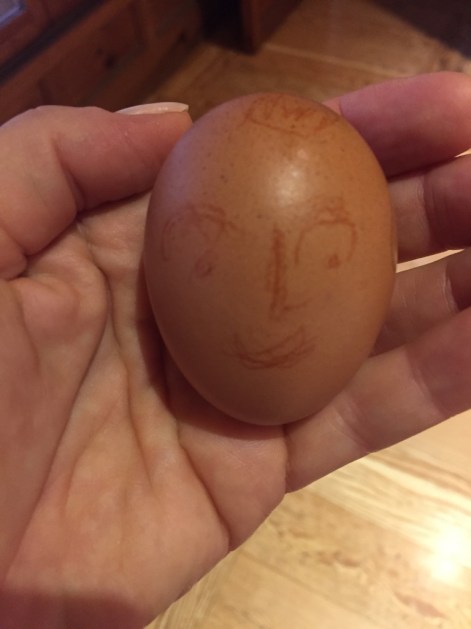 In the year and a half we’ve lived here, there have been several small fairs along what one would call “Main Street” if in fact the busy street was in a small town. Twice now in Seongbukdong, we’ve stumbled into a large organized community gathering where lots of families along Main Street set up chairs and blankets as if waiting for a parade. On the blankets, they all seemed to be selling/trading all clothes/toys/books that they had outgrown; it was a neighborhood yard sale of sorts with food stalls (of course!) that enabled families to efficiently exchange items they needed/no longer wanted with others in the community. Quaint and certainly not something I can imagine happening in NYC!
This Korean sense of community means that there is always a group of people watching out for the individual’s well-being, safety. When there’s a perceived need for assistance, like with heavy bags up subway stairs, or hailing a cab, or needing to share an umbrella, a complete stranger will step in to help another stranger, usually without any words exchanged and just minimal (just a quick nod) of gratitude expressed afterwards. Queuing in line is always orderly and there are two distinct lines formed in front of elevator doors and subways doors to allow dis-embarking passengers the central corridor. Quiet patience and acceptance are always evident versus sighing, verbal complaining and other rude behavior that we are used to seeing in the U.S. No one here tries to place him/herself above others since they are all part of the same community. When we travel back home, we notice in America the absence of this communal thinking; now the right of the individual that is woven into the very fabric of America feels a bit greedy or entitled by comparison.
Personal belongings are likewise looked after by the community. We often see purses, phones, etc. just sitting on empty seats in coffee shops, left unattended while its owner is in the bathroom, getting his order, etc. Below are sights we see often around Seoul. Near my Korean class is a popular bookstore and there are usually stacks of luggage at the top of the subway stairs, near the bookstore which I can only assume belong to shoppers. Pretty sure the nice backpack and sleeping bag shown below would be gone in a nanosecond if left on the streets/subway stairs of NYC.
The second image I shot on the subway on my way back from a trip to see the cherry blossoms in Tokoyo. Here again are bags (admittedly not so applealing but unattended nevertheless) that I saw a man deposit on the subway platform at the airport for nearly 20 minutes while he was….who knows?… and I was curiously searching for him. These days I’m used to seeing unattended bags and don’t automatically think dark terrorist thoughts, but this time I was even a bit perplexed that they were left alone for so long. The man came back to retrieve them just as before he needed to board the subway.


There’s virtually no risk that the item would be stolen; this idea wouldn’t even enter into a Korean’s mind! In fact, just this week in my Korean class when we were learning grammar points related to asking permission to do something/being told something is not allowed, one student mentioned that you can’t bring clothes for sale into public restrooms in stores. The teacher then explained that this was because it would be rude to those waiting to use the toilet if a customer tried on the clothing in the stall. I raised my hand to offer that perhaps it was to prevent stealing the items. You should have seen the shock on my teacher’s face at this suggestion! She was just astounded that this was a possibility, once again an example of how generally Korean’s respect each other’s belongings.
Mutual trust goes hand in hand with this sense of community and we often hand our car keys over to the cafe/restaurant owner who offers to find us a parking spot nearby. No ticket/money is exchanged. Services (repairs, deliveries, tutoring, etc) are frequently performed without documentation and before payment is received. Daily, I see Koreans helping each other out in small ways that surprise and remind me how this “group mindset” positively influences Korean society.
 seoulfulsojourn.net